Low Code Development Platform Market (2026 - 2035)

Low Code Development Platform Market Size, Share and Trends Analysis Research Report By Component (Solution and Service), Type (General Purpose Platform, Database App Platform, Process App Platform, Request Handling Platform and Others), Deployment (On Premise and On Cloud), Organization Size (Small and Medium Enterprise and Large Enterprise), Vertical (Retail and E-Commerce, Healthcare Media and Entertainment, BFSI, IT & Telecommunications, Government and Others), and Region (North America, Europe, Asia-Pacific, Middle East & Africa, and South America) - Forecast till 2035
ID: MRFR/ICT/3912-CR
167 Pages
Ankit Gupta, Aarti Dhapte
Last Updated: August 04, 2026
Low Code Development Platform Market
Market Size
Forecast Period2026-2035
CAGR (2026-2035)21.85%
2025 Market SizeUSD 28.15 Billion
2035 Market SizeUSD 168.50 Billion
Key Players
Microsoft
Salesforce
OutSystems
Mendix
Appian
ServiceNow
Opportunities
  • Generative AI–Native Development Platforms
  • Vertical-Specific Low-Code Solutions for Regulated Industries
  • Emerging-Market Digital Leapfrogging

Low Code Development Platform Market Summary

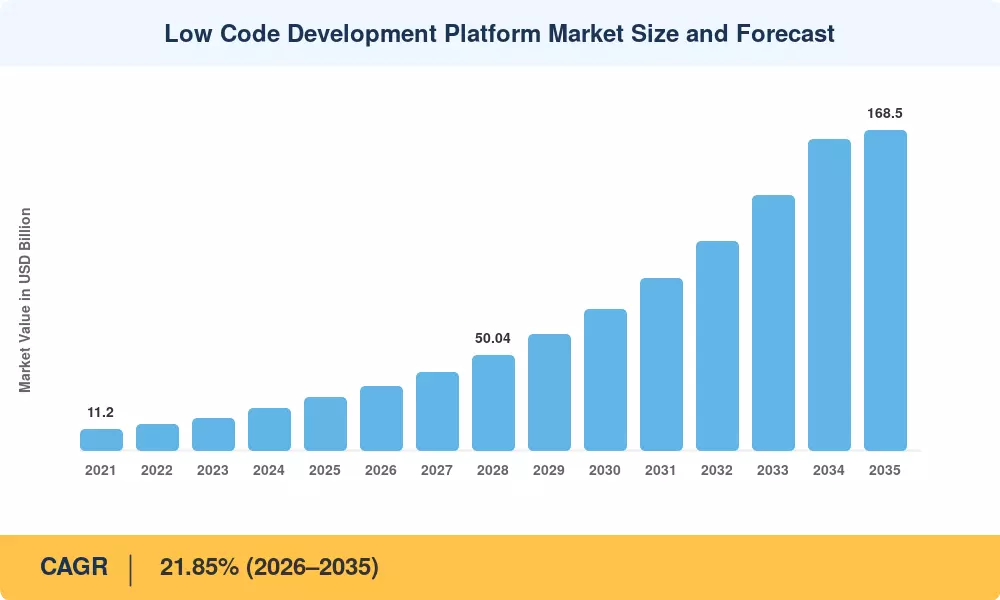
The Low Code Development Platform Market was valued at USD 28.15 billion in 2025 and is projected to reach USD 33.72 billion in 2026 before climbing to USD 168.50 billion by 2035, registering a CAGR of 21.85% during the 2026–2035 forecast period. This acceleration is anchored in two converging forces: federal agencies across the US and EU issuing multi-year blanket purchase agreements for rapid application development solutions, and an acute global developer shortage that the US Bureau of Labor Statistics estimates will leave 1.4 million software positions unfilled by 2030 [2]. These pressures are compelling enterprises to rethink how they build and deploy software.

Legacy modernization is the central catalyst. Organizations running twenty-year-old COBOL and mainframe stacks are migrating toward citizen developer platforms and drag-and-drop software builder environments that slash delivery timelines from months to weeks. A 2024 CIO survey found that 70% of new enterprise applications will use visual app builder technologies by 2027, up from under 25% in 2020. Cloud-first architectures and AI-driven development copilots are further compressing build cycles for the Low Code Development Platform Market.

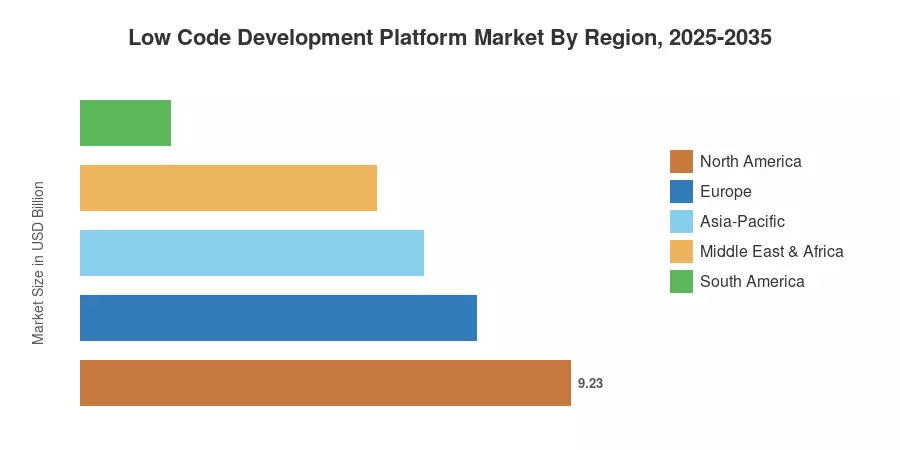
North America commands roughly 32.8% of global revenue, driven by enterprise IT budgets and federal digital-transformation mandates. Asia-Pacific is the fastest-growing region at a 22.95% CAGR, fueled by India's Digital India program and China's expanding SaaS ecosystem. Europe holds the second-largest share at approximately 26.5%, where EU composable-banking and DORA compliance deadlines are pushing financial institutions toward no-code development tools


Key Report Takeaways

• By Component

  • Platform offerings dominated the Low Code Development Platform Market with a 76.2% revenue share in 2025, reflecting enterprise preference for integrated drag-and-drop software builder suites
  • Services are expanding at a 25.4% CAGR through 2035, driven by implementation consulting and citizen developer platforms training

• By Application Type

  • Web-based development accounted for USD 15.87 billion in 2025, underscoring demand for browser-native rapid application development
  • Mobile development is the fastest-growing application segment at a 24.5% CAGR, as enterprises prioritize field-workforce apps using visual app builder tools

• By Region

  • North America led the Low Code Development Platform Market in 2025, capturing 32.8% share
  • Asia-Pacific is poised for the fastest expansion, projected at a 22.95% CAGR through 2035
  • Europe contributed approximately USD 7.46 billion in 2025, with BFSI and public-sector digitization as key demand drivers


Market Size and Forecast (2021–2035)

MRFR's market-sizing model integrates bottom-up revenue estimates from vendor financial disclosures, validated against top-down macroeconomic indicators. All figures are expressed in USD Billion and reflect end-user spending across platform licenses, subscription fees, and professional services related to the Low Code Development Platform Market.
Low Code Development Platform Market Size and Forecast
Our Impact
Enabled $4.3B Revenue Impact for Fortune 500 and Leading Multinationals
Partnering with 2000+ Global Organizations Each Year
30K+ Citations by Top-Tier Firms in the Industry

Driver Impact Analysis

Driver ~% Impact on CAGR Geographic Relevance Impact Timeline
Acute developer talent shortage ~22% Global Short-term (≤2 yr)
Legacy-system modernization mandates ~20% North America, Europe Medium-term (2–4 yr)
AI copilot & GenAI integration ~18% Global Short-term (≤2 yr)
Cloud-first & sovereign-cloud policies ~15% Asia-Pacific, Europe Medium-term (2–4 yr)
Regulatory compliance deadlines (DORA, FedRAMP) ~12% North America, Europe Medium-term (2–4 yr)
Citizen developer workforce expansion ~8% Global Long-term (≥4 yr)
Data-fabric & composable architecture adoption ~5% Global Long-term (≥4 yr)


Developer Talent Shortage as a Structural Accelerant

The global shortage of professional software developers has crossed a critical threshold. As per recent reports, by 2028, the developer gap will cost the global economy more than USD 8.5 trillion in unrealized digital products and services [2]. This deficit is not cyclical — it reflects demographic patterns and the exponential growth in software demand across every industry. Enterprises are responding by deploying drag-and-drop software builder platforms that enable business analysts and domain experts to create production-grade applications without writing traditional code. The Low Code Development Platform Market directly benefits from this structural workforce mismatch.

Legacy-System Modernization Mandates

US federal agencies spent over USD 100 billion maintaining legacy IT systems in fiscal year 2024, according to the Government Accountability Office [8]. The Biden-era Technology Modernization Fund and its successor allocations have directed billions toward replacing COBOL-based mainframe applications with rapid application development environments. Similar urgency exists in European banking, where the ECB's 2027 composable-banking directive requires institutions to expose APIs across core systems — a task that visual app builder platforms can accomplish in a fraction of traditional development time.

AI Copilot and Generative AI Integration

Platform vendors began embedding generative AI assistants directly into their no-code development tools throughout 2024, allowing users to describe application requirements in natural language and receive working prototypes. Microsoft's Copilot integration into Power Platform reportedly cut average app-creation time by 40% in enterprise pilots [7]. This convergence of AI and low-code is expanding the addressable user base from trained developers to any knowledge worker, a shift that enlarges the Low Code Development Platform Market substantially.

Cloud-First and Sovereign-Cloud Frameworks

Governments in India, Indonesia, France, and Germany have enacted data-residency and sovereign-cloud mandates that require public-sector applications to run on nationally controlled infrastructure [11]. Low-code vendors with multi-cloud deployment capabilities — including citizen developer platforms that support private-cloud and air-gapped environments — are winning procurement contracts that were previously reserved for custom-built government systems.


Restraints Impact Analysis

The restraint percentages below estimate directional drag on the Low Code Development Platform Market CAGR. They do not sum algebraically with driver impacts and should be interpreted as independent risk-weighted headwinds.

Restraint ~% Drag on CAGR Geographic Relevance Impact Timeline
Vendor lock-in and portability concerns ~–4% Global Medium-term (2–4 yr)
Security and compliance gaps in citizen-built apps ~–3.5% North America, Europe Short-term (≤2 yr)
Scalability limitations for complex workloads ~–3% Global Long-term (≥4 yr)
Integration complexity with legacy middleware ~–2.5% Global Medium-term (2–4 yr)
Shadow IT governance risks ~–2% Global Short-term (≤2 yr)


Vendor Lock-In and Portability Risks

A 2024 survey found that 58% of enterprises cited proprietary data models and runtime dependencies as the top barrier to switching drag-and-drop software builder platforms. Once an organization builds hundreds of applications on a single vendor's environment, migration costs can rival the original implementation investment. This lock-in effect suppresses competitive pressure and slows procurement decisions, particularly among large enterprises evaluating the Low Code Development Platform Market for the first time.

Security Gaps in Citizen-Developed Applications

When business users build apps without formal security training, vulnerabilities proliferate. OWASP's 2024 Low-Code Security Top 10 report identified injection flaws and broken access controls in over 35% of citizen-developed applications audited across Fortune 500 companies [18]. Regulated industries — banking, healthcare, defense — impose additional compliance layers that rapid application development platforms must embed natively or risk disqualification from procurement shortlists.

Scalability Ceilings for Mission-Critical Workloads

While no-code development tools excel at departmental and workflow applications, enterprise architects remain cautious about deploying them for high-throughput transaction processing. Benchmarks from ThoughtWorks show that several leading visual app builder platforms experience latency degradation beyond 10,000 concurrent users [19], pushing organizations toward hybrid architectures that blend low-code front-ends with custom-coded back-ends.


Low Code Development Platform Market Opportunities

Generative AI–Native Development Platforms

Vendors that embed huge language models directly into their platform’s IDE enabling prompt-to-prototype workflows will catch the next wave of the Low Code Development Platform Market. Early movers report 3× faster prototyping cycles than standard drag-and-drop software building methodologies


Vertical-Specific Low-Code Solutions for Regulated Industries

Healthcare, banking and government sectors need pre-built compliance modules (HIPAA, PCI-DSS, FedRAMP). Industry-specific templates and audit trails in citizen developer platforms will address segments not yet covered by horizontal solutions


Emerging-Market Digital Leapfrogging

MeitY, India has committed USD 1.2 billion for digital public infrastructure in 2024–2025 and Southeast Asian countries are spending extensively in e-governance applications [11]. These markets don't have large traditional pools of developers, hence fast application development platforms are the de facto modernization vehicle


Low-Code as a Data Monetization Enabler

Companies are now building customer-facing data dashboards and API marketplaces with visual app builder tools, and they’re doing it in weeks, not quarters. This will provide recurring revenues for existing data assets and will establish the Low Code Development Platform Market as an infrastructure for the data economy


Embedded Finance and Composable Banking Modules

EU's PSD3 and open-banking regulations compel financial institutions to expose functionality through composable APIs. Low-code platforms that ship pre-certified banking modules — payments, KYC, lending workflows — will see disproportionate adoption among mid-tier banks and fintechs seeking no-code development tools for compliance


Low Code Development Platform Market Future Outlook

AI-Autonomous Development Agents (2026–2029)

By 2028, 80% of low-code platforms will embed autonomous development agents capable of generating, testing, and deploying applications with minimal human oversight. This shift will expand the Low Code Development Platform Market beyond traditional IT departments into operations, HR, and finance teams that currently rely on spreadsheets. Drag-and-drop software builder interfaces will evolve into conversational prompts, reducing the skill threshold further.

Platform Economics and Marketplace Consolidation (2027–2031)

The platform model is shifting toward app-store ecosystems where third-party developers publish reusable components, templates, and connectors. Salesforce, Microsoft, and OutSystems have each launched component marketplaces, creating network effects that reinforce market concentration. According to a recent projection, marketplace-driven revenue will constitute 18% of citizen developer platforms revenue by 2031 [14].

Composable Enterprise Architecture (2028–2033)

The Low Code Development Platform Market will increasingly serve as middleware connecting ERPs, CRMs, and data lakes through pre-built connectors rather than custom integration code.

Sustainability and ESG Reporting Automation (2029–2035)

The EU's Corporate Sustainability Reporting Directive (CSRD) and the SEC's climate-disclosure rules require companies to collect, validate, and report granular ESG data. Visual app builder platforms are emerging as the fastest route to building internal ESG dashboards and audit workflows. BloombergNEF estimates that ESG-reporting software spend will reach USD 4.8 billion by 2030, with no-code development tools capturing a growing share [22].


Low Code Development Platform Market Segmentation

By Component

The Low Code Development Platform Market is segmented into Platform and Services.

Segment Key Metric Primary Demand Driver
Platform 76.2% share (2025) Integrated IDE, drag-and-drop software builder, and AI copilot bundles
Services 25.4% CAGR (2026–2035) Implementation consulting, training for citizen developer platforms


Platform offerings anchor the Low Code Development Platform Market because enterprises prefer unified environments that combine visual app builder canvases, pre-built connectors, and deployment automation. Vendors like Microsoft (Power Platform), Salesforce (Lightning), and OutSystems bundle AI-assisted code generation directly into the platform tier, reinforcing subscription stickiness.

Services are growing faster as organizations scale from pilot projects to enterprise-wide rollouts. System integrators such as Accenture, and Infosys have established dedicated rapid application development practices, offering center-of-excellence setup, governance frameworks, and training curricula for citizen developers.

By Application Type

The Low Code Development Platform Market segments into Web-Based and Mobile-Based development.

Segment Key Metric Primary Demand Driver
Web-Based USD 15.87 Billion (2025) Enterprise portals, dashboards, internal workflows
Mobile-Based 24.5% CAGR (2026–2035) Field-workforce apps, customer-facing mobile experiences


Web-based development remains the volume leader because most enterprise no-code development tools projects target internal dashboards, approval workflows, and data-entry portals that run in a browser. These use cases align naturally with drag-and-drop software builder interfaces optimized for desktop layouts.

Mobile-based development is accelerating as enterprises equip field technicians, retail associates, and logistics workers with purpose-built apps. Platforms offering native mobile rendering, offline-sync capabilities, and device-sensor integration within visual app builder environments capture premium pricing in this segment.

By Deployment Mode

Segment Key Metric Primary Demand Driver
Cloud 64.5% share (2025) SaaS subscription models, elastic scalability
On-Premises USD 9.97 Billion (2025) Data-residency mandates, air-gapped defense environments


Cloud deployment dominates the Low Code Development Platform Market as citizen developer platforms migrate workloads to AWS, Azure, and GCP. On-premises persists in regulated verticals — defense, healthcare, banking — where sovereign-cloud and data-residency rules require local hosting.

By Organization Size

Segment Key Metric Primary Demand Driver
Large Enterprises 67.5% share (2025) Enterprise-wide digital transformation, IT backlog reduction
SMEs 23.7% CAGR (2026–2035) Affordable rapid application development without dedicated dev teams


Large enterprises dominate spending because they face the largest IT backlogs —a recent study the average enterprise has a 12-month application-request backlog. SMEs represent the fastest-growing segment as subscription pricing and no-code development tools lower the financial barrier to entry.

By Industry Vertical

Segment Key Metric Primary Demand Driver
BFSI 28.3% share (2025) Regulatory compliance (DORA, PSD3), open-banking API mandates
Retail & E-Commerce USD 3.94 Billion (2025) Omnichannel customer-experience apps
IT & Telecom 22.1% CAGR (2026–2035) Internal tool consolidation and drag-and-drop software builder adoption
Healthcare USD 2.53 Billion (2025) Patient-portal and EHR-workflow digitization
Education 25.7% CAGR (2026–2035) Campus-management and LMS integration using visual app builder tools
Manufacturing USD 1.97 Billion (2025) Shop-floor quality-control and MES-integration apps
Government & Public Sector 21.8% CAGR (2026–2035) E-governance portals and citizen developer platforms mandates


BFSI is the largest vertical in the Low Code Development Platform Market because banking institutions face simultaneous regulatory deadlines and customer-experience pressure. Education is the fastest-growing vertical, as universities and school districts adopt no-code development tools to build student-management and remote-learning systems rapidly.


Regional Market Share Analysis

Region Key Metric Primary Investment Themes
North America 32.8% share (2025) FedRAMP modernization, enterprise AI copilot adoption
Europe USD 7.46 Billion (2025) DORA compliance, composable banking, sovereign cloud
Asia-Pacific 22.95% CAGR (2026–2035) Digital India, ASEAN e-governance, developer shortage
South America USD 1.69 Billion (2025) Fintech regulation, public-sector digitization
Middle East & Africa 19.8% CAGR (2026–2035) Smart-city programs, oil & gas digitization
Total USD 28.15 Billion (2025)

The Low Code Development Platform Market exhibits a multi-polar regional structure, with North America maintaining revenue leadership and Asia-Pacific accelerating faster than any other geography. Sovereign-cloud policies, developer workforce dynamics, and regulatory compliance timelines create distinct adoption curves across regions.


North America

Country Key Metric Key Driver
US 78.5% of regional share Federal IT modernization & FedRAMP low-code procurement [8]
Canada 14.2% CAGR (2026–2035) Provincial healthcare digitization using citizen developer platforms
Mexico USD 0.52 Billion (2025) Nearshoring-driven enterprise IT upgrades


North America's dominance in the Low Code Development Platform Market stems from the depth of enterprise IT budgets and a regulatory environment that incentivizes rapid application development. The US General Services Administration's 2024 blanket purchase agreements for low-code solutions exceeded USD 2.1 billion in ceiling value [8], while Canadian provinces are deploying drag-and-drop software builder platforms for healthcare scheduling and benefits administration.

Europe

Country Key Metric Key Driver
Germany 22.3% of regional share Industry 4.0 factory-floor app development
UK 19.75% CAGR (2026–2035) Post-Brexit fintech regulatory divergence
France USD 0.98 Billion (2025) Sovereign-cloud mandates (SecNumCloud)
Italy 17.6% CAGR (2026–2035) Public-sector digitization under PNRR funding
Spain USD 0.41 Billion (2025) SME digital transformation grants
Nordic Countries 15.8% of regional share Advanced e-governance and visual app builder adoption
Russia USD 0.22 Billion (2025) Import-substitution software mandates
Rest of Europe 12.5% CAGR (2026–2035) EU cohesion-fund driven modernization


European demand for the Low Code Development Platform Market is inseparable from the regulatory calendar. The EU's Digital Operational Resilience Act (DORA), effective January 2025, requires financial entities to demonstrate end-to-end digital resilience — a mandate that has triggered a procurement wave for no-code development tools capable of building monitoring dashboards and incident-response workflows under tight timelines [9].

Asia-Pacific

Country Key Metric Key Driver
China 28.4% of regional share Enterprise SaaS expansion and government digitization
India 24.8% CAGR (2026–2035) Digital India & acute developer talent reallocation
Japan USD 1.85 Billion (2025) Legacy mainframe migration ("2025 cliff")
South Korea 21.2% CAGR (2026–2035) Government AI strategy and rapid application development
ASEAN USD 0.92 Billion (2025) E-governance and fintech super-app ecosystems
Rest of Asia-Pacific 19.5% CAGR (2026–2035) Telecom and utility digitization


Asia-Pacific is the fastest-growing region in the Low Code Development Platform Market because it combines severe developer shortages with aggressive government digitization spending. India alone added over 1.5 million new IT positions between 2022 and 2025, yet vacancy rates remained above 30%, making citizen developer platforms essential to filling the output gap [2].

South America

Country Key Metric Key Driver
Brazil 58.3% of regional share Open-banking (PIX) and fintech compliance
Argentina 18.7% CAGR (2026–2035) Agricultural technology and drag-and-drop software builder tools
Rest of South America USD 0.38 Billion (2025) Government e-services modernization


Brazil's central bank mandated open-banking interoperability through PIX and Open Finance phases, compelling mid-tier banks to deploy rapid application development platforms for API management and customer-portal construction [15].

Middle East & Africa

Country Key Metric Key Driver
Saudi Arabia 35.2% of regional share Vision 2030 smart-city programs and visual app builder deployments
UAE 21.5% CAGR (2026–2035) Dubai's paperless government initiative
South Africa USD 0.18 Billion (2025) Financial-services compliance digitization
Egypt 19.2% CAGR (2026–2035) National e-government portal expansion
Rest of MEA USD 0.15 Billion (2025) Oil & gas field-operations digitization


Saudi Arabia's Vision 2030 has allocated over USD 500 billion to economic diversification programs, with dedicated technology funds directing procurement toward no-code development tools that allow non-technical government employees to build citizen-service applications [11].


Low Code Development Platform Market By Region, 2025-2035

Competitive Benchmarking

The Low Code Development Platform Market exhibits moderate concentration, with the top five vendors controlling an estimated 45–52% of global revenue. The Herfindahl-Hirsch Index (HHI) sits in the 800–1,200 range, indicating a competitive but not fragmented structure. Platform vendors are differentiating through generative AI integration, vertical-specific templates, and ecosystem marketplace breadth. Strategic acquisitions — such as Salesforce's MuleSoft integration and Siemens's Mendix buildout — have consolidated capabilities around rapid application development and data-fabric architectures.

Company Est. Revenue Share Range Key Offerings Strategic Positioning
Microsoft ~12–16% Power Platform (Power Apps, Power Automate, Copilot Studio) Ecosystem integration with Azure, Office 365, Dynamics
Salesforce ~8–12% Lightning Platform, MuleSoft Composer CRM-native citizen developer platforms, AppExchange marketplace
OutSystems ~6–9% OutSystems Developer Cloud, AI Mentor High-performance drag-and-drop software builder for complex apps
Mendix (Siemens) ~5–8% Mendix Platform, Mendix for Industry Industrial IoT and manufacturing-specific visual app builder
Appian ~4–6% Appian Platform, Process Mining Process automation and case-management low-code
ServiceNow ~4–6% App Engine, Creator Workflows ITSM-native rapid application development for enterprise workflows
Pegasystems ~3–5% Pega Platform, Pega GenAI Blueprint Decisioning and AI-powered no-code development tools
Zoho ~2–4% Zoho Creator, Zoho One Suite SME-focused, price-competitive drag-and-drop software builder
Retool ~1–3% Retool Platform, Retool Mobile Internal-tool development for engineering-adjacent teams
Kissflow ~1–2% Kissflow Work Platform Workflow-centric citizen developer platforms for mid-market


Recent News & Developments

  • Microsoft (March 2025): Launched Copilot Studio generative-AI features for Power Platform, enabling natural-language app scaffolding across the Low Code Development Platform Market [7].


  • Salesforce (November 2024): Introduced Einstein 1 Platform integration into Lightning, embedding predictive analytics into citizen developer platforms workflows [24].
  • Mendix (September 2024): Expanded Mendix for Industry with pre-built manufacturing-execution templates, targeting Siemens's industrial customer base with visual app builder tools [25].
  • Appian (July 2021 ): Acquired process-mining startup Lana Labs to strengthen data-driven workflow optimization inside its no-code development tools suite [14].
  • ServiceNow (May 2024): Announced App Engine Studio enhancements with generative-AI prompt-to-flow capabilities for IT service-management applications [26].
  • European Commission (March 2024): Published DORA technical standards mandating financial-entity digital resilience testing — accelerating procurement of drag-and-drop software builder platforms across EU banks [9].


Low Code Development Platform Market Report Scope

Parameter Detail
Market Scope Global Low Code Development Platform Market — platform software and professional services
Study Period 2021–2035
CAGR 21.85% (2026–2035)
Market Size (2025) USD 28.15 Billion
Market Size (2035) USD 168.50 Billion
Fastest Growing Segment Education vertical (25.7% CAGR); Mobile-based application (24.5% CAGR)
Companies Profiled Microsoft, Salesforce, OutSystems, Mendix (Siemens), Appian, ServiceNow, Pegasystems, Zoho, Retool, Kissflow
Valuation Currency USD Billion


FAQs

How do procurement teams evaluate total cost of ownership for low-code platforms versus custom development?
TCO comparisons should factor in licensing, implementation services, developer training, and long-term maintenance. A 2024 TEI framework found that citizen developer platforms deliver 60% lower three-year TCO than equivalent custom-coded solutions when workload complexity remains moderate [17].
What governance frameworks prevent shadow IT risks when enabling citizen developers?
Leading organizations establish a Center of Excellence that defines approved data sources, security guardrails, and deployment-approval gates. Recent study recommends tiered governance — sandbox, departmental, production — that scales oversight proportionally to application criticality [3].
How does the Low Code Development Platform Market address regulatory compliance in highly regulated industries?
Vendors targeting BFSI and healthcare embed pre-certified compliance modules — HIPAA, PCI-DSS, SOC 2 — directly into platform templates. DORA-aligned audit-trail features are now table-stakes for any platform selling into European financial institutions [9].
Can the Low Code Development Platform Market support real-time, high-transaction workloads like payment processing?
Most platforms handle mid-volume transactional workloads effectively, but ultra-high-frequency systems still require custom-coded back-ends. Hybrid architectures combining a drag-and-drop software builder front-end with microservice APIs address this gap [19].
What role does generative AI play in differentiating the Low Code Development Platform Market from traditional RAD tools?
GenAI transforms low-code from visual configuration into conversational development, where users describe requirements in plain language. Platforms with embedded LLMs reduce prototyping time by up to 3× compared to traditional rapid application development approaches [7].
How should enterprises approach multi-vendor low-code strategies to avoid lock-in in the Low Code Development Platform Market?
Enterprises should adopt open-standard APIs (REST, OData) and containerized deployment models that decouple applications from proprietary runtimes. Abstracting the data layer through a vendor-neutral data-fabric reduces switching costs by an estimated 40% [17].
What emerging use cases will drive the next growth wave in the Low Code Development Platform Market?
ESG-reporting dashboards, embedded-finance modules, and AI-agent orchestration represent the highest-growth adjacencies. BloombergNEF projects ESG-software spend reaching USD 4.8 billion by 2030, with no-code development tools capturing expanding share [22].    
Author
Author
Author Profile
Ankit Gupta LinkedIn
Team Lead - Research
Ankit Gupta is a seasoned market intelligence and strategic research professional with over six plus years of experience in the ICT and Semiconductor industries. With academic roots in Telecom, Marketing, and Electronics, he blends technical insight with business strategy. Ankit has led 200+ projects, including work for Fortune 500 clients like Microsoft and Rio Tinto, covering market sizing, tech forecasting, and go-to-market strategies. Known for bridging engineering and enterprise decision-making, his insights support growth, innovation, and investment planning across diverse technology markets.
Co-Author
Co-Author Profile
Aarti Dhapte LinkedIn
AVP - Research
A consulting professional focused on helping businesses navigate complex markets through structured research and strategic insights. I partner with clients to solve high-impact business problems across market entry strategy, competitive intelligence, and opportunity assessment. Over the course of my experience, I have led and contributed to 100+ market research and consulting engagements, delivering insights across multiple industries and geographies, and supporting strategic decisions linked to $500M+ market opportunities. My core expertise lies in building robust market sizing, forecasting, and commercial models (top-down and bottom-up), alongside deep-dive competitive and industry analysis. I have played a key role in shaping go-to-market strategies, investment cases, and growth roadmaps, enabling clients to make confident, data-backed decisions in dynamic markets.

Research Approach


Secondary Research

The secondary research process involved comprehensive analysis of technology regulatory frameworks, enterprise software databases, digital transformation whitepapers, and authoritative ICT industry publications. Key sources included the National Institute of Standards and Technology (NIST) Cybersecurity and Software Standards, European Commission Digital Single Market Strategy and EU Digital Programme initiatives, International Organization for Standardization (ISO/IEC) Software Engineering Standards, Institute of Electrical and Electronics Engineers (IEEE) Software Development Standards, US Census Bureau Business Enterprise Surveys and Technology Adoption Metrics, Eurostat Digital Economy and Society Statistics, Organisation for Economic Co-operation and Development (OECD) Digital Economy Outlook, World Economic Forum (WEF) Digital Transformation Initiative Reports, Asia-Pacific Economic Cooperation (APEC) Digital Innovation Policies, National Informatics Centre (NIC) India Digital Government Reports, UK Government Digital Service (GDS) Transformation Guidelines, for Enterprise Low-Code Application Platforms, Forrester Wave for Low-Code Development Platforms, IDC Worldwide Application Development Software Market Forecasts, Linux Foundation Open Source Development Reports, CompTIA IT Industry Outlook, and national digital transformation agency reports from key markets (US Digital Service, Singapore GovTech, Estonia e-Residency Programme). These sources were used to collect software adoption statistics, regulatory compliance frameworks, enterprise digitalization trends, pricing benchmarks, and competitive landscape analysis for general purpose platforms, database application platforms, process automation platforms, and request handling solutions.


Primary Research

To gather both qualitative and quantitative information, the primary research process involved interviewing players from both the supply and demand sides. CEOs, CTOs, CPOs, VPs of platform engineering, heads of regulatory compliance, and enterprise sales directors from cloud service providers, systems integrators (SIs), low-code platform vendors, and regulatory compliance agencies were among the supply-side sources. Members of the demand side included procurement leads from healthcare systems, government agencies, telecommunications providers, retail/e-commerce enterprises, BFSI institutions, enterprise architects, IT directors, application development managers, and Chief Digital Officers (CDOs). We confirmed product roadmaps and AI integration timelines through primary research, and we gathered insights on patterns of adoption by citizen developers, enterprise pricing models, strategies for API integration, and the dynamics of legacy system modernization. Primary research also validated market segmentation across cloud and on-premise deployments.

Primary Respondent Breakdown:

By Designation: C-level Executives (32%), Director Level (31%), Others (37%)

By Region: North America (40%), Europe (28%), Asia-Pacific (25%), Rest of World (7%)


Market Size Estimation

Global market valuation was derived through revenue triangulation and enterprise adoption rate analysis. The methodology included:

Identification of 50+ key platform vendors across North America, Europe, Asia-Pacific, and Latin America (including Microsoft, Salesforce, Appian, Mendix, OutSystems, Pega, Zoho, ServiceNow, and emerging niche players)

Product mapping across general purpose platforms, database-specific platforms, process application platforms, and request handling platforms

Analysis of reported SaaS revenues, subscription bookings, and professional services income specific to low-code platform portfolios

Coverage of vendors representing 75-80% of global market share in 2024

Extrapolation using bottom-up (enterprise seat count × ARPU by organization size and vertical) and top-down (vendor revenue validation against total addressable market estimates) approaches to derive segment-specific valuations across cloud and on-premise deployment models

Download Free Sample

Kindly complete the form below to receive a free sample of this Report

Download PDF ×

We do not share your information with anyone. However, we may send you emails based on your report interest from time to time. You may contact us at any time to opt-out.