Download Free Sample
Kindly complete the form below to receive a free sample of this Report
Luxury Goods Maintenance & Repair Services Market Research Report Information By Service Type (Cleaning, Restoration, Repair, Customization, Maintenance), By Customer Type (Individual Consumers, Retailers, Luxury Brands, Collectors, Resellers), By Service Channel (In-Store Services, Online Services, Mobile Services, Direct-To-Consumer Services, Third-Party Services), By Luxury Goods Category (Watches, Jewelry, Handbags, Footwear, Apparel) And By Region (North America, Europe, Asia-Pacific, And Rest Of The World) – Market Forecast Till 2035.
As per MRFR analysis, the Luxury Goods Maintenance & Repair Services Market was estimated at 24.5 USD Billion in 2024. The luxury goods maintenance and repair services industry is projected to grow from 25.31 USD Billion in 2025 to 35.0 USD Billion by 2035, exhibiting a compound annual growth rate (CAGR) of 3.3% during the forecast period 2025 - 2035.
The Luxury Goods Maintenance and Repair Services Market is experiencing a transformative shift towards sustainability and digital integration.
| 2024 Market Size | 24.5 (USD Billion) |
| 2035 Market Size | 35.0 (USD Billion) |
| CAGR (2025 - 2035) | 3.3% |
Louis Vuitton (FR), Hermes (FR), Gucci (IT), Chanel (FR), Prada (IT), Burberry (GB), Tiffany & Co. (US), Rolex (CH), Cartier (FR)
Our Impact
Enabled $4.3B Revenue Impact for Fortune 500 and Leading Multinationals
Partnering with 2000+ Global Organizations Each Year
30K+ Citations by Top-Tier Firms in the Industry
The Luxury Goods Maintenance & Repair Services Market is currently experiencing a notable evolution, driven by a confluence of consumer preferences and technological advancements. As individuals increasingly prioritize sustainability and longevity in their luxury purchases, the demand for maintenance and repair services appears to be on the rise. This shift reflects a broader trend towards responsible consumption, where consumers seek to extend the life of their high-end items rather than replace them. Furthermore, the integration of digital platforms into service offerings seems to enhance customer engagement, allowing for more personalized experiences and streamlined processes. In addition, the Luxury Goods Maintenance & Repair Services Market is likely to witness a growing emphasis on craftsmanship and artisanal skills. As consumers become more discerning, they may gravitate towards services that not only restore but also enhance the original quality of their luxury items. This trend suggests a potential for service providers to differentiate themselves through specialized skills and bespoke offerings. Overall, the market appears poised for growth, driven by evolving consumer expectations and a commitment to preserving luxury goods for future generations.
The Luxury Goods Maintenance & Repair Services Market is increasingly influenced by a sustainability focus. Consumers are becoming more aware of the environmental impact of fast fashion and disposable luxury items. As a result, there is a growing preference for services that promote the longevity of products, encouraging repairs and maintenance over new purchases.
Digital integration is transforming the Luxury Goods Maintenance & Repair Services Market. Service providers are adopting online platforms to facilitate bookings, consultations, and customer interactions. This trend enhances convenience and accessibility, allowing consumers to engage with services in a more efficient manner.
There is a rising appreciation for artisanal craftsmanship within the Luxury Goods Maintenance & Repair Services Market. Consumers are increasingly valuing the skills and expertise involved in repairing and maintaining luxury items. This trend indicates a potential shift towards bespoke services that highlight quality and attention to detail.
The Luxury Goods Maintenance & Repair Services Market appears to be positively influenced by the increasing disposable income among consumers. As individuals experience growth in their financial capabilities, they are more inclined to invest in luxury items, necessitating maintenance and repair services. Reports indicate that the luxury goods sector has seen a steady rise in sales, with a notable increase in high-end products. This trend suggests that as consumers acquire more luxury items, the demand for specialized maintenance and repair services will likely follow suit. Furthermore, the willingness to spend on preserving the quality and longevity of luxury goods indicates a shift in consumer behavior towards valuing craftsmanship and durability, thereby enhancing the overall market for maintenance and repair services.
The Luxury Goods Maintenance & Repair Services Market is experiencing a transformation driven by technological advancements. Innovations in repair techniques and tools are enhancing the efficiency and effectiveness of maintenance services. For instance, the integration of digital platforms allows consumers to easily access repair services, track the status of their items, and receive personalized recommendations. Moreover, the use of advanced materials and techniques in repairs ensures that luxury goods are restored to their original quality. This technological evolution not only improves customer satisfaction but also expands the market reach for maintenance and repair services. As consumers increasingly rely on technology, the demand for innovative solutions in the luxury goods sector is expected to grow, further propelling the market.
The Luxury Goods Maintenance & Repair Services Market is likely to benefit from the increase in luxury goods ownership among consumers. As more individuals invest in high-end products, the need for maintenance and repair services becomes more pronounced. Recent statistics indicate a surge in luxury goods sales, particularly in categories such as fashion, accessories, and electronics. This trend suggests that as ownership rises, so does the potential for wear and tear, necessitating professional maintenance services. Furthermore, the growing trend of personalization in luxury goods, where consumers seek unique and tailored items, may also lead to an increased demand for specialized repair services. Thus, the expansion of luxury goods ownership is expected to significantly contribute to the growth of the maintenance and repair services market.
The Luxury Goods Maintenance & Repair Services Market is increasingly shaped by a growing awareness of sustainability among consumers. As environmental concerns gain prominence, individuals are more inclined to seek services that extend the life of their luxury items rather than opting for new purchases. This shift in consumer mindset aligns with the broader trend of sustainability, where maintaining and repairing luxury goods is viewed as a responsible choice. Data suggests that the market for sustainable luxury is expanding, with consumers prioritizing brands that demonstrate a commitment to eco-friendly practices. Consequently, the demand for maintenance and repair services is likely to rise, as consumers aim to reduce waste and promote longevity in their luxury possessions.
The Luxury Goods Maintenance & Repair Services Market is influenced by a cultural shift towards valuing quality over quantity. Consumers are increasingly prioritizing the acquisition of fewer, high-quality luxury items rather than numerous lower-quality products. This trend is indicative of a broader societal movement that emphasizes craftsmanship, heritage, and the longevity of products. As consumers invest in fewer luxury goods, they are more likely to seek maintenance and repair services to preserve these valuable items. This shift not only enhances the perceived value of luxury goods but also fosters a market environment where maintenance and repair services are essential for sustaining the quality and integrity of these products. Consequently, this cultural transformation is expected to drive demand within the luxury goods maintenance and repair services market.
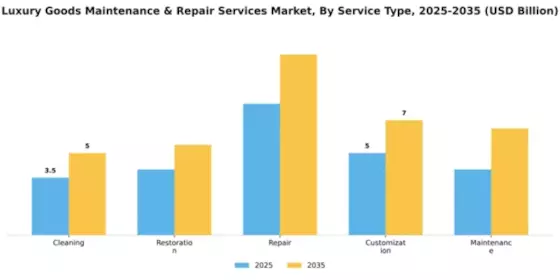
The Luxury Goods Maintenance & Repair Services Market witnesses a diverse range of service types, with Cleaning emerging as the largest segment due to its essential role in maintaining the pristine condition of luxury items. It captures substantial market share as luxury consumers prioritize cleanliness and preservation. Meanwhile, Customization is gaining traction, rapidly becoming a significant player as consumers seek personalized experiences and bespoke modifications to their luxury possessions, reflecting individual style and preference. Examining growth trends, it's evident that the Cleaning service remains crucial, while Customization is catalyzed by shifting consumer preferences towards uniqueness. Factors such as an increase in disposable income and a growing appreciation for personalized luxury services contribute to the rapid growth of Customization, positioning it as the segment to watch in the upcoming years.
Cleaning (Dominant) vs. Restoration (Emerging)
Cleaning and Restoration are two vital components of the Luxury Goods Maintenance & Repair Services Market. Cleaning stands as the dominant segment, underscoring its importance in extending the life of luxury goods. Clients are drawn to reliable cleaning services that preserve their high-value items’ aesthetics and integrity. Restoration, while emerging, is increasingly relevant as consumers look to rejuvenate and revitalize luxury items that may have experienced wear and tear over time. This segment appeals to eco-conscious customers who prefer refurbishing existing items rather than purchasing new ones, aligning with sustainability trends. Together, these segments highlight the dual approach luxury consumers take in valuing both maintenance and rejuvenation of their cherished possessions.
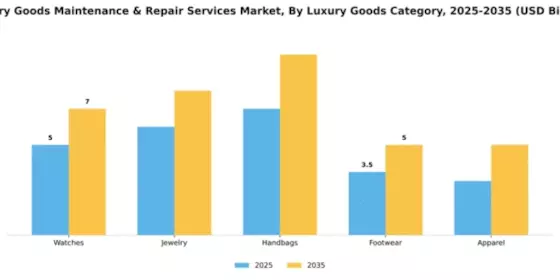
In the Luxury Goods Maintenance & Repair Services Market, the distribution of market share is notably concentrated among the primary categories: Watches, Jewelry, Handbags, Footwear, and Apparel. Watches hold the largest segment share, reflecting their enduring appeal and significant investment value among luxury consumers. Conversely, Jewelry is experiencing rapid growth, driven by changing consumer preferences for unique and personalized pieces, which resonate with younger demographics seeking expressive luxury products.
Watches (Dominant) vs. Jewelry (Emerging)
The Watches segment dominates the Luxury Goods Maintenance & Repair Services Market due to the high demand for luxury timepieces that symbolize status and craftsmanship. This segment is characterized by brand loyalty, with consumers often seeking repair services from authorized dealers to maintain the authenticity and value of their pieces. In contrast, the Jewelry segment is emerging strongly, particularly as consumers increasingly value bespoke and artisanal pieces. As a result, repair services focused on unique jewelry pieces are expanding, catering to a demographic that desires more individuality in their luxury purchases, reflecting broader trends in personal expression and customization.
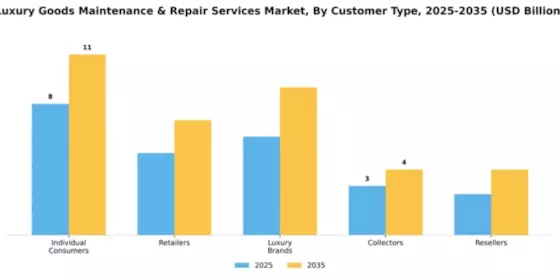
In the Luxury Goods Maintenance & Repair Services Market, individual consumers represent the largest segment, showcasing a significant share due to their consistent demand for personalized services for their luxury items. This demographic prioritizes high-quality maintenance and repair, attracted by the emotional and monetary value of their possessions. Retailers, on the other hand, have emerged as the fastest-growing segment, expanding rapidly as they seek to enhance customer experience and satisfaction by offering in-house maintenance and repair services, thus capturing a larger market share.
Individual Consumers (Dominant) vs. Retailers (Emerging)
Individual consumers dominate the Luxury Goods Maintenance & Repair Services Market, driven by their desire for high-end, customized services that reflect the premium status of their luxury items. These customers are often willing to invest significantly in the upkeep of their possessions, ensuring longevity and aesthetic appeal. In contrast, retailers represent an emerging force, increasingly investing in maintenance services to differentiate themselves in a competitive market. By providing specialized services that cater to the needs of their clientele, retailers are not only enhancing customer loyalty but also tapping into new revenue streams, establishing themselves as crucial players in the sector.
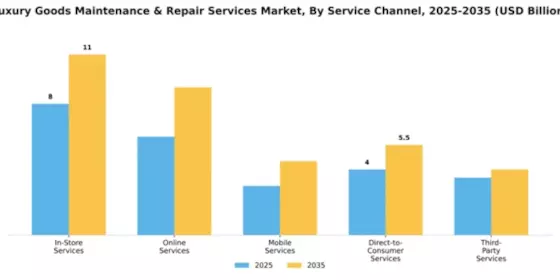
In the Luxury Goods Maintenance & Repair Services Market, In-Store Services maintains the largest market share, benefiting from the personalized experience and direct interaction with customers. This segment thrives on high-touch services and the ability to provide immediate solutions, making it the preferred choice for luxury goods consumers seeking quality and confidence in repairs. Online Services, while currently smaller in share, are the fastest-growing segment as more consumers shift towards convenience and accessibility. The rise of digital platforms has enabled brands to offer online scheduling, consultations, and even virtual assessments, appealing to millennials and Gen Z who prefer to shop and service their luxury goods online.
In-Store Services (Dominant) vs. Mobile Services (Emerging)
In-Store Services stand out as the dominant force in the Luxury Goods Maintenance & Repair Services Market, characterized by their face-to-face engagement and tailored service offerings. This direct channel fosters trust and loyalty among high-end consumers, ensuring quality assurance for valuable items. Conversely, Mobile Services are emerging rapidly, appealing to luxury consumers who prioritize convenience. These services allow technicians to perform repairs or maintenance at a location of the customer’s choice. The rise of mobile apps and on-demand economy has made this service channel increasingly popular, especially among busy professionals who still want to maintain the luxury quality of their possessions without the hassle of traditional service models.
Get more detailed insights about Luxury Goods Maintenance & Repair Services Market Request Free Sample
North America is poised to maintain its leadership in the Luxury Goods Maintenance & Repair Services Market, holding a market size of $10.0 billion. Key growth drivers include a robust consumer base with high disposable income, increasing demand for premium services, and a focus on sustainability. Regulatory support for luxury brands and service providers further enhances market dynamics, ensuring compliance with quality standards and consumer protection laws. The competitive landscape is characterized by the presence of major players such as Tiffany & Co. and Rolex, which dominate the market with their extensive service networks. The U.S. and Canada are the leading countries, showcasing a strong inclination towards luxury maintenance services. The market is expected to grow as consumers increasingly prioritize the longevity and care of their luxury items, further solidifying North America's position as a market leader.
Europe, with a market size of $8.0 billion, is a cultural hub for luxury goods, driving demand for maintenance and repair services. The region benefits from a rich heritage of craftsmanship and a strong consumer preference for high-quality services. Regulatory frameworks in countries like France and Italy promote sustainable practices, enhancing the appeal of luxury maintenance services. The increasing trend of personalization and customization also fuels market growth, as consumers seek tailored solutions for their luxury items. Leading countries such as France, Italy, and the UK are home to iconic brands like Chanel and Gucci, which significantly influence market dynamics. The competitive landscape is marked by a blend of established luxury houses and emerging service providers, all vying for a share of the affluent consumer base. The presence of key players ensures a diverse range of services, catering to the unique needs of luxury consumers across Europe.
Asia-Pacific is rapidly emerging as a significant player in the Luxury Goods Maintenance & Repair Services Market, with a market size of $5.5 billion. The region's growth is driven by rising disposable incomes, a burgeoning middle class, and increasing consumer awareness about luxury item care. Regulatory initiatives aimed at enhancing service quality and consumer protection are also contributing to market expansion, fostering a more reliable service environment. Countries like China, Japan, and South Korea are at the forefront of this growth, with a strong presence of luxury brands such as Burberry and Cartier. The competitive landscape is evolving, with both established luxury brands and local service providers competing to meet the demands of discerning consumers. As the market matures, the focus on quality and authenticity will become increasingly important, shaping the future of luxury maintenance services in the region.
The Middle East and Africa region, with a market size of $1.0 billion, is an emerging market for Luxury Goods Maintenance & Repair Services. The growth is primarily driven by increasing wealth among consumers and a rising interest in luxury brands. Regulatory frameworks are gradually evolving to support the luxury sector, enhancing consumer confidence in maintenance services. The region's unique cultural dynamics also play a role in shaping consumer preferences for luxury goods. Countries like the UAE and South Africa are leading the charge, with a growing number of luxury retailers and service providers entering the market. The competitive landscape is characterized by a mix of international luxury brands and local players, all striving to capture the attention of affluent consumers. As the market develops, the focus on quality service and brand reputation will be crucial for success in this burgeoning sector.
The Luxury Goods Maintenance & Repair Services Market is characterized by a competitive landscape that is increasingly shaped by innovation, sustainability, and digital transformation. Key players such as Louis Vuitton (FR), Gucci (IT), and Rolex (CH) are actively redefining their operational strategies to enhance customer experience and streamline service delivery. For instance, Louis Vuitton (FR) has focused on integrating advanced digital tools into its service offerings, which not only improves efficiency but also elevates customer engagement. Similarly, Gucci (IT) has been investing in sustainable practices, aligning its repair services with eco-friendly materials and processes, thereby appealing to a more environmentally conscious consumer base. These strategic initiatives collectively foster a competitive environment that emphasizes quality, service excellence, and brand loyalty.The market structure appears moderately fragmented, with a blend of established luxury brands and emerging service providers. Key business tactics such as localizing manufacturing and optimizing supply chains are prevalent among major players. For example, Rolex (CH) has localized its repair services in key markets, which enhances turnaround times and customer satisfaction. This localized approach, coupled with the strong brand equity of these luxury firms, allows them to maintain a competitive edge while navigating the complexities of global supply chains.In November Chanel (FR) announced the launch of a new repair service initiative aimed at extending the lifecycle of its luxury handbags. This initiative not only underscores Chanel's commitment to sustainability but also enhances customer loyalty by offering personalized repair options. The strategic importance of this move lies in its potential to attract a demographic increasingly concerned with sustainability, thereby reinforcing Chanel's brand image as a leader in luxury and responsible consumption.In October Burberry (GB) unveiled a partnership with a technology firm to develop an AI-driven platform for its maintenance and repair services. This platform is designed to streamline service requests and improve customer interaction through predictive analytics. The significance of this development is profound, as it positions Burberry (GB) at the forefront of digital innovation in the luxury sector, potentially setting a new standard for customer service in maintenance and repair.In September Tiffany & Co. (US) expanded its repair services to include a new line of eco-friendly materials, reflecting a growing trend towards sustainability in luxury goods. This strategic pivot not only aligns with consumer preferences but also enhances Tiffany's (US) brand reputation as a socially responsible entity. The integration of sustainable practices into repair services is likely to resonate well with consumers, further differentiating Tiffany in a competitive market.As of December the Luxury Goods Maintenance & Repair Services Market is witnessing a shift towards digitalization, sustainability, and AI integration. Strategic alliances among key players are increasingly shaping the competitive landscape, fostering innovation and enhancing service delivery. The evolution of competitive differentiation appears to be moving away from traditional price-based competition towards a focus on technological advancement, service reliability, and sustainable practices. This trend suggests that companies that prioritize innovation and customer-centric strategies will likely emerge as leaders in this dynamic market.


The Luxury Goods Maintenance & Repair Services Market is projected to grow at a 3.3% CAGR from 2025 to 2035, driven by increasing consumer demand for high-quality service and sustainability.
New opportunities lie in:
By 2035, the market is expected to solidify its position as a vital component of luxury goods.
| MARKET SIZE 2024 | 24.5(USD Billion) |
| MARKET SIZE 2025 | 25.31(USD Billion) |
| MARKET SIZE 2035 | 35.0(USD Billion) |
| COMPOUND ANNUAL GROWTH RATE (CAGR) | 3.3% (2025 - 2035) |
| REPORT COVERAGE | Revenue Forecast, Competitive Landscape, Growth Factors, and Trends |
| BASE YEAR | 2024 |
| Market Forecast Period | 2025 - 2035 |
| Historical Data | 2019 - 2024 |
| Market Forecast Units | USD Billion |
| Key Companies Profiled | Louis Vuitton (FR), Hermes (FR), Gucci (IT), Chanel (FR), Prada (IT), Burberry (GB), Tiffany & Co. (US), Rolex (CH), Cartier (FR) |
| Segments Covered | Service Type, Luxury Goods Category, Customer Type, Service Channel |
| Key Market Opportunities | Integration of advanced digital platforms enhances customer engagement in the Luxury Goods Maintenance and Repair Services Market. |
| Key Market Dynamics | Rising consumer demand for personalized services drives innovation and competition in luxury goods maintenance and repair. |
| Countries Covered | North America, Europe, APAC, South America, MEA |
The market valuation reached 24.5 USD Billion in 2024.
The market is expected to grow to 35.0 USD Billion by 2035.
The market is anticipated to experience a CAGR of 3.3% from 2025 to 2035.
The Repair segment is likely to reach approximately 11.0 USD Billion by 2035.
The Handbags category was valued at 7.0 USD Billion in 2024 and is expected to grow to 10.0 USD Billion by 2035.
Individual Consumers are expected to contribute around 11.0 USD Billion by 2035.
Online Services are projected to grow from 6.0 USD Billion in 2024 to approximately 9.0 USD Billion by 2035.
Mobile Services are anticipated to reach about 4.5 USD Billion by 2035, indicating a smaller share compared to In-Store Services.
Trends include increasing consumer demand for customization and restoration services, reflecting a shift towards personalized luxury experiences.



Kindly complete the form below to receive a free sample of this Report

“This is really good guys. Excellent work on a tight deadline. I will continue to use you going forward and recommend you to others. Nice job”


“Thanks. It’s been a pleasure working with you, please use me as reference with any other Intel employees.”


“Thanks for sending the report it gives us a good global view of the Betaïne market.”


“Thank you, this will be very helpful for OQS.”


“We found the report very insightful! we found your research firm very helpful. I'm sending this email to secure our future business.”


“I am very pleased with how market segments have been defined in a relevant way for my purposes (such as "Portable Freezers & refrigerators" and "last-mile"). In general the report is well structured. Thanks very much for your efforts.”


“I have been reading the first document or the study, ,the Global HVAC and FP market report 2021 till 2026. Must say, good info! I have not gone in depth at all parts, but got a good indication of the data inside!”


“We got the report in time, we really thank you for your support in this process. I also thank to all of your team as they did a great job.”


“The Automotive 48V ECU Components Procurement Intelligence Study” was a complex project, but the Market Research Future (MRFR) team handled it with quality, agility, and customer-centricity. They delivered all requested data on time and within the agreed scope. The team, including Shubhendra Anand and Rahul Gotadki, was always readily available to clarify questions and swiftly implement necessary adjustments, driving the project to a successful conclusion within a very demanding timeframe.
I would also like to specifically commend Akshay Agarwal for his responsiveness and support at every stage—from our initial inquiry on May 6th through to final delivery on June 18th. His dedication made the entire process seamless.”



