Magnet Wire Market
Magnet Wire Market Summary
As per Market Research Future analysis, the Magnet Wire Market Size was estimated at 28.49 USD Billion in 2024. The Magnet Wire industry is projected to grow from 29.51 USD Billion in 2025 to 41.96 USD Billion by 2035, exhibiting a compound annual growth rate (CAGR) of 3.58% during the forecast period 2025 - 2035
Key Market Trends & Highlights
The Magnet Wire Market is currently experiencing robust growth driven by technological advancements and increasing demand across various sectors.
- The rise of electric vehicles is significantly boosting the demand for magnet wire, particularly in North America.
- Sustainability initiatives are prompting manufacturers to adopt more eco-friendly materials, with aluminum magnet wire gaining traction as the fastest-growing segment.
- Technological innovations in manufacturing processes are enhancing the efficiency and performance of round magnet wire, which remains the largest segment.
- The expansion of consumer electronics and the increase in renewable energy sources are key drivers propelling market growth.
Market Size & Forecast
| 2024 Market Size | 28.49 (USD Billion) |
| 2035 Market Size | 41.96 (USD Billion) |
| CAGR (2025 - 2035) | 3.58% |
Major Players
Southwire Company (US), General Cable (US), Magnecomp Precision Technology (MY), LS Cable & System (KR), Sumitomo Electric Industries (JP), Furukawa Electric Co. (JP), Rea Magnet Wire Company (US), KME Germany GmbH (DE), Ametek, Inc. (US)
Magnet Wire Market Trends
The Magnet Wire Market is currently experiencing a dynamic evolution, driven by various factors that influence demand and supply. The increasing adoption of electric vehicles and renewable energy technologies appears to be a primary catalyst for growth. As industries seek to enhance energy efficiency and reduce carbon footprints, the need for high-performance magnet wire becomes more pronounced. According to recent industry evaluations, the expanding magnet wire market share of electric mobility and renewable energy sectors is reshaping production strategies. Manufacturers are investing in advanced insulation materials, improved thermal resistance technologies, and enhanced conductivity solutions to meet growing application requirements. Additionally, innovations in enamel coatings and high-temperature insulation systems are strengthening product performance across demanding environments. .
In addition to technological advancements, regulatory frameworks promoting sustainable practices may also shape the Magnet Wire Market. Manufacturers are increasingly focusing on producing eco-friendly products that comply with stringent environmental standards. This shift not only aligns with global sustainability goals but also caters to the evolving preferences of consumers and businesses alike. As the market continues to adapt to these trends, it is poised for further growth, with opportunities emerging in both established and developing regions.
Rise of Electric Vehicles
The rapid expansion of the EV industry is significantly increasing demand within the magnet wire market. Electric drivetrains, battery systems, and charging infrastructure require high-performance winding solutions. This trend is especially benefiting the copper magnet wire market, as copper remains the preferred conductor in high-efficiency motors due to its superior electrical conductivity and thermal performance. As EV manufacturers seek compact, lightweight, and high-output motors, demand for advanced insulation technologies—including those used in the polyimide magnet wire market—is expected to rise. Polyimide-coated magnet wires offer exceptional heat resistance, making them ideal for high-temperature EV applications.
Sustainability Initiatives
Growing environmental concerns are prompting manufacturers to adopt sustainable practices. The Magnet Wire Market is likely to see an increase in the production of eco-friendly magnet wire, which aligns with global efforts to reduce environmental impact.
Technological Innovations
Ongoing advancements in materials and manufacturing techniques are enhancing the performance of magnet wire. Innovations may lead to lighter, more efficient products, thereby expanding their applicability in various industries.
Magnet Wire Market Drivers
Expansion of Consumer Electronics
The Magnet Wire Market is significantly influenced by the expansion of consumer electronics. With the proliferation of smart devices, including smartphones, tablets, and wearable technology, the demand for efficient electrical components has escalated. Magnet wire is essential in the manufacturing of transformers, inductors, and motors used in these devices. Market data indicates that the consumer electronics sector is expected to grow at a rate of approximately 5% annually, thereby driving the demand for magnet wire. This growth presents opportunities for innovation and development within the Magnet Wire Market.
Growth in Electric Motor Production
The Magnet Wire Market is poised for growth due to the rising production of electric motors across various sectors. Electric motors are integral to numerous applications, including industrial machinery, HVAC systems, and home appliances. The increasing focus on energy efficiency and the transition towards electric vehicles further amplify the demand for high-quality magnet wire. Recent statistics reveal that the electric motor market is projected to expand at a CAGR of 7% over the next few years, which will likely bolster the Magnet Wire Market as manufacturers seek to meet this rising demand.
Increase in Renewable Energy Sources
The Magnet Wire Market is experiencing a notable surge due to the increasing adoption of renewable energy sources. As countries strive to meet energy demands sustainably, the integration of wind and solar power systems has become paramount. These systems require efficient electrical conductors, where magnet wire plays a crucial role. The demand for magnet wire in wind turbines and solar inverters is projected to grow, with estimates suggesting a compound annual growth rate of around 6% over the next five years. This trend indicates a robust market potential for manufacturers and suppliers within the Magnet Wire Market.
Regulatory Support for Energy Efficiency
The Magnet Wire Market is positively impacted by regulatory support aimed at promoting energy efficiency. Governments worldwide are implementing policies and standards that encourage the use of energy-efficient technologies, which often rely on high-performance magnet wire. These regulations are driving manufacturers to innovate and produce magnet wire that meets enhanced efficiency criteria. As energy efficiency becomes a priority, the Magnet Wire Market is expected to grow, with projections indicating a potential increase in market size by 4% annually. This regulatory environment fosters a competitive landscape, encouraging advancements in magnet wire applications.
Advancements in Manufacturing Technologies
The Magnet Wire Market is benefiting from advancements in manufacturing technologies that enhance the production efficiency and quality of magnet wire. Innovations such as improved insulation materials and automated winding processes are enabling manufacturers to produce magnet wire that meets stringent performance standards. These technological improvements not only reduce production costs but also increase the reliability and longevity of the wire. As a result, the Magnet Wire Market is likely to see a shift towards higher-quality products, catering to the evolving needs of various applications, including automotive and industrial sectors.
Market Segment Insights
By Type: Copper (Largest) vs. Aluminum (Fastest-Growing)
The Magnet Wire Market showcases a significant divide between copper and aluminum types, with copper leading the market due to its superior electrical conductivity and performance characteristics. This segment holds the largest share, resulting from its long-standing application in various industries, including construction, transportation, and electronics. On the other hand, aluminum is gaining traction as a viable alternative due to its lighter weight and cost-effectiveness, catering to growing sectors where reducing weight while maintaining efficacy is essential.
Magnet Wire Market Type: Copper (Dominant) vs. Aluminum (Emerging)
Copper magnet wire remains the dominant player in the market due to its excellent conductivity, making it the preferred choice for critical applications including transformers, inductors, and motors. Its robust performance at high temperatures and resistance to corrosion further solidifies its position in demanding environments. Conversely, aluminum magnet wire, labeled as the emerging choice, is gaining popularity due to its lighter weight, which allows for greater design flexibility and improved efficiency in various applications. Additionally, the cost advantages of aluminum in manufacturing processes are propelling its adoption in sectors seeking to optimize production costs while maintaining acceptable performance standards. Together, these materials are shaping the future of the Magnet Wire Market.
By Form: Round Magnet Wire (Largest) vs. Rectangular Magnet Wire (Fastest-Growing)
The 'Form' segment of the Magnet Wire Market is characterized by a diverse array of wire types, with Round Magnet Wires holding the largest share within this category. Round wires are traditionally popular due to their excellent electromotive capabilities and ease of production, making them a preferred choice in various applications. In contrast, Rectangular Magnet Wires are emerging rapidly, thanks to their ability to offer better space utilization and efficiency in electrical devices, contributing to their noteworthy growth in the market.
Round Magnet Wire (Dominant) vs. Rectangular Magnet Wire (Emerging)
Round Magnet Wire is the dominant player in the magnet wire segment, renowned for its versatility and superior performance in motors, transformers, and generators. Its circular geometry ensures consistent electric field distribution, making it highly effective for a range of applications. Conversely, Rectangular Magnet Wire is becoming an emerging favorite, particularly in compact electronic devices and energy-efficient applications. This wire form typically allows for a higher packing density in windings, optimizing space and weight, which appeals to manufacturers striving for greater efficiency in production. As the market evolves, the distinct characteristics of these wire forms position them strategically for varying industry needs.
By Application: Transformers (Largest) vs. Motors (Fastest-Growing)
In the Magnet Wire Market, the application segment showcases a diverse landscape, with transformers claiming the largest share. This reflects the extensive use of magnet wire in power supply systems, where efficient electromagnetic performance is crucial. Motors follow closely, with a significant portion attributed to their role in various industries, from automotive to manufacturing. Home appliances and generators also contribute to the market, though with comparatively smaller shares, indicating that while they are important, they do not overshadow the dominance of transformers and motors.
Motors: Fastest-Growing vs. Generators: Established Segment
The motors segment stands out as the fastest-growing application in the Magnet Wire Market, driven by increasing demand for electric vehicles and automation in various industries. With advancements in technology pushing the boundaries of efficiency and performance, manufacturers are investing heavily in high-quality magnet wire. On the other hand, the generator application, while established, serves as a reliable segment with steady demand, particularly in renewable energy sources like wind and hydro power generation. As environmental concerns rise, both segments are likely to evolve, ensuring magnet wire remains integral to their operations.
By End-Use Industry: Electrical & Electronics (Largest) vs. Automotive (Fastest-Growing)
The magnet wire market is predominantly driven by the electrical and electronics sector, which holds the largest market share due to the increasing demand for electronic devices and renewable energy technologies. This segment includes a wide array of applications such as motors, transformers, and generators that are essential for modern electronics. Following closely is the automotive industry, which is rapidly increasing its share as electric vehicles (EVs) gain traction, further driving the demand for magnet wire in automotive applications.
Electrical & Electronics: High Demand (Dominant) vs. Automotive: EV Boom (Emerging)
The electrical and electronics segment remains the dominant force in the magnet wire market, fueled by ongoing advances in technology and the surge in production of consumer electronics, which necessitate efficient motor windings. Meanwhile, the automotive sector, particularly in the context of electric vehicles, is emerging as a significant player. This segment is characterized by its need for lightweight and highly conductive magnet wires to enhance the performance of EVs, thus reflecting a trend towards sustainability and innovation in vehicle design. As technological advancements continue, these segments are expected to evolve, with the automotive sector gaining momentum.
Regional Insights
North America : Innovation and Demand Surge
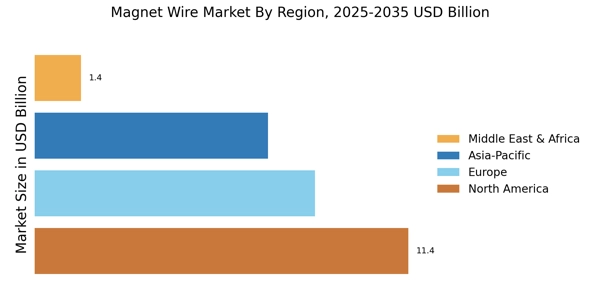
North America is witnessing significant growth in the magnet wire market, driven by the increasing demand for electric vehicles and renewable energy technologies. The region holds approximately 40% of the global market share, making it the largest market. Regulatory support for clean energy initiatives and advancements in manufacturing processes are further propelling this growth. The demand for high-performance magnet wire is expected to rise as industries focus on efficiency and sustainability. The United States is the leading country in this region, with major players like Southwire Company and General Cable dominating the market. The competitive landscape is characterized by innovation and strategic partnerships among key players. The presence of advanced manufacturing facilities and a skilled workforce enhances the region's capability to meet the growing demand for magnet wire, ensuring a robust market environment.
Europe : Sustainability and Innovation Focus
Europe is emerging as a significant player in the magnet wire market, driven by stringent regulations promoting energy efficiency and sustainability. The region accounts for approximately 30% of the global market share, making it the second-largest market. The European Union's Green Deal and various national initiatives are catalyzing investments in electric mobility and renewable energy, which in turn boosts the demand for magnet wire products. Leading countries in Europe include Germany, France, and the UK, with key players such as KME Germany GmbH and Sumitomo Electric Industries. The competitive landscape is marked by innovation in product development and a focus on eco-friendly materials. The presence of established manufacturers and a growing number of startups contribute to a dynamic market environment, fostering collaboration and technological advancements.
Asia-Pacific : Rapid Industrialization and Growth
The Asia-Pacific region is experiencing rapid growth in the magnet wire market, fueled by industrialization and increasing investments in infrastructure. This region holds approximately 25% of the global market share, with countries like China and India leading the charge. The demand for magnet wire is being driven by the booming automotive and electronics sectors, alongside government initiatives to enhance manufacturing capabilities and promote electric vehicles. China is the largest market in this region, with significant contributions from companies like LS Cable & System and Furukawa Electric Co. The competitive landscape is characterized by a mix of local and international players, with a focus on innovation and cost-effective production methods. The presence of a large consumer base and growing industrial activities further solidifies the region's position in The Magnet Wire Market.
Middle East and Africa : Emerging Markets and Opportunities
The Middle East and Africa region is gradually emerging in the magnet wire market, driven by increasing industrial activities and infrastructure development. This region currently holds about 5% of the global market share, with potential for significant growth as economies diversify and invest in manufacturing. The demand for magnet wire is expected to rise, particularly in sectors like construction and renewable energy, supported by government initiatives aimed at economic diversification. Countries such as South Africa and the UAE are leading the market in this region, with a growing presence of key players. The competitive landscape is evolving, with local manufacturers beginning to establish themselves alongside international companies. As the region continues to develop, the magnet wire market is poised for expansion, presenting opportunities for investment and innovation.
Key Players and Competitive Insights
In August Southwire Company (US) announced the launch of a new line of eco-friendly magnet wire, which utilizes recycled materials in its production. This strategic move is significant as it aligns with the growing trend towards sustainability in manufacturing, potentially attracting environmentally conscious customers and enhancing the company’s market position. The introduction of this product could also set a precedent for competitors to follow suit, thereby influencing overall market standards.
In September Sumitomo Electric Industries (JP) unveiled a partnership with a leading electric vehicle manufacturer to supply high-performance magnet wire tailored for electric motors. This collaboration is crucial as it not only expands Sumitomo's market reach but also positions the company at the forefront of the burgeoning electric vehicle sector. Such strategic alliances are likely to enhance technological capabilities and foster innovation within the industry.
In July General Cable (US) completed the acquisition of a regional magnet wire manufacturer, which is expected to bolster its production capacity and market share in North America. This acquisition reflects a broader trend of consolidation within the industry, as companies seek to enhance their competitive edge through increased scale and operational efficiency. The integration of this new entity may also facilitate the sharing of best practices and technological advancements, further strengthening General Cable's position in the market.
As of October the Magnet Wire Market is witnessing trends such as digitalization, sustainability, and the integration of artificial intelligence in manufacturing processes. Strategic alliances are increasingly shaping the competitive landscape, enabling companies to pool resources and expertise. Looking ahead, it is anticipated that competitive differentiation will evolve, with a shift from price-based competition to a focus on innovation, technology, and supply chain reliability. Companies that can effectively leverage these trends are likely to secure a more robust market position.
Key Companies in the Magnet Wire Market include
Industry Developments
March 2021: For the drive motors of the electric Kia EV6 and IONIQ 5 vehicles, LS Cable & System Ltd. announced that it had become the sole provider of enameled magnet wire. Additionally, the business is developing high-voltage magnet wires further for prospective usage in EVs produced by General Motors.
February 2021: Essex Furukawa decided to use the Sight Machine to start the company's magnet wire plant in Mexico's digital transformation. The sight Machine is designed to help increase the output of magnet wire, which is necessary for the manufacture of electric vehicles.
Future Outlook
Magnet Wire Market Future Outlook
The Magnet Wire Market is projected to grow at a 3.58% CAGR from 2025 to 2035, driven by increasing demand in electric vehicles, renewable energy, and advanced electronics.
New opportunities lie in:
- Expansion into electric vehicle charging infrastructure solutions.
- Development of high-efficiency magnet wire for renewable energy applications.
- Investment in smart manufacturing technologies for enhanced production efficiency.
By 2035, the Magnet Wire Market is expected to achieve robust growth, reflecting evolving technological demands.
Market Segmentation
Magnet Wire Market Form Outlook
- Round Magnet Wires
- Rectangular Magnet Wires
- Square Magnet Wire
- Round Bondable Magnet Wire
Magnet Wire Market Type Outlook
- Copper
- Aluminum
Magnet Wire Market Application Outlook
- Transformers
- Motors
- Home Appliance
- Generators
- Inductors
- Others
Magnet Wire Market End-Use Industry Outlook
- Electrical & Electronics
- Industrial
- Transportation
- Infrastructure
- Medical
- Aerospace
- Automotive
- Telecommunication
- Others
Report Scope
| MARKET SIZE 2024 | 28.49(USD Billion) |
| MARKET SIZE 2025 | 29.51(USD Billion) |
| MARKET SIZE 2035 | 41.96(USD Billion) |
| COMPOUND ANNUAL GROWTH RATE (CAGR) | 3.58% (2025 - 2035) |
| REPORT COVERAGE | Revenue Forecast, Competitive Landscape, Growth Factors, and Trends |
| BASE YEAR | 2024 |
| Market Forecast Period | 2025 - 2035 |
| Historical Data | 2019 - 2024 |
| Market Forecast Units | USD Billion |
| Key Companies Profiled | Southwire Company (US), General Cable (US), Magnecomp Precision Technology (MY), LS Cable & System (KR), Sumitomo Electric Industries (JP), Furukawa Electric Co. (JP), Rea Magnet Wire Company (US), KME Germany GmbH (DE), Ametek, Inc. (US) |
| Segments Covered | Type, Form, Application, End-Use Industry, Region |
| Key Market Opportunities | Growing demand for energy-efficient motors drives innovation in the Magnet Wire Market. |
| Key Market Dynamics | Rising demand for energy-efficient motors drives innovation and competition in the magnet wire market. |
| Countries Covered | North America, Europe, APAC, South America, MEA |
Market Highlights
FAQs
What is the current valuation of the Magnet Wire Market in 2025?
The Magnet Wire Market is valued at approximately 28.49 USD Billion in 2024.
What is the projected market size for the Magnet Wire Market by 2035?
The market is expected to reach a valuation of 41.96 USD Billion by 2035.
What is the expected CAGR for the Magnet Wire Market during the forecast period 2025 - 2035?
The anticipated CAGR for the Magnet Wire Market during the forecast period is 3.58%.
Which companies are considered key players in the Magnet Wire Market?
Key players in the market include Southwire Company, General Cable, Magnecomp Precision Technology, and others.
What are the main types of magnet wire in the market?
The primary types of magnet wire include Copper and Aluminum, with valuations of 18.0 and 10.49 USD Billion respectively in 2024.
How do the different forms of magnet wire compare in terms of market valuation?
Round Magnet Wires and Rectangular Magnet Wires are leading forms, valued at 10.0 and 8.0 USD Billion respectively in 2024.
What applications dominate the Magnet Wire Market?
Which end-use industries are the largest consumers of magnet wire?
What is the market outlook for the Magnet Wire Market in the coming years?
How does the Magnet Wire Market's growth compare across different segments?
Research Approach
Secondary Research
The secondary research process involved comprehensive analysis of regulatory databases, industry standards repositories, trade publications, and authoritative energy & materials organizations. Key sources included the International Electrotechnical Commission (IEC), National Electrical Manufacturers Association (NEMA), American Society for Testing and Materials (ASTM International), International Copper Association (ICA), Copper Development Association (CDA), Aluminum Association, US Department of Energy (DOE) Office of Electricity, European Copper Institute (ECI), China Electrical Equipment Industry Association (CEEIA), Japan Electrical Manufacturers' Association (JEMA), Electric Vehicle World Sales Database, International Energy Agency (IEA) Global EV Outlook, BloombergNEF Electric Vehicle Market Reports, International Conference on Magnetics (Intermag), IEEE Magnetics Society Publications, European Automobile Manufacturers' Association (ACEA), and national standards bodies including DIN (Germany), BSI (UK), and JIS (Japan).
Data on the cost of conductor materials, statistics on the manufacture of transformers and motors, projections for EV production, trends in electrical infrastructure investment, and insulation technology standards for copper and aluminum magnet wire types were gathered from these sources.
Primary Research
To gather both qualitative and quantitative insights, supply-side and demand-side stakeholders were interviewed during the primary research process. CEOs, VPs of manufacturing operations, heads of raw material procurement, and R&D directors from companies that made copper rods, insulation coatings, and magnet wire were examples of supply-side sources. Demand-side sources comprised chief engineers from electric motor manufacturers, transformers OEMs, EV powertrain designers, procurement leads from appliance manufacturers, and technical specification managers from renewable energy generator producers. Primary research established coating technology roadmaps, validated market segmentation across round, rectangular, and square wire types, and collected information on EV motor winding standards, high-frequency transformer needs, and trends in aluminum substitution.
Primary Respondent Breakdown:
By Designation: C-level Primaries (32%), Director Level (31%), Others (37%)
By Region: North America (32%), Europe (30%), Asia-Pacific (28%), Rest of World (10%)
Market Size Estimation
Revenue mapping and consumption volume analysis were used to get the global market valuation. The following were part of the methodology:
Finding more than fifty major producers of enameled copper wire, aluminum winding wire, and custom rectangular conductors across North America, Europe, Asia-Pacific, and Latin America
Application categories include motors, transformers, generators, inductors, and household appliances; product mapping includes copper and aluminum varieties; and round, rectangular, square, and bondable forms.
Examination of projected and reported yearly revenues for magnet wire portfolios, including sales of insulated winding wire and counterparts for bare conductor
coverage of producers who will hold 75–80% of the world market in 2024, including industry giants in the automotive traction motor winding, fine gauge electronics wire, and heavy building wire sectors.
Segment-specific valuations for electrical and electronics, transportation, and infrastructure end-use verticals are derived through extrapolation using top-down (OEM procurement validation across automotive, energy, and industrial sectors) and bottom-up (tonnage consumption × average selling price by conductor material and insulation class) approaches.
Kindly complete the form below to receive a free sample of this Report
Customer Stories
“This is really good guys. Excellent work on a tight deadline. I will continue to use you going forward and recommend you to others. Nice job”
“Thanks. It’s been a pleasure working with you, please use me as reference with any other Intel employees.”
“Thanks for sending the report it gives us a good global view of the Betaïne market.”
“Thank you, this will be very helpful for OQS.”
“We found the report very insightful! we found your research firm very helpful. I'm sending this email to secure our future business.”
“I am very pleased with how market segments have been defined in a relevant way for my purposes (such as "Portable Freezers & refrigerators" and "last-mile"). In general the report is well structured. Thanks very much for your efforts.”
“I have been reading the first document or the study, ,the Global HVAC and FP market report 2021 till 2026. Must say, good info! I have not gone in depth at all parts, but got a good indication of the data inside!”
“We got the report in time, we really thank you for your support in this process. I also thank to all of your team as they did a great job.”