Manhole Covers Market (2026 - 2035)

Manhole Covers Market Research Report Information By Type (Metal cap, Regenerated resin, High strength steel fiber cement, concrete, Others), By Application (Municipal, Airport & ports, Others), And By Region (North America, Europe, Asia-Pacific, And Rest Of The World) โ€“Market Forecast Till 2035
ID: MRFR/PCM/0864-HCR
111 Pages
Snehal Singh
Last Updated: July 12, 2026
Manhole Covers Market
Market Size
Forecast Period2026-2035
CAGR (2026-2035)5.37%
2025 Market SizeUSD 6.12 Billion
2035 Market SizeUSD 10.32 Billion
Key Players
EJ Group
Saint-Gobain PAM
Neenah Foundry
Fibrelite
Crescent Foundry
Ducast Factory LLC
Opportunities
  • Sensor-Embedded Smart Covers
  • Composite Material Penetration in Emerging Markets
  • Circular-Economy Recycled Iron Covers

Manhole Covers Market Summary

The global Manhole Covers Market was valued at USD 6.12 Billion in 2025 and is projected to grow from USD 6.45 Billion in 2026 to USD 10.32 Billion by 2035, registering a CAGR of 5.37% during the 2026โ€“2035 forecast period. This growth is anchored in accelerating urbanization โ€” the UN projects 68% of the global population will live in cities by 2050 โ€” and the corresponding surge in underground utility buildouts. Governments across the EU, China, and North America have collectively pledged over USD 420 Billion toward water, wastewater, and broadband infrastructure between 2024 and 2032, directly expanding procurement volumes for the Manhole Covers Market [1][2].

A material technology shift is redefining the competitive landscape of the Manhole Covers Market. Traditional grey iron and ductile iron covers, long the default specification, are losing ground to fiber-reinforced polymer (FRP) composites and polymer-concrete alternatives that offer superior corrosion resistance, lower installation weight, and built-in anti-theft characteristics. Telecom operators rolling out 5G small cells require RF-transparent lids that metal simply cannot provide, while smart-city pilot programs in Seoul, Amsterdam, and Singapore are integrating IoT sensors directly into cover assemblies to monitor flood risk, gas accumulation, and unauthorized entry [3][4].

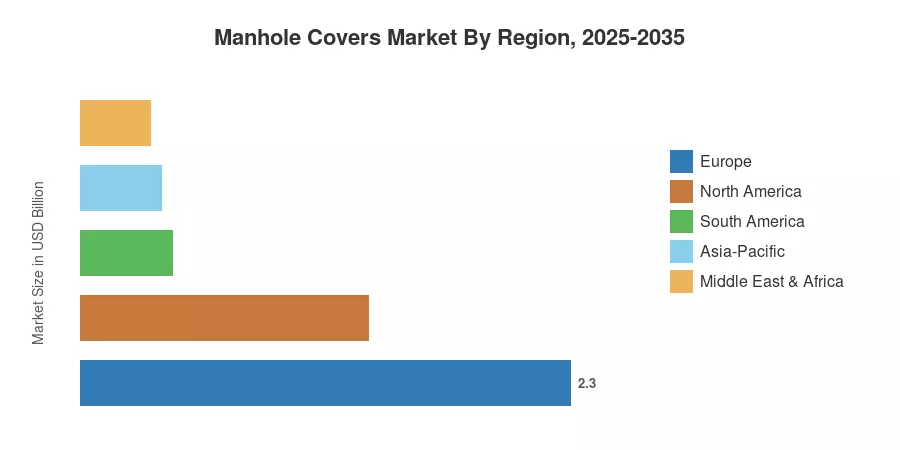
Europe commands the largest share of the Manhole Covers Market at approximately 37.6% of 2025 revenue, driven by strict EN 124-compliant procurement standards and dense underground utility networks. Asia-Pacific is the fastest-growing region, posting an anticipated CAGR of 6.13% through 2035, led by massive metro rail expansions in India and China's "sponge city" stormwater programs. North America holds roughly 22% of the global Manhole Covers Market, where aging water systems and the Bipartisan Infrastructure Law's USD 55 Billion water allocation are sustaining replacement-cycle demand [5][6]. The decade ahead will see material innovation, digital integration, and regulatory harmonization converge to reshape how municipalities procure and manage these essential assets.

ย 

Key Report Takeaways

โ€ข By Material Type

  • Cast Iron captured approximately 42.7% of Manhole Covers Market revenue in 2025, reflecting its continued specification dominance in legacy road and highway projects across Europe and North America.
  • Composite materials are forecast to register the fastest material-type CAGR of 6.29% through 2035, propelled by telecom 5G lid requirements and anti-theft mandates.
  • Ductile Iron remains the second-largest material segment within the Manhole Covers Market, valued at approximately USD 1.41 Billion in 2025.

โ€ข By Application

  • Road infrastructure accounted for roughly 31.7% of the Manhole Covers Market in 2025, underpinned by highway resurfacing programs and new expressway construction in Asia.
  • Telecommunication and Data applications are projected to expand at a 6.49% CAGR through 2035, the fastest among all application segments.

โ€ข By Region

  • Europe led the Manhole Covers Market with a 37.6% share in 2025.
  • Asia-Pacific is expected to record the highest regional CAGR of 6.13% through 2035.

ย 

Market Size and Forecast (2021โ€“2035)

Market Research Future derives historical estimates from customs trade data, foundry production indices, and municipal procurement filings, while forecast projections integrate urbanization trajectories, infrastructure spending pipelines, and material substitution curves.
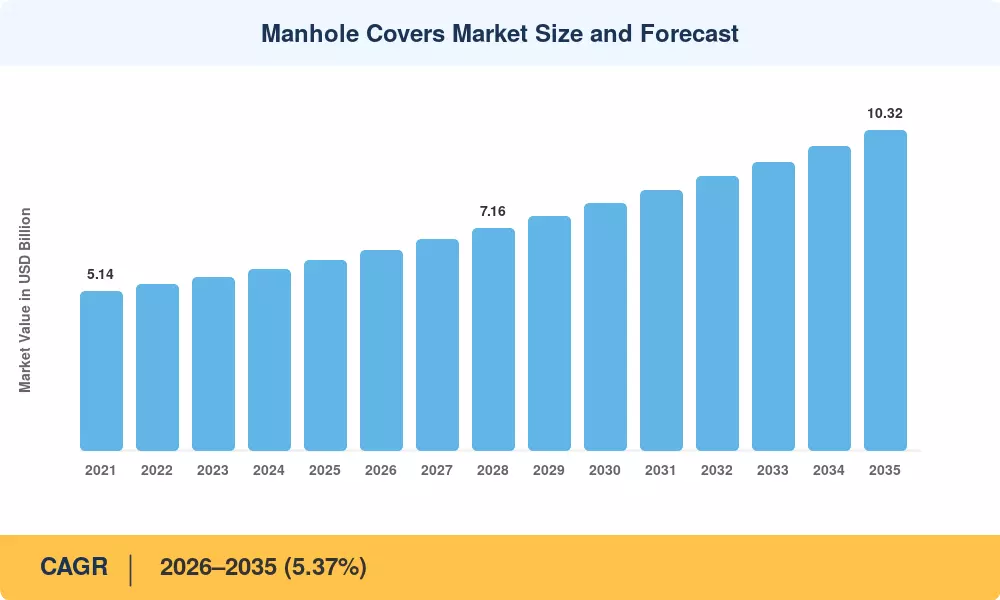
Manhole Covers Market Size and Forecast
Our Impact
Enabled $4.3B Revenue Impact for Fortune 500 and Leading Multinationals
Partnering with 2000+ Global Organizations Each Year
30K+ Citations by Top-Tier Firms in the Industry

Driver Impact Analysis

Driver ~% Impact on CAGR Geographic Relevance Impact Timeline
Urban Water & Sewer Expansion +1.4% Global Long-term (โ‰ฅ4 yr)
5G & Telecom Network Buildouts +0.9% Asia-Pacific, Europe Medium-term (2โ€“4 yr)
Smart-City IoT Mandates +0.8% Europe, East Asia Medium-term (2โ€“4 yr)
Highway & Road Expansion Programs +0.7% Asia-Pacific, MEA Long-term (โ‰ฅ4 yr)
Anti-Theft Regulations for Covers +0.5% India, Africa, South America Short-term (โ‰ค2 yr)
Composite Material Cost Competitiveness +0.6% North America, Europe Medium-term (2โ€“4 yr)
Aging Infrastructure Replacement Cycles +0.4% North America, Europe Long-term (โ‰ฅ4 yr)

ย 

Urban Water and Sewer Expansion

Strong below-ground utility networks are becoming increasingly necessary due to rapid urbanization. The Jal Jeevan Mission (JJM) remains a pillar of water infrastructure strategy in India. With a government allocation of roughly INR 67,670 crore for the 2026โ€“2027 fiscal year, the mission has undergone considerable budgetary revisions, but the goal of providing piped water to everyone is still the main priority. Standardized, long-lasting access points are required for continuous maintenance with every new connection. In a similar vein, China's approach to urban water infrastructure has developed; long-term operational maintenance and real-world performance monitoring of drainage and infiltration systems have taken precedence over the initial construction-heavy phase of the "Sponge City" plan. For the Manhole Covers Market, these utility-scale projects guarantee a consistent, high-volume procurement pipeline.

ย 

5G Telecom Network Buildouts

A dense network of small-cell nodes, many of which use below-grade access points for fiber-optic and power distribution, is necessary for the growth of 5G infrastructure. Simplifying the deployment of small-area wireless access points (SAWAPs) is the main goal of the European Commission's "Digital Decade" initiative. The industry is increasingly using RF-transparent composite lids to avoid signal attenuation, even though there is no uniform requirement for particular lid materials. This is especially true in high-density urban regions where millimeter-wave performance is crucial. The need for non-metallic, RF-friendly access covers has become a typical requirement in telecommunications infrastructure projects as 5G density continues to rise across key global markets through 2026.

ย 

Smart-City IoT Mandates

In order to monitor vital environmental data, including real-time flood levels, toxic gas accumulation (such as hydrogen sulfide), and unlawful access, municipalities are gradually integrating IoT sensors into manhole and utility cover assemblies. Agencies like Singapore's PUB are increasingly including digital-ready infrastructure criteria in new utility contracts, even though precise "smart-city" mandates differ by location. By switching from reactive schedules to data-driven, predictive models, these installations seek to improve infrastructure resilience in an increasingly urbanized environment and successfully lower emergency call-outs.

ย 

Anti-Theft Regulatory Pressures

Metal theft of manhole covers poses public safety hazards and costs municipalities millions annually. India's Bureau of Indian Standards updated IS 1726 in 2024 to mandate locking mechanisms and composite alternatives in high-theft zones, a specification change affecting an estimated 12 million covers across municipal networks [7]. South Africa's Johannesburg Water reported replacing over 40,000 stolen covers per year at a cost exceeding ZAR 180 million, accelerating the shift to theft-resistant composite designs [12].

ย 

Restraints Impact Analysis

Restraint ~% Impact on CAGR Geographic Relevance Impact Timeline
Volatile Raw Material Pricing โ€“0.6% Global Short-term (โ‰ค2 yr)
Price Underbidding by Uncertified Foundries โ€“0.5% India, SE Asia Medium-term (2โ€“4 yr)
Slow Adoption of New Standards โ€“0.4% South America, MEA Long-term (โ‰ฅ4 yr)
High Tooling Costs for Composite Molds โ€“0.3% North America, Europe Short-term (โ‰ค2 yr)
Limited Recycling Infrastructure for FRP โ€“0.2% Global Long-term (โ‰ฅ4 yr)

ย 

Volatile Raw Material Pricing

Ductile-iron scrap prices fluctuated between USD 1,800 and USD 2,200 per ton throughout 2025, squeezing foundry margins and creating unpredictable bid pricing for municipal procurement officers [8]. This volatility discourages long-term fixed-price contracts and delays capital-budget approvals, particularly in price-sensitive markets. While composite alternatives offer price stability, the Manhole Covers Market transition remains gradual due to specification inertia.

Price Underbidding by Uncertified Foundries

Small regional foundries in Southeast Asia and India routinely undercut qualified suppliers by 25โ€“40% on tenders, frequently utilizing inferior alloys that fail load-bearing tests in three to five years [13]. This technique increases lifespan costs by forcing early replacement cycles and undermining the revenue base for compliance manufacturers. States and provinces continue to enforce quality requirements inconsistently, which exacerbates the issue for the larger manhole covers market.

ย 

ย 

Manhole Covers Market Opportunities

Sensor-Embedded Smart Covers

The integration of environmental and structural health sensors into manhole covers creates a recurring revenue stream through monitoring-as-a-service contracts. Cities that have piloted these systems report 20โ€“35% reductions in emergency maintenance callouts. The addressable opportunity for the Manhole Covers Market in smart covers alone could reach USD 1.2 Billion by 2032 as urban digital-twin platforms demand real-time underground asset data [4].

Composite Material Penetration in Emerging Markets

Due to severe cover-theft issues in South Asia and Sub-Saharan Africa, lightweight, low-scrap-value composite coverings are especially appealing. The Manhole Covers Market can profit from public-private procurement partnerships in these high-growth regions since telecom operators in Bangladesh, Kenya, and Nigeria are co-funding cover replacements to safeguard fiber assets [12].

ย 

Circular-Economy Recycled Iron Covers

European foundries are piloting closed-loop recycling programs where decommissioned cast iron covers are re-melted and recast into EN 124-compliant replacements. Saint-Gobain PAM's pilot in Lyon achieved 92% material recovery rates in 2024, reducing per-unit carbon emissions by 38% [16]. This model aligns with EU Taxonomy requirements and could become a differentiator for the Manhole Covers Market across sustainability-conscious procurement frameworks.

Standardization-Driven Export Markets

The adoption of EN 124 and ASTM C478/A536 standards by Middle Eastern and African countries is opening export corridors for European and North American manufacturers. Saudi Arabia's SASO adopted EN 124 equivalents in 2024, creating a quality benchmark that favors established producers over local informal foundries[14].

Data Monetization from Underground Asset Networks

Aggregated data from sensor-equipped covers โ€” flow rates, temperature, gas concentrations โ€” holds commercial value for insurance underwriters, real estate developers, and climate-risk modelers. The Manhole Covers Market participants that control the sensor platform and data pipeline can capture subscription revenue well beyond the physical product sale[11].

ย 

Manhole Covers Market Future Outlook

Digital Twin Integration and Predictive Maintenance

The confluence of IoT-equipped covers with municipal digital-twin platforms is transforming the Manhole Covers Market from commodity hardware to data-integrated asset management. By 2030, a predicted 15% of new cover installations in advanced metropolitan economies are likely to incorporate embedded sensors. These sensors provide continuous data streams on flow, temperature, and structural integrity, enabling utilities to migrate from reactive replacement cycles to predictive, condition-based maintenance models.

ย 

Platform Economics and Cover-as-a-Service

Several manufacturers are experimenting with leasing models where municipalities pay per-cover monthly fees covering installation, monitoring, and replacement. This platform approach shifts procurement from capital expenditure to operating expenditure, smoothing budget cycles and aligning vendor incentives with product durability. The Manhole Covers Market could see 8โ€“12% of European procurement transition to service-based contracts by 2032 [20].

Sustainability Reporting and Carbon-Labeled Procurement

EU Corporate Sustainability Reporting Directive (CSRD) requirements are pushing municipalities to track embodied carbon in infrastructure purchases. Composite covers typically carry 40โ€“55% lower cradle-to-gate carbon footprints than ductile iron equivalents, giving them a procurement advantage in carbon-scored tenders. The Manhole Covers Market will increasingly segment along environmental performance metrics rather than material tradition [16][21].

Autonomous Utility Inspection Networks

Autonomous underground inspection robots โ€” already deployed by Thames Water and Tokyo Metropolitan Government โ€” require standardized access points with machine-readable identifiers and automated locking mechanisms. As robotic inspection scales from pilot to standard practice through 2035, cover specifications will evolve to accommodate autonomous access protocols, creating a retrofit and replacement wave across the Manhole Covers Market [22].

ย 

Manhole Covers Market Segmentation

By Material Type

Segment Key Metric Primary Demand Driver
Cast Iron ~42.7% share (2025) Legacy highway specifications
Ductile Iron USD 1.41 Billion (2025) Load-bearing urban road applications
Steel CAGR 4.65% Industrial facility access points
Reinforced Concrete ~15.0% share (2025) Pedestrian zones, low-load settings
Others (incl. Composite) CAGR 6.29% 5G telecom, anti-theft mandates

ย 

Cast Iron remains the backbone of the Manhole Covers Market, specified by transportation departments for load class D400 and above applications on highways and arterial roads. Its dominance, however, is eroding as composite alternatives demonstrate competitive 50-year lifecycle costs when factoring in theft resistance, corrosion immunity, and lower installation labor. The Manhole Covers Market is witnessing a gradual but irreversible shift toward composite materials in telecom, pedestrian, and flood-prone applications where metal covers present functional disadvantages.

Ductile Iron occupies the premium tier of the Manhole Covers Market, favored for heavy-traffic urban intersections and airport taxiways where impact resistance is paramount. Manufacturers like EJ Group and Saint-Gobain PAM continue to invest in ductile iron foundry capacity even as composite adoption accelerates, recognizing that critical load-bearing applications will sustain demand through 2035 and beyond.

By Application

Segment Key Metric Primary Demand Driver
Road Infrastructure ~31.7% share (2025) Highway expansion, resurfacing programs
Water and Waste-Water USD 1.53 Billion (2025) Sanitation mandates, sponge cities
Telecommunication and Data CAGR 6.49% 5G fiber deployment, RF-transparent lids
Electric and Power Utility ~14.0% share (2025) Underground cable network access
Gas Distribution CAGR 4.88% Safety inspection access requirements
Others USD 0.33 Billion (2025) District heating, industrial process

ย 

Road infrastructure drives the greatest application-level demand within the Manhole Covers Market, where covers must meet stringent load classifications (EN 124 Class D400/E600) for vehicle traffic. Water and wastewater represent the second-largest application, with developing economies investing heavily in first-time sewer network construction. The Manhole Covers Market's fastest application growth occurs in Telecommunication and Data, where the simultaneous rollout of 5G and fiber-to-the-premises demands tens of thousands of new below-grade access points annually across Asia, Europe, and North America [3][10].

ย 

Regional Market Share Analysis

Region Key Metric Primary Investment Themes
North America ~22.0% share (2025) Water system replacement, composite transition
Europe ~37.6% share (2025) EN 124 compliance, smart-city integration
Asia-Pacific 6.13% CAGR (2026โ€“2035) Metro rail, sponge-city programs, 5G
South America USD 0.43 Billion (2025) PPP-driven sanitation projects
Middle East & Africa USD 0.33 Billion (2025) Standards adoption, anti-theft mandates
Total USD 6.12 Billion (2025) โ€”

The Manhole Covers Market exhibits distinct regional dynamics shaped by infrastructure maturity, material preferences, and regulatory frameworks.

ย 

North America

Country Key Metric Key Driver
US ~71% of regional share EPA CWSRF funding, aging sewer networks
Canada CAGR 5.08% Municipal climate adaptation programs
Mexico USD 0.11 Billion (2025) Urban housing expansion, CONAGUA mandates

ย 

The US dominates North American demand for the Manhole Covers Market, propelled by the Bipartisan Infrastructure Law's USD 55 Billion water allocation and EPA Clean Water State Revolving Fund disbursements. Charlotte Pipe's 2026 acquisition of Neenah Foundry signals consolidation pressure as buyers seek national supply assurance and economies of scale [6][9].

Europe

Country Key Metric Key Driver
Germany ~21% of regional share Autobahn resurfacing, DIN/EN standards
UK CAGR 5.25% Water company AMP8 investment cycle
France USD 0.38 Billion (2025) Grand Paris Express metro expansion
Italy ~9% of regional share PNRR infrastructure modernization
Spain CAGR 4.92% Tourism-driven urban renewal
Nordic Countries USD 0.22 Billion (2025) Climate-resilient stormwater systems
Russia ~6% of regional share Housing renovation programs
Rest of Europe CAGR 4.78% EU cohesion fund infrastructure projects

ย 

Europe's leadership in the Manhole Covers Market reflects decades of rigorous standards enforcement and dense underground networks. The UK's AMP8 regulatory period (2025โ€“2030) commits water companies to GBP 96 Billion in network investment, creating a sustained procurement pipeline [5][17].

Asia-Pacific

Country Key Metric Key Driver
China ~38% of regional share Sponge-city programs, metro buildouts
India CAGR 6.82% Jal Jeevan Mission, Smart Cities Mission
Japan USD 0.19 Billion (2025) Earthquake-resilient cover upgrades
South Korea CAGR 5.91% 5G node deployment, K-Water programs
ASEAN ~11% of regional share Urban sanitation modernization
Rest of Asia-Pacific CAGR 5.44% Emerging city infrastructure buildouts

ย 

Asia-Pacific's rapid growth within the Manhole Covers Market is driven by India's urbanization rate exceeding 35% and China's mandate to upgrade drainage systems across 30 designated sponge cities [1][2]. India alone installed an estimated 3.8 million new covers between 2022 and 2025 under Smart Cities Mission phases.

South America

Country Key Metric Key Driver
Brazil ~58% of regional share PLANSAB sanitation targets
Argentina CAGR 4.63% Buenos Aires sewer expansion
Rest of South America USD 0.08 Billion (2025) Multilateral development bank projects

ย 

Brazil's Marco Legal do Saneamento (2020) mandates universal sanitation coverage by 2033, requiring massive expansion of sewer networks and corresponding cover procurement for the Manhole Covers Market [18]. Private concessionaires under PPP frameworks are driving quality improvements over traditional municipal self-supply.

Middle East & Africa

Country Key Metric Key Driver
Saudi Arabia ~28% of regional share Vision 2030 megaprojects
UAE CAGR 5.67% Smart-city infrastructure investments
South Africa USD 0.06 Billion (2025) Theft-replacement cycle demand
Egypt CAGR 5.12% New Administrative Capital construction
Rest of MEA ~22% of regional share Urbanization-driven sanitation expansion

ย 

The Middle East and Africa segment of the Manhole Covers Market is shaped by contrasting dynamics: Gulf states deploying premium composite covers for smart-city districts, while Sub-Saharan African municipalities grapple with theft-replacement volumes. Saudi Arabia's NEOM project alone specifies over 85,000 composite IoT-enabled covers for its linear city infrastructure [19].

ย 

Manhole Covers Market By Region, 2025-2035

Competitive Benchmarking

The Manhole Covers Market exhibits moderate concentration, with the top five players accounting for an estimated 28โ€“35% of global revenue. The HHI index is low relative to concentrated industrial markets, reflecting a fragmented supply base of regional foundries alongside a handful of multinational manufacturers pursuing consolidation strategies. Charlotte Pipe's acquisition of Neenah Foundry in 2026 signals the beginning of a consolidation cycle in North America [9].

Company Est. Revenue Share Range Key Offerings Strategic Positioning
EJ Group ~7โ€“10% Full-range ductile/grey iron, composite covers Global distribution, multi-material portfolio
Saint-Gobain PAM ~6โ€“9% Ductile iron, recycled-iron programs European market leader, sustainability focus
Neenah Foundry (Charlotte Pipe) ~4โ€“7% Ductile iron, decorative covers North American consolidation play
Fibrelite ~3โ€“5% GRP composite covers, telecom-grade lids Composite specialist, RF-transparency
Crescent Foundry ~3โ€“5% Grey and ductile iron, export-focused India-based, price-competitive supplier
Ducast Factory LLC ~2โ€“4% Ductile iron, EN 124-certified Middle East manufacturing base
Polieco Group ~2โ€“4% Polymer-concrete, composite covers Italian specialty manufacturer
Jinlong Casting ~2โ€“4% Grey/ductile iron, large-volume OEM China-based capacity leader
Fundiciรณn Benito ~2โ€“3% Ductile iron, custom architectural covers Southern European heritage brand
Aquacast Ltd ~1โ€“3% Composite access covers, rail-grade lids UK specialist, Network Rail approved
Eagle Manufacturing Group ~1โ€“3% Grey iron, ductile iron, steel covers US regional foundry network

ย 

ย 

Recent News & Developments

  • Charlotte Pipe (January 2026): Completed acquisition of Neenah Foundry, consolidating two major US ductile-iron producers and creating the largest North American cover manufacturer with estimated combined revenue exceeding USD 400 Million [9].

ย 

  • Saint-Gobain PAM (June 2025): Opened a closed-loop recycling line at its Pont-ร -Mousson plant, enabling 92% material recovery from decommissioned iron covers and reducing per-unit carbon emissions by 38% [16].
  • Bingham & Taylor (November 2025): Bingham & Taylor, a family-run business that specializes in subterranean infrastructure access solutions for water and gas utility customers throughout North America, was acquired by Charlotte Pipe and Foundry Company and Neenah Foundry. By increasing their product line and clientele, this acquisition is anticipated to improve their standing in the manhole cover industry.

ย 

ย 

ย 

ย 

ย 

Manhole Covers Market Report Scope

Parameter Detail
Market Scope Global Manhole Covers Market by Material Type, Application, and Geography
Study Period 2021โ€“2035
CAGR Window 2026โ€“2035 (5.37%)
Market Size (2025) USD 6.12 Billion
Market Size (2035) USD 10.32 Billion
Fastest Growing Material Composite (Others) โ€” CAGR 6.29%
Fastest Growing Application Telecommunication and Data โ€” CAGR 6.49%
Fastest Growing Region Asia-Pacific โ€” CAGR 6.13%
Companies Profiled 11 key players
Valuation Currency USD Billion

ย 

ย 

FAQs

What procurement criteria should municipalities prioritize when switching from iron to composite covers?
Specify load class per EN 124 or ASTM, verify UV stability ratings for exposed installations, and confirm anti-theft certification. Composite covers should carry third-party load-test documentation matching the traffic classification of the installation site [15].
How do RF-transparent covers differ from standard composite alternatives?
RF-transparent covers use glass-fiber reinforcement without carbon or metallic fillers, allowing 5G millimeter-wave signals to pass through. Standard composites may include conductive additives that attenuate radio frequencies [3].
What is the typical replacement cycle for ductile iron covers in urban roads?
Ductile iron covers in D400 urban applications typically last 30โ€“50 years depending on traffic volume and corrosion exposure. Composite alternatives offer comparable lifespans with lower theft-replacement interruptions [7].
How does the Manhole Covers Market address counterfeit product risks in developing regions?
Certified manufacturers embed QR-code traceability and unique casting marks into EN 124-compliant products. Procurement agencies in India and Africa increasingly require third-party batch testing at delivery [13].
What role do public-private partnerships play in Manhole Covers Market growth in South America?
PPP concessionaires under Brazil's sanitation framework procure higher-grade covers to meet contractual durability targets. This drives premiumization compared to traditional municipal self-supply [18].
Can existing iron covers be retrofitted with IoT sensors, or is full replacement needed?
Bolt-on sensor modules exist for retrofit applications, though purpose-built sensor-embedded covers offer better weatherproofing and data reliability. Retrofit kits typically cost 30โ€“40% of full replacement [4].
How do fluctuating scrap metal prices affect the Manhole Covers Market competitively?
Iron scrap price spikes compress foundry margins and destabilize municipal bid pricing. This volatility accelerates composite adoption by offering fixed-price procurement stability [8]. ย  ย 
Author
Author
Author Profile
Snehal Singh LinkedIn
Manager - Research
High acumen in analyzing complex macro & micro markets with more than 6 years of work experience in the field of market research. By implementing her analytical skills in forecasting and estimation into market research reports, she has expertise in Packaging, Construction, and Equipment domains. She handles a team size of 20-25 resources and ensures smooth running of the projects, associated marketing activities, and client servicing.

Research Approach

Research Methodology on Manhole Covers Market

Research Design

ย 

This report aims to present an in-depth analysis of the currently existing Manhole Covers Market. An exploratory research design has been applied to investigate the present trend and future prospects of the market in the forecast period 2023 to 2030. Secondary research tools were applied to get access to data collected from previous market studies, documents, and journals that can provide reliable and timely information on the market size of Manhole Covers. Moreover, primary research tools such as open-ended interviews and questionnaires were used to understand customer responses and their attitude towards the product.

Secondary Research

Secondary research involves literature, market reports, newspapers, magazines, and journals. This research will provide information about the application sector, competitive environment, top players in the Manhole Covers Market, and different strategies used by them. Secondary data sources include authentic web portals, organisation reports, proprietary databases and directories, business magazines, trade publications, company presentations, economic reports, legal databases, and government data.

Primary Research

Primary research is the collection of qualitative and quantitative data from active market participants including customers, suppliers, manufacturers, etc. It includes open-ended interviews and questionnaires that enable an understanding of customer perspectives and provide in-depth insights into the current market. To understand the data analysis process and gain insights market sizing method was adopted which includes a top-down approach and a bottom-up approach.

Data Collection Parameters

The data collection parameters for this report involve both primary and secondary research Our research process begins with an exhaustive market study of the present market scenario through secondary research. Secondary data sources included are authentic web portals, organizational annual reports, proprietary databases, and directories, business magazines, trade publications, company presentations, economic reports, legal databases, and government data. Also, interviews including open-ended and closed-ended questions were conducted with experts and investors to understand their perceptions and business plans. After all the data collection, market sizing was done to identify the revenue by different segments and countries in the Global Manhole Covers Market.

Market Sizing

For market sizing, top-down and bottom-up approaches were used, depending on the nature of the target market, product type, application, and geography. The bottom-up approach was used to calculate the regional markets and the overall size of the market. The top-down approach was used to retrieve the estimated number of individuals in each segment of the market. Subsequently, the estimated market size was validated using both primary and secondary resources. The data collected from the secondary sources was used to establish the overall size of the Global Manhole Covers Market.

Data Triangulation

The data triangulation technique was used to assess the market size. Primary, secondary, and quantitative data triangulation were used to validate the market size. Moreover, several interviews were conducted with key opinion leaders to further analyze and get the market size. After triangulation, the data procured from two different sources was combined and restructured into a reasonable shape to gain clear and accurate estimations.

Data Analysis and Estimation Approach

The global Manhole Covers Market was analyzed using established qualitative and quantitative procedures to provide a comprehensive overview of its performance. Initial research and judgmental methods were applied wherever possible to represent the market by combining historical market analysis and value-based estimations. Landmark cases, support and restraining factors, government initiatives, regulations, global trends, market events, market dynamics, macroeconomic conditions, etc. were taken into consideration while estimating and forecasting the market size of Manhole Covers.

Factor Analysis

To estimate the market size of the Manhole Covers Market, a factor analysis was carried out. The market size was calculated based on key parameters such as product type, application, and region. These factors were further split into sub-factors, in addition to induce sources such as bottom-up and top-down approaches. The bottom-up approach included an analysis of the regional markets and added required data to arrive at the estimated global market size. A top-down approach was applied to forecast the application range, product types, and regions that have the highest impact on the Manhole Covers Market.

Time-series Analysis

This research report included a time series analysis that involved the year-wise analysis of the Manhole Covers Market. Data points for each of the geographies and years were collected through various sources such as industry documentation, journals, databases, and various relevant sources. At the same time, various demand-side and supply-side data points were taken into account to obtain the required reliability. Subsequently, the collected data was evaluated using descriptive analysis and qualitative analysis. The data points were then reconciled to ensure their accuracy and reliability.

Download Free Sample

Kindly complete the form below to receive a free sample of this Report

Download PDF ×

We do not share your information with anyone. However, we may send you emails based on your report interest from time to time. You may contact us at any time to opt-out.
















