×
Request Free Sample ×

Kindly complete the form below to receive a free sample of this Report

* Please use a valid business email

Leading companies partner with us for data-driven Insights

clients tt-cursor
Hero Background

Mass Flow Controller Market

ID: MRFR/SEM/3540-HCR
100 Pages
Ankit Gupta
October 2025

Mass Flow Controller Market Research Report Information By Connection Type (Direct, Indirect), By Flow measurement (Low, Medium, High), By Connectivity (Analog, Profibus, Profinet, Analog, RS-485, Ethercat, Modbus RTU, Device Net, Modbus TCPIP, Foundation Fieldbus), By End User (Chemicals, Oil and Gas, Pharmaceuticals, Semiconductors, Food and Beverages, Water and Wastewater Treatment, Metals and Mining), And By Region (North America, Europe, Asia-Pacific, And Rest Of The World) – Market Forecast Till 2035

Share:
Download PDF ×

We do not share your information with anyone. However, we may send you emails based on your report interest from time to time. You may contact us at any time to opt-out.

Mass Flow Controller Market Infographic
Purchase Options

Mass Flow Controller Market Summary

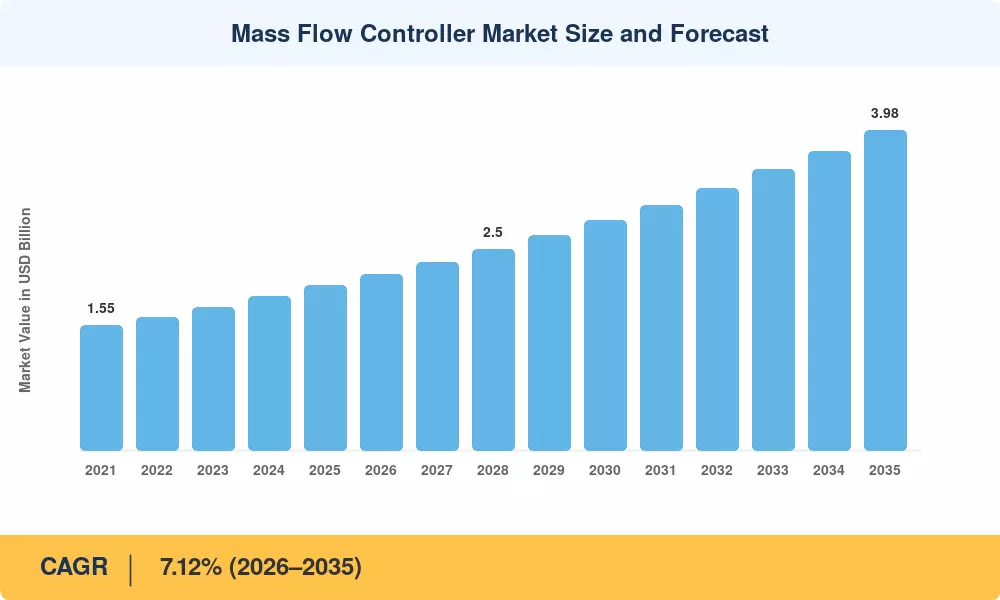
As per MRFR analysis, the Mass Flow Controller Market Size was estimated at 1493.07 USD Million in 2024. The Mass Flow Controller industry is projected to grow from 1575.82 USD Million in 2025 to 2702.46 USD Million by 2035, exhibiting a compound annual growth rate (CAGR) of 5.54 during the forecast period 2025 - 2035.

Key Market Trends & Highlights

The Mass Flow Controller Market is experiencing robust growth driven by technological advancements and increasing demand across various sectors.

  • North America remains the largest market for mass flow controllers, primarily due to its strong semiconductor manufacturing sector.
  • Asia-Pacific is identified as the fastest-growing region, fueled by rapid industrialization and technological adoption.
  • The semiconductor manufacturing segment leads the market, while the pharmaceuticals segment is witnessing the fastest growth due to rising healthcare demands.
  • Key market drivers include the rising demand in semiconductor manufacturing and the expansion of the renewable energy sector, which are significantly influencing market dynamics.

Market Size & Forecast

2024 Market Size 1493.07 (USD Million)
2035 Market Size 2702.46 (USD Million)
CAGR (2025 - 2035) 5.54%

Major Players

Brooks Instrument (US), MKS Instruments (US), Emerson Electric (US), Siemens (DE), Bronkhorst (NL), Kobold (DE), Yokogawa (JP), Aalborg (US), Vögtlin Instruments (CH)

Mass Flow Controller Market Trends

The Mass Flow Controller Market is currently experiencing a dynamic evolution, driven by advancements in technology and increasing demand across various industries. The integration of automation and precision measurement capabilities has become paramount, as industries seek to enhance efficiency and reduce operational costs. This market is characterized by a diverse range of applications, including semiconductor manufacturing, pharmaceuticals, and environmental monitoring, which collectively contribute to its growth. Furthermore, the emphasis on sustainability and energy efficiency is prompting manufacturers to innovate and develop more effective flow control solutions. In December 2025, the Mass Flow Controller Market appears poised for continued expansion, as emerging technologies such as IoT and AI are likely to play a pivotal role in shaping future developments. The growing trend towards smart manufacturing and process optimization suggests that the demand for advanced flow controllers will persist. Additionally, the increasing focus on regulatory compliance and safety standards across industries may further drive the adoption of sophisticated mass flow controllers, ensuring precise control and monitoring of gas and liquid flows. Overall, the market landscape is evolving, reflecting a blend of technological advancements and shifting consumer preferences.

Technological Advancements

The Mass Flow Controller Market is witnessing rapid technological advancements, particularly in the areas of automation and digitalization. These innovations are enhancing the precision and reliability of flow measurement, which is crucial for various applications. As industries increasingly adopt smart technologies, the demand for advanced mass flow controllers that integrate seamlessly with existing systems is likely to rise.

Sustainability Initiatives

There is a growing emphasis on sustainability within the Mass Flow Controller Market, as companies strive to reduce their environmental impact. This trend is driving the development of energy-efficient flow control solutions that minimize waste and optimize resource usage. Manufacturers are increasingly focusing on creating products that align with global sustainability goals, which may influence purchasing decisions.

Regulatory Compliance

The Mass Flow Controller Market is also shaped by stringent regulatory requirements across different sectors. As industries face increasing scrutiny regarding safety and environmental standards, the demand for mass flow controllers that ensure compliance is likely to grow. This trend underscores the importance of precision and reliability in flow measurement, as companies seek to adhere to regulations while maintaining operational efficiency.

Mass Flow Controller Market Drivers

Market Growth Projections

The Global Mass Flow Controller Market Industry is projected to experience substantial growth in the coming years. With a market value of 1.49 USD Billion in 2024, it is expected to reach 2.7 USD Billion by 2035, reflecting a robust CAGR of 5.56% from 2025 to 2035. This growth is driven by various factors, including increasing demand in semiconductor manufacturing, advancements in industrial automation, and the expansion of the renewable energy sector. The market's trajectory indicates a strong potential for mass flow controllers across diverse applications, reinforcing their significance in modern industrial processes.

Growing Renewable Energy Sector

The Global Mass Flow Controller Market Industry is positively impacted by the burgeoning renewable energy sector. As countries worldwide shift towards sustainable energy sources, the need for efficient gas flow management in processes such as biogas production and hydrogen generation becomes increasingly critical. Mass flow controllers are essential in optimizing these processes, ensuring that gas flows are accurately measured and controlled. This trend aligns with global efforts to reduce carbon emissions and transition to cleaner energy solutions. The growth of the renewable energy sector is likely to drive demand for mass flow controllers, contributing to the overall expansion of the market.

Advancements in Industrial Automation

The Global Mass Flow Controller Market Industry is significantly influenced by advancements in industrial automation technologies. As industries increasingly adopt automation to enhance efficiency and reduce operational costs, the demand for mass flow controllers rises. These devices are integral to automated systems, ensuring accurate gas flow measurements and control in various applications, including chemical processing and energy generation. The integration of smart technologies, such as IoT and AI, further enhances the capabilities of mass flow controllers, making them indispensable in modern manufacturing environments. This trend is likely to propel the market forward, contributing to its projected growth and expansion.

Regulatory Compliance and Safety Standards

The Global Mass Flow Controller Market Industry is shaped by stringent regulatory compliance and safety standards across various sectors. Industries such as pharmaceuticals, food and beverage, and chemicals are increasingly required to adhere to regulations that mandate precise control of gas flows to ensure product safety and quality. Mass flow controllers play a vital role in meeting these compliance requirements, thereby driving their adoption. As regulations evolve and become more stringent, the demand for reliable and accurate mass flow controllers is expected to grow, further solidifying their importance in maintaining industry standards and enhancing operational safety.

Emerging Applications in Medical Technology

The Global Mass Flow Controller Market Industry is witnessing growth due to emerging applications in medical technology. Mass flow controllers are increasingly utilized in medical devices and equipment, particularly in respiratory care and anesthesia systems. The need for precise gas flow control in these applications is crucial for patient safety and effective treatment. As the healthcare sector continues to innovate and expand, the demand for reliable mass flow controllers is expected to rise. This trend highlights the versatility of mass flow controllers and their critical role in enhancing the performance of medical technologies, thereby contributing to the overall growth of the market.

Increasing Demand in Semiconductor Manufacturing

The Global Mass Flow Controller Market Industry experiences a surge in demand driven by the semiconductor manufacturing sector. As the industry evolves, the need for precise gas flow control becomes paramount to ensure product quality and yield. In 2024, the market is projected to reach 1.49 USD Billion, reflecting the growing reliance on mass flow controllers for processes such as chemical vapor deposition and etching. This trend is expected to continue, with the market anticipated to expand at a CAGR of 5.56% from 2025 to 2035, reaching an estimated 2.7 USD Billion by 2035. Such growth underscores the critical role of mass flow controllers in maintaining the integrity of semiconductor production.

Market Segment Insights

By Application: Semiconductor Manufacturing (Largest) vs. Pharmaceuticals (Fastest-Growing)

The Mass Flow Controller market is significantly dominated by the Semiconductor Manufacturing application, which captures a substantial portion of the market share. This segment represents a critical component in the production process, ensuring precise gas flow management for semiconductor fabrication. Following closely are Chemical Processing and Food & Beverage applications, which also contribute significantly, but not on the same scale as Semiconductor Manufacturing.

Semiconductor Manufacturing (Dominant) vs. Pharmaceuticals (Emerging)

Semiconductor Manufacturing serves as the cornerstone of the Mass Flow Controller market, relying on advanced technology to maintain the precision required in the production of microchips. This application benefits from continuous innovation and increasing demand for electronic devices. On the other hand, the Pharmaceuticals application is emerging rapidly as regulatory requirements for manufacturing processes tighten. Innovations in drug delivery systems and the rising trend towards personalized medications drive the demand for precise flow control of gases and liquids, positioning it as a significant growth area for Mass Flow Controllers.

By End Use Industry: Aerospace (Largest) vs. Healthcare (Fastest-Growing)

In the Mass Flow Controller Market, the end use industry segment shows a diverse distribution of market share among key players, primarily driven by aerospace, automotive, energy, and healthcare applications. Aerospace holds the largest share, capitalizing on advanced technological applications and stringent regulations favoring precision flow control. Following aerospace, the automotive industry also commands a significant share, focusing on increasing efficiency and enhancing vehicle performance through precise mass flow management. The growth trends in the Mass Flow Controller Market are significantly influenced by the evolving demands of the healthcare sector, which is emerging as the fastest-growing end use industry. Innovations in medical technology and the increasing focus on critical care applications have escalated the demand for precise measurement and control solutions. Furthermore, the rising integration of automation in energy and automotive applications also enhances market dynamics, propelling the growth of mass flow controllers across these diverse industries.

Aerospace: Dominant vs. Healthcare: Emerging

Aerospace exemplifies a dominant end use industry in the Mass Flow Controller Market, characterized by its stringent requirements for accuracy and reliability in various applications, including aircraft manufacturing and space exploration. This sector's heavy investment in research and development fosters advancements in mass flow controller technology, ensuring compliance with safety and efficiency standards. Conversely, the healthcare sector represents an emerging segment, witnessing rapid growth driven by technological advancements in medical devices and enhanced patient care solutions. The industry's increasing focus on precision in diagnostics and treatments necessitates highly accurate and reliable mass flow controllers. This shift highlights a transformational phase in the healthcare landscape as demand surges for innovative flow measurement and control solutions.

By Type: Thermal Mass Flow Controller (Largest) vs. Coriolis Mass Flow Controller (Fastest-Growing)

The Mass Flow Controller market is characterized by a diverse range of technologies, with Thermal Mass Flow Controllers commanding a substantial share. This dominance is attributed to their widespread application in various industries, particularly in processes that demand precise flow measurement and control. On the other hand, Coriolis Mass Flow Controllers are witnessing a rapid increase in market uptake due to their ability to offer high accuracy and versatility across a broader range of applications, marking a significant shift in industry preferences.

Technology: Thermal Mass Flow Controller (Dominant) vs. Coriolis Mass Flow Controller (Emerging)

Thermal Mass Flow Controllers are recognized for their robust performance and reliability, especially in gas flow measurement applications. Their established market presence is enhanced by the ability to operate efficiently in varying environmental conditions. Meanwhile, Coriolis Mass Flow Controllers represent a newer, evolving technology that offers high precision and flexibility, suited for both gas and liquid measurements. Their growing popularity stems from their capability to provide real-time flow measurement without the need for calibration, making them an attractive option for modern industrial applications. As industries seek improved accuracy and efficiency, both types are poised for further development and adoption.

By Technology: Digital Technology (Largest) vs. Smart Technology (Fastest-Growing)

The Mass Flow Controller Market exhibits a diverse landscape characterized by three primary technologies: Analog, Digital, and Smart. Currently, Digital Technology holds the largest share in the market due to its precision, reliability, and ease of integration into existing systems. Following closely, Smart Technology is rapidly gaining ground, leveraging advancements in IoT and automation to offer enhanced control and monitoring capabilities. Analog Technology, though still relevant, is gradually being overshadowed by these more sophisticated solutions. Growth trends within the Mass Flow Controller Market highlight a shift towards Digital and Smart Technologies. This evolution is driven by the increasing demand for automation in industries such as semiconductor manufacturing and chemical processing. The movement towards Industry 4.0 and smart factories further propels the adoption of Smart Technology, which promises more adaptive solutions for real-time process management.

Technology: Digital Technology (Dominant) vs. Smart Technology (Emerging)

Digital Technology in the Mass Flow Controller Market stands out as the dominant segment, offering consistent and highly accurate flow measurement, making it an ideal choice for critical industrial applications. Its capability to provide seamless integration with process control systems enhances operational efficiency and reduces the margin for error. Meanwhile, Smart Technology is emerging as a front-runner among new entrants, characterized by its connectivity features and data analytics capabilities. This technology allows for remote monitoring and management, which is increasingly sought after in modern industrial environments. The combination of real-time data accessibility and automated control empowers companies to optimize processes, reduce downtime, and improve overall productivity, positioning Smart Technology as a crucial player in the future of the Mass Flow Controller Market.

By Flow Rate: Low Flow Rate (Largest) vs. High Flow Rate (Fastest-Growing)

The Mass Flow Controller Market shows a distinct division in market share among its flow rate segments, with the Low Flow Rate leading due to its applications in sensitive processes requiring precise flow measurements. This segment caters predominantly to industries such as pharmaceuticals and electronics, where accuracy is paramount. In contrast, the Medium Flow Rate and High Flow Rate segments follow, with the latter gaining traction in applications such as gas processing and chemical manufacturing, where higher throughput is advantageous. Growth prospects for the Mass Flow Controller Market are influenced by the rising demand for efficient and precise control in manufacturing processes. Low Flow Rate devices continue to dominate the market, but High Flow Rate controllers are rapidly emerging due to advancements enabling higher capacities and efficiencies. Automation, coupled with the growth of industries demanding high precision, is driving investment into these faster-growing segments, reshaping market dynamics.

Low Flow Rate (Dominant) vs. High Flow Rate (Emerging)

The Low Flow Rate segment of the Mass Flow Controller Market is characterized by its focus on precision, essential for applications that require meticulous measurement and control. This sector serves industries such as semiconductor manufacturing and biotechnology, where even minute variations in flow can lead to significant product quality issues. In contrast, the High Flow Rate segment is on an upward growth trajectory, driven by industrial applications including petrochemical production and power generation. This segment is becoming increasingly relevant as companies seek innovative solutions to enhance productivity. It emphasizes the need for robustness under varying conditions and high throughput, differentiating itself from the precision-critical Low Flow Rate devices.

Get more detailed insights about Mass Flow Controller Market

Regional Insights

North America : Market Leader in Innovation

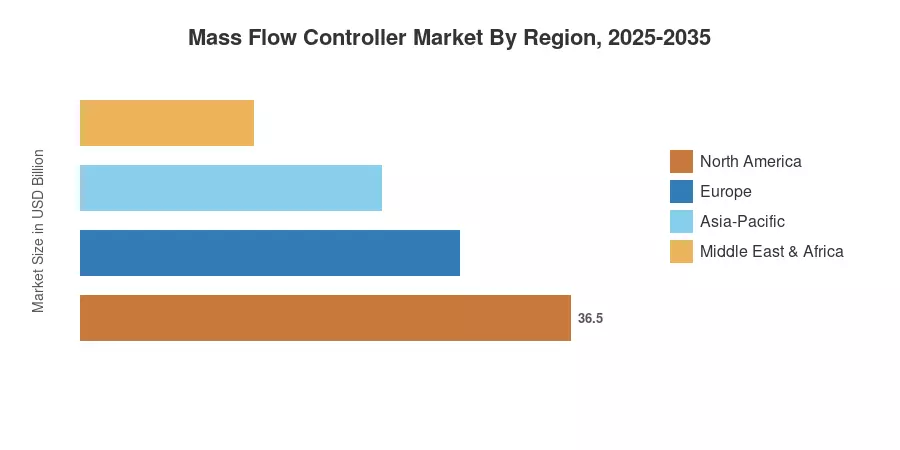
North America continues to lead the Mass Flow Controller market, holding a significant share of 746.54M in 2024. The region's growth is driven by advancements in technology, increasing demand for precision in manufacturing, and stringent regulatory standards. The presence of major industries such as semiconductor manufacturing and pharmaceuticals further fuels demand, supported by government initiatives promoting innovation and efficiency in production processes. The competitive landscape in North America is robust, featuring key players like Brooks Instrument, MKS Instruments, and Emerson Electric. These companies are at the forefront of technological advancements, offering a range of products tailored to various applications. The U.S. remains the largest market, with Canada and Mexico also contributing to regional growth. The focus on automation and smart manufacturing is expected to enhance market dynamics further, solidifying North America's position as a leader in the Mass Flow Controller sector.

Europe : Emerging Regulatory Frameworks

Europe's Mass Flow Controller market is valued at 372.77M, driven by stringent regulatory frameworks and a growing emphasis on environmental sustainability. The region's commitment to reducing emissions and enhancing energy efficiency is propelling demand for advanced flow control technologies. Regulatory bodies are increasingly mandating the use of precise measurement tools in various industries, which is expected to boost market growth significantly. Leading countries in this region include Germany, the UK, and France, where major players like Siemens and Bronkhorst are actively innovating. The competitive landscape is characterized by a mix of established firms and emerging startups, all vying for market share. The European market is also witnessing collaborations between technology providers and end-users to develop customized solutions, enhancing the overall market appeal. "The European Union is committed to fostering innovation in flow measurement technologies to meet environmental goals," European Commission report, European Commission.

Asia-Pacific : Rapid Industrialization and Growth

The Asia-Pacific region, valued at 307.66M, is witnessing rapid growth in the Mass Flow Controller market, driven by industrialization and increasing investments in manufacturing. Countries like China, Japan, and India are leading this growth, with a focus on enhancing production efficiency and quality control. The demand for automation in various sectors, including electronics and automotive, is further propelling the market forward, supported by government initiatives aimed at boosting manufacturing capabilities. The competitive landscape in Asia-Pacific is evolving, with both local and international players vying for market share. Companies like Yokogawa and Aalborg are expanding their presence, while new entrants are emerging to cater to the growing demand. The region's focus on smart manufacturing and Industry 4.0 is expected to create new opportunities for innovation and growth in the Mass Flow Controller market, making it a key area for future investments.

Middle East and Africa : Untapped Market Opportunities

The Middle East and Africa region, with a market size of 66.1M, presents significant growth potential for the Mass Flow Controller market. The region is gradually adopting advanced technologies, driven by increasing industrial activities and a focus on infrastructure development. Countries like the UAE and South Africa are leading the charge, with investments in sectors such as oil and gas, which require precise flow measurement solutions to enhance operational efficiency. The competitive landscape is still developing, with a mix of local and international players entering the market. Companies are focusing on establishing partnerships and collaborations to expand their reach. The region's unique challenges, such as regulatory hurdles and varying levels of technological adoption, present both challenges and opportunities for growth. "The Middle East is poised for a technological transformation that will enhance industrial efficiency," report from the Gulf Cooperation Council.

Key Players and Competitive Insights

The Mass Flow Controller Market is characterized by a dynamic competitive landscape, driven by technological advancements and increasing demand across various sectors, including semiconductor manufacturing, pharmaceuticals, and environmental monitoring. Key players such as Brooks Instrument (US), MKS Instruments (US), and Emerson Electric (US) are strategically positioned to leverage innovation and operational efficiency. Brooks Instrument (US) focuses on enhancing its product portfolio through continuous innovation, while MKS Instruments (US) emphasizes strategic partnerships to expand its market reach. Emerson Electric (US) is actively pursuing digital transformation initiatives, which collectively shape a competitive environment that prioritizes technological superiority and customer-centric solutions.

In terms of business tactics, companies are increasingly localizing manufacturing to reduce lead times and optimize supply chains. The market structure appears moderately fragmented, with several players vying for market share. However, the collective influence of major companies like Siemens (DE) and Yokogawa (JP) suggests a trend towards consolidation, as these firms seek to enhance their competitive edge through mergers and acquisitions.

In November 2025, Brooks Instrument (US) announced the launch of a new line of mass flow controllers designed specifically for the semiconductor industry. This strategic move is significant as it aligns with the growing demand for precision in semiconductor manufacturing, positioning Brooks Instrument to capture a larger share of this lucrative market segment. The introduction of these advanced controllers is likely to enhance operational efficiency and reduce costs for manufacturers, thereby solidifying Brooks' market position.

In October 2025, MKS Instruments (US) entered into a partnership with a leading AI technology firm to integrate artificial intelligence into its mass flow control systems. This collaboration is poised to revolutionize the way flow controllers operate, enabling predictive maintenance and real-time data analytics. Such advancements not only improve product reliability but also enhance customer satisfaction, indicating MKS's commitment to innovation and technological leadership.

In September 2025, Emerson Electric (US) expanded its The Mass Flow Controller. This acquisition is expected to bolster Emerson's capabilities in providing localized solutions and enhance its supply chain efficiency. By integrating the acquired company's technologies and expertise, Emerson aims to offer more tailored solutions to its customers, thereby reinforcing its competitive advantage in the market.

As of December 2025, current competitive trends indicate a strong emphasis on digitalization, sustainability, and AI integration within the Mass Flow Controller Market. Strategic alliances are increasingly shaping the landscape, as companies recognize the value of collaboration in driving innovation. The shift from price-based competition to a focus on technological differentiation and supply chain reliability is evident. Moving forward, companies that prioritize innovation and adaptability are likely to thrive, as the market continues to evolve in response to emerging technologies and customer demands.

Key Companies in the Mass Flow Controller Market market include

Industry Developments

  • Q2 2024: Brooks Instrument Launches New SLA Series Biotech Mass Flow Controller Market for Bioprocessing Applications Brooks Instrument announced the release of its new SLA Series Biotech Mass Flow Controller Market, designed specifically for bioprocessing and pharmaceutical applications, featuring enhanced accuracy and digital communications.
  • Q2 2024: HORIBA Scientific Expands Mass Flow Controller Market Production Facility in New Jersey HORIBA Scientific inaugurated an expanded manufacturing facility in Piscataway, NJ, to increase production capacity for its mass flow controllers, supporting growth in semiconductor and life sciences markets.
  • Q1 2024: Alicat Scientific Announces Partnership with BioPharm Solutions for Custom Mass Flow Controller Market Integration Alicat Scientific entered into a partnership with BioPharm Solutions to co-develop custom mass flow controller systems for advanced bioprocessing equipment.
  • Q2 2024: Bronkhorst High-Tech Introduces FLEXI-FLOW Compact Mass Flow Controller Market for Industrial Automation Bronkhorst High-Tech launched the FLEXI-FLOW Compact, a new mass flow controller designed for industrial automation, featuring multi-gas compatibility and IoT connectivity.
  • Q3 2024: MKS Instruments Appoints New Vice President of Flow Solutions MKS Instruments announced the appointment of Dr. Lisa Chen as Vice President of Flow Solutions, overseeing the company's mass flow controller product line and strategic growth initiatives.
  • Q2 2024: Hitachi High-Tech Acquires German Flow Controller Manufacturer Sensirion AG Hitachi High-Tech completed the acquisition of Sensirion AG, a leading German manufacturer of mass flow controllers, to expand its portfolio in semiconductor and medical device markets.
  • Q1 2024: Sierra Instruments Wins Major Contract to Supply Mass Flow Controllers for Hydrogen Fuel Cell Plant in South Korea Sierra Instruments secured a contract to provide mass flow controllers for a new hydrogen fuel cell manufacturing facility in South Korea, supporting the country's clean energy initiatives.
  • Q2 2025: Vögtlin Instruments Launches Red-y Smart Series 2 Mass Flow Controller Market Vögtlin Instruments introduced the Red-y Smart Series 2, a next-generation mass flow controller with improved accuracy and digital interface options for laboratory and industrial use.
  • Q1 2025: Teledyne Hastings Instruments Announces New Manufacturing Facility in Virginia for Mass Flow Controllers Teledyne Hastings Instruments opened a new manufacturing facility in Hampton, Virginia, to increase production of its mass flow controllers for global distribution.
  • Q2 2025: Brooks Instrument Partners with Siemens for Advanced Process Control Integration Brooks Instrument formed a partnership with Siemens to integrate its mass flow controllers into Siemens' advanced process control systems for chemical and pharmaceutical industries.
  • Q1 2025: HORIBA Receives Regulatory Approval for Mass Flow Controller Market Use in Japanese Pharmaceutical Manufacturing HORIBA announced regulatory approval from Japan's Ministry of Health, Labour and Welfare for its mass flow controllers to be used in pharmaceutical manufacturing processes.
  • Q3 2024: Alicat Scientific Secures Series B Funding to Expand Mass Flow Controller Market Product Line Alicat Scientific raised Series B funding to accelerate development and commercialization of new mass flow controller technologies for environmental and industrial applications.

Future Outlook

Mass Flow Controller Market Future Outlook

The Mass Flow Controller Market is projected to grow at a 5.54% CAGR from 2024 to 2035, driven by advancements in automation, increased demand in semiconductor manufacturing, and the rise of renewable energy applications.

New opportunities lie in:

  • Development of integrated smart flow control systems for industrial applications.
  • Expansion into emerging markets with tailored mass flow solutions.
  • Partnerships with renewable energy firms for optimized gas flow management.

By 2035, the Mass Flow Controller Market is expected to achieve robust growth and innovation.

Market Segmentation

Mass Flow Controller Market Type Outlook

  • Thermal Mass Flow Controller
  • Coriolis Mass Flow Controller
  • Differential Pressure Mass Flow Controller

Mass Flow Controller Market Flow Rate Outlook

  • Low Flow Rate
  • Medium Flow Rate
  • High Flow Rate

Mass Flow Controller Market Technology Outlook

  • Analog Technology
  • Digital Technology
  • Smart Technology

Mass Flow Controller Market Application Outlook

  • Chemical Processing
  • Semiconductor Manufacturing
  • Food and Beverage
  • Pharmaceuticals

Mass Flow Controller Market End Use Industry Outlook

  • Aerospace
  • Automotive
  • Energy
  • Healthcare

Report Scope

MARKET SIZE 20241493.07(USD Million)
MARKET SIZE 20251575.82(USD Million)
MARKET SIZE 20352702.46(USD Million)
COMPOUND ANNUAL GROWTH RATE (CAGR)5.54% (2024 - 2035)
REPORT COVERAGERevenue Forecast, Competitive Landscape, Growth Factors, and Trends
BASE YEAR2024
Market Forecast Period2025 - 2035
Historical Data2019 - 2024
Market Forecast UnitsUSD Million
Key Companies ProfiledBrooks Instrument (US), MKS Instruments (US), Emerson Electric (US), Siemens (DE), Bronkhorst (NL), Kobold (DE), Yokogawa (JP), Aalborg (US), Vögtlin Instruments (CH)
Segments CoveredApplication, End Use Industry, Type, Technology, Flow Rate
Key Market OpportunitiesIntegration of advanced automation technologies enhances efficiency in the Mass Flow Controller Market.
Key Market DynamicsTechnological advancements and regulatory changes drive demand for precision in the Mass Flow Controller Market.
Countries CoveredNorth America, Europe, APAC, South America, MEA

Market Highlights

Author
Ankit Gupta
Senior Research Analyst

Ankit Gupta is an analyst in market research industry in ICT and SEMI industry. With post-graduation in "Telecom and Marketing Management" and graduation in "Electronics and Telecommunication" vertical he is well versed with recent development in ICT industry as a whole. Having worked on more than 150+ reports including consultation for fortune 500 companies such as Microsoft and Rio Tinto in identifying solutions with respect to business problems his opinions are inclined towards mixture of technical and managerial aspects.

Leave a Comment

FAQs

How much is the Mass Flow Controller market?

The Mass Flow Controller market size was valued at USD 1.49 billion in 2024.

What is the growth rate of the Mass Flow Controller market?

The market is projected to grow at a CAGR of 5.54% during the forecast period, 2025 to 2035.

Which region held the largest market share in the Mass Flow Controller market?

North America had the largest share of the Mass Flow Controller market.

Who are the key players in the Mass Flow Controller market?

The key players in the market are Hitachi Metals, Ltd, Sensirion, Horiba Ltd, Azbil Corporation, MKS Instruments, JK Products & Services, New Hills Pumping Inc, Cimex Controls Inc, Advitech Inc, FLSmidth Solutions.

Which Connectivity led the Mass Flow Controller market?

The Analog category dominated the market in 2022.

Which End User had the largest market share in the market?

The Food and Beverages segment had the largest share in the market for Mass Flow Controllers.

Download Free Sample

Kindly complete the form below to receive a free sample of this Report

Compare Licence

×
Features License Type
Single User Multiuser License Enterprise User
Price $4,950 $5,950 $7,250
Maximum User Access Limit 1 User Upto 10 Users Unrestricted Access Throughout the Organization
Free Customization
Direct Access to Analyst
Deliverable Format
Platform Access
Discount on Next Purchase 10% 15% 15%
Printable Versions