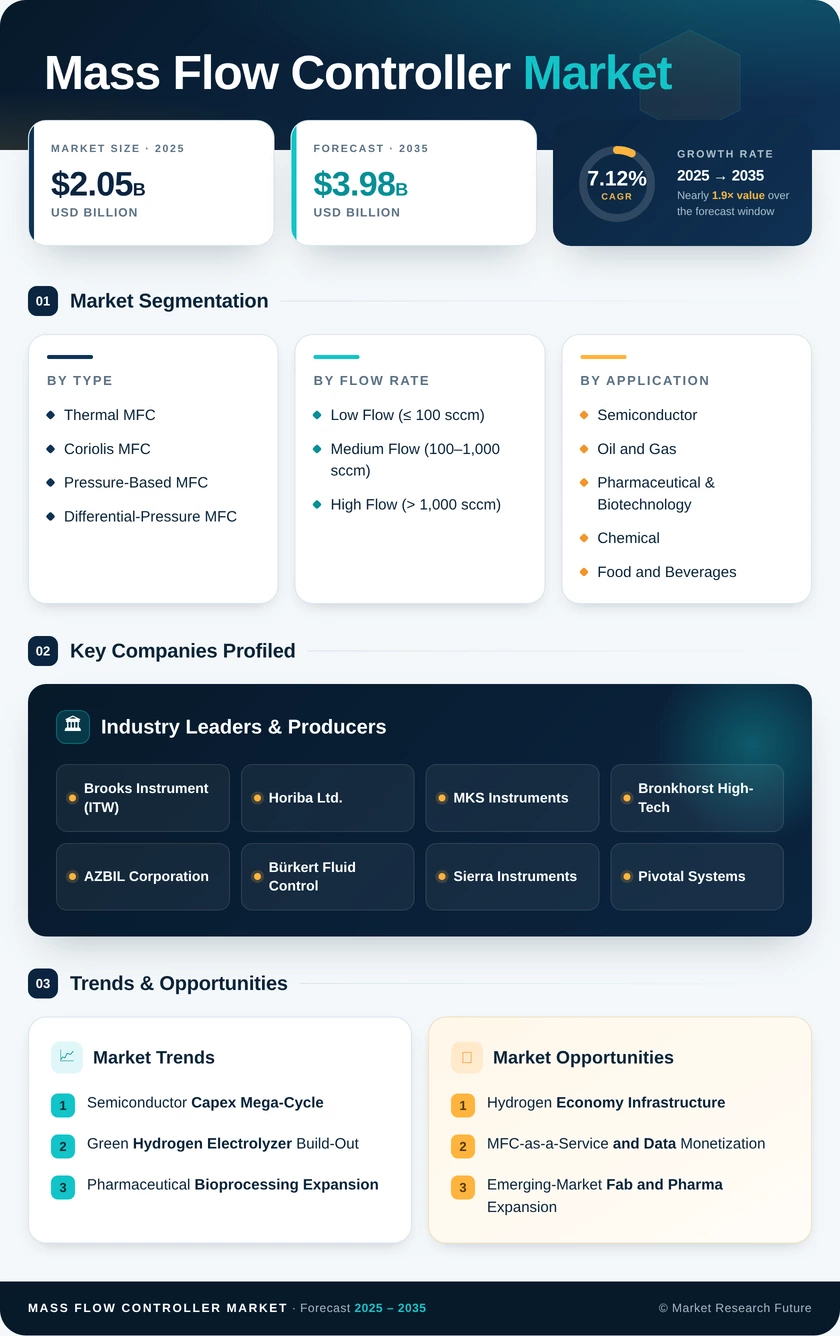
Mass Flow Controller Market

ID: MRFR/SEM/3540-HCR
100 Pages
Ankit Gupta
Last Updated: June 17, 2026
Mass Flow Controller Market Size, Share and Research Report By Material Type (Stainless Steel, Exotic Alloys, Others (Polymer, Ceramic)), By Flow Rate (Low Flow (≤ 100 sccm), Medium Flow (100–1,000 sccm), High Flow (> 1,000 sccm)), By Product Type (Thermal MFC, Coriolis MFC, Pressure-Based MFC, Differential-Pressure MFC), By End-User Industry (Semiconductor, Oil and Gas, Pharmaceutical & Biotechnology, Chemical, Food and Beverages, Renewable Energy & Fuel Cells, Others (Aerospace, R&D, HVAC)) and By Regional (North America, Europe, South America, Asia Pacific, Middle East and Africa) - Industry Forecast to 2035.
Download PDF ×

We do not share your information with anyone. However, we may send you emails based on your report interest from time to time. You may contact us at any time to opt-out.

  1. 1 Market Overview |
    1. 1.1 Study Assumptions & Market Definition |
    2. 1.2 Scope of the Study |
    3. 1.3 Research Methodology
  2. 2 Market Summary & Key Takeaways
  3. 3 Market Dynamics |
    1. 3.1 Market Drivers Analysis | |
      1. 3.1.1 Semiconductor Capex Mega-Cycle | |
      2. 3.1.2 Green Hydrogen Electrolyzer Build-Out | |
      3. 3.1.3 Pharmaceutical Bioprocessing Expansion | |
      4. 3.1.4 Emissions and Leak-Detection Regulations | |
      5. 3.1.5 Additive Manufacturing Gas Delivery Needs | |
      6. 3.1.6 Digital Twin & Predictive Maintenance Adoption | |
      7. 3.1.7 Food & Beverage Modified-Atmosphere Packaging |
    2. 3.2 Market Restraints Analysis | |
      1. 3.2.1 Chinese Entrant Pricing Pressure | |
      2. 3.2.2 Long Semiconductor Downcycle Risk | |
      3. 3.2.3 Supply-Chain Bottlenecks for Exotic Alloy Components | |
      4. 3.2.4 Integration Complexity with Legacy DCS/SCADA | |
      5. 3.2.5 Calibration Drift and Maintenance Cost Perception |
    3. 3.3 Market Opportunity Analysis | |
      1. 3.3.1 Hydrogen Economy Infrastructure | |
      2. 3.3.2 MFC-as-a-Service and Data Monetization | |
      3. 3.3.3 Emerging-Market Fab and Pharma Expansion | |
      4. 3.3.4 Additive Manufacturing Gas Delivery | |
      5. 3.3.5 Food and Beverage Modified-Atmosphere Packaging |
    4. 3.4 Industry Value Chain Analysis |
    5. 3.5 Porter's Five Forces Analysis
  4. 4 Global Mass Flow Controller Market Size & Forecast (2021–2035) |
    1. 4.1 Historical Market Size (2021–2025) |
    2. 4.2 Current & Forecast Market Size (2026–2035) |
    3. 4.3 Market Size by Revenue (USD Billion) |
    4. 4.4 Year-over-Year Growth Analysis
  5. 5 Segmentation Analysis |
    1. 5.1 By Material Type | |
      1. 5.1.1 Stainless Steel | |
      2. 5.1.2 Exotic Alloys | |
      3. 5.1.3 Others (Polymer, Ceramic) |
    2. 5.2 By Flow Rate | |
      1. 5.2.1 Low Flow (≤ 100 sccm) | |
      2. 5.2.2 Medium Flow (100–1,000 sccm) | |
      3. 5.2.3 High Flow (> 1,000 sccm) |
    3. 5.3 By Product Type | |
      1. 5.3.1 Thermal MFC | |
      2. 5.3.2 Coriolis MFC | |
      3. 5.3.3 Pressure-Based MFC | |
      4. 5.3.4 Differential-Pressure MFC |
    4. 5.4 By End-User Industry | |
      1. 5.4.1 Semiconductor | |
      2. 5.4.2 Oil and Gas | |
      3. 5.4.3 Pharmaceutical & Biotechnology | |
      4. 5.4.4 Chemical | |
      5. 5.4.5 Food and Beverages | |
      6. 5.4.6 Renewable Energy & Fuel Cells | |
      7. 5.4.7 Others (Aerospace, R&D, HVAC)
  6. 6 Regional Analysis |
    1. 6.1 North America | |
      1. 6.1.1 United States | |
      2. 6.1.2 Canada | |
      3. 6.1.3 Mexico |
    2. 6.2 Europe | |
      1. 6.2.1 Germany | |
      2. 6.2.2 United Kingdom | |
      3. 6.2.3 France | |
      4. 6.2.4 Italy | |
      5. 6.2.5 Spain | |
      6. 6.2.6 Nordic Countries | |
      7. 6.2.7 Russia | |
      8. 6.2.8 Rest of Europe |
    3. 6.3 Asia-Pacific | |
      1. 6.3.1 China | |
      2. 6.3.2 Japan | |
      3. 6.3.3 South Korea | |
      4. 6.3.4 India | |
      5. 6.3.5 ASEAN | |
      6. 6.3.6 Rest of Asia-Pacific |
    4. 6.4 South America | |
      1. 6.4.1 Brazil | |
      2. 6.4.2 Argentina | |
      3. 6.4.3 Rest of South America |
    5. 6.5 Middle East & Africa | |
      1. 6.5.1 Saudi Arabia | |
      2. 6.5.2 UAE | |
      3. 6.5.3 South Africa | |
      4. 6.5.4 Egypt | |
      5. 6.5.5 Rest of MEA
  7. 7 Competitive Landscape |
    1. 7.1 Market Share Analysis (2025) |
    2. 7.2 Competitive Benchmarking Matrix |
    3. 7.3 Company Profiles | |
      1. 7.3.1 Brooks Instrument (ITW) | |
      2. 7.3.2 Horiba Ltd. | |
      3. 7.3.3 MKS Instruments | |
      4. 7.3.4 Bronkhorst High-Tech | |
      5. 7.3.5 AZBIL Corporation | |
      6. 7.3.6 Bürkert Fluid Control | |
      7. 7.3.7 Sierra Instruments | |
      8. 7.3.8 Pivotal Systems | |
      9. 7.3.9 Teledyne Hastings | |
      10. 7.3.10 Sevenstar Electronics
  8. 8 Future Outlook & Strategic Recommendations (2026–2035) |
    1. 8.1 AI-Driven Autonomous Flow Control |
    2. 8.2 Platform Economics and MFC-as-a-Service |
    3. 8.3 Electrification and the Hydrogen Supercycle |
    4. 8.4 ESG Reporting and Traceability Mandates
  9. 9 Recent Developments & News
  10. 10 Frequently Asked Questions (FAQs)
  11. 11 Report Scope & Methodology |
    1. 11.1 Study Period & Base Year |
    2. 11.2 Data Sources & Citations |
    3. 11.3 Abbreviations
  12. 12 LIST OF TABLES |
  13. TABLE 1 Global Mass Flow Controller Market Size & Forecast, by Revenue (USD Billion), 2021–2035 |
  14. TABLE 2 Global Mass Flow Controller Market — Year-over-Year Growth Analysis, 2021–2035 |
  15. TABLE 3 Driver Impact Analysis — Mass Flow Controller Market, 2026–2035 |
  16. TABLE 4 Restraint Impact Analysis — Mass Flow Controller Market, 2026–2035 |
  17. TABLE 5 Global Mass Flow Controller Market Size, by Material Type, 2021–2035 (USD Billion) |
  18. TABLE 6 Global Mass Flow Controller Market Size, by Flow Rate, 2021–2035 (USD Billion) |
  19. TABLE 7 Global Mass Flow Controller Market Size, by Product Type, 2021–2035 (USD Billion) |
  20. TABLE 8 Global Mass Flow Controller Market Size, by End-User Industry, 2021–2035 (USD Billion) |
  21. TABLE 9 Global Mass Flow Controller Market Size, by Region, 2021–2035 (USD Billion) |
  22. TABLE 10 North America Mass Flow Controller Market Size, by Country, 2021–2035 (USD Billion) |
  23. TABLE 11 Europe Mass Flow Controller Market Size, by Country, 2021–2035 (USD Billion) |
  24. TABLE 12 Asia-Pacific Mass Flow Controller Market Size, by Country, 2021–2035 (USD Billion) |
  25. TABLE 13 South America Mass Flow Controller Market Size, by Country, 2021–2035 (USD Billion) |
  26. TABLE 14 Middle East & Africa Mass Flow Controller Market Size, by Country, 2021–2035 (USD Billion) |
  27. TABLE 15 Competitive Benchmarking Matrix — Global Mass Flow Controller Market, 2025 |
  28. TABLE 16 Company Profiles — Key Players, Global Mass Flow Controller Market |
  29. TABLE 17 Recent Developments & Strategic Announcements, 2023–2025 |
  30. TABLE 18 North America Mass Flow Controller Market Size, by Material Type, 2021–2035 (USD Billion) |
  31. TABLE 19 North America Mass Flow Controller Market Size, by Flow Rate, 2021–2035 (USD Billion) |
  32. TABLE 20 North America Mass Flow Controller Market Size, by Product Type, 2021–2035 (USD Billion) |
  33. TABLE 21 North America Mass Flow Controller Market Size, by End-User Industry, 2021–2035 (USD Billion) |
  34. TABLE 22 Europe Mass Flow Controller Market Size, by Material Type, 2021–2035 (USD Billion) |
  35. TABLE 23 Europe Mass Flow Controller Market Size, by Flow Rate, 2021–2035 (USD Billion) |
  36. TABLE 24 Europe Mass Flow Controller Market Size, by Product Type, 2021–2035 (USD Billion) |
  37. TABLE 25 Europe Mass Flow Controller Market Size, by End-User Industry, 2021–2035 (USD Billion) |
  38. TABLE 26 Asia-Pacific Mass Flow Controller Market Size, by Material Type, 2021–2035 (USD Billion) |
  39. TABLE 27 Asia-Pacific Mass Flow Controller Market Size, by Flow Rate, 2021–2035 (USD Billion) |
  40. TABLE 28 Asia-Pacific Mass Flow Controller Market Size, by Product Type, 2021–2035 (USD Billion) |
  41. TABLE 29 Asia-Pacific Mass Flow Controller Market Size, by End-User Industry, 2021–2035 (USD Billion) |
  42. TABLE 30 South America Mass Flow Controller Market Size, by Material Type, 2021–2035 (USD Billion) |
  43. TABLE 31 South America Mass Flow Controller Market Size, by Flow Rate, 2021–2035 (USD Billion) |
  44. TABLE 32 South America Mass Flow Controller Market Size, by Product Type, 2021–2035 (USD Billion) |
  45. TABLE 33 South America Mass Flow Controller Market Size, by End-User Industry, 2021–2035 (USD Billion) |
  46. TABLE 34 Middle East & Africa Mass Flow Controller Market Size, by Material Type, 2021–2035 (USD Billion) |
  47. TABLE 35 Middle East & Africa Mass Flow Controller Market Size, by Flow Rate, 2021–2035 (USD Billion) |
  48. TABLE 36 Middle East & Africa Mass Flow Controller Market Size, by Product Type, 2021–2035 (USD Billion) |
  49. TABLE 37 Middle East & Africa Mass Flow Controller Market Size, by End-User Industry, 2021–2035 (USD Billion) |
  50. TABLE 38 Report Scope & Methodology Summary |
  51. TABLE 39 Detailed Sources and Citations
  52. 13 LIST OF FIGURES |
  53. FIGURE 1 Global Mass Flow Controller Market Dynamics — Drivers, Restraints, and Opportunities |
  54. FIGURE 2 Mass Flow Controller Industry Value Chain Analysis |
  55. FIGURE 3 Porter's Five Forces Analysis — Mass Flow Controller Market |
  56. FIGURE 4 Global Mass Flow Controller Market Size Trend & Forecast (USD Billion), 2021–2035 |
  57. FIGURE 5 Mass Flow Controller Market Share, by Material Type (%), 2025 |
  58. FIGURE 6 Mass Flow Controller Market Share, by Flow Rate (%), 2025 |
  59. FIGURE 7 Mass Flow Controller Market Share, by Product Type (%), 2025 |
  60. FIGURE 8 Mass Flow Controller Market Share, by End-User Industry (%), 2025 |
  61. FIGURE 9 Mass Flow Controller Market Share, by Region (%), 2025 |
  62. FIGURE 10 North America Mass Flow Controller Market — Country Share (%), 2025 |
  63. FIGURE 11 Europe Mass Flow Controller Market — Country Share (%), 2025 |
  64. FIGURE 12 Asia-Pacific Mass Flow Controller Market — Country Share (%), 2025 |
  65. FIGURE 13 South America Mass Flow Controller Market — Country Share (%), 2025 |
  66. FIGURE 14 Middle East & Africa Mass Flow Controller Market — Country Share (%), 2025 |
  67. FIGURE 15 Competitive Landscape — Mass Flow Controller Market Revenue Share Analysis, 2025

Segmentation Quick Reference

DimensionSub-SegmentsDominant SegmentFastest Growing Segment
Material TypeStainless Steel, Exotic Alloys, OthersStainless SteelExotic Alloys
Flow RateLow, Medium, HighLow FlowHigh Flow
Product TypeThermal MFC, Coriolis MFC, Pressure-Based MFC, Differential-Pressure MFCThermal MFCCoriolis MFC
End-User IndustrySemiconductor, Oil and Gas, Pharmaceutical & Biotechnology, Chemical, Food and Beverages, Renewable Energy & Fuel Cells, OthersSemiconductorRenewable Energy & Fuel Cells
GeographyNorth America, Europe, Asia-Pacific, South America, Middle East & AfricaAsia-PacificAsia-Pacific


Market Segmentation Overview

By Material Type

Sub-SegmentKey Trend
Stainless SteelContinued dominance in standard semiconductor and chemical applications; price competition from Asian manufacturers
Exotic AlloysRapid adoption of hydrogen electrolysis and corrosive-gas semiconductor etch processes
Others (Polymer, Ceramic)Niche applications in food & beverage MAP and cost-sensitive HVAC systems


Stainless steel remains the default material choice for the majority of mass flow controller installations, though exotic alloys are gaining ground rapidly as hydrogen economy and aggressive-chemistry applications demand superior corrosion resistance.

By Flow Rate

Sub-SegmentKey Trend
Low Flow (≤ 100 sccm)Critical for ALD and CVD precursor delivery at advanced semiconductor nodes
Medium Flow (100–1,000 sccm)Growing in pharmaceutical bioprocessing and specialty chemical dosing
High Flow (> 1,000 sccm)Expanding with electrolyzer hydrogen delivery and bulk industrial gas systems


Low-flow controllers dominate by revenue share due to premium pricing in semiconductor applications, while high-flow units represent the fastest-growing segment as industrial-scale hydrogen and gas delivery systems modernize.

By Product Type

Sub-SegmentKey Trend
Thermal MFCMature technology with excellent accuracy-to-cost ratio; largest installed base
Coriolis MFCFastest growing; direct mass measurement eliminates gas-specific calibration
Pressure-Based MFCGaining share in high-purity EUV lithography gas delivery
Differential-Pressure MFCEstablished in oil & gas and bulk chemical flow measurement


Thermal technology continues to anchor the product landscape, but Coriolis architectures are increasingly specified for new hydrogen and biologics facilities where multi-gas flexibility is paramount.

By End-User Industry

Sub-SegmentKey Trend
SemiconductorLargest revenue contributor; driven by sub-2 nm node transitions
Oil and GasEmissions monitoring mandates driving digital MFC adoption
Pharmaceutical & BiotechnologyBiologics CDMO expansion; GMP traceability requirements
ChemicalProcess intensification and specialty chemical precision dosing
Food and BeveragesModified-atmosphere packaging line automation
Renewable Energy & Fuel CellsFastest growing: electrolyzer and fuel-cell stack deployment
OthersAerospace, R&D laboratories, HVAC systems


Semiconductor remains the market's center of gravity, but renewable energy and fuel cell applications are reshaping the growth trajectory as global electrolyzer deployment accelerates toward net-zero targets.