Mechanical Keyboard Market (2025 - 2035)

Mechanical Keyboard Market Size, Share and Research Report By Switch Type (Non-Tactile Linear Switches, Tactile Switches, Clicky Switches, Optical & Hall-Effect Switches), By Connectivity (Wired, Wireless (2.4 GHz), Wireless (Bluetooth)), By Form Factor (Full-Size (100%), Tenkeyless (80%), 65% Compact, 60% and Below), By Keycap Material (ABS, PBT (Double-Shot), POM and Other), By Application and End User (Gaming and Esports, Office and Industrial, Enthusiast / DIY, Content Creation) and By Regional (North America, Europe, South America, Asia Pacific, Middle East and Africa) - Industry Forecast to 2035.
ID: MRFR/SEM/0708-CR
101 Pages
Aarti Dhapte, Shubham Munde
Last Updated: July 09, 2026
Mechanical Keyboard Market
Market Size
Forecast Period2025-2035
CAGR (2025-2035)5.65%
2025 Market SizeUSD 2.71 Billion
2035 Market SizeUSD 4.67 Billion
Key Players
Logitech
Corsair Gaming
Razer Inc.
Cherry GmbH
HyperX
SteelSeries
Opportunities
  • Low-Profile Switches for Ultrabook and Tablet Pairings
  • Subscription-Based Firmware and Customization Platforms
  • Emerging-Market Penetration Through Local Assembly

Mechanical Keyboard Market Summary

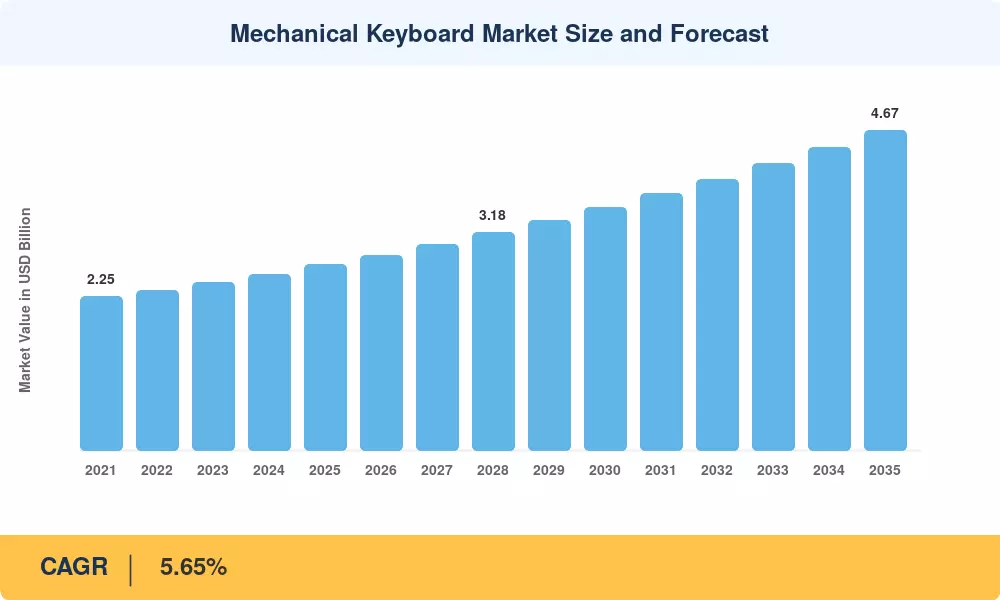
The Mechanical Keyboard Market reached USD 2.71 Billion in 2025 and is projected to grow from USD 2.85 Billion in 2026 to USD 4.67 Billion by 2035, registering a 5.65% CAGR during 2026–2035. Two catalysts anchor this expansion: the permanent shift to hybrid-work models — which increased home-office peripheral spending by roughly 22% between 2021 and 2024 [1] — and the professionalization of esports, where tournament organizers now mandate certified input devices across most tier-one leagues [2]. These converging tailwinds have repositioned the Mechanical Keyboard Market from a niche gaming accessory into a mainstream productivity tool.

The technological trend in the Mechanical Keyboard Market is based on the transition from traditional rubber-dome and membrane designs to optical and hall-effect switch designs. Mechanical switches in the Cherry MX style are still dominant, although optical alternatives now provide actuation latencies below 0.2 ms and are attractive to competitive gamers prepared to pay a 30–40 % premium [3]. Hall-effect designs add the capacity to take an analog input, so pressure-sensitive keystrokes can operate like a joystick axis – something that’s gaining favor in simulation and creative-software processes [4].

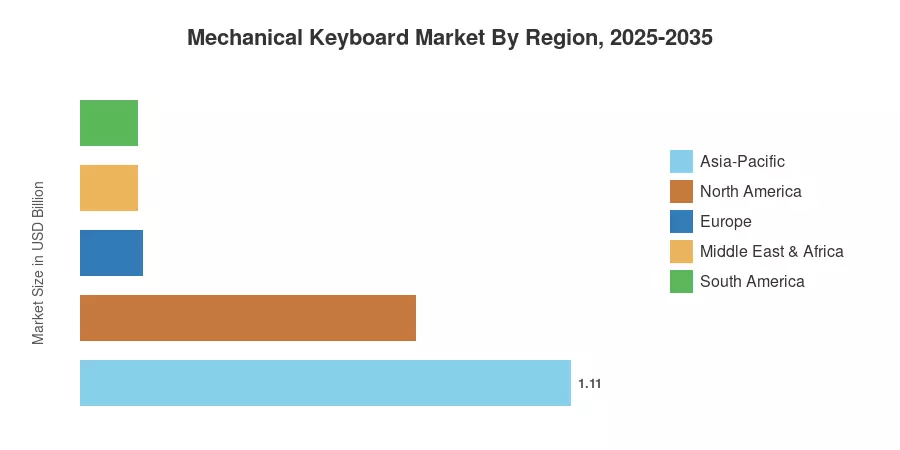
Asia-Pacific is the largest region in the Mechanical Keyboard Market, contributing around 41% of the revenue. The region is boosted by China’s vertically integrated manufacturing clusters and South Korea’s competitive gaming culture. North America is the second largest market at about 28%, due to high-refresh-rate gaming adoption and corporate ergonomic spending. Growth in Europe is around 5.1% CAGR, with workplace health directives driving companies to premium peripherals. We see a positive outlook through 2035 as switch miniaturization and wireless developments expand the addressable population beyond conventional enthusiasts.

Key Report Takeaways — Mechanical Keyboard Market

By Switch Type

  • Non-tactile linear switches held approximately 47% of the Mechanical Keyboard Market in 2025, reflecting strong demand from competitive gaming communities.
  • Optical and hall-effect switches are forecast to expand at an 8.2% CAGR through 2035, the fastest among all switch categories.

By Connectivity & Form Factor

  • Wired keyboards retained roughly 74% of the Mechanical Keyboard Market in 2025, though 2.4 GHz wireless solutions are advancing at a 6.8% CAGR.
  • Full-size layouts led form-factor revenue with about 45% share in 2025; compact 65% layouts are growing at an 8.9% CAGR.

By Application & Geography

  • Gaming and esports commanded approximately 64% of the Mechanical Keyboard Market in 2025, while enthusiast and DIY use cases posted the highest growth at 9.2% CAGR.
  • Asia-Pacific captured about 41% of global revenue in 2025 and recorded the fastest regional CAGR at 6.4%.

Mechanical Keyboard Market Size and Forecast (2021–2035)

Market Research Future (MRFR)’s in-house estimation approach combines primary interview data from 120+ OEM procurement managers, distributor channel audits across 14 countries, and secondary validation using import/export customs databases. Historical figures (2021–2024) represent certified industry revenues; the base year 2025 amount underpins the anticipated trajectory. All projections apply a constant-currency adjustment pegged to 2025 USD.
Mechanical Keyboard Market Size and Forecast
Our Impact
Enabled $4.3B Revenue Impact for Fortune 500 and Leading Multinationals
Partnering with 2000+ Global Organizations Each Year
30K+ Citations by Top-Tier Firms in the Industry

Driver Impact Analysis

Driver ~% Impact on CAGR Geographic Relevance Impact Timeline
Hybrid and remote work adoption +1.3% Global Short-term (≤2 yr)
Esports professionalization and tournament growth +1.1% NA, APAC Medium-term (2–4 yr)
Optical and hall-effect switch innovation +0.9% Global Long-term (≥4 yr)
Ergonomic workplace mandates +0.6% Europe, NA Medium-term (2–4 yr)
Content-creator peripheral demand +0.5% NA, APAC Short-term (≤2 yr)
Enterprise IT refresh cycles +0.4% Global Medium-term (2–4 yr)
Compact form-factor adoption in mobile workstations +0.3% APAC, Europe Long-term (≥4 yr)

Hybrid and Remote Work Adoption

Global Workplace Analytics estimates that 58% of knowledge workers operated under hybrid schedules by Q4 2024, up from 36% in 2021 [7]. This shift prompted corporate IT departments to allocate USD 1.2 billion annually to home-office peripheral stipends, with mechanical keyboards capturing a growing proportion of that spend. The Mechanical Keyboard Market benefits directly because hybrid workers invest in durable, ergonomic peripherals they use eight hours daily — a purchase pattern quite different from the impulse-driven gaming cycle.

Esports Professionalization and Tournament Growth

The global esports economy surpassed USD 2.1 billion in 2024, and major leagues, including the Valorant Champions Tour and League of Legends Championship Series, now require certified peripherals for competition [8]. Equipment sponsorship contracts between keyboard OEMs and professional teams rose 34% year-over-year in 2024, pulling brand visibility into mainstream media. This dynamic creates a trickle-down effect: casual gamers replicate the setups they watch professional players use during live-streamed events.

Optical and Hall-Effect Switch Innovation

Hall-effect switches eliminate physical contact between components, theoretically offering unlimited lifespan and user-adjustable actuation points through firmware [9]. Wooting — an early innovator in the category — demonstrated 0.1 mm actuation resolution at CES 2024, attracting interest from simulation enthusiasts and creative professionals. Optical switches, meanwhile, deliver bounce-free debounce performance that eliminates the 5 ms latency penalty inherent in traditional mechanical contacts, making them the preferred choice in competitive first-person-shooter titles.

Ergonomic Workplace Mandates

The European Union's revised Display Screen Equipment Directive, updated in 2023, tightened employer obligations around input-device ergonomics for employees working more than four hours per day at a screen [10]. Germany's DGUV Information 215-410 guideline specifically recommends keyboards with defined tactile feedback and adjustable tilt, creating a compliance-driven purchasing channel for the Mechanical Keyboard Market.

Restraints Impact Analysis

Restraint ~% Impact on CAGR Geographic Relevance Impact Timeline
Premium pricing versus membrane alternatives −0.8% Global Short-term (≤2 yr)
Acoustic noise concerns in shared workspaces −0.5% Europe, NA Medium-term (2–4 yr)
Weight and bulk limit portable use −0.4% Global Long-term (≥4 yr)
Supply-chain concentration in southern China −0.3% Global Medium-term (2–4 yr)
Fragmented switch-compatibility standards −0.2% Global Long-term (≥4 yr)

Premium Pricing Versus Membrane Alternatives

An entry-level mechanical keyboard retails between USD 50 and USD 80, while a comparable membrane board costs USD 12–25 [14]. This three-to-four-times price gap remains the single largest barrier to mass adoption, particularly in price-sensitive markets such as India, Brazil, and Southeast Asia. Corporate procurement teams often default to bundled membrane peripherals when outfitting hundreds of workstations, keeping mechanical penetration below 15% in enterprise IT orders globally.

Acoustic Noise in Shared Workspaces

Open-plan offices and co-working spaces penalize the audible click of tactile and clicky switches. A 2024 workplace productivity survey by Steelcase found that keyboard noise ranked as the third-most-cited distraction in shared environments [15]. While silent linear switches and gasket-mount dampening designs address this concern, they add USD 15–30 per unit to manufacturing costs, partially offsetting the value proposition that makes mechanical keyboards attractive for office procurement.

Supply-Chain Concentration

Approximately 72% of global mechanical keyboard production capacity is concentrated in Guangdong province, China [16]. Geopolitical tensions, tariff adjustments, and periodic COVID-era factory closures exposed vulnerability in this concentrated supply chain. Diversification into Vietnam and Thailand manufacturing is underway but remains nascent, with fewer than 8% of units sourced from alternative locations as of 2024.

Mechanical Keyboard Market Opportunities

Low-Profile Switches for Ultrabook and Tablet Pairings

As laptops slim below 15 mm in thickness, external low-profile mechanical keyboards are emerging as the preferred companion peripheral for professionals who dock ultrabooks at standing desks. Kailh and Gateron both launched sub-12 mm travel switches in 2024, opening a form factor previously monopolized by scissor mechanisms.

Subscription-Based Firmware and Customization Platforms

Several OEMs are piloting software-as-a-service models that offer cloud-synced key mappings, AI-generated lighting profiles, and predictive macro suggestions. Razer's Synapse platform already tracks over 100 million registered devices, illustrating the scale at which peripheral data can be monetized through premium feature tiers and partner integrations.

Emerging-Market Penetration Through Local Assembly

India's Production-Linked Incentive scheme for IT hardware, extended through 2028 with a USD 2.4 billion allocation, creates a tariff-advantaged pathway for brands willing to establish local assembly lines. Domestic assembly could reduce retail prices by 18–22%, bringing mechanical keyboards within reach of India's 45-million-strong PC gaming base.

Enterprise Ergonomic Procurement Programs

Fortune 500 companies increasingly treat ergonomic peripherals as a health-and-safety budget item rather than discretionary IT spend. Procurement contracts that bundle keyboards with ergonomic assessments represent a high-value, recurring revenue channel for the Mechanical Keyboard Market.

Custom Enthusiast and DIY Kits

The enthusiast segment posts the fastest CAGR across all application categories. Group-buy platforms and direct-to-consumer kit sellers generated an estimated USD 320 million in revenue in 2024, and this channel rewards brands that offer modular, hot-swappable designs with premium margins exceeding 45%.

Mechanical Keyboard Market Future Outlook

AI-Driven Personalization and Adaptive Input

By 2028, on-device machine-learning processors will enable keyboards to learn individual typing patterns and auto-adjust actuation force per key. Early prototypes from Wooting and Razer already ship with per-key sensitivity calibration, and the next generation will integrate predictive text layers that reduce error rates by an estimated 15–20% for professional typists [17].

Platform Economics and Software Monetization

The peripheral industry is pivoting from one-time hardware sales toward recurring software revenue. Cloud-synced profiles, marketplace ecosystems for user-created macros, and integration APIs with productivity suites like Microsoft 365 will transform keyboards into platform endpoints. Market Research Future (MRFR) estimates that software-attached revenue could represent 8–12% of the total Mechanical Keyboard Market value by 2032.

Sustainability and Circular-Design Mandates

The EU's Ecodesign for Sustainable Products Regulation, effective from 2026, will require electronics manufacturers to publish repairability scores and use minimum recycled-plastic content [18]. Mechanical keyboards — with their modular switch plates, replaceable keycaps, and hot-swap sockets — are structurally well-positioned to meet these mandates, potentially gaining regulatory advantage over sealed membrane alternatives.

Convergence with Extended-Reality Workspaces

As mixed-reality headsets mature, physical keyboards will serve as the primary tactile anchor in virtual desktop environments. Apple Vision Pro and Meta Quest already support Bluetooth keyboard passthrough, and upcoming XR operating systems will allocate dedicated haptic-feedback channels to physical input devices, sustaining relevance for the Mechanical Keyboard Market well beyond 2035 [19].

Mechanical Keyboard Market Segmentation

By Switch Type

Segment Key Metric Primary Demand Driver
Non-Tactile Linear Switches ~47% share (2025) Competitive gaming, smooth keystroke
Tactile Switches 4.9% CAGR Office typists, tactile feedback preference
Clicky Switches USD 0.31 Billion (2025) Enthusiast community, audible confirmation
Optical & Hall-Effect Switches 8.2% CAGR Latency-sensitive esports, analog input


Non-tactile linear switches anchor the Mechanical Keyboard Market because competitive gamers overwhelmingly favor their smooth, resistance-free travel for rapid key presses. Cherry MX Red and Gateron Yellow remain the volume leaders, though budget-oriented Outemu and Akko alternatives are eroding incumbent share in the sub-USD 60 price tier. Optical and hall-effect variants represent the fastest-evolving category, attracting performance-obsessed buyers willing to pay premium prices for sub-millisecond actuation advantages.

By Connectivity

Segment Key Metric Primary Demand Driver
Wired ~74% share (2025) Zero-latency tournament requirements
Wireless (2.4 GHz) 6.8% CAGR Desk flexibility, clean aesthetics
Wireless (Bluetooth) USD 0.22 Billion (2025) Multi-device pairing, portability


Wired connectivity still dominates the Mechanical Keyboard Market due to its guaranteed zero-latency performance, which remains non-negotiable at the tournament level. Wireless adoption accelerates in the productivity and casual-gaming segments, where 2.4 GHz dongles now deliver polling rates of 1,000 Hz — effectively matching wired performance for all but the most latency-sensitive applications.

By Form Factor

Segment Key Metric Primary Demand Driver
Full-Size (100%) ~45% share (2025) Data-entry professionals, numpad reliance
Tenkeyless (80%) USD 0.38 Billion (2025) General gaming, desk-space savings
65% Compact 8.9% CAGR Portable setups, aesthetic minimalism
60% and Below 5.2% CAGR Enthusiast builds, travel use


By Keycap Material

Segment Key Metric Primary Demand Driver
ABS ~62% share (2025) Cost-effective mass production
PBT (Double-Shot) 8.4% CAGR Durability, texture retention
POM and Other USD 0.05 Billion (2025) Niche enthusiast preferences


By Application and End User

Segment Key Metric Primary Demand Driver
Gaming and Esports ~64% share (2025) Performance requirements, sponsorship
Office and Industrial 4.8% CAGR Ergonomic compliance, durability
Enthusiast / DIY 9.2% CAGR Customization culture, group buys
Content Creation USD 0.09 Billion (2025) Macro programming, streaming setups


Gaming and esports remain the revenue backbone of the Mechanical Keyboard Market, with professional and semi-professional players generating outsized brand influence relative to their unit volume. The enthusiast and DIY segment, while smaller in absolute terms, delivers the highest CAGR as community-driven platforms like Geekhack, r/MechanicalKeyboards, and global group-buy organizers sustain a culture of limited-edition releases with premium price points averaging USD 250–400 per unit.


Regional Market Share Analysis

Region Key Metric Primary Investment Themes
North America ~28% share (2025) Esports infrastructure, corporate ergonomics
Europe 5.1% CAGR (2026–2035) Workplace health directives, sustainability
Asia-Pacific ~41% share (2025) Manufacturing scale, domestic gaming growth
South America USD 0.13 Billion (2025) E-commerce expansion, local assembly
Middle East & Africa 4.8% CAGR (2026–2035) IT modernization, youth demographics
Total USD 2.71 Billion (2025)

The Mechanical Keyboard Market exhibits a balanced growth profile across all five major regions, though Asia-Pacific's manufacturing dominance and growing domestic consumption give it a structural advantage.


North America

Country Key Metric Key Driver
US ~72% of regional share Esports viewership, corporate IT budgets
Canada 5.3% CAGR Hybrid-work adoption, bilingual keycap demand
Mexico USD 0.04 Billion (2025) E-commerce growth, nearshoring trends


The United States anchors the North American Mechanical Keyboard Market through a combination of high disposable income, a mature esports audience exceeding 35 million viewers, and Fortune 500 ergonomic procurement programs. Best Buy and Amazon remain the primary retail channels, though direct-to-consumer enthusiast brands are gaining share rapidly.

Europe

Country Key Metric Key Driver
Germany ~26% of regional share DGUV ergonomic mandates
UK 5.4% CAGR Content-creator peripheral demand
France USD 0.07 Billion (2025) Gaming café expansion
Italy 4.6% CAGR SME digitization programs
Spain ~7% of regional share Youth gaming demographics
Nordic Countries 5.8% CAGR High remote-work penetration
Russia USD 0.04 Billion (2025) Domestic brand substitution
Rest of Europe ~12% of regional share Mixed adoption patterns


Germany's strict workplace input-device guidelines position it as the region's largest single-country contributor to the Mechanical Keyboard Market. The Nordic countries punch above their GDP weight due to exceptionally high remote-work rates — Sweden and Finland report over 40% of workers on permanent hybrid arrangements [7].

Asia-Pacific

Country Key Metric Key Driver
China ~48% of regional share Vertically integrated manufacturing
India 7.8% CAGR PLI scheme, mobile gaming crossover
Japan USD 0.11 Billion (2025) Compact keyboard preference, office culture
South Korea ~14% of regional share Esports ecosystem, PC bang culture
ASEAN 6.9% CAGR Rising middle class, e-commerce platforms
Rest of Asia-Pacific ~5% of regional share Niche enthusiast communities


Asia-Pacific dominates the Mechanical Keyboard Market because China simultaneously serves as the world's factory floor and its fastest-growing consumption base. Shenzhen alone hosts over 200 mechanical keyboard brands, ranging from sub-USD 30 budget boards to premium custom offerings exceeding USD 500. South Korea's PC bang infrastructure — approximately 8,500 active venues — generates continuous replacement demand for commercial-grade mechanical peripherals.

South America

Country Key Metric Key Driver
Brazil ~62% of regional share Gaming community growth
Argentina 4.2% CAGR Currency stabilization, import easing
Rest of South America USD 0.02 Billion (2025) Early-stage adoption


Brazil's 85-million-strong gamer population makes it South America's primary opportunity for mechanical keyboard brands. However, high import tariffs (up to 60% on finished electronics) constrain average selling prices and favor locally assembled alternatives.

Middle East & Africa

Country Key Metric Key Driver
Saudi Arabia ~31% of regional share Vision 2030 digital transformation
UAE 5.5% CAGR Esports investment, smart-city programs
South Africa USD 0.02 Billion (2025) IT services sector growth
Egypt 4.3% CAGR Youth population, affordable brand entry
Rest of MEA ~22% of regional share Early digital adoption


Saudi Arabia's Gaming and Esports Strategy, launched under Vision 2030, allocated SAR 142 billion toward entertainment infrastructure, indirectly supporting peripheral demand as the kingdom builds regional esports arenas and training academies [8].


Mechanical Keyboard Market By Region, 2025-2035

Competitive Benchmarking

The Mechanical Keyboard Market is somewhat concentrated, where the top five companies represent around 35-42% of the market revenue share (2018-2023). The Herfindahl-Hirschman Index is below 1,000, indicating a fragmented competitive landscape where giant consumer electronics corporations fight with nimble, enthusiast-focused firms. Barriers to entry remain reasonable – switch sourcing is standardized, and contract manufacturing in Shenzhen can accommodate minimum orders of only 500 units.

Company Est. Revenue Share Range Key Offerings for the Mechanical Keyboard Market Strategic Positioning
Logitech (Logitech G) ~9–12% G Pro X, G915 Multi-segment leader; wireless innovation
Corsair Gaming ~8–11% K100, K70 Pro RGB ecosystem; iCUE software platform
Razer Inc. ~7–10% Huntsman V3, BlackWidow Optical-switch pioneer; esports sponsorships
Cherry GmbH ~5–8% MX Board, MX-LP Switch IP holder; OEM supply dominance
HyperX (HP Inc.) ~4–7% Alloy Origins, Alloy Rise Value-performance ratio; console crossover
SteelSeries ~4–6% Apex Pro, Apex 9 Adjustable-actuation technology
Keychron ~3–5% Q Series, K Series Enthusiast-to-mainstream bridge; Mac-first
Ducky Channel ~2–4% One 3, Shine 7 Enthusiast credibility; limited editions
Das Keyboard (Metadot) ~1–3% 6 Professional, 4 Ultimate Professional and developer focus
Leopold ~1–3% FC900R, FC750R Build quality; minimal-design philosophy

Recent News & Developments

  • Razer Inc. (October 2024): Launched the Huntsman V3 Pro with adjustable hall-effect switches and 0.1 mm actuation resolution, targeting competitive FPS players [9].
  • Corsair Gaming (August 2024): Acquired Drop (formerly Massdrop), gaining access to the enthusiast group-buy distribution model and expanding its custom keycap pipeline [20].
  • Cherry GmbH (June 2024): Announced the MX2A switch platform with retooled molds for reduced stem wobble, responding to criticism from the enthusiast community regarding legacy MX tolerances [21].
  • Keychron (March 2024): Opened its first European distribution warehouse in the Netherlands, cutting delivery times from 21 days to 3–5 days for EU customers [22].
  • European Commission (January 2024): Published updated Ecodesign implementing measures covering input peripherals, requiring repairability scoring for keyboards sold in the EU starting 2027 [18].
  • Logitech (November 2023): Introduced the G Pro X TKL with LIGHTSPEED wireless at a 2,000 Hz polling rate, setting a new benchmark for wireless tournament-grade peripherals [23].
  • Wooting (September 2023): Secured EUR 8 Million in Series A funding to scale production of its 60HE hall-effect keyboard line, which generated a six-month backorder queue at launch [24].
  • SteelSeries (July 2023): Partnered with Riot Games to become the official keyboard sponsor of the 2024 Valorant Champions Tour, integrating in-game lighting effects with Apex Pro models [25].

Mechanical Keyboard Market Report Scope

Parameter Detail
Market Scope Global Mechanical Keyboard Market across switch type, connectivity, form factor, keycap material, application, end user, distribution channel, and geography
Study Period 2021–2035
CAGR (2026–2035) 5.65%
Market Size — Base Year (2025) USD 2.71 Billion
Market Size — Forecast End (2035) USD 4.67 Billion
Fastest Growing Segment Enthusiast / DIY (9.2% CAGR)
Companies Profiled 10 (Logitech, Corsair, Razer, Cherry, HyperX, SteelSeries, Keychron, Ducky, Das Keyboard, Leopold)
Valuation Currency USD Billion


FAQs

What is the projected market valuation of the Mechanical Keyboard Market by 2035?

The Mechanical Keyboard Market is projected to reach approximately 5.899 USD Billion by 2035.

What was the market valuation of the Mechanical Keyboard Market in 2024?

In 2024, the Mechanical Keyboard Market was valued at 1.89 USD Billion.

What is the expected CAGR for the Mechanical Keyboard Market during the forecast period 2025 - 2035?

The expected CAGR for the Mechanical Keyboard Market during the forecast period 2025 - 2035 is 10.9%.

Which segment of mechanical keyboards is projected to have the highest growth by 2035?

The Tactile Switches segment is projected to grow from 0.567 USD Billion in 2024 to 1.743 USD Billion by 2035.

How do wired and wireless mechanical keyboards compare in terms of market valuation?

Wired Mechanical Keyboards were valued at 1.1345 USD Billion in 2024, while Wireless Mechanical Keyboards were valued at 0.7555 USD Billion.

What applications are driving growth in the Mechanical Keyboard Market?

The Commercial application segment is expected to grow significantly, from 0.756 USD Billion in 2024 to 2.367 USD Billion by 2035.

Who are the key players in the Mechanical Keyboard Market?

Key players in the Mechanical Keyboard Market include Corsair, Razer, Logitech, SteelSeries, HyperX, Ducky, Cooler Master, Keychron, and Varmilo.

What was the market valuation for Clicky Switches in 2024?
The market valuation for Clicky Switches in 2024 was 0.378 USD Billion.
What is the projected market size for Linear Switches by 2035?
The market size for Linear Switches is projected to reach 2.001 USD Billion by 2035.
How does the growth of the Mechanical Keyboard Market reflect on consumer trends?
The growth of the Mechanical Keyboard Market suggests a rising demand among professional gamers and commercial users, indicating a shift towards specialized and high-performance keyboards.
Author
Author
Author Profile
Aarti Dhapte LinkedIn
AVP - Research
A consulting professional focused on helping businesses navigate complex markets through structured research and strategic insights. I partner with clients to solve high-impact business problems across market entry strategy, competitive intelligence, and opportunity assessment. Over the course of my experience, I have led and contributed to 100+ market research and consulting engagements, delivering insights across multiple industries and geographies, and supporting strategic decisions linked to $500M+ market opportunities. My core expertise lies in building robust market sizing, forecasting, and commercial models (top-down and bottom-up), alongside deep-dive competitive and industry analysis. I have played a key role in shaping go-to-market strategies, investment cases, and growth roadmaps, enabling clients to make confident, data-backed decisions in dynamic markets.
Co-Author
Co-Author Profile
Shubham Munde LinkedIn
Team Lead - Research
Shubham brings over 7 years of expertise in Market Intelligence and Strategic Consulting, with a strong focus on the Automotive, Aerospace, and Defense sectors. Backed by a solid foundation in semiconductors, electronics, and software, he has successfully delivered high-impact syndicated and custom research on a global scale. His core strengths include market sizing, forecasting, competitive intelligence, consumer insights, and supply chain mapping. Widely recognized for developing scalable growth strategies, Shubham empowers clients to navigate complex markets and achieve a lasting competitive edge. Trusted by start-ups and Fortune 500 companies alike, he consistently converts challenges into strategic opportunities that drive sustainable growth.
Download Free Sample

Kindly complete the form below to receive a free sample of this Report

Download PDF ×

We do not share your information with anyone. However, we may send you emails based on your report interest from time to time. You may contact us at any time to opt-out.