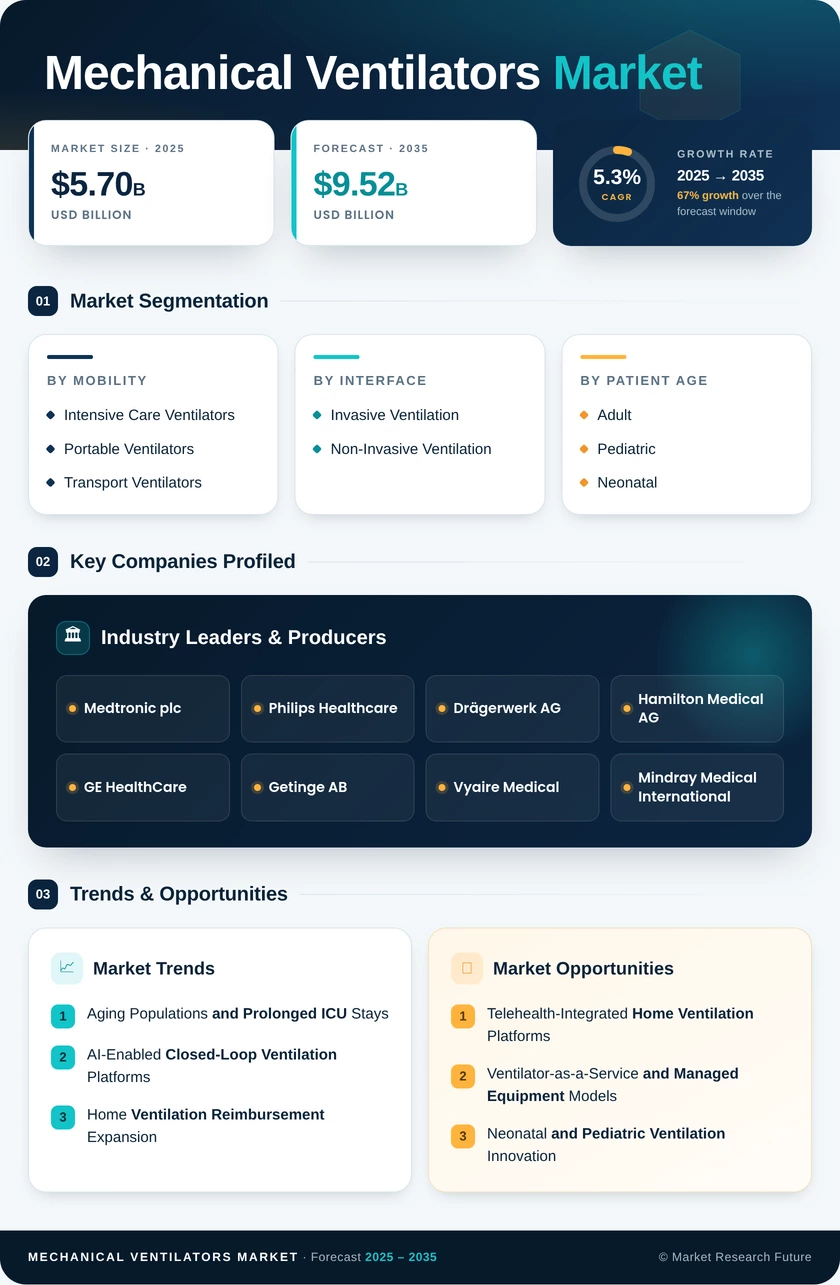
Segmentation Quick Reference
| Dimension | Sub-Segments | Dominant Segment | Fastest Growing Segment |
| By Mobility | Intensive Care Ventilators, Portable Ventilators, Transport Ventilators | Intensive Care Ventilators | Portable Ventilators |
| By Interface | Invasive Ventilation, Non-Invasive Ventilation | Invasive Ventilation | Non-Invasive Ventilation |
| By Patient Age | Adult, Pediatric, Neonatal | Adult | Neonatal |
| By End User | Hospitals, Home Healthcare, Ambulatory Surgical Centers | Hospitals | Home Healthcare |
| By Geography | North America, Europe, Asia-Pacific, South America, Middle East & Africa | North America | Asia-Pacific |
Market Segmentation Overview
By Mobility
| Sub-Segment | Key Trend |
| Intensive Care Ventilators | AI-enabled closed-loop automation and multi-modal ventilation platforms driving fleet upgrades |
| Portable Ventilators | Battery runtime improvements and cellular connectivity enabling home-care and EMS expansion |
| Transport Ventilators | Lightweight designs with full ICU-mode capability for inter-facility patient transfers |
Intensive care ventilators remain the revenue backbone of this segment, but portable devices are closing the gap as clinical settings diversify beyond the traditional hospital ICU. Manufacturers are investing in hybrid platforms that serve both transport and home-care applications to maximize addressable use cases.
By Interface
| Sub-Segment | Key Trend |
| Invasive Ventilation | Advanced synchronization algorithms and automated weaning protocols improving patient outcomes |
| Non-Invasive Ventilation | Expanded reimbursement coverage and COPD management driving adoption in home-care settings |
Invasive ventilation remains clinically essential for acute respiratory failure, but non-invasive platforms are capturing incremental share as clinical evidence strengthens their role in early intervention and chronic disease management. The interface divide is increasingly blurred as dual-mode devices capable of both invasive and non-invasive support gain market traction.
By Patient Age
| Sub-Segment | Key Trend |
| Adult | Largest patient pool; AI-driven personalization of ventilation parameters gaining adoption |
| Pediatric | Growing demand for size-specific circuits and age-appropriate ventilation modes |
| Neonatal | NICU expansion in emerging markets and specialized volume-guarantee modes driving fastest growth |
Adult ventilators dominate installed base, yet neonatal devices present the highest growth opportunity as governments across Asia-Pacific and South America invest in neonatal intensive care capacity to reduce infant mortality rates.
By End User
| Sub-Segment | Key Trend |
| Hospitals | Fleet modernization cycles and AI integration driving replacement demand |
| Home Healthcare | Medicare coverage expansion and remote monitoring technology enabling home-based ventilation |
| Ambulatory Surgical Centers | Rising outpatient procedural volumes requiring standby ventilation capacity |
Hospitals will continue to account for the majority of ventilator procurement, but home healthcare represents the most dynamic growth channel as payer models shift toward reimbursing ventilation therapy delivered outside institutional settings.