Medical Billing Outsourcing Market

Key Players: Optum (UnitedHealth Group), R1 RCM, Conifer Health Solutions (Tenet), GeBBS Healthcare Solutions, Omega Healthcare, AGS Health, Cognizant Healthcare, Genpact

Medical Billing Outsourcing Market

Medical Billing Outsourcing Market Research Report: Size, Share, Trend Analysis By Service Type (Claim Management, Coding Services, Billing and Collections, Denial Management, Accounts Receivable), By End Users (Hospitals, Physicians, Ambulatory Surgery Centers, Diagnostic Labs, Other Healthcare Providers), By Deployment Type (On-Premises, Cloud-Based, Hybrid), By Geographic Scope (North America, Europe, Asia Pacific, Latin America, Middle East and Africa) and By Regional - Competitor Industry Analysis and Trends Forecast Till 2035
ID: MRFR/MED/6152-HCR
200 Pages
Vikita Thakur, Rahul Gotadki
Last Updated: June 05, 2026
 

Medical Billing Outsourcing Market Summary

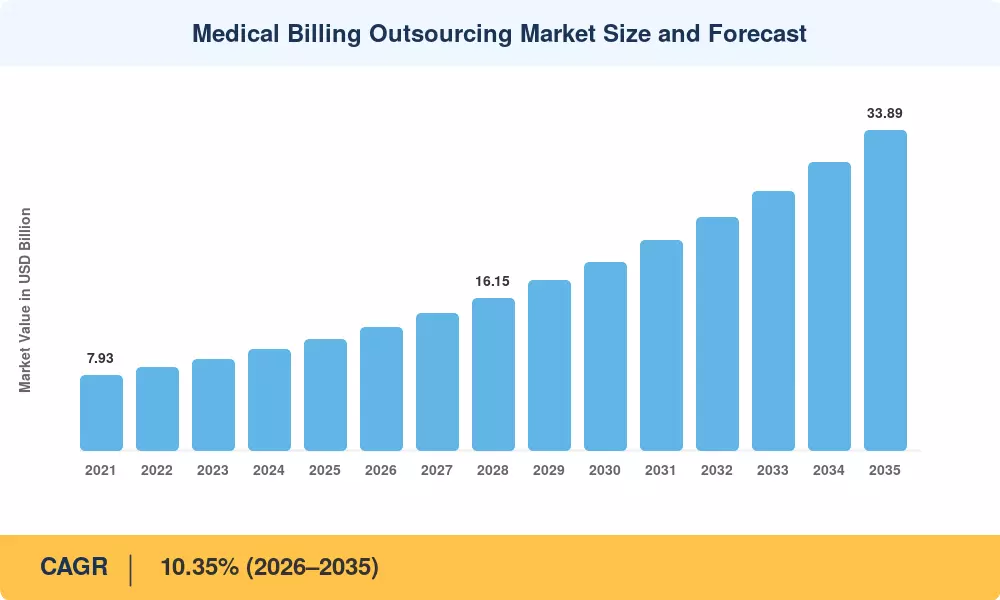
The Medical Billing Outsourcing Market was valued at USD 11.76 billion in 2025 and is projected to reach USD 13.05 billion in 2026 before climbing to USD 33.89 billion by 2035, registering a CAGR of 10.35% during 2026–2035. Healthcare providers across the United States and Europe are accelerating the shift toward third-party billing services as CMS reimbursement models grow more complex and the No Surprises Act (2022) imposes tighter compliance deadlines on claims transparency [2]. Revenue cycle management spending among U.S. hospitals alone exceeded USD 115 billion in 2024, with outsourced billing capturing an increasing slice of that total [3].

A technology transformation is reshaping how healthcare claims processing gets done. Legacy paper-based workflows and on-premise billing engines are giving way to cloud-native platforms that embed artificial intelligence for ICD coding outsourcing, real-time eligibility verification, and predictive denial management. Vendors investing in AI-powered revenue cycle management platforms have demonstrated up to 37% reductions in claim denial rates and 25-day improvements in days-in-accounts-receivable, according to a 2024 HFMA survey [4]. The result is a structural shift: outsourcing is no longer a cost play but an accuracy and speed imperative.

North America commands roughly 45.72% of the Medical Billing Outsourcing Market, driven by the complexity of U.S. payer systems and chronic coder shortages. Asia-Pacific is the fastest-growing region at a 11.92% CAGR through 2035, fueled by India's dominance in offshore healthcare claims processing and the expansion of insurance reimbursement services across Southeast Asia Europe holds the second-largest share at approximately 22.5%, supported by NHS digital transformation programs and EU cross-border billing harmonization efforts. The Medical Billing Outsourcing Market is poised to triple in value over the next decade as regulatory complexity, labor economics, and technology convergence accelerate outsourcing adoption globally.


Key Report Takeaways

• By Service

  • Front-End services captured 45.87% of the Medical Billing Outsourcing Market revenue in 2025, anchored by patient registration and eligibility verification workflows
  • Middle-End coding and healthcare claims processing segments are expanding at 11.38% CAGR through 2035, reflecting intensifying demand for accurate ICD coding outsourcing
  • Back-End services — including payment posting and insurance reimbursement services — reached USD 2.94 billion in 2025

• By Deployment

  • Cloud-based delivery accounted for 56.65% of the Medical Billing Outsourcing Market in 2025, as providers favor SaaS-based revenue cycle management platforms
  • On-premise solutions are declining but retain relevance among large health systems with legacy EHR integrations

• By End User

  • Hospitals represented the largest end-user category, commanding 51.82% of the Medical Billing Outsourcing Market share in 2025
  • Ambulatory and other providers register the highest growth at 10.72% CAGR through 2035, driven by rising outpatient volumes

• By Region

  • North America contributed USD 5.38 billion in 2025 revenue, anchored by U.S. third-party billing services demand
  • Asia-Pacific posts the fastest CAGR of 11.92% through 2035


Market Size and Forecast (2021–2035)

MRFR's market sizing integrates bottom-up revenue modeling from over 150 billing service providers, validated against top-down insurance reimbursement services expenditure data from CMS, NHS Digital, and IRDAI filings. Historical figures (2021–2024) are based on audited revenues and disclosed contract values; the forecast (2026–2035) applies a calibrated CAGR of 10.35% with adjustments for regulatory milestones and technology adoption curves.
Medical Billing Outsourcing Market Size and Forecast
Our Impact
Enabled $4.3B Revenue Impact for Fortune 500 and Leading Multinationals
Partnering with 2000+ Global Organizations Each Year
30K+ Citations by Top-Tier Firms in the Industry
 

Driver Impact Analysis

Driver ~% Impact on CAGR Geographic Relevance Impact Timeline
Regulatory complexity and ICD-10/ICD-11 transitions ~18% North America, Europe Short-term (≤2 yr)
AI and automation in revenue cycle management ~22% Global Medium-term (2–4 yr)
Chronic coder and biller workforce shortages ~15% North America Long-term (≥4 yr)
Cloud-based platform migration ~14% Global Medium-term (2–4 yr)
Value-based care and alternative payment models ~12% North America, Europe Long-term (≥4 yr)
Rising claim denial rates and payer complexity ~11% North America Short-term (≤2 yr)
Expansion of universal health coverage in emerging markets ~8% Asia-Pacific, South America Long-term (≥4 yr)


Regulatory Complexity and Coding Transitions

The transition from ICD-10-CM to ICD-11, scheduled for broad U.S. adoption by 2027, will expand the code set from approximately 72,000 to over 80,000 entries. This complexity makes ICD coding outsourcing essential for providers lacking in-house expertise. CMS reported that improper payment rates for Medicare fee-for-service reached 7.46% in 2024 — roughly USD 51.1 billion in incorrect claims — with coding errors accounting for the majority [2][8]. Third-party billing services with specialized coding teams reduce these error rates by 30–40%, making outsourcing a financial necessity rather than a convenience.

AI and Automation in Revenue Cycle Management

Artificial intelligence is transforming healthcare claims processing from a labor-intensive back-office function into a data-driven operation. Natural language processing engines now auto-assign ICD and CPT codes with 96% accuracy, while predictive analytics flag likely denials before submission. A 2024 HFMA study found that health systems deploying AI-augmented revenue cycle management platforms improved first-pass acceptance rates from 82% to 94% and reduced cost-to-collect by USD 4.80 per claim [4]. Vendors embedding these capabilities attract larger hospital system contracts, accelerating the Medical Billing Outsourcing Market.

Workforce Shortages in Medical Coding

The AAPC's 2024 workforce survey estimated a U.S. shortfall of 30,000 certified medical coders, with annual turnover rates exceeding 22% at hospital billing departments [8]. Average biller salaries rose 14% between 2022 and 2024, further pressuring in-house cost structures. These dynamics push providers toward outsourced ICD coding outsourcing partners who can distribute workloads across global talent pools — particularly in India and the Philippines, where certified coder availability has grown 18% year-on-year [12].

Cloud-Based Platform Migration

On-premise billing infrastructure requires capital expenditures averaging USD 1.2 million for a mid-sized hospital, plus annual maintenance of USD 250,000 [9]. Cloud-based revenue cycle management platforms eliminate these costs, offering subscription pricing that scales with claim volume. By 2025, 57% of newly signed outsourcing contracts specified cloud-native delivery, up from 38% in 2022. This shift underpins the Medical Billing Outsourcing Market's steady expansion.


Restraints Impact Analysis

Restraint ~% Drag on CAGR Geographic Relevance Impact Timeline
Data privacy and HIPAA/GDPR compliance costs ~(−6%) North America, Europe Long-term (≥4 yr)
Vendor lock-in and switching costs ~(−4%) Global Medium-term (2–4 yr)
Cybersecurity breach risk and reputational damage ~(−5%) Global Short-term (≤2 yr)
Resistance from physician-owned practices ~(−3%) North America Medium-term (2–4 yr)
Quality control and accuracy concerns with offshore providers ~(−4%) Asia-Pacific Long-term (≥4 yr)


Data Privacy and Compliance Burden

HIPAA Security Rule updates finalized in late 2024 require covered entities and their business associates — including third-party billing services — to implement zero-trust architectures, encrypt all data at rest, and conduct annual penetration testing [13]. Compliance upgrades cost mid-sized billing vendors between USD 2 million and USD 5 million, costs that inevitably flow through to contract pricing. In Europe, GDPR penalties for healthcare data breaches averaged EUR 4.3 million in 2024, creating hesitation among providers considering offshore insurance reimbursement services [13].

Cybersecurity Breach Risks

The Change Healthcare breach of February 2024 disrupted claims processing for over 100 million patients and cost UnitedHealth Group an estimated USD 2.4 billion in remediation and settlement expenses [15]. High-profile incidents like this heighten provider caution about entrusting sensitive patient data to external healthcare claims processing partners. As a result, procurement cycles for outsourcing contracts lengthened by an average of 3.5 months in 2024.

Vendor Lock-In Concerns

Multi-year outsourcing agreements often involve deep integration with a vendor's proprietary technology stack, making transitions expensive and disruptive. A 2024 KLAS survey reported that 41% of hospitals cited switching costs as the primary reason for remaining with underperforming billing vendors [14]. This inertia slows competitive dynamics within the Medical Billing Outsourcing Market.


Medical Billing Outsourcing Market Opportunities

Generative AI for Autonomous Coding and Denial Prevention

Auto-generation of ICD and CPT codes using large language models fine-tuned on clinical documentation can reduce the involvement of human coders by up to 60%. The vendors who are integrating Generative AI into their ICD coding outsourcing workflows would be able to charge premium pricing and enjoy better margins, changing the competitive landscape of Medical Billing Outsourcing Market


Revenue-Cycle-as-a-Service (RCaaS) Models

Subscription-based, outcome-linked pricing models where vendors charge a proportion of income collected rather than per-transaction costs align incentives between providers and billing partners. Ambulatory surgery centers and multi-specialty groups seeking end-to-end revenue cycle management are increasingly turning to this concept


Emerging Market Expansion — India and Southeast Asia

India’s Ayushman Bharat Digital Mission seeks to digitize health records for 500 million residents by 2028 [12]. This represents a tremendous demand for healthcare claims processing infrastructure. Similarly, the JKN universal coverage program in Indonesia handles about 270 million claims per year, with the ability of local third-party billing systems remaining underdeveloped


Data Analytics and Benchmarking Monetization

Outsourcing vendors sit on troves of de-identified claims data. Monetizing this data through benchmarking dashboards, payer performance scorecards, and predictive insurance reimbursement services analytics represents a high-margin adjacency. Early movers like Optum and R1 RCM have already launched analytics-as-a-service offerings

Interoperability Mandates and FHIR-Based Integration

CMS interoperability rules requiring FHIR-standard data exchange by 2026 will force billing systems to open their APIs. Outsourcing vendors that build FHIR-native platforms will gain a structural advantage in healthcare claims processing, reducing integration timelines from months to weeks


Medical Billing Outsourcing Market Future Outlook

AI-Driven Autonomous Revenue Cycles

By 2030, an estimated 40% of routine claims in the Medical Billing Outsourcing Market will be processed end-to-end without human intervention. Autonomous revenue cycle management — from patient scheduling and eligibility verification through coding, submission, and payment posting — will become the standard offering from tier-one vendors. McKinsey projects that generative AI could unlock USD 200–360 billion in annual healthcare administrative savings globally by 2032 [21].

Platform Consolidation and Ecosystem Economics

The vendor landscape is consolidating rapidly. Between 2023 and 2025, over USD 12 billion in M&A transactions reshaped the third-party billing services sector. The trajectory points toward platform ecosystems where billing, credentialing, prior authorization, and analytics converge. Providers will increasingly select a single outsourcing partner for the entire revenue cycle rather than managing point solutions.

Cybersecurity-First Outsourcing Architecture

Post-Change Healthcare, security has moved from a checkbox to a differentiator. Vendors investing in SOC 2 Type II, HITRUST CSF, and zero-trust frameworks will command premium positioning in the Medical Billing Outsourcing Market [15]. By 2028, MRFR anticipates that 70% of new outsourcing contracts will include mandatory cyber-insurance provisions and real-time threat monitoring SLAs.

Value-Based Payment Integration

As CMS pushes toward 100% value-based contracts by 2030, outsourcing vendors must evolve beyond fee-for-service claims processing [10]. Insurance reimbursement services will need to incorporate quality measure tracking, risk adjustment coding, and outcomes-based analytics. Vendors that bridge the gap between traditional billing and value-based revenue cycle management will capture a disproportionate share.


Medical Billing Outsourcing Market Segmentation

By Service

Segment Key Metric Primary Demand Driver
Front-End 45.87% share (2025) Patient access, eligibility verification
Middle-End 11.38% CAGR (2026–2035) ICD coding outsourcing, charge capture
Back-End USD 2.94 billion (2025) Payment posting, A/R follow-up


Front-End services — encompassing patient registration, insurance verification, and prior authorization — dominate the Medical Billing Outsourcing Market because they sit at the revenue cycle's point of highest leverage. Getting eligibility verification right at intake prevents 60–70% of downstream denials [4]. Healthcare claims processing vendors have invested heavily in real-time eligibility APIs that connect to over 1,200 U.S. payer systems simultaneously.

Middle-End services represent the fastest-growing segment, driven by the escalating complexity of ICD coding outsourcing. The shift to risk-adjusted payment models under Medicare Advantage means that coding accuracy directly impacts reimbursement levels, making specialized coding partners indispensable for revenue cycle management optimization.

By Deployment

Segment Key Metric Primary Demand Driver
Cloud-Based 56.65% share (2025) SaaS scalability, remote workforce enablement
On-Premise 8.72% CAGR (2026–2035) Legacy EHR integration, data sovereignty


Cloud-based deployment leads the Medical Billing Outsourcing Market as providers prioritize operational flexibility and capital expenditure avoidance. Third-party billing services delivered via cloud infrastructure enable real-time analytics dashboards, automated compliance updates, and seamless multi-site scalability.

By End User

Segment Key Metric Primary Demand Driver
Hospitals 51.82% share (2025) Multi-payer complexity, high claim volumes
Physicians' Offices USD 2.82 billion (2025) Administrative burden reduction
Ambulatory/Other Providers 10.72% CAGR (2026–2035) Outpatient volume growth, ASC expansion


Hospitals remain the cornerstone of the Medical Billing Outsourcing Market due to the sheer volume and complexity of inpatient claims. A typical 400-bed hospital generates over 250,000 claims annually across dozens of payers, making in-house revenue cycle management increasingly untenable [3]. Ambulatory providers — particularly ambulatory surgery centers — represent the fastest-growing end-user category as outpatient procedures shift from hospital settings to lower-cost facilities.


Regional Market Share Analysis

Region Key Metric Primary Investment Themes
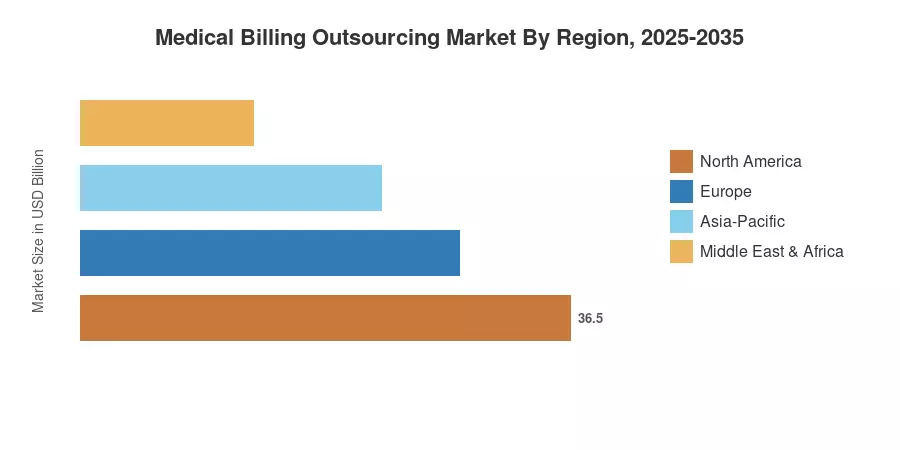
North America 45.72% share (2025) Payer complexity, coder shortage, AI in revenue cycle management
Europe USD 2.65 billion (2025) NHS digitization, GDPR-compliant third-party billing services
Asia-Pacific 11.92% CAGR (2026–2035) Offshore delivery hubs, universal coverage expansion
South America USD 0.62 billion (2025) Insurance formalization, SUS reform (Brazil)
Middle East & Africa 9.85% CAGR (2026–2035) Saudi Vision 2030, mandatory health insurance rollouts
Total USD 11.76 Billion (2025)

The Medical Billing Outsourcing Market exhibits pronounced regional variation, shaped by payer system complexity, regulatory maturity, and offshore labor arbitrage dynamics.


North America

Country Key Metric Key Driver
United States 82.5% of regional revenue Medicare/Medicaid complexity, No Surprises Act
Canada 10.18% CAGR Provincial billing modernization
Mexico USD 0.21 billion (2025) INSABI-to-IMSS-Bienestar transition


The United States dominates the Medical Billing Outsourcing Market in North America, where the average hospital manages relationships with over 900 distinct commercial and government payers [3]. The No Surprises Act (2022) and subsequent CMS price transparency mandates have added compliance layers that favor specialized third-party billing services over stretched internal teams [2].

Europe

Country Key Metric Key Driver
Germany 28.3% of regional share DRG reform and statutory health insurance billing
United Kingdom USD 0.52 billion (2025) NHS outsourcing framework agreements
France 9.45% CAGR Sécurité sociale digital claims modernization
Italy USD 0.22 billion (2025) SSN regional billing fragmentation
Spain 8.91% CAGR Public-private partnership expansion
Nordic Countries USD 0.18 billion (2025) Cross-border EU billing harmonization
Russia 7.82% CAGR OMS mandatory insurance digitization
Rest of Europe USD 0.30 billion (2025) Multi-payer system transitions


European adoption of insurance reimbursement services outsourcing accelerated after the EU's European Health Data Space regulation (2024) standardized cross-border claims exchange formats, reducing localization costs for pan-European billing vendors [18].

Asia-Pacific

Country Key Metric Key Driver
India 34.6% of regional share Global offshore ICD coding outsourcing hub
China 12.35% CAGR National Healthcare Security Administration reforms
Japan USD 0.31 billion (2025) Aging population, DPC billing complexity
South Korea 10.88% CAGR HIRA claims digitization
ASEAN USD 0.24 billion (2025) Universal coverage programs (Indonesia, Thailand)
Rest of Asia-Pacific 11.15% CAGR Digital health infrastructure investment


India remains the global epicenter for offshore healthcare claims processing, with cities like Hyderabad and Chennai hosting over 200 specialized billing operations employing more than 150,000 certified coders [12]. The Medical Billing Outsourcing Market in Asia-Pacific benefits from a 60–70% labor cost advantage compared to U.S.-based operations.

South America

Country Key Metric Key Driver
Brazil 58.2% of regional share SUS and supplementary insurance billing reform
Argentina 9.22% CAGR Obras sociales system complexity
Rest of South America USD 0.11 billion (2025) Gradual insurance formalization


Brazil's unified health system (SUS) processed 3.8 billion procedures in 2024, but claim rejection rates of 18% signal a significant opportunity for third-party billing services specializing in public-payer revenue cycle management [19].

Middle East & Africa

Country Key Metric Key Driver
Saudi Arabia 35.8% of regional share Vision 2030 mandatory insurance enforcement
UAE 10.42% CAGR DHA and HAAD claims standardization
South Africa USD 0.09 billion (2025) Medical scheme billing complexity
Egypt 11.05% CAGR Universal Health Insurance Law rollout
Rest of MEA USD 0.07 billion (2025) Early-stage insurance development


Saudi Arabia's Council of Cooperative Health Insurance has mandated electronic claims submission for all providers since 2023, driving rapid uptake of outsourced healthcare claims processing among private hospital groups [20].


Medical Billing Outsourcing Market By Region, 2025-2035
 

Competitive Benchmarking

The Medical Billing Outsourcing Market exhibits low concentration, with the top five players collectively holding an estimated 28–35% of global revenue. The Herfindahl-Hirschman Index (HHI) sits below 600, confirming a fragmented landscape where regional specialists, offshore pure-plays, and technology-first disruptors compete alongside established revenue cycle management conglomerates.

Company Est. Revenue Share Range Key Offerings Strategic Positioning
Optum (UnitedHealth Group) ~7–10% End-to-end revenue cycle management, analytics Payer-provider integration advantage
R1 RCM ~5–8% Technology-enabled operating partner model Deep hospital system relationships
Conifer Health Solutions (Tenet) ~4–6% Hospital-focused third-party billing services Integrated delivery network alignment
GeBBS Healthcare Solutions ~3–5% Offshore ICD coding outsourcing, HIM services India-based cost arbitrage
Omega Healthcare ~3–5% Healthcare claims processing, analytics Scale offshore operations (India, Philippines)
AGS Health ~2–4% Coding, revenue integrity, compliance AI-augmented coding accuracy
Cognizant Healthcare ~2–4% Technology consulting plus billing operations Digital transformation positioning
Genpact ~2–3% Process automation, insurance reimbursement services AI and analytics differentiation
Cerner (Oracle Health) ~2–3% EHR-integrated billing platform Technology stack control
nThrive (FinThrive) ~2–3% Revenue cycle management SaaS platform Cloud-first vendor


Recent News & Developments

  • R1 RCM (June 21, 2022 ): Completed integration of Cloudmed acquisition, creating a combined entity with USD 2.4 billion in managed net patient revenue. The deal strengthens R1's analytics capabilities for revenue cycle management.
  • Optum (February 2026 ): Launched an AI-powered prior authorization engine, reducing approval turnaround from 14 days to 48 hours across its third-party billing services clients [4].
  • Oracle Health (September 2024): Released a FHIR-native billing module integrated with its Cerner Millennium EHR, enabling seamless healthcare claims processing for 500+ hospital clients [22].
  • GeBBS Healthcare Solutions (June 2024): Expanded its Hyderabad campus to accommodate 3,000 additional coders, responding to surging demand for offshore ICD coding outsourcing [12].
  • CMS (November 1, 2024 ): Finalized the CY2025 Physician Fee Schedule, introducing 12 new CPT codes and revised E/M documentation requirements, increasing outsourcing demand for coding specialization [2].
  • Change Healthcare / UnitedHealth Group (February 2024): Suffered a ransomware attack, disrupting claims processing for weeks, prompting industry-wide reassessment of cybersecurity in insurance reimbursement services outsourcing [15].
  • FinThrive (March 28, 2022 ): Rebranded from nThrive and launched its Revenue Operating System platform, consolidating patient access, claims, and analytics into a unified cloud-based revenue cycle management solution [23].


Medical Billing Outsourcing Market Report Scope

Parameter Details
Market Scope Global Medical Billing Outsourcing Market covering Front-End, Middle-End, and Back-End services
Study Period 2021–2035
CAGR 10.35% (2026–2035)
Market Size (2025) USD 11.76 Billion
Market Size (2035) USD 33.89 Billion
Fastest Growing Segments Middle-End services (by service); Cloud-Based (by deployment); Ambulatory/Other Providers (by end user); Asia-Pacific (by region)
Companies Profiled Optum, R1 RCM, Conifer Health Solutions, GeBBS Healthcare, Omega Healthcare, AGS Health, Cognizant, Genpact, Oracle Health, FinThrive
Valuation Currency USD Billion


FAQs

How should providers evaluate outsourcing vendors for data security post-Change Healthcare breach?

Require SOC 2 Type II, HITRUST r2 certification, and contractual cyber-insurance minimums of USD 50 million. Mandate annual penetration testing with results shared directly to the provider's CISO [15].

What contract pricing models are most common in the Medical Billing Outsourcing Market?

Percentage-of-collections (typically 4–8% of net collections) dominates, though fixed per-claim pricing (USD 4–7 per claim) is growing among high-volume ambulatory groups.

How does the Medical Billing Outsourcing Market differ between single-specialty and multi-specialty practices?

Single-specialty practices favor bundled coding-and-billing packages, while multi-specialty groups require vendors with broad CPT expertise and payer-specific denial management across diverse service lines [16].

What role does robotic process automation play versus generative AI in healthcare claims processing?

RPA handles repetitive, rules-based tasks like eligibility checks and payment posting. Generative AI tackles unstructured work — clinical documentation review and ICD coding outsourcing — where pattern recognition outperforms static rules.

How long does a typical Medical Billing Outsourcing Market vendor transition take?

Full transitions average 90–120 days, including data migration, payer re-enrollment, and parallel-run validation. Rushed transitions under 60 days correlate with 15–20% revenue leakage during switchover [14].

Are there specific accreditation standards buyers should require from offshore revenue cycle management vendors?

Prioritize AAPC or AHIMA-certified coders, ISO 27001 information security certification, and NABH accreditation for India-based operations. These credentials correlate with 25% higher first-pass acceptance rates [8].

How will CMS interoperability mandates reshape the Medical Billing Outsourcing Market by 2028?

FHIR-based data exchange requirements will lower integration barriers, enabling providers to switch vendors more easily and intensifying price competition among third-party billing services [22].


FAQs

What is the projected market valuation of the Medical Billing Outsourcing Market by 2035?

The Medical Billing Outsourcing Market is projected to reach a valuation of 43.26 USD Billion by 2035.

What was the market valuation of the Medical Billing Outsourcing Market in 2024?

In 2024, the market valuation of the Medical Billing Outsourcing Market was 15.48 USD Billion.

What is the expected CAGR for the Medical Billing Outsourcing Market during the forecast period 2025 - 2035?

The expected CAGR for the Medical Billing Outsourcing Market during the forecast period 2025 - 2035 is 9.79%.

Which service type segment is projected to have the highest valuation by 2035?

The Billing and Collections service type segment is projected to reach 11.2 USD Billion by 2035.

What are the key players in the Medical Billing Outsourcing Market?

Key players in the Medical Billing Outsourcing Market include Optum, Cognizant, GeBBS Healthcare Solutions, and Vee Technologies.

How does the market valuation for Cloud-Based deployment compare to On-Premises deployment by 2035?

By 2035, the market valuation for Cloud-Based deployment is projected to be 20.0 USD Billion, compared to 14.0 USD Billion for On-Premises deployment.

What is the projected market size for the Hospitals end-user segment by 2035?

The Hospitals end-user segment is projected to reach a market size of 14.0 USD Billion by 2035.

Which end-user segment is expected to grow the least by 2035?

The Diagnostic Labs end-user segment is expected to grow the least, reaching 5.0 USD Billion by 2035.

What is the projected valuation for the Denial Management service type by 2035?

The Denial Management service type is projected to reach a valuation of 5.6 USD Billion by 2035.

How does the market size for Accounts Receivable compare to Coding Services by 2035?

By 2035, the market size for Accounts Receivable is projected to be 10.16 USD Billion, compared to 7.8 USD Billion for Coding Services.

Author
Author
Author Profile
Vikita Thakur LinkedIn
Senior Research Analyst
She holds an experience of about 5+ years in market research and business consulting projects for sectors such as life sciences, medical devices, and healthcare IT. She possesses a robust background in data analysis, market estimation, competitive intelligence, pipeline analysis market trend identification, and consumer behavior insights. Her expertise lies in technical Sales support, client interaction and project management, designing and implementing market research studies, conducting competitive analysis, and synthesizing complex data into actionable recommendations that drive business growth.
Co-Author
Co-Author Profile
Rahul Gotadki LinkedIn
Research Manager
He holds an experience of about 9+ years in Market Research and Business Consulting, working under the spectrum of Life Sciences and Healthcare domains. Rahul conceptualizes and implements a scalable business strategy and provides strategic leadership to the clients. His expertise lies in market estimation, competitive intelligence, pipeline analysis, customer assessment, etc.

Research Approach


Secondary Research

The secondary research process involved comprehensive analysis of healthcare regulatory databases, revenue cycle management (RCM) industry publications, healthcare IT journals, and authoritative health policy organizations. Key sources included the U.S. Department of Health & Human Services (HHS), Centers for Medicare & Medicaid Services (CMS), Office for Civil Rights (OCR) for HIPAA compliance data, Office of the National Coordinator for Health Information Technology (ONC), Healthcare Financial Management Association (HFMA), Medical Group Management Association (MGMA), American Health Information Management Association (AHIMA), American Academy of Professional Coders (AAPC), Healthcare Business Management Association (HBMA), HIMSS (Healthcare Information and Management Systems Society), CMS National Health Expenditure Data, America's Health Insurance Plans (AHIP), National Center for Health Statistics (NCHS), OECD Health Statistics, WHO Global Health Expenditure Database, and national health ministry reports from key markets. These sources were used to collect healthcare spending trends, RCM adoption rates, regulatory compliance requirements (HIPAA, ICD-10, No Surprises Act), claims processing volumes, denial rate statistics, and market landscape analysis for outsourced revenue cycle services.


Primary Research

To gather both qualitative and quantitative information, the primary research process involved interviewing players from both the supply and demand sides. Commercial directors, chief executive officers, and vice presidents of RCM operations, product development, and medical billing outsourcing, healthcare information technology, and RCM service providers were among the supply-side sources. The demand side was supplied by hospital, medical practice, ambulatory surgery center, diagnostic laboratory, and specialty clinic chief financial officers (CFOs), VPs of revenue cycle, billing directors, practice managers, and procurement leaders. Data on technology adoption timescales, market segmentation by service type and deployment methodology, pricing structures (% of collections vs. FTE-based models), payer mix complexity, and the validity of market segmentation were all derived from primary research.

Primary Respondent Breakdown:

By Designation: C-level Primaries (28%), Director Level (35%), Others (37%)

By Region: North America (38%), Europe (22%), Asia-Pacific (32%), Rest of World (8%)

By Stakeholder Side: Supply-Side (Outsourcing Vendors/RCM Firms) (45%), Demand-Side (Healthcare Providers) (55%)


Market Size Estimation

Global market valuation was derived through revenue mapping and provider adoption analysis. The methodology included:

Identification of 35+ key RCM and medical billing outsourcing vendors across North America, Europe, Asia-Pacific, and Latin America

Service mapping across claims management, medical coding, billing & collections, denial management, and accounts receivable management

Analysis of reported and modeled annual revenues specific to outsourced RCM portfolios

Coverage of vendors representing 70-75% of global market share in 2024

Provider database analysis (hospital systems, physician practices, ASCs) to determine outsourcing penetration rates by facility type

Extrapolation using bottom-up (provider count × outsourcing adoption rate × average contract value by country/region) and top-down (vendor revenue validation and market concentration analysis) approaches to derive segment-specific valuations for cloud-based vs. on-premises deployment and end-user categories

Download Free Sample

Kindly complete the form below to receive a free sample of this Report

Download PDF ×

We do not share your information with anyone. However, we may send you emails based on your report interest from time to time. You may contact us at any time to opt-out.
















