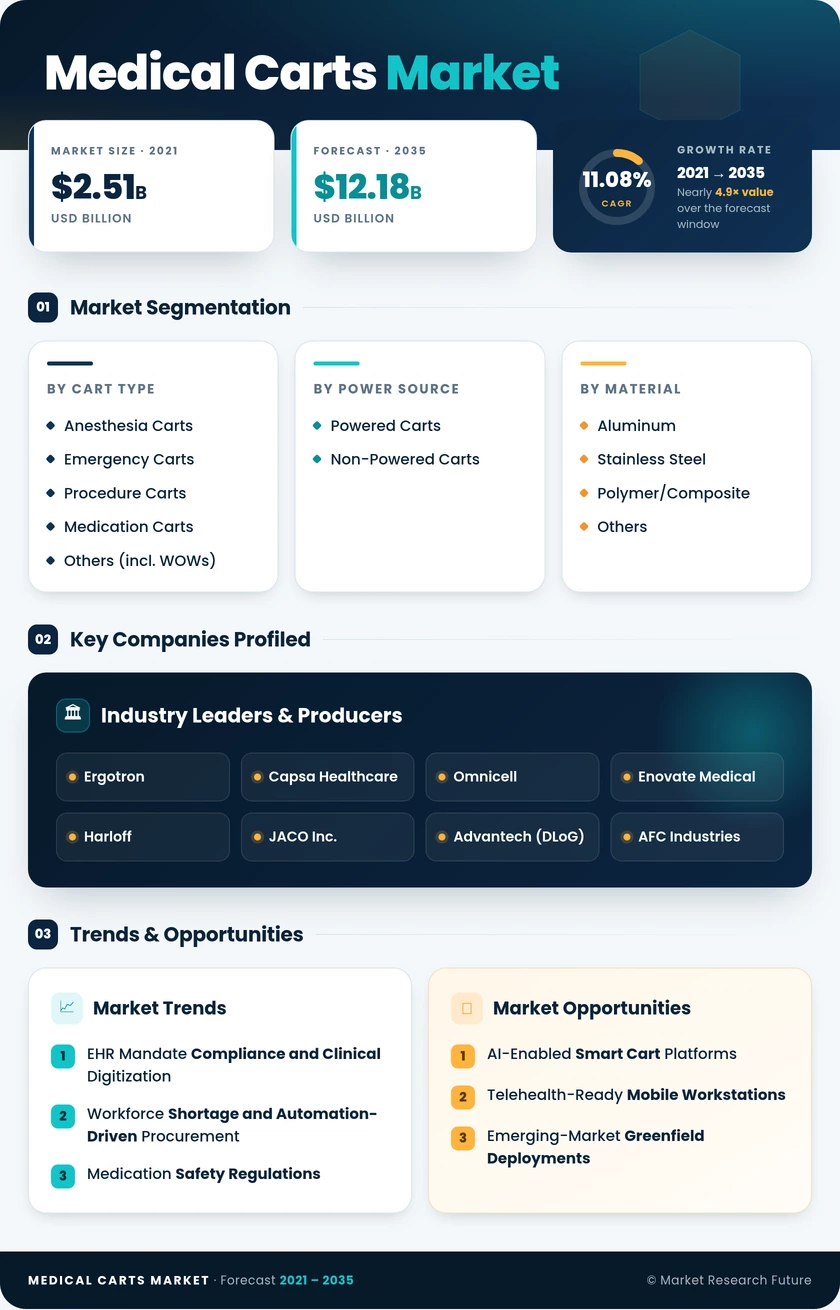
Segmentation Quick Reference
| Dimension | Sub-Segments | Dominant Segment | Fastest Growing Segment |
| By Cart Type | Anesthesia Carts, Emergency Carts, Procedure Carts, Medication Carts, Others (incl. WOWs) | Emergency Carts | Others (Workstations-on-Wheels) |
| By Power Source | Powered Carts, Non-Powered Carts | Non-Powered Carts | Powered Carts |
| By Material | Aluminum, Stainless Steel, Polymer/Composite, Others | Stainless Steel | Polymer/Composite |
| By End User | Hospitals, Ambulatory Surgical Centers, Specialty Clinics, Others | Hospitals | Ambulatory Surgical Centers |
| By Geography | North America, Europe, Asia-Pacific, South America, Middle East & Africa | North America | Asia-Pacific |
Market Segmentation Overview
By Cart Type
| Sub-Segment | Key Trend |
| Anesthesia Carts | Standardized drawer configurations aligned to ASA guidelines; shift toward RFID-tracked supply trays |
| Emergency Carts | AHA/ERC-mandated crash cart equipment with automated defibrillator mounts and smart medication locks |
| Procedure Carts | Modular, specialty-specific designs for endoscopy, orthopedic, and catheterization labs |
| Medication Carts | Barcode-verified dispensing with closed-loop administration; integration with pharmacy information systems |
| Others (incl. WOWs) | Mobile workstation for clinicians with integrated computing, telemedicine, and ergonomic height adjustment |
Cart type segmentation reflects the clinical function each platform serves. Emergency carts dominate revenue because of universal regulatory mandates, while workstations-on-wheels are growing fastest due to the digital transformation of bedside clinical workflows.
By Power Source
| Sub-Segment | Key Trend |
| Powered Carts | Lithium-iron-phosphate batteries, hot-swap capability, and solid-state technology on the horizon |
| Non-Powered Carts | Cost-effective manual configurations for low-acuity and resource-constrained settings |
The powered versus non-powered split tracks closely with facility acuity level and IT infrastructure readiness. As computing requirements at the point of care increase, the powered segment's share is expected to approach parity with non-powered by the early 2030s.
By Material
| Sub-Segment | Key Trend |
| Aluminum | Lightweight frames for bedside nursing cart applications; anodized finishes for infection resistance |
| Stainless Steel | Preferred for high-acuity crash cart and procedure cart environments; autoclave-compatible |
| Polymer/Composite | Antimicrobial additives, weight reduction by 25–35% versus steel, and growing OEM adoption |
| Others | Specialty alloys and hybrid material constructions for niche applications |
Infection-control protocols and ergonomic considerations increasingly influence material selection. Polymer and composite materials are gaining acceptance as antimicrobial additive technology matures.
By End User
| Sub-Segment | Key Trend |
| Hospitals | Full cart-type portfolio deployment across ED, OR, pharmacy, nursing units, and telemedicine |
| Ambulatory Surgical Centers | Compact, modular procedure carts; rapid turnover design for outpatient throughput |
| Specialty Clinics | Disease-specific configurations for oncology infusion, dialysis, and wound care |
| Others | Military field medicine, home health, long-term care, and veterinary applications |
Hospital dominance reflects the sheer scale of acute-care operations, but ambulatory surgical centers are the fastest-growing end-user channel as outpatient surgical volumes continue migrating from inpatient settings.