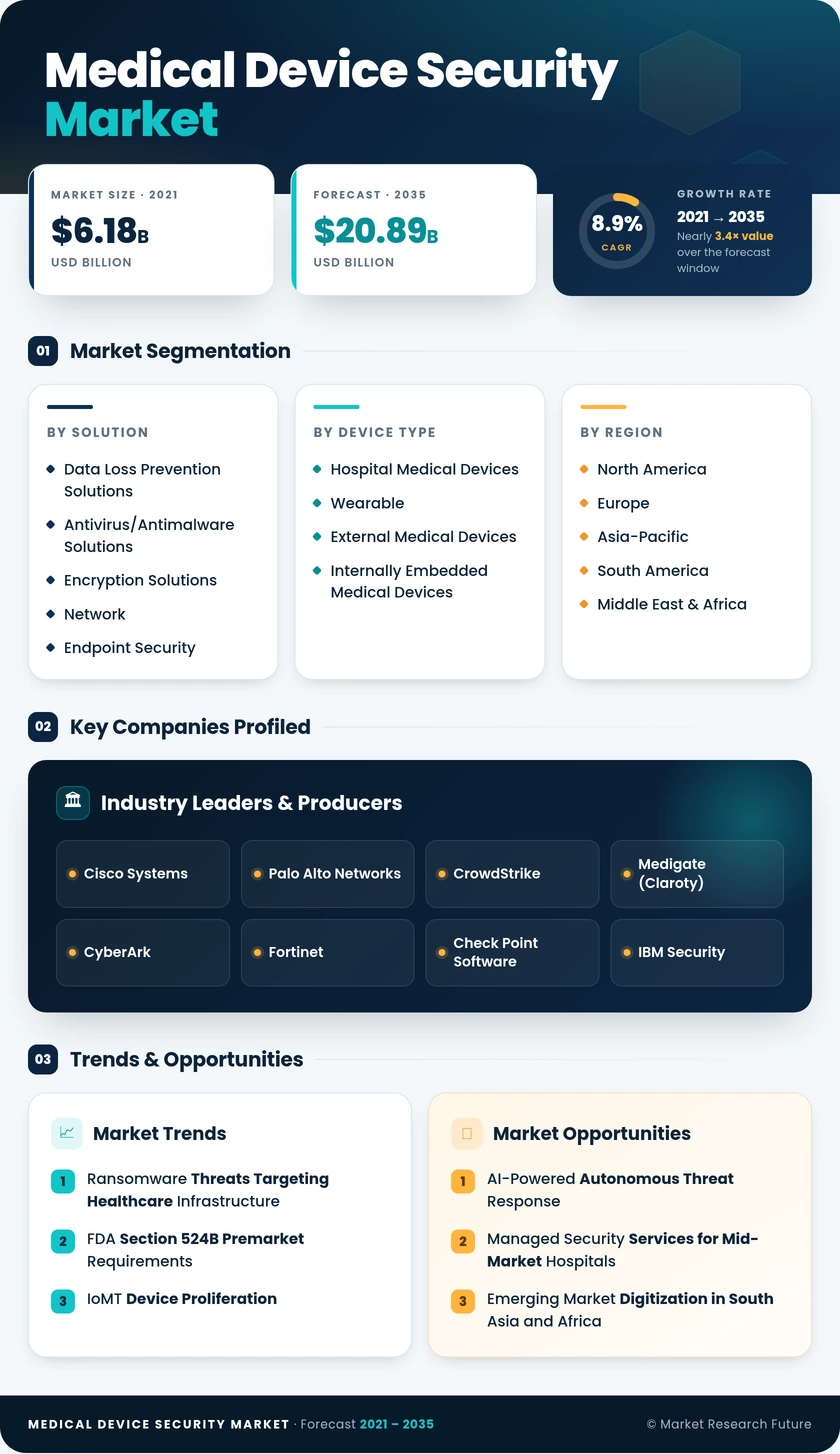
Segmentation Quick Reference
| Dimension | Sub-Segments | Dominant Segment | Fastest Growing Segment |
| By Solution | Data Loss Prevention Solutions, Antivirus/Antimalware Solutions, Encryption Solutions, Network and Endpoint Security, Identity and Access Management, Other Solutions | Network and Endpoint Security | Encryption Solutions |
| By Device Type | Hospital Medical Devices, Wearable and External Medical Devices, Internally Embedded Medical Devices | Hospital Medical Devices | Wearable and External Medical Devices |
| By Region | North America, Europe, Asia-Pacific, South America, Middle East & Africa | North America | Asia-Pacific |
Market Segmentation Overview
By Solution
| Sub-Segment | Key Trend |
| Data Loss Prevention Solutions | Growing enforcement of cross-border PHI transfer restrictions under HIPAA and GDPR |
| Antivirus/Antimalware Solutions | Transition from signature-based to behavior-based detection for IoMT environments |
| Encryption Solutions | Expansion of end-to-end encryption for telehealth and remote monitoring data flows |
| Network and Endpoint Security | Rapid adoption of zero-trust micro-segmentation and network access control |
| Identity and Access Management | Mandatory multi-factor authentication for clinical system access |
| Other Solutions | Emergence of SBOM management platforms and automated vulnerability scanning |
Solution-level segmentation reflects the layered approach healthcare organizations are taking to secure connected medical device environments. Network and Endpoint Security leads as organizations prioritize visibility and segmentation, while Encryption Solutions grow fastest as data-in-transit protection becomes a regulatory imperative across telehealth and remote monitoring use cases.
By Device Type
| Sub-Segment | Key Trend |
| Hospital Medical Devices | Increasing network segmentation mandates for imaging, infusion, and monitoring systems |
| Wearable and External Medical Devices | Rapid proliferation of remote patient monitoring creating new endpoint security requirements |
| Internally Embedded Medical Devices | Growing connectivity in cardiac implants and neurostimulators demanding over-the-air security |
Device type segmentation captures the diverse risk profiles across clinical environments. Hospital Medical Devices dominate spending due to their high density and direct patient-safety implications, while Wearable and External Medical Devices represent the fastest growth vector as healthcare extends beyond traditional facility boundaries into home and ambulatory settings.