Medical Device Testing Services Market

Key Players: SGS SA, Bureau Veritas, Intertek Group, TÜV SÜD, Eurofins Scientific, UL Solutions, Element Materials Technology, NAMSA

Medical Device Testing Services Market

Medical Device Testing Services Market Research Report Information By Services (Biocompatibility Tests, Chemistry Test and Microbiology & Sterility Test), By Phase (Preclinical and Clinical) And By Region (North America, Europe, Asia-Pacific, And Rest Of The World), Forecast Till 2035
ID: MRFR/MED/10831-HCR
131 Pages
Vikita Thakur, Rahul Gotadki
Last Updated: June 22, 2026

Medical Device Testing Services Market Summary

The Global Medical Device Testing Services Market size was valued at USD 10.72 Billion in 2025, and the market is projected to grow from USD 11.80 Billion in 2026 to USD 28.05 Billion by 2035, registering a CAGR of 10.1% during the forecast period 2026–2035. Two forces sit behind this trajectory: the FDA's 2023 cybersecurity pre-market guidance now compels every connected-device maker to demonstrate threat modeling, software bill-of-materials integrity, and patch-management capability before clearance [1], while the EU Medical Device Regulation (MDR) transition deadline has funneled thousands of legacy CE-marked products back through conformity assessment, overwhelming in-house validation teams and pushing spend toward accredited third-party labs [2].

The technology transition in this field is centered around the move from exclusively wet-lab biocompatibility and sterility processes to integrated digital + bench workflows. In-silico toxicological platforms and computational fatigue models already satisfy parts of ISO 10993 standards, reducing animal-study timeframes by 20-30% for qualifying device materials [3]. The FDA’s 2024 draft guidance on computer modeling and simulation (CM&S) for medical devices actively incentivizes this move, allowing sponsors to supplement physical testing with validated simulations, a policy shift anticipated to save manufacturers USD 1.2 billion in total through 2030 [4].


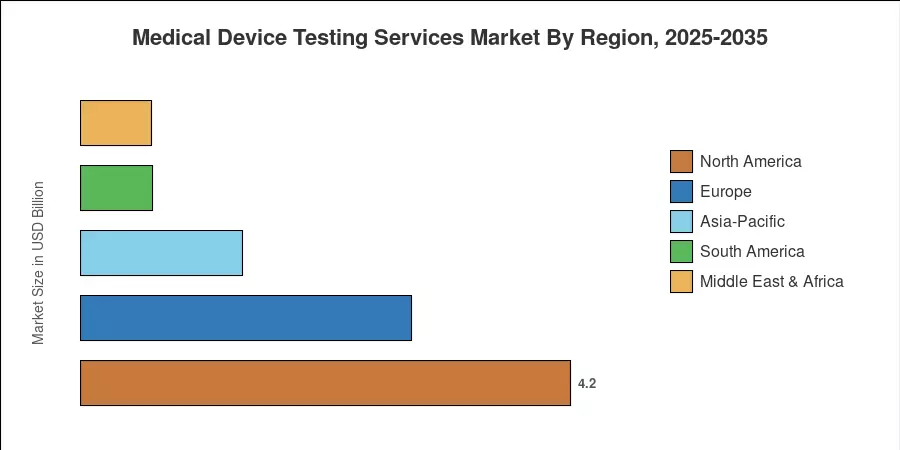
The North American market for medical device testing services accounted for 39.2% of the total market in 2024, driven by the world's most extensive network of FDA-registered testing labs and a substantial MedTech OEM presence focused in Minnesota, Massachusetts and Southern California. Asia-Pacific is the fastest developing area at 13.0% CAGR, driven by China’s NMPA reform goal and India’s burgeoning CDSCO infrastructure. Europe is second at 26.5%, because of re-certification traffic from MDR that will continue far into the late 2020s. The medical device testing services industry is set to see a decade of structurally elevated demand due to rising device complexity, from AI-powered surgical robots to biodegradable cardiac stents.


Key Report Takeaways

• By Service Type

  • Biocompatibility testing commanded 32.0% of the medical device testing services market in 2024, reflecting the non-negotiable nature of ISO 10993 requirements across all device classes.
  • Electrical safety and EMC testing are forecast to expand at a 14.5% CAGR through 2035, driven by the proliferation of connected wearables and AI-enabled implantables.

• By the Development Phase

  • Pre-clinical testing protocols accounted for 47.5% of demand in 2024, as most regulatory pathways front-load evidence generation before first-in-human studies.
  • Post-market surveillance testing will advance at a 13.8% CAGR to 2035, fueled by MDR Article 83 obligations and FDA post-market cybersecurity mandates.

• By Device Class

  • Class II devices represented 55.0% of global testing volume in 2024.
  • Class III device testing is set to grow at a 14.8% CAGR, tied to rising complexity in combination products and AI/ML-enabled diagnostics.

• By End User

  • Medical device OEMs generated 61.0% of total spending in 2024.
  • Contract research organizations are forecast to expand at a 12.8% CAGR as outsourcing accelerates among mid-tier manufacturers.

• By Geography

  • North America held 39.2% of the medical device testing services market, supported by a dense regulatory infrastructure.
  • Asia-Pacific will post the strongest regional CAGR at 13.0% through 2035.


Market Size and Forecast (2021–2035)

Market Research Future used a bottom-up revenue research approach across accredited testing labs and CROs. It notified body service arms to build historical estimates for the medical device testing services industry, cross-referenced with published financials and third-party benchmarks. Forecast-period forecasts are based on a calibrated 10.1% CAGR, anchored on regulatory-pipeline demand modeling.
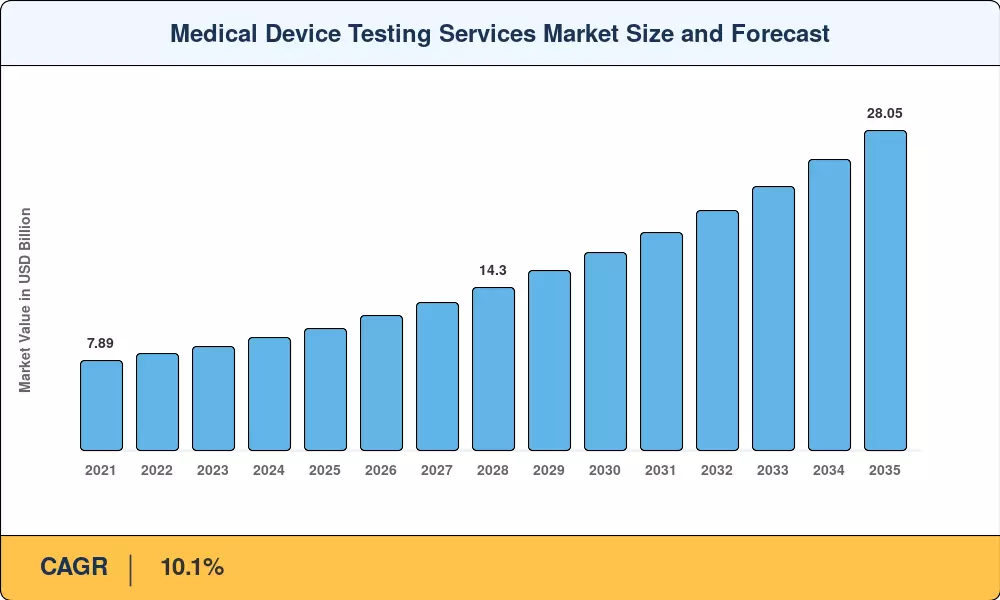
Medical Device Testing Services Market Size and Forecast
Our Impact
Enabled $4.3B Revenue Impact for Fortune 500 and Leading Multinationals
Partnering with 2000+ Global Organizations Each Year
30K+ Citations by Top-Tier Firms in the Industry

Driver Impact Analysis

Driver ~% Impact on CAGR Geographic Relevance Impact Timeline
Tightening FDA and EU MDR regulatory requirements +2.2 North America, Europe Short-term (≤2 yr)
Connected-device and AI/ML device proliferation +1.9 Global Medium-term (2–4 yr)
Outsourcing shifts from in-house to third-party labs +1.5 Global Medium-term (2–4 yr)
Asia-Pacific regulatory harmonization (NMPA, CDSCO, PMDA) +1.3 Asia-Pacific Long-term (≥4 yr)
Adoption of in-silico and computational testing tools +1.1 North America, Europe Long-term (≥4 yr)
Post-market surveillance expansion under MDR/IVDR +1.0 Europe Short-term (≤2 yr)
Growth of combination products and drug-device hybrids +0.8 North America, Europe Medium-term (2–4 yr)


Tightening FDA and EU MDR Regulatory Requirements

The FDA's 2023 final guidance on cybersecurity in medical devices (Section 524B of the FD&C Act) now makes a software bill of materials (SBOM) and threat-model documentation mandatory for every pre-market submission involving connected functionality [1]. Simultaneously, the EU MDR's Article 120 transition timeline forced an estimated 23,000 legacy devices through full re-certification by May 2024, generating a backlog that notified bodies still process at constrained throughput — Medtech Europe reported a 42% shortfall in notified-body audit capacity as recently as Q1 2025 [2]. Together, these mandates guarantee sustained demand for external testing partners equipped with cross-jurisdictional accreditation.

Connected-Device and AI/ML Device Proliferation

The integration of Artificial Intelligence and Machine Learning (AI/ML) into medical technology is accelerating rapidly. By early 2026, the FDA had authorized over 1,350 AI-enabled medical devices, a significant increase from 2022 figures. This growth trajectory necessitates rigorous electromagnetic compatibility (EMC) screening, software lifecycle verification, and wireless coexistence testing. Simultaneously, the global wearable health technology market is experiencing sustained expansion, with billions of units currently active. Every new variant or software update for these connected devices must undergo stringent biocompatibility, electrical safety, and human-factors (usability) validation before market entry, driving the demand for specialized third-party testing services.


Outsourcing Shift from In-House to Third-Party Labs

The high fixed costs associated with maintaining internal, ISO 17025-accredited testing laboratories—which include specialized equipment, facility overhead, and highly trained personnel—have incentivized mid-tier and large-scale device manufacturers to shift toward external testing partners. Industry trends indicate that third-party labs, which aggregate testing demand across numerous OEMs, are becoming the preferred model for pre-clinical biocompatibility and safety testing. This structural move allows manufacturers to optimize R&D expenditure and reduce time-to-market by leveraging the broader, validated scope of accreditation held by global testing organizations.


Asia-Pacific Regulatory Harmonization

China's NMPA completed a major overhaul of its device registration system in 2021, aligning review pathways with ISO 13485 and IEC 62304 for the first time [7]. India's CDSCO rolled out revised Medical Device Rules in 2023, mandating third-party lab testing for Class C and Class D devices. Japan's PMDA continues to accept STED-format dossiers with mutual recognition of certain IEC test reports. Collectively, these reforms create new billable testing volume that international labs — SGS, Intertek, TÜV SÜD — are capturing through regional facility expansion.


Restraints Impact Analysis

Restraint ~% Impact on CAGR Geographic Relevance Impact Timeline
In-silico substitution of legacy wet-lab protocols –0.9 North America, Europe Long-term (≥4 yr)
Notified-body and lab capacity bottlenecks –0.7 Europe Short-term (≤2 yr)
Price compression from commoditized routine tests –0.6 Global Medium-term (2–4 yr)
Lengthy accreditation timelines for new entrants –0.5 Asia-Pacific, South America Medium-term (2–4 yr)
Data-sovereignty restrictions on cross-border testing –0.4 Asia-Pacific, MEA Long-term (≥4 yr)


In-Silico Substitution of Legacy Protocols

Computational modeling is progressively displacing bench-level tests that once represented reliable, recurring revenue for testing labs. The FDA's 2024 CM&S draft guidance endorses virtual biocompatibility screening for chemical characterization and cytotoxicity prediction under ISO 10993-18 [4]. While this reduces cost for OEMs, it compresses revenue for providers whose service mix skews heavily toward conventional extractables-and-leachables studies — a segment estimated at USD 1.1 billion globally in 2024. Providers that fail to integrate in-silico capabilities risk losing 10–15% of their biocompatibility revenue by 2030.

Notified-Body Capacity Bottlenecks

Europe currently operates with only 39 MDR-designated notified bodies, down from over 80 under the legacy Medical Device Directive [11]. This shortage creates audit backlogs that slow device re-certification and, by extension, delay the downstream testing campaigns that manufacturers schedule around conformity assessment timelines. The bottleneck temporarily suppresses the volume of testing engagements that labs can initiate, even though total addressable demand remains elevated.

Price Compression from Commoditized Routine Tests

Routine sterility assays, particulate-matter counts, and basic electrical safety checks face steady pricing pressure as more labs achieve ISO 17025 accreditation in cost-competitive geographies such as India and Malaysia [13]. Average per-test pricing for standard bioburden assays declined approximately 8% between 2021 and 2024 across the Asia-Pacific region, squeezing margins even as volumes grow. This trend incentivizes labs to shift their revenue mix toward higher-value, consultancy-embedded testing packages.


Medical Device Testing Services Market Opportunities

AI-Driven Autonomous Testing Platforms

Robotic sample-handling systems paired with machine-learning-based anomaly detection can increase lab throughput by 40–50% while reducing human error rates [15]. Labs that invest in automation platforms — Siemens Healthineers' Atellica-style robotic lines adapted for device testing — will capture throughput-sensitive OEM contracts as product refresh cycles compress below 18 months.

Emerging-Market Lab Expansion

Africa's medical device import market is projected to reach USD 9.4 billion by 2030, yet fewer than 10 ISO 17025-accredited device testing labs operate across the continent today [16]. Nigeria, Kenya, and South Africa represent near-term entry points where international testing firms can establish satellite facilities aligned with local regulatory bodies such as NAFDAC and SAHPRA, generating first-mover advantages in a market currently served almost entirely by overseas labs.

Lifecycle Testing-as-a-Service (TaaS) Models

Rather than billing per test, leading labs are piloting subscription-based contracts that cover a product's full lifecycle — from design verification through post-market surveillance. This annuity model smooths revenue cyclicality and deepens client switching costs. Early adopters report 25% higher customer retention rates versus project-based pricing [6].

Real-World Evidence Integration

The FDA's 2023 framework for leveraging real-world data (RWD) in regulatory decisions opens a pathway for testing labs to bundle post-market performance analytics with traditional surveillance testing [17]. Labs that build data-science capabilities can offer integrated RWD dossiers, raising average contract values by an estimated 35% versus standalone testing.

Combination Product and Drug-Device Hybrid Testing

Combination products — such as pre-filled syringes with integral needle-safety devices or drug-eluting stents — require parallel testing under both 21 CFR 820 (device QSR) and 21 CFR 211 (drug cGMP) [9]. Fewer than 15% of global testing labs hold dual accreditation across these frameworks, creating a premium pricing opportunity for those that do.


Medical Device Testing Services Market Future Outlook

AI-Integrated Testing Workflows

Artificial intelligence will reshape the medical device testing services market not by replacing lab work but by compressing it. Machine-learning algorithms capable of predicting biocompatibility endpoints from chemical-structure databases — such as QSAR models accepted under revised OECD guidelines — could reduce animal-study requirements by 30–40% for qualifying materials by 2030 [15]. Labs that embed AI triaging into their intake workflows will deliver faster turnaround and attract the growing cohort of software-as-a-medical-device (SaMD) developers whose products iterate on six-month cycles rather than multi-year design-freeze timelines.

Platform Economics and Lab Consolidation

The testing industry's top five players currently hold an estimated 32–36% combined revenue share, and M&A activity suggests that figure will climb past 40% by 2030 as platform-scale economics reward breadth of accreditation [6]. Eurofins Scientific alone completed over 40 acquisitions between 2020 and 2024, extending its geographic footprint into India, South Korea, and Brazil. Smaller labs lacking capital for instrument upgrades and digital workflow investments will increasingly become acquisition targets, accelerating the medical device testing services market toward moderate-to-high concentration.

Sustainability and Green Chemistry in Testing Protocols

The European Commission's 2024 revision of REACH restrictions on per- and polyfluoroalkyl substances (PFAS) directly impacts extractables-and-leachables protocols for polymer-based devices [21]. Labs will need validated alternative solvents and analytical methods, a transition that the International Organization for Standardization is addressing through ISO 10993-18 Amendment 2, expected for publication by 2027. Testing providers that proactively develop green-chemistry-compatible workflows will differentiate themselves with ESG-conscious OEMs and notified bodies prioritizing sustainable manufacturing evidence.

Real-World Performance Monitoring as a Testing Service

Post-market surveillance is evolving from periodic complaint-review exercises into continuous, data-driven performance monitoring. The FDA's 2024 National Evaluation System for Health Technology (NEST) initiative connects real-world device performance data from electronic health records, registries, and claims databases to regulatory decision-making [17]. Testing labs positioned to collect, curate, and analyze RWD on behalf of manufacturers will unlock a high-margin service layer atop traditional bench testing — transforming the medical device testing services market from a pre-market bottleneck into a lifecycle partner.


Medical Device Testing Services Market Segmentation

By Service Type

Segment Metric Primary Demand Driver
Biocompatibility Testing 32.0% share (2024) ISO 10993 requirements across all device classes
Sterility & Microbiology Testing USD 2.24 Billion (2025) Single-use device proliferation
Electrical Safety & EMC Testing 14.5% CAGR (2026–2035) Connected-device and wearable growth
Material Characterization & Analytical Chemistry 16.8% share (2024) Extractables/leachables for polymer devices
Other Service Types 10.1% CAGR (2026–2035) Shelf-life, package integrity, usability


Biocompatibility testing remains the single largest service category in the medical device testing services market because virtually every device that contacts patient tissue, blood, or mucosal surfaces must generate a biological evaluation file under ISO 10993. The scope ranges from cytotoxicity and sensitization assays through chronic implantation studies that can run 26 weeks or longer for Class III products. Electrical safety and EMC testing is catching up as the fastest-growing segment because connected devices — from Bluetooth-enabled insulin pumps to RF-communicating surgical robots — must satisfy IEC 60601-1-2 Ed. 4 electromagnetic compatibility suites alongside traditional electrical leakage and dielectric strength protocols.

By Development Phase

Segment Metric Primary Demand Driver
Pre-Clinical Testing 47.5% share (2024) Front-loaded regulatory evidence requirements
Clinical-Phase Testing 21.3% share (2024) GCP-compliant performance validation
Post-Market Surveillance Testing 13.8% CAGR (2026–2035) MDR Article 83, FDA NEST framework


Pre-clinical testing dominates spending because regulators across all major jurisdictions require exhaustive bench and animal data before granting first-in-human study approvals. The medical device testing services market sees the fastest growth, however, in post-market surveillance, where the EU MDR's periodic safety update report (PSUR) and post-market clinical follow-up (PMCF) obligations compel manufacturers to maintain continuous testing relationships well beyond initial market clearance.

By Device Class

Segment Metric Primary Demand Driver
Class I Devices 11.2% share (2024) Baseline biocompatibility and labeling verification
Class II Devices 55.0% share (2024) Largest device population by SKU count
Class III Devices 14.8% CAGR (2026–2035) Complex implantables and combination products


Class II devices generate the majority of testing revenue simply because this classification encompasses the broadest spectrum of products — from powered surgical instruments to diagnostic imaging accessories — that require substantial equivalence evidence under the 510(k) pathway. Class III device testing grows fastest because these high-risk products demand the most extensive test programs, often spanning multi-year implantation studies, fatigue and wear testing, and full electrical safety suites.

By End User

Segment Metric Primary Demand Driver
Medical Device OEMs 61.0% share (2024) Direct regulatory submission responsibility
Contract Research Organizations 12.8% CAGR (2026–2035) CRO-mediated outsourcing for smaller OEMs
Academic & Research Institutions 8.6% share (2024) Investigator-initiated device studies
Hospitals & Healthcare Systems 5.2% share (2024) In-house reprocessing validation


OEMs remain the dominant end-user segment because they carry direct responsibility for assembling the regulatory dossier — and therefore for commissioning every test that populates it. Contract research organizations represent the fastest-growing channel as mid-tier and start-up device companies increasingly delegate entire testing programs to CROs capable of managing multi-site, multi-jurisdiction campaigns under a single master service agreement.


Regional Market Share Analysis

Region Metric Primary Investment Themes
North America 39.2% revenue share (2024) FDA cybersecurity mandates, AI/ML clearance surge
Europe 26.5% revenue share (2024) MDR/IVDR re-certification backlog
Asia-Pacific 13.0% CAGR (2026–2035) NMPA overhaul, CDSCO expansion, PMDA alignment
South America USD 0.62 Billion (2025) ANVISA modernization, local OEM growth
Middle East & Africa 5.7% revenue share (2024) Import-driven testing demand, SAHPRA capacity building
Total USD 10.72 Billion (2025)

The medical device testing services market maintains a pronounced tilt toward developed-market regulatory hubs, though the regional mix is shifting as emerging economies formalize their device oversight infrastructure.


North America

Country Metric Key Driver
United States 82.3% of regional share FDA 510(k)/PMA pipeline volume
Canada 10.6% of regional share Health Canada MDSAP participation
Mexico COFEPRIS-aligned testing mandates Nearshoring of device manufacturing


The United States alone accounts for the bulk of North American demand because the FDA's pre-market review system — spanning 510(k), De Novo, and PMA pathways — touches an estimated 6,200 device submissions annually [18]. Canada's adoption of the Medical Device Single Audit Program (MDSAP) has streamlined manufacturer audits but simultaneously raised the testing evidence bar, compelling exporters to engage accredited North American labs. Mexico's expanding medical device manufacturing base, driven by nearshoring trends from multinationals such as Medtronic and Becton Dickinson, adds incremental testing demand anchored to COFEPRIS registration requirements.

Europe

Country Metric Key Driver
Germany 23.8% of regional share TÜV/DEKRA notified-body concentration
United Kingdom 11.4% CAGR Post-Brexit UKCA marking requirements
France 15.2% of regional share LNE/G-MED accreditation hub
Italy USD 0.38 Billion (2025) Orthopedic and cardiovascular device cluster
Spain 6.1% of regional share Growing IVD manufacturing base
Nordic Countries 8.7% of regional share Digital health and wearable focus
Russia 3.2% of regional share Roszdravnadzor registration mandates
Rest of Europe 10.8% of regional share Varied national transpositions of MDR


Europe's medical device testing services market is shaped by the MDR/IVDR transition, which has created an estimated EUR 2.1 billion compliance-testing surge between 2021 and 2027 [2]. Germany leads regionally because four of Europe's largest notified bodies — TÜV SÜD, TÜV Rheinland, DEKRA, and BSI Germany — operate headquarters or major technical centers on German soil. The UK's divergence from EU regulation through its UKCA marking scheme effectively duplicates testing requirements for any manufacturer selling into both markets, adding incremental volume that benefits labs with dual-accredited facilities.

Asia-Pacific

Country Metric Key Driver
China 34.6% of regional share NMPA reform and domestic OEM expansion
India 14.8% CAGR CDSCO Medical Device Rules 2023
Japan 22.1% of regional share PMDA quality standards, aging-society device demand
South Korea 12.5% of regional share MFDS K-MDR framework
ASEAN 11.2% CAGR AMDD harmonization initiative
Rest of Asia-Pacific 8.4% of regional share Emerging regulatory formalization


Asia-Pacific represents the fastest-growing region in the medical device testing services market, driven by regulatory modernization across its three largest economies. China's NMPA processed over 18,000 device registrations in 2024, a 22% increase over 2022, and mandated third-party testing for all Class III and select Class II products [7]. India's revised Medical Device Rules require performance-testing evidence from NABL-accredited laboratories for higher-risk categories, creating fresh demand that both global and domestic labs are racing to capture. Japan's PMDA maintains some of the world's most rigorous usability and electrical-safety requirements, sustaining premium testing revenue per submission.

South America

Country Metric Key Driver
Brazil 62.4% of regional share ANVISA GMP and registration mandates
Argentina 18.1% of regional share ANMAT device classification system
Rest of South America 19.5% of regional share Varied harmonization with IMDRF


Brazil's ANVISA has progressively tightened good manufacturing practice inspections for imported devices since 2020, requiring detailed test reports from ISO 17025-accredited facilities as part of the ANVISA registration dossier [19]. This policy creates a captive testing-demand stream for every multinational targeting the Brazilian market, which imported approximately USD 4.2 billion in medical devices in 2024.

Middle East & Africa

Country Metric Key Driver
Saudi Arabia 28.3% of regional share Saudi FDA (SFDA) Vision 2030 healthcare investment
UAE 24.7% of regional share Dubai MedTech hub, MOH registration
South Africa 19.2% of regional share SAHPRA medical device regulation rollout
Egypt 11.5% of regional share EDA device classification modernization
Rest of MEA 16.3% of regional share Fragmented regulatory landscape


The Middle East & Africa region is in the early stages of formalizing device testing infrastructure. Saudi Arabia's SFDA published updated guidance on electromagnetic compatibility testing in 2024, aligned with IEC 60601-1-2 Ed. 4, creating new testing mandates for the estimated 18,000 device registrations processed annually [20]. South Africa's SAHPRA, which assumed regulatory responsibility from the Medicines Control Council in 2018, has been steadily building its medical-device evaluation capacity. However, testing remains predominantly outsourced to European and North American labs.


Medical Device Testing Services Market By Region, 2025-2035

Competitive Benchmarking

The medical device testing services industry is moderately concentrated. The top five players hold an estimated combined share of 32–36%, with the rest of the majority coming from a lengthy tail of specialized regional laboratories. The Herfindahl-Hirschman Index (HHI) is in the range of 600-900, suggesting a fairly fragmented business with scale advantages in the breadth of accreditations and geography being supplemented with specialty knowledge in some test areas.

Company Est. Revenue Share Range Key Offerings Strategic Positioning
SGS SA ~7–9% Biocompatibility, sterilization validation, EMC testing Broadest global lab network; 2,600+ offices
Bureau Veritas ~5–7% Material characterization, regulatory consulting Strong EU MDR conformity assessment positioning
Intertek Group ~5–7% Electrical safety, wireless coexistence, performance testing Deep IEC 60601 and FDA 510(k) expertise
TÜV SÜD ~4–6% Full-scope notified-body and testing services Dual notified-body/lab accreditation advantage
Eurofins Scientific ~4–6% Biocompatibility, microbiology, analytical chemistry Aggressive acquisition-led geographic expansion
UL Solutions ~3–5% Electrical safety, EMC, cybersecurity testing Strong brand in North American safety certification
Element Materials Technology ~3–5% Materials testing, fatigue and mechanical evaluation Specialized in implant-grade material validation
NAMSA ~2–4% Biocompatibility, toxicology, regulatory strategy Dedicated MedTech-only focus
Toxikon Corporation ~1–3% GLP biocompatibility, analytical chemistry Specialized contract lab for Class III devices
WuXi AppTec ~1–3% Bioanalytical, microbiology, device-drug combo testing Asia-Pacific CRO scale with cross-border reach


Recent News & Developments


  • FDA (March 2024): Published draft guidance on computer modeling and simulation for medical device regulatory submissions, formally endorsing CM&S as supplementary evidence [4].
  • European Commission (September 2023): Extended the MDR transition deadline for certain Class III and implantable devices to December 2027 under Regulation (EU) 2023/607, redistributing testing timelines across a wider window [8].


Medical Device Testing Services Market Report Scope

Parameter Detail
Market Scope Global medical device testing services market covering testing, validation, and certification services for regulated medical devices
Study Period 2021–2035
Historical Period 2021–2024
Base Year 2025
Forecast Period 2026–2035
CAGR (2026–2035) 10.1%
Market Size (2025) USD 10.72 Billion
Market Size (2035) USD 28.05 Billion
Fastest Growing Segment Electrical Safety & EMC Testing (14.5% CAGR)
Fastest Growing Region Asia-Pacific (13.0% CAGR)
Companies Profiled SGS, Bureau Veritas, Intertek, TÜV SÜD, Eurofins, UL Solutions, Element, NAMSA, Toxikon, WuXi AppTec
Valuation Currency USD Billion


FAQs

How long does a typical Class III biocompatibility testing program take from protocol design to final report?

A full ISO 10993-compliant program for a Class III implantable device typically requires 9–14 months, driven primarily by 26-week chronic implantation studies and histopathology analysis timelines [3].

What accreditations should buyers verify before selecting a medical device testing services market provider?

Prioritize ISO 17025 for lab competence, ISO/IEC 13485 awareness, and GLP certification for toxicology studies. FDA-recognized and EU-notified-body affiliations add jurisdictional credibility [1].

How does the UKCA marking requirement affect testing costs for manufacturers selling into both EU and UK markets?

Manufacturers must duplicate certain EMC and safety tests under separate EU MDR and UKCA frameworks, raising compliance costs by an estimated 15–20% versus single-market submissions [2].

Can in-silico testing fully replace physical biocompatibility assays under current FDA guidelines?

No. The FDA's 2024 CM&S guidance allows computational models as supplementary evidence, not as standalone replacements for physical extraction and biological endpoint studies [4].

What pricing model delivers better value for high-volume OEMs — per-test billing or subscription-based testing-as-a-service?

Subscription models typically reduce per-unit costs by 20–30% for OEMs commissioning more than 50 test campaigns annually, while also locking in priority scheduling [6].

How are cybersecurity testing requirements changing the scope of pre-market submissions for connected devices?

The FDA now requires SBOM documentation, threat modeling, and patch-management plans for every networked device, adding 4–8 weeks and USD 80,000–150,000 to typical submission timelines [1].

Which emerging device categories are creating the most novel testing challenges for the medical device testing services market?

AI/ML-enabled SaMD products, biodegradable implants, and drug-device combination products each require multi-disciplinary testing protocols that span software, materials, and pharmacological endpoints simultaneously [5][9].    
Author
Author
Author Profile
Vikita Thakur LinkedIn
Senior Research Analyst
She holds an experience of about 5+ years in market research and business consulting projects for sectors such as life sciences, medical devices, and healthcare IT. She possesses a robust background in data analysis, market estimation, competitive intelligence, pipeline analysis market trend identification, and consumer behavior insights. Her expertise lies in technical Sales support, client interaction and project management, designing and implementing market research studies, conducting competitive analysis, and synthesizing complex data into actionable recommendations that drive business growth.
Co-Author
Co-Author Profile
Rahul Gotadki LinkedIn
Research Manager
He holds an experience of about 9+ years in Market Research and Business Consulting, working under the spectrum of Life Sciences and Healthcare domains. Rahul conceptualizes and implements a scalable business strategy and provides strategic leadership to the clients. His expertise lies in market estimation, competitive intelligence, pipeline analysis, customer assessment, etc.

Research Approach


Secondary Research

The secondary research process involved comprehensive analysis of regulatory databases, international standards repositories, peer-reviewed scientific journals, clinical validation studies, and authoritative health and standards organizations. Key sources included the US Food & Drug Administration (FDA) Center for Devices and Radiological Health (CDRH), European Medicines Agency (EMA) Medical Device Coordination Group (MDCG), International Organization for Standardization (ISO) Technical Committee 194 (Biological Evaluation of Medical Devices), International Electrotechnical Commission (IEC) TC 62 (Electrical Equipment in Medical Practice), National Institute of Standards and Technology (NIST) Health IT and Medical Devices Division, Centers for Disease Control and Prevention (CDC) Healthcare Infection Control Practices Advisory Committee, World Health Organization (WHO) Prequalification of Medical Devices Programme, European Commission Medical Device Regulation (EU MDR 2017/745) Database, Medicines and Healthcare products Regulatory Agency (MHRA) UK, Health Canada Medical Devices Bureau, Therapeutic Goods Administration (TGA) Australia, Pharmaceuticals and Medical Devices Agency (PMDA) Japan, China National Medical Products Administration (NMPA), ASTM International Committee F04 (Medical and Surgical Materials and Devices), Association for the Advancement of Medical Instrumentation (AAMI), Regulatory Affairs Professionals Society (RAPS), and Global Harmonization Task Force (GHTF) study group reports. These sources were used to collect regulatory framework data, certification requirement changes, biocompatibility testing protocols (ISO 10993 series), electrical safety standards (IEC 60601), sterilization validation requirements, clinical trial validation studies, and market landscape analysis for biocompatibility tests, chemistry tests, microbiology & sterility tests, and preclinical versus clinical phase testing services.

Additional secondary sources included annual reports and investor presentations from leading Contract Research Organizations (CROs) and testing laboratories, SEC filings (10-K, 10-Q) for publicly listed testing service providers, ISO certification body accreditation records, notified body audit reports, and industry association publications from AdvaMed (Advanced Medical Technology Association), MedTech Europe, and Asia Pacific Medical Technology Association (APACMed).


Primary Research

In the primary research process, supply-side and demand-side stakeholders were interviewed to obtain qualitative and quantitative insights. Supply-side sources included CEOs, COOs, VPs of Regulatory Affairs, Quality Assurance Directors, Laboratory Directors, and Business Development Heads from medical device testing laboratories, CROs, notified bodies, and regulatory consulting firms. Demand-side sources comprised VP-level executives and regulatory managers from Class II and Class III medical device manufacturers, quality directors from pharmaceutical-medical device combination product companies, and procurement leads from multinational medical device corporations, emerging medtech startups, and hospital procurement consortia. Primary research validated

Download Free Sample

Kindly complete the form below to receive a free sample of this Report

Download PDF ×

We do not share your information with anyone. However, we may send you emails based on your report interest from time to time. You may contact us at any time to opt-out.














