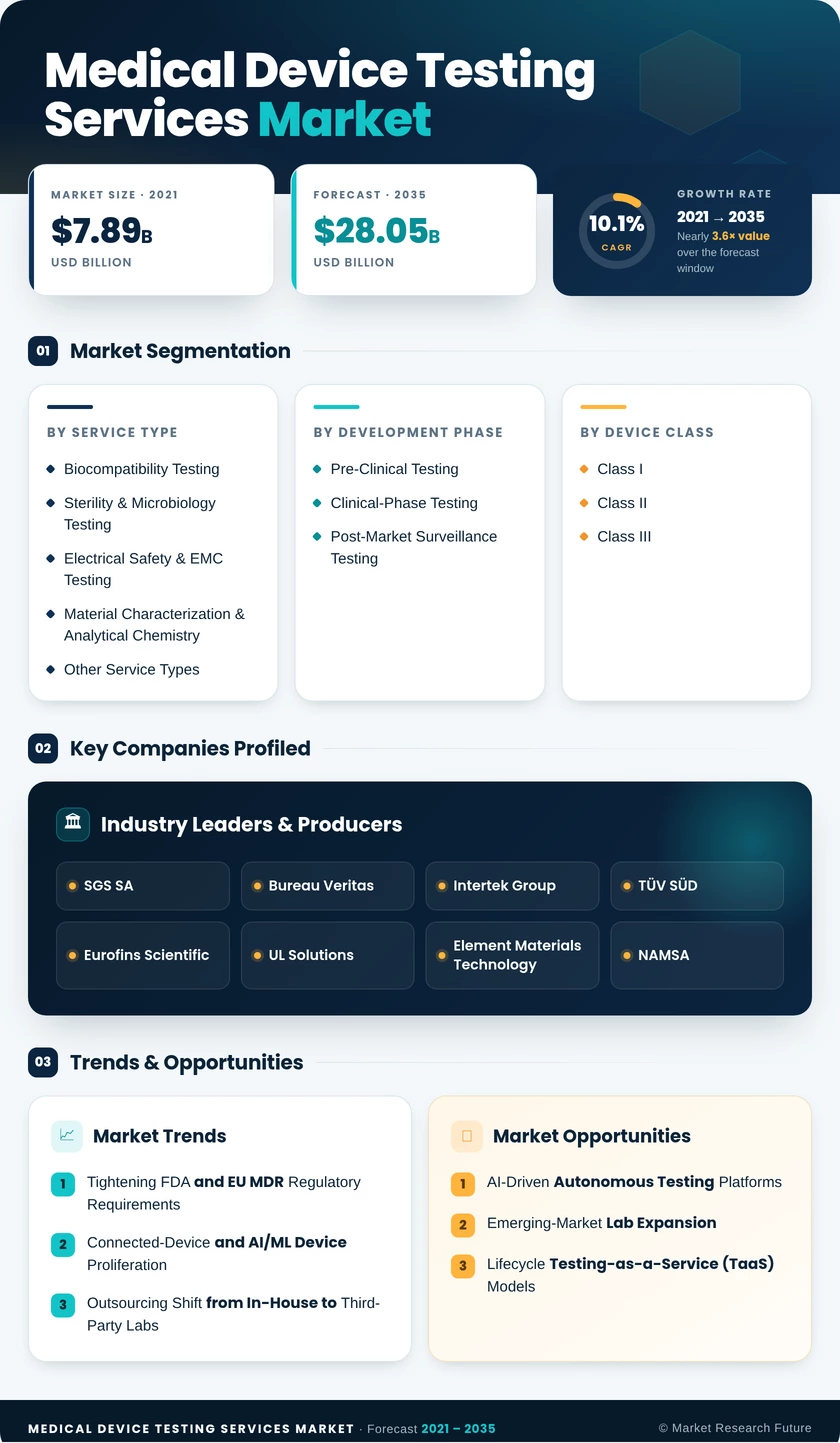
Segmentation Quick Reference
| Dimension | Sub-Segments | Dominant Segment | Fastest Growing Segment |
| Service Type | Biocompatibility Testing; Sterility & Microbiology Testing; Electrical Safety & EMC Testing; Material Characterization & Analytical Chemistry; Other Service Types | Biocompatibility Testing (32.0% share, 2024) | Electrical Safety & EMC Testing (14.5% CAGR) |
| Development Phase | Pre-Clinical Testing; Clinical-Phase Testing; Post-Market Surveillance Testing | Pre-Clinical Testing (47.5% share, 2024) | Post-Market Surveillance Testing (13.8% CAGR) |
| Device Class | Class I; Class II; Class III | Class II (55.0% share, 2024) | Class III (14.8% CAGR) |
| End User | Medical Device Testing Services Market OEMs; Contract Research Organizations; Academic & Research Institutions; Hospitals & Healthcare Systems | Medical Device Testing Services Market OEMs (61.0% share, 2024) | Contract Research Organizations (12.8% CAGR) |
| Geography | North America; Europe; Asia-Pacific; South America; Middle East & Africa | North America (39.2% share, 2024) | Asia-Pacific (13.0% CAGR) |
Market Segmentation Overview
By Service Type
| Sub-Segment | Key Trend |
| Biocompatibility Testing | Shift toward in-silico toxicology supplements under revised ISO 10993-18 guidance. |
| Sterility & Microbiology Testing | Growing demand from the proliferation of single-use surgical devices |
| Electrical Safety & EMC Testing | Rapid expansion driven by connected wearables and AI-enabled implantables |
| Material Characterization & Analytical Chemistry | Increasing complexity of extractables/leachables programs for novel polymer materials |
| Other Service Types | Shelf-life, package integrity, and human factors/usability testing are gaining prominence. |
Biocompatibility testing remains the foundational service category, required across virtually all device classifications that involve patient contact. Electrical safety and EMC testing is gaining share fastest as wireless connectivity and AI-driven functionality become standard features in new-generation devices, requiring multifaceted IEC 60601 compliance suites.
By the Development Phase
| Sub-Segment | Key Trend |
| Pre-Clinical Testing | Front-loaded regulatory evidence strategy drives the majority of spending |
| Clinical-Phase Testing | GCP-compliant device performance validation is rising with combination products. |
| Post-Market Surveillance Testing | EU MDR PSUR/PMCF obligations and FDA NEST framework expand ongoing testing mandates. |
Pre-clinical testing commands the largest share because most regulatory pathways globally require substantial bench, animal, and analytical evidence before any first-in-human study can proceed. Post-market surveillance is accelerating as regulators shift from episodic complaint review to continuous performance monitoring models.
By Device Class
| Sub-Segment | Key Trend |
| Class I Devices | Baseline compliance testing with low per-device spend |
| Class II Devices | Broadest product population drives the highest aggregate testing volumes. |
| Class III Devices | Complex implantables and AI/ML diagnostics require extensive multi-year programs. |
Class II devices generate the largest total testing revenue due to the sheer breadth of products — from powered surgical tools to diagnostic accessories — that require 510(k) substantial-equivalence evidence. Class III device testing grows fastest, reflecting the rising complexity and regulatory burden of high-risk implantable and life-sustaining products.
By End User
| Sub-Segment | Key Trend |
| Medical Device Testing Services Market OEMs | Direct regulatory submission responsibility sustains dominant spend |
| Contract Research Organizations | CRO-mediated outsourcing is accelerating among start-ups and mid-tier OEMs |
| Academic & Research Institutions | Investigator-initiated device studies and translational research demand |
| Hospitals & Healthcare Systems | In-house reprocessing validation and point-of-care device verification |
OEMs remain the largest end-user segment because they bear direct accountability for every test in their regulatory submission dossier. CROs represent the fastest-growing channel as smaller device companies delegate entire multi-site testing programs under single master service agreements.
By Geography
| Sub-Segment | Key Trend |
| North America | Dense FDA-registered lab infrastructure and deepest OEM concentration |
| Europe | MDR/IVDR re-certification backlog is sustaining elevated compliance testing volumes |
| Asia-Pacific | NMPA, CDSCO, and PMDA reform driving fastest regional growth |
| South America | ANVISA GMP enforcement is creating captive import-driven testing demand |
| Middle East & Africa | Early-stage regulatory formalization; heavy reliance on overseas lab capacity |
North America leads globally owing to the scale of the FDA-regulated device ecosystem and the concentration of accredited testing labs. Asia-Pacific is the fastest-growing region as China, India, and Japan simultaneously modernize their device regulatory frameworks, unlocking fresh testing demand that global and domestic labs are racing to serve.