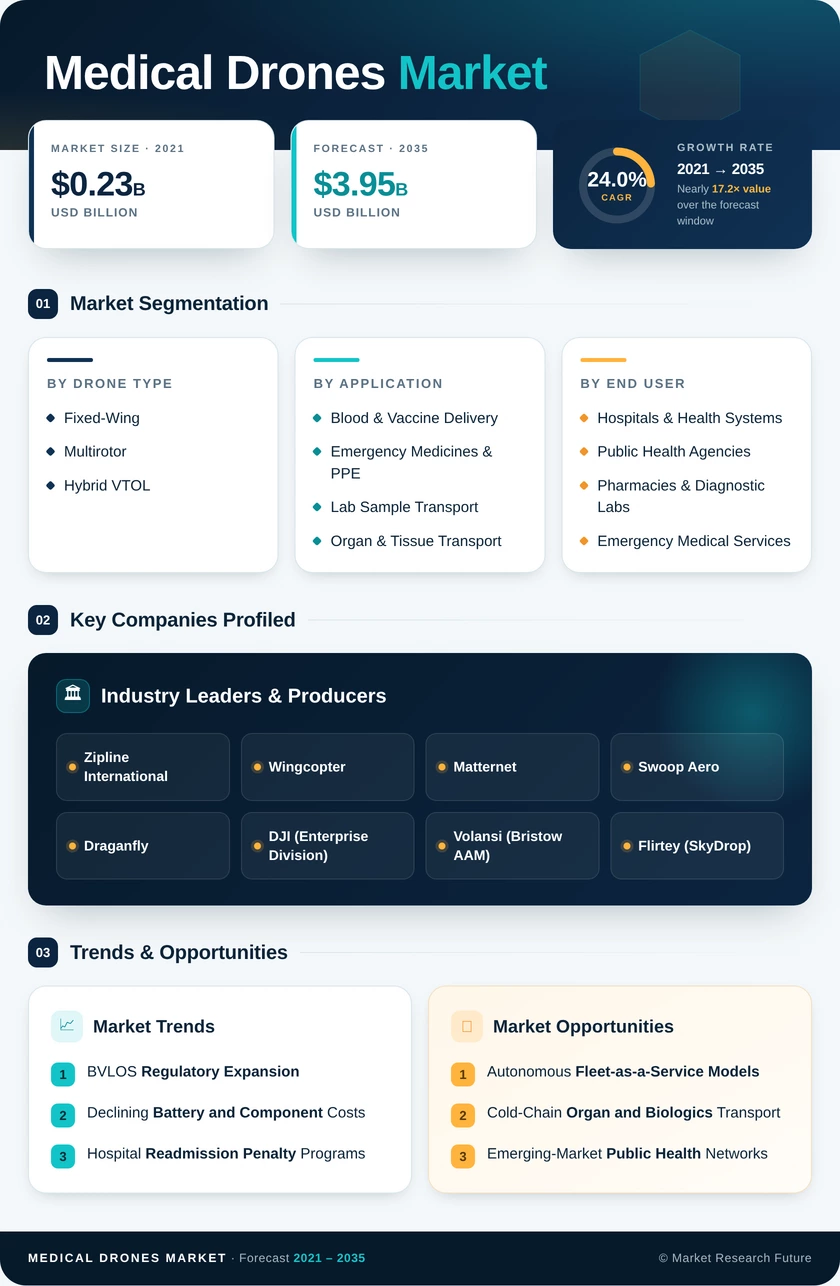
Segmentation Quick Reference
| Dimension | Sub-Segments | Dominant Segment | Fastest Growing Segment |
| Drone Type | Fixed-Wing, Multirotor, Hybrid VTOL | Multirotor (55.2% share, 2024) | Hybrid VTOL (28.9% CAGR) |
| Application | Blood & Vaccine Delivery, Emergency Medicines & PPE, Lab Sample Transport, Organ & Tissue Transport | Blood & Vaccine Delivery (49.8% share, 2024) | Organ & Tissue Transport (23.6% CAGR) |
| End User | Hospitals & Health Systems, Public Health Agencies, Pharmacies & Diagnostic Labs, Emergency Medical Services | Hospitals & Health Systems (56.5% share, 2024) | Public Health Agencies (23.8% CAGR) |
| Payload Capacity | <2 kg, 2–5 kg, >5 kg | 2–5 kg (44.5% share, 2024) | >5 kg (22.1% CAGR) |
| Range | ≤20 km, 20–80 km, >80 km | 20–80 km (47.9% share, 2024) | >80 km (22.7% CAGR) |
Market Segmentation Overview
By Drone Type
| Sub-Segment | Key Trend |
| Fixed-Wing | Preferred for long-range rural corridors; limited by runway or launcher requirements |
| Multirotor | Dominant in urban and campus environments, improving battery endurance |
| Hybrid VTOL | Fastest adoption curve; combines VTOL flexibility with fixed-wing range efficiency. |
Hybrid VTOL platforms are bridging the gap between short-range multirotor convenience and fixed-wing endurance, enabling missions that were previously impractical for either platform type alone. OEMs are prioritizing modular payload bays that allow rapid reconfiguration between blood-delivery and organ-transport missions.
By Application
| Sub-Segment | Key Trend |
| Blood & Vaccine Delivery | Established at scale in Africa and expanding to North America and Europe |
| Emergency Medicines & PPE | Growing rapidly post-pandemic as stockpile distribution strategies evolve |
| Lab Sample Transport | Hospital-to-lab shuttle services are reducing diagnostic turnaround times. |
| Organ & Tissue Transport | High-value, time-critical niche attracting premium service pricing |
Blood and vaccine delivery is the foundational use case that proved the commercial viability of medical drones. Organ and tissue transport is attracting outsize investment due to the exceptional revenue-per-flight opportunity and the measurable clinical impact of reduced ischemic times.
By End User
| Sub-Segment | Key Trend |
| Hospitals & Health Systems | Largest buyers, driven by operational efficiency and penalty avoidance |
| Public Health Agencies | Scaling from pilot programs to permanent infrastructure |
| Pharmacies & Diagnostic Labs | Emerging direct-to-patient prescription delivery models |
| Emergency Medical Services | AED and antidote dispatch for cardiac and overdose emergencies |
Hospitals remain the anchor customers, but the fastest growth is shifting toward public health agencies as national governments commit multi-year drone logistics contracts. Emergency medical services represent a high-profile opportunity with strong public support for drone-delivered AEDs and naloxone.
By Payload Capacity
| Sub-Segment | Key Trend |
| <2 kg | Lightweight diagnostic kits and single-unit pharmaceutical deliveries |
| 2–5 kg | Core segment covering blood products and multi-vial vaccine shipments |
| >5 kg | Emerging heavy-lift category for organs, bulk supplies, and emergency caches |
The 2–5 kg band will remain dominant through the forecast period, but the greater-than-5 kg category is where the next wave of platform innovation is concentrated as OEMs develop airframes capable of carrying 10–15 kg payloads across 100+ km distances.
By Range
| Sub-Segment | Key Trend |
| ≤20 km | Intra-campus and intra-city shuttle routes with high daily frequency |
| 20–80 km | Inter-facility suburban and peri-urban delivery; largest revenue segment |
| >80 km | Rural, remote, and island territory logistics; fastest growing range band |
The 20–80 km range segment captures the greatest share of current commercial activity. However, the greater-than-80 km band will see the steepest growth as hybrid VTOL and hydrogen-powered platforms extend practical mission radius into underserved geographies.