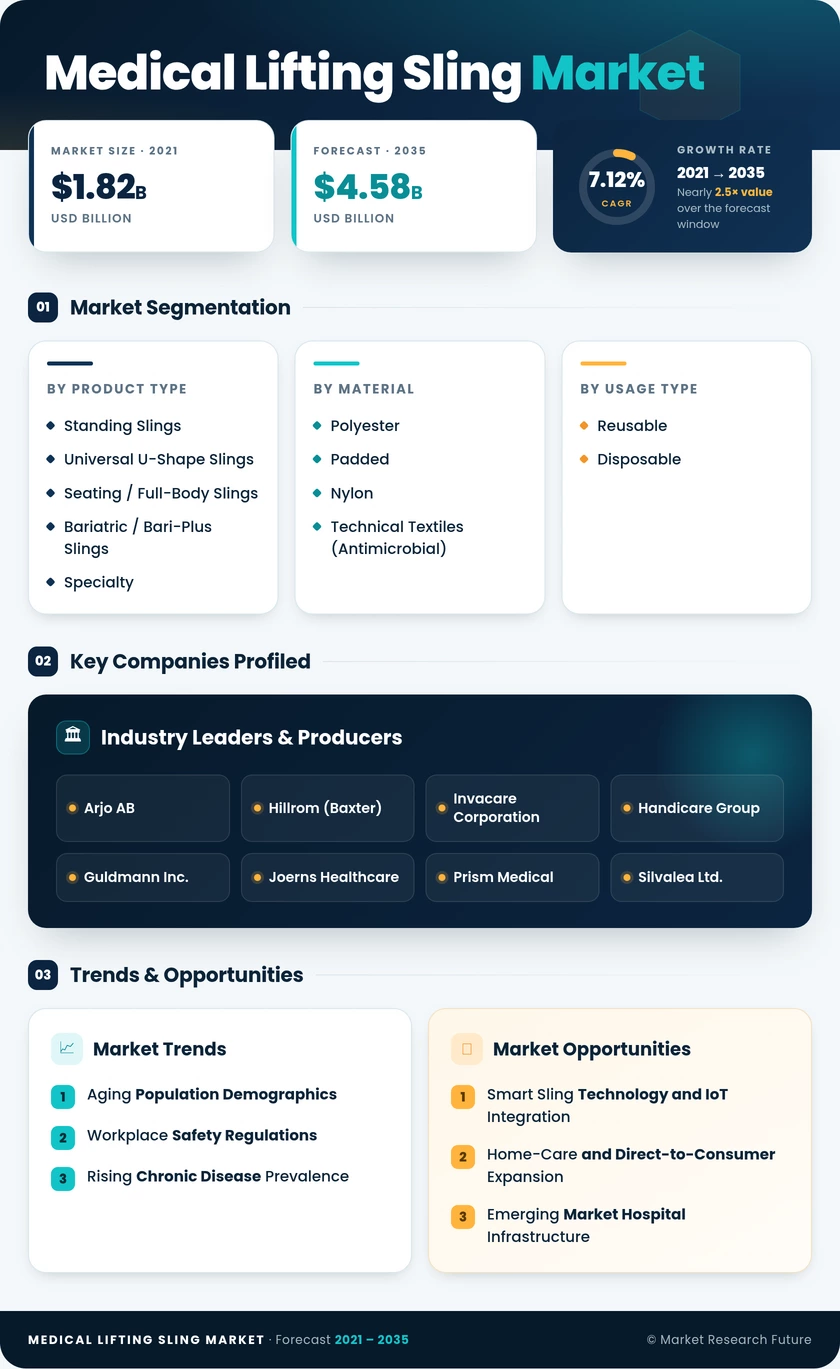
Segmentation Quick Reference
| Dimension | Sub-Segments | Dominant Segment | Fastest Growing Segment |
| Product Type | Standing Slings, Universal U-Shape Slings, Seating / Full-Body Slings, Bariatric / Bari-Plus Slings, Specialty and Toileting Slings | Seating / Full-Body Slings | Bariatric / Bari-Plus Slings |
| Material | Polyester, Padded, Nylon, Technical Textiles (Antimicrobial) | Polyester | Technical Textiles (Antimicrobial) |
| Usage Type | Reusable, Disposable | Reusable | Disposable |
| End User | Hospitals & Surgical Centers, Rehabilitation Centers, Home-Care & Long-Term Care, Others (Military, EMS) | Hospitals & Surgical Centers | Home-Care & Long-Term Care |
| Region | North America, Europe, Asia-Pacific, South America, Middle East & Africa | North America | Asia-Pacific |
Market Segmentation Overview
By Product Type
| Sub-Segment | Key Trend |
| Standing Slings | Growing adoption of early-mobilization rehabilitation protocols to reduce hospital length of stay |
| Universal U-Shape Slings | Increasing preference for multi-purpose slings that reduce inventory complexity across care settings |
| Seating / Full-Body Slings | Standard specification across acute-care procurement contracts; the highest unit volume globally |
| Bariatric / Bari-Plus Slings | Fastest-growing category driven by obesity prevalence and expanded safe working load requirements. |
| Specialty and Toileting Slings | Dignity-preserving designs are gaining traction in patient-centered care models. |
Product type segmentation reflects the clinical diversity of patient transfer scenarios, from simple standing assists in rehabilitation to complex full-body repositioning in critical care. Bariatric and bari-plus slings continue to gain procurement priority as healthcare systems adapt to heavier patient populations.
By Material
| Sub-Segment | Key Trend |
| Polyester | Industry-standard material maintains dominance through cost-performance balance. |
| Padded | Rising specification in long-term care settings prioritizing pressure injury prevention |
| Nylon | Preferred for lightweight disposable sling applications in acute settings |
| Technical Textiles (Antimicrobial) | Rapid adoption driven by hospital-acquired infection prevention mandates |
Material innovation is reshaping the competitive landscape, with antimicrobial technical textiles commanding price premiums of 25–40% over standard polyester. Sustainability-certified recycled polyester blends are emerging as a differentiator in European procurement tenders.
By Usage Type
| Sub-Segment | Key Trend |
| Reusable | Dominant format supported by industrial laundering infrastructure and sustainability goals |
| Disposable | Gaining share in infection-sensitive environments, including ICUs and isolation wards |
The reusable-versus-disposable balance varies significantly by care setting, with acute-care facilities increasingly adopting hybrid approaches that deploy disposable slings in high-risk isolation scenarios and reusable options for routine transfers.
By End User
| Sub-Segment | Key Trend |
| Hospitals & Surgical Centers | Largest buyer segment driven by regulatory compliance and high transfer volumes |
| Rehabilitation Centers | Expanding adoption of standing slings and progressive mobilization protocols |
| Home-Care & Long-Term Care | Fastest-growing segment benefiting from aging-in-place policies and DME reimbursement |
| Others (Military, EMS) | Niche applications in field medical operations and emergency patient evacuation |
End-user diversification is a defining trend in the medical lifting sling market, as traditional hospital-centric demand gives way to growth in home-care, rehabilitation, and non-traditional settings. The aging-in-place movement and expanded insurance coverage for home-based patient transfer equipment are accelerating this structural shift.