Medical Nutrition Market Summary
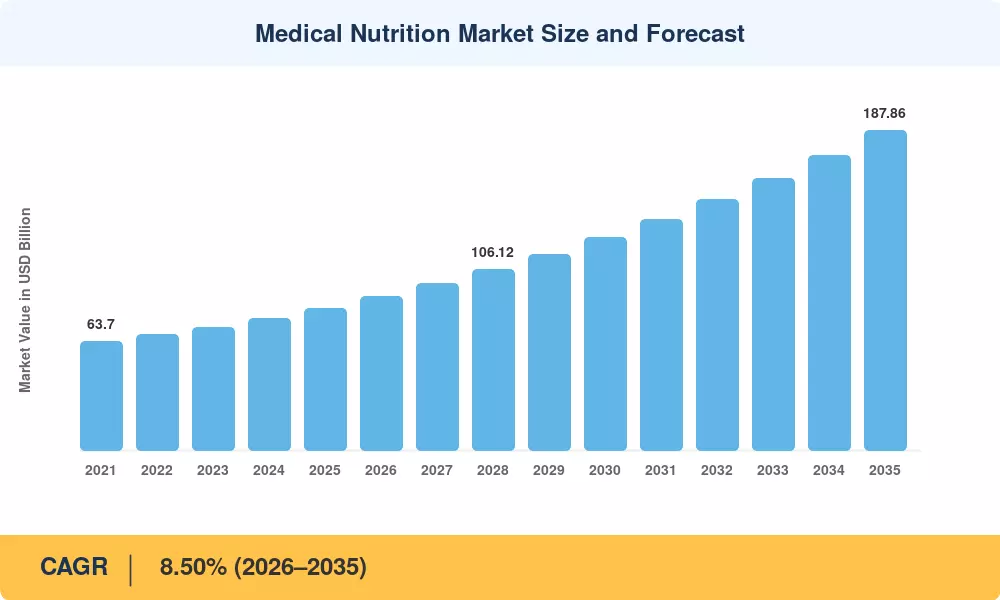
The Medical Nutrition Market reached an estimated USD 83.50 billion in 2025 and is projected to grow from USD 90.15 billion in 2026 to USD 187.86 billion by 2035, registering a CAGR of 8.50% during the 2026–2035 forecast period. This trajectory is anchored in the accelerating burden of chronic metabolic conditions — diabetes alone now affects over 537 million adults globally [1] — and an aging population that demands specialized dietary interventions across acute and post-acute care settings. Government-led nutrition screening mandates in the EU and expanded Medicare reimbursement codes for medical food in the United States are injecting policy-driven momentum into the Medical Nutrition Market.
There is a change going on in the delivery of nutritional care. Biomarker analytics and digital monitoring technologies are driving the shift away from traditional one-size-fits-all tube-feeding regimens towards condition-specific precision-formulated solutions. In 2023-2025, hospital systems in OECD nations committed an expected USD 4.2 billion to nutrition informatics and individualized feeding programs [2]. Moreover, regulatory agencies such as the FDA and EFSA have also simplified approval processes for Foods for Special Medical Purposes (FSMP), resulting in a shortening of the time to market for new formulations.
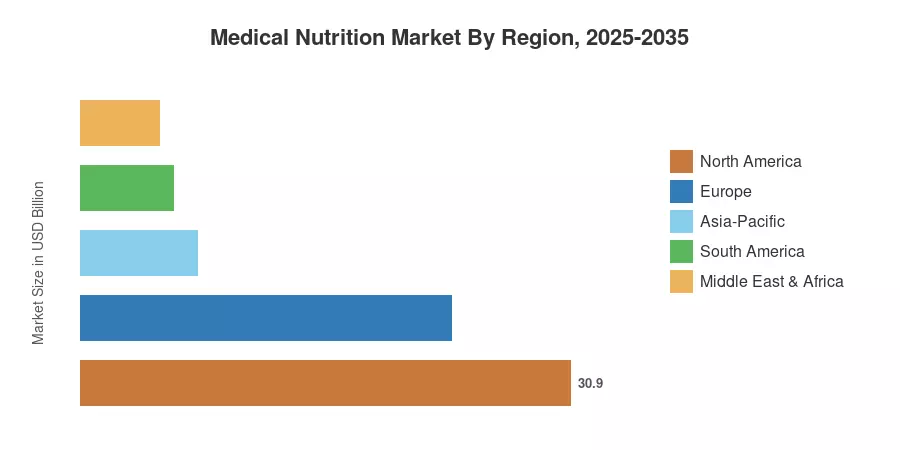
North America dominated the Medical Nutrition Market with the greatest part of almost 37.0% of 2025 revenue, followed by Europe. This may be attributed to the strong insurance frameworks and well-established dietetics infrastructure. The Asia-Pacific area is the fastest-growing at a predicted CAGR of 8.80% through 2035, driven by increasing healthcare expenditure in China and India. Europe is second with a share of around 28.0% of sales and has excellent uptake of clinical guidelines. The Medical Nutrition Market is poised for ongoing growth as nutritional therapy becomes an integral part of treatment procedures in multidisciplinary care models.
Key Report Takeaways
• By Route of Administration
- Oral and enteral administration accounted for approximately 74.0% of Medical Nutrition Market revenue in 2025, reflecting the dominance of bedside and home-based feeding protocols.
- Parenteral administration is forecast to expand at a 9.0% CAGR through 2035, driven by rising ICU admissions and complex surgical recovery needs.
• By Product Type & Form
- Infant nutrition products led the Medical Nutrition Market in 2025 with a 47.2% product-type share, supported by neonatal intensive care demand.
- Liquid formulations captured roughly 64.0% of form-based revenue in 2025, while semi-solid products are set to grow at a 9.1% CAGR.
• By Geography
- North America generated approximately USD 30.90 billion in 2025 Medical Nutrition Market revenue.
- The Asia-Pacific region is expected to post an 8.80% CAGR through 2035, with China and India as primary growth engines.
- Europe contributed about 28.0% of global demand, anchored by Germany, the UK, and France.
Market Size and Forecast (2021–2035)
The Medical Nutrition Market size has been estimated by Market Research Future (MRFR), using a triangulated approach, wherein the demand side is analyzed through care setting. In contrast, the supply side is analyzed through company financials. The estimates are cross-validated through data published by WHO & OECD health accounts on clinical nutrition expenditure [3].





















.webp?v=1787579597)
