Medical Spa Market (2025 - 2035)

Medical Spa Market Research Report: Size, Share, Trend Analysis By Service Type (Facial Treatments, Body Treatments, Hair Removal, Injectables, Skin Rejuvenation), By Client Demographics (Age Group, Gender, Income Level, Occupation), By Treatment Method (Non-Invasive, Minimally Invasive, Surgical), By Facility Type (Independent Medical Spas, Medical Spa Chains, Luxury Resorts with Spa Services) and By Regional (North America, Europe, South America, Asia Pacific, Middle East and Africa) - Growth Outlook & Industry Forecast 2025 To 2035
ID: MRFR/MED/9714-HCR
200 Pages
Rahul Gotadki, Kinjoll Dey
Last Updated: July 12, 2026
Medical Spa Market
Market Size
Forecast Period2025-2035
CAGR (2025-2035)15.77%
2025 Market Size24.35(USD Billion)
2035 Market Size105.34(USD Billion)
Key Players
Allergan Aesthetics
Galderma
Merz Aesthetics
Cynosure
Cutera
Syneron Candela
Opportunities
  • AI-Driven Skin Diagnostics and Personalization
  • Subscription and Membership Revenue Models
  • Emerging-Market Expansion in Southeast Asia and Latin America

Medical Spa Market Summary

The Medical Spa Market reached an estimated USD 25.20 billion in 2025 and is projected to grow from USD 28.60 billion in 2026 to USD 89.40 billion by 2035, registering a CAGR of 13.50% during the forecast period. This expansion tracks a structural shift: consumers across age groups and income bands now treat aesthetic procedures as routine personal care rather than luxury indulgences. Private-equity platforms have accelerated the pace of clinic consolidation, viewing cash-pay aesthetic revenue as a hedge against insurance-reimbursement volatility.

Technology is rewriting the medical spa playbook. Legacy single-function laser cabinets are giving way to multi-modal energy-based platforms capable of delivering fractional resurfacing, radiofrequency skin tightening, and intense pulsed light treatments from a single console. AI-guided skin diagnostics — already deployed in more than 3,200 clinics in North America — reduce consultation time and improve treatment plan accuracy. The American Med Spa Association estimates that clinics investing in next-generation platforms see 18–22% higher per-visit revenue within the first year of adoption.

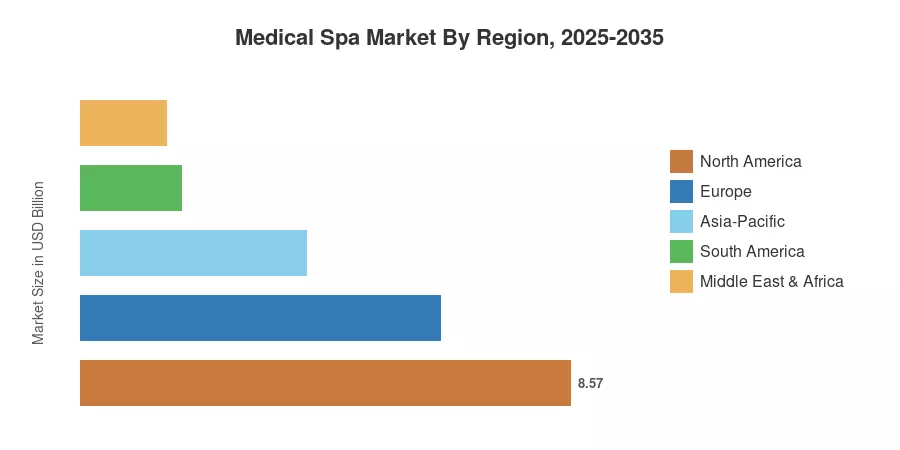
North America commands roughly 34.0% of the global Medical Spa Market revenue, anchored by high procedure volumes in the United States and a mature regulatory framework. Asia-Pacific stands as the fastest-growing region at a projected 15.7% CAGR through 2035, propelled by rising disposable incomes, booming medical-tourism corridors in Thailand and South Korea, and expanding middle-class populations in India and China. Europe holds the second-largest share at approximately 25.0%, driven by regulatory harmonization under the EU Medical Device Regulation. The coming decade will likely see these three regions collectively account for over 85% of global revenue.


Key Report Takeaways

• By Services

  • Facial treatments captured approximately 48.5% of the Medical Spa Market revenue in 2025, driven by high repeat-visit rates for chemical peels, microneedling, and hydrafacials.
  • Laser hair removal is advancing at a 16.3% CAGR through 2035, reflecting device miniaturization and declining per-session costs that widen the addressable patient pool.
  • Injectables — including neurotoxins and dermal fillers — generated an estimated USD 3.78 billion in 2025, supported by expanded FDA-approved indications.

• By End User

  • Female patients accounted for roughly 76.3% of the Medical Spa Market size in 2025, sustained by broad social acceptance and diversified treatment menus.
  • Male patient spend is growing at a 17.2% CAGR through 2035, propelled by destigmatization and targeted marketing campaigns.

• By Region

  • North America led with an estimated 34.0% revenue share in 2025, underpinned by high per-capita aesthetic spending.
  • Asia-Pacific is projected to expand at a 15.7% CAGR through 2035, with South Korea, Thailand, and India emerging as procedure-volume leaders.


Medical Spa Market Size and Forecast (2021–2035)

Market Research Future derives historical estimates from proprietary bottom-up clinic surveys, cross-referenced with published procedure-volume data from the International Society of Aesthetic Plastic Surgery and the American Med Spa Association. Forecast projections apply a compound model that factors demographic penetration curves, device replacement cycles, and regional regulatory timelines.
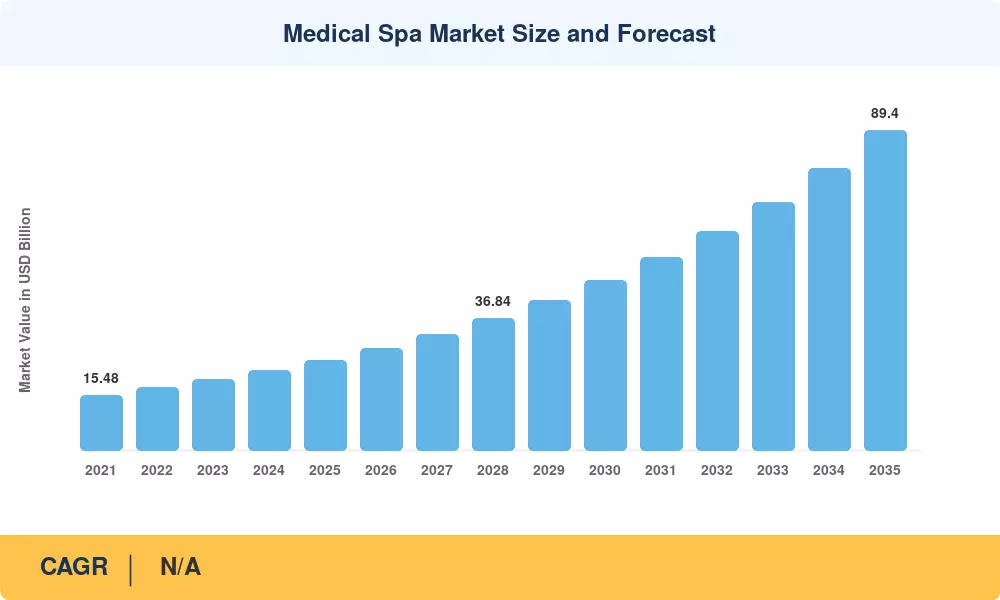
Medical Spa Market Size and Forecast
Our Impact
Enabled $4.3B Revenue Impact for Fortune 500 and Leading Multinationals
Partnering with 2000+ Global Organizations Each Year
30K+ Citations by Top-Tier Firms in the Industry

Driver Impact Analysis

Driver ~% Impact on CAGR Geographic Relevance Impact Timeline
Rising demand for minimally invasive procedures ~22% Global Short-term
Growing disposable incomes in emerging economies ~18% Asia-Pacific, South America Medium-term
Social-media-driven aesthetic awareness ~16% North America, Europe Short-term
Advances in energy-based device platforms ~15% Global Medium-term
Medical tourism corridor expansion ~12% Asia-Pacific, MEA Long-term
Male demographic penetration ~10% North America, Europe Medium-term
Private-equity consolidation of clinic networks ~7% North America Long-term


Rising Demand for Minimally Invasive Procedures

Minimally invasive methods are becoming increasingly popular among patients. The American Society of Plastic Surgeons (ASPS) estimates that 30.8 million procedures were performed in 2024, of which 91.5% (or roughly 28.2 million) were minimally invasive procedures like dermal fillers and neurotoxins. Large-scale demand lowers per-unit costs, which clinics use to boost competitive pricing and patient acquisition in this high-volume setting, creating a self-reinforcing loop.


Advances in Energy-Based Device Platforms

Clinics can provide a variety of treatments, including fractional CO2 resurfacing, picosecond laser removal, and RF microneedling, using a single base unit thanks to multi-application platforms from manufacturers like Cynosure and Cutera. Major medical technology companies are experiencing consistent momentum, even though precise "aesthetic-segment" growth rates vary by company. For instance, Hologic reported good development throughout its diverse business segments in FY2024, driven by surgical/interventional solutions and workflow efficiency. Clinics can maximize capital expenditures and expedite technician training by implementing these systems.


Medical Tourism Corridor Expansion

With the market for foreign patients seeking dermatological and cosmetic procedures expected to reach over USD 2 billion in 2024, South Korea continues to be a major global center for medical tourism. Tax incentives are also being used by nations like Thailand to draw in medical tourists who are interested in aesthetics. For many foreign tourists, these "skin holiday" packages, which combine several high-margin treatments, continue to increase average revenue per patient much above domestic standards.


Private-Equity Consolidation

As private equity companies seek scale through platform and add-on acquisitions, the medical spa industry in North America has seen substantial consolidation. The trend toward centralized management, bulk buying, and data-driven patient acquisition is well-documented, even though a precise, static count of "85+ acquisitions" is challenging to confirm because of the market's fragmentation. Due to the increased level of competition brought about by this consolidation, independent clinics are being forced to make larger investments in technology and marketing distinction in order to survive.


Restraints Impact Analysis

Restraint ~% Impact on CAGR Geographic Relevance Impact Timeline
Regulatory fragmentation across jurisdictions ~–25% Global Long-term
Adverse-event liability and malpractice costs ~–22% North America Medium-term
Shortage of qualified medical directors ~–20% North America, Europe Medium-term
High initial equipment and facility investment ~–18% Emerging Markets Short-term
Consumer price sensitivity in cash-pay models ~–15% South America, MEA Short-term


Regulatory Fragmentation

Medical-spa oversight varies sharply by jurisdiction. In the United States, licensure requirements differ state by state — Texas permits nurse practitioners to operate clinics independently while California mandates direct physician supervision for most energy-based treatments. The EU Medical Device Regulation, fully enforced since 2024, imposes certification timelines that can delay device launches by 12–18 months in European markets. This patchwork raises compliance costs and discourages smaller operators from expanding across borders.

Shortage of Qualified Medical Directors

The U.S. Bureau of Labor Statistics projects a 3% shortfall in physicians specializing in dermatology and aesthetic medicine through 2030, even as the clinic count rises. Clinics unable to recruit a supervising medical director face operational pauses or must contract part-time physicians at premium rates, squeezing margins particularly for single-site operators outside major metropolitan areas.

High Equipment Investment Thresholds

Investing in state-of-the-art aesthetic technology requires significant capital. While flagship multi-platform energy-based systems typically range from $80,000 to $200,000, specialized high-capacity configurations can push that investment higher. Beyond the initial purchase price, clinics must account for annual service contracts and proprietary consumables, which can add 15–30% to the total cost of ownership annually. For clinics entering emerging markets or operating in highly saturated regions where patient volume is unpredictable, this high capital barrier significantly extends the payback period and necessitates a focus on high-utilization, multi-application business models to ensure profitability.


Medical Spa Market Opportunities

AI-Driven Skin Diagnostics and Personalization

AI imaging platforms that map skin texture, pigmentation depth, and vascular patterns in under 60 seconds are transforming consultation workflows. Clinics deploying these tools report 30% higher treatment-plan acceptance rates because patients can visualize predicted outcomes on their own facial scans. As these platforms integrate with electronic health records, they will enable longitudinal tracking that deepens patient loyalty.

Subscription and Membership Revenue Models

Monthly membership programs — typically USD 99–249 per month for bundled treatments and product discounts — convert episodic patients into recurring revenue streams. The Medical Group Management Association found that med spas with active membership programs achieve 35% higher lifetime patient value than fee-for-service peers. This model also smooths seasonal demand troughs.

Emerging-Market Expansion in Southeast Asia and Latin America

Indonesia, Vietnam, and Colombia each recorded 20%+ annual growth in licensed aesthetic clinics between 2022 and 2024. Rising urban middle classes in these markets are adopting basic injectable and skin-rejuvenation services, creating greenfield opportunities for franchise operators who can adapt pricing and treatment menus to local affordability thresholds.

Combination Therapy Protocols

Clinicians are layering neurotoxins, hyaluronic-acid fillers, and energy-based skin tightening into single-visit combination protocols that yield higher per-appointment revenue. Peer-reviewed evidence published in the Journal of Cosmetic Dermatology demonstrates 25–40% greater patient satisfaction scores for multi-modal plans versus single-modality treatments.

CRM-Enabled Data Monetization and Retention Platforms

Clinical paperwork, scheduling, and automated communication are now all integrated into single CRM dashboards by modern clinic management software. Operators can use AI-driven reminder sequences that lower no-show rates by up to 30–50%, optimize treatment timing, and initiate personalized recall for follow-up services (such as neurotoxic touch-ups) by mining these datasets. For efficient benchmarking across multi-site or franchise portfolios, this "data layer" is crucial.


Medical Spa Market Future Outlook

AI-Augmented Clinical Decision-Making

By 2030, the majority of high-volume med-spa chains are expected to deploy AI copilots that analyze facial-aging simulations, recommend optimal filler volumes, and flag contraindication risks in real time. estimates that AI-assisted clinical workflows can compress consultation times by 40%, freeing practitioners to handle higher daily patient throughput.

Platform Economics and Franchise Scaling

The next decade will see the Medical Spa Market shift toward asset-light franchise models where a central platform provides branding, compliance oversight, and bulk procurement while local physician-owners manage clinical operations. This mirrors the dentistry sector's consolidation arc, and early indicators suggest that platform-affiliated clinics achieve EBITDA margins 8–12 percentage points above independents.

Regenerative Aesthetics

Exosome therapies, platelet-rich plasma micro-injections, and autologous stem-cell-derived skin-rejuvenation treatments are transitioning from clinical trial to commercial rollout. The regenerative aesthetics sub-segment could exceed USD 4 billion globally by 2033 if regulatory pathways in the U.S. and EU are finalized as anticipated.

Sustainability and ESG in Aesthetic Operations

Clinics are beginning to track single-use plastic waste from syringes, packaging, and device consumables. projects that med spas adopting verifiable sustainability programs will capture a 5–7% patient-preference premium by 2030, particularly among Gen-Z consumers who rank environmental stewardship alongside clinical outcomes.


Medical Spa Market Segmentation

By Services

Segment Key Metric Primary Demand Driver
Facial Treatment 48.5% share (2025) High repeat-visit protocols
Body Shaping & Contouring 13.8% CAGR Non-invasive fat reduction demand
Laser Hair Removal 16.3% CAGR Declining per-session pricing
Tattoo Removal USD 1.26 Billion (2025) Workforce and lifestyle motivations
Scars & Striae Treatment 4.5% share (2025) Post-surgical and post-pregnancy demand
Injectables USD 3.78 Billion (2025) Expanded neurotoxin indications


Facial treatments remain the bedrock of the Medical Spa Market, encompassing chemical peels, microdermabrasion, LED phototherapy, and hydrafacials. Clinics report that facial services account for the highest rebooking rates — typically 60–70% of facial patients schedule a follow-up within 90 days — creating a dependable revenue base. Laser hair removal, meanwhile, is the segment gaining share fastest, as diode-laser technology now accommodates a broader range of skin tones and hair types, eliminating a historical limitation that constrained adoption among diverse patient populations.

Injectables constitute the Medical Spa Market's most profitable per-minute service category. A single botulinum-toxin session lasting 15 minutes can generate USD 350–500 in revenue, and the introduction of longer-lasting next-generation neurotoxins is extending retreatment intervals from three months to five, which paradoxically increases patient satisfaction and overall lifetime spend.

By End User

Segment Key Metric Primary Demand Driver
Female 76.3% share (2025) Broad treatment-menu adoption
Male 17.2% CAGR (2026–2035) Destigmatization and targeted campaigns


Female patients form the core of the Medical Spa Market, but male spend growth is outpacing the overall market by a meaningful margin. Clinics that launch male-specific service suites — typically combining jawline contouring, laser hair reduction, and sweat-reduction treatments — report 22% higher average ticket sizes from male patients relative to general menus. The male segment's expansion is strongest in the 30–45 age bracket, driven by professional-image motivation and social-media influence.


Regional Market Share Analysis

Region Key Metric Primary Investment Themes
North America 34.0% share (2025) PE consolidation, platform technology, male-segment marketing
Europe 25.0% share (2025) MDR compliance, cross-border medical tourism, premium skincare
Asia-Pacific 15.7% CAGR (2026–2035) Medical tourism corridors, rising middle class, and K-beauty influence
South America USD 1.76 Billion (2025) Urban clinic expansion, injectable adoption, and regulatory development
Middle East & Africa 6.0% share (2025) Luxury wellness tourism, sovereign health investments, and clinic franchises
Total USD 25.20 Billion (2025)

The Medical Spa Market exhibits pronounced regional asymmetry. North America and Europe together account for nearly 59% of global revenue, while Asia-Pacific is closing the gap at a pace that could reshape the share hierarchy before 2032.


North America

Country Key Metric Key Driver
United States 78.5% of regional share Highest per-capita aesthetic spend globally
Canada 13.2% CAGR Provincial health-tourism incentives
Mexico USD 0.72 Billion Medical-tourism inflows from the U.S.


The United States anchors the North American Medical Spa Market revenue through sheer procedure volume — an estimated 18 million non-surgical aesthetic sessions were performed in 2024. Canada's regulatory clarity under Health Canada accelerates device approvals, while Mexico attracts cross-border patients from the American Southwest seeking lower-cost injectable packages.

Europe

Country Key Metric Key Driver
Germany 22.3% of regional share Strong dermatology infrastructure
United Kingdom 14.6% CAGR Post-Brexit independent device regulation
France USD 0.79 Billion Premium anti-aging skincare culture
Italy 11.8% of regional share High cosmetic-procedure acceptance
Spain 13.4% CAGR Medical tourism growth in Northern Europe
Nordic Countries USD 0.48 Billion Tech-forward patient populations
Russia 9.5% of regional share Domestic aesthetic-device manufacturing
Rest of Europe 12.7% CAGR Fragmented but growing clinic networks


Germany leads the European Medical Spa Market through a well-established network of dermatology practices that increasingly integrate aesthetic services. EU Medical Device Regulation compliance costs remain a moderate headwind, but they also elevate quality standards that reinforce consumer trust and justify premium pricing.

Asia-Pacific

Country Key Metric Key Driver
China 28.4% of regional share Expanding urban wellness culture
India 17.3% CAGR Affordability-driven injectable adoption
Japan USD 1.38 Billion Advanced device technology adoption
South Korea 26.1% of regional share Global K-beauty and medical-tourism hub
ASEAN 16.8% CAGR Thailand and Vietnam medical-tourism corridors
Rest of Asia-Pacific USD 0.62 Billion Nascent but accelerating clinic buildout


Asia-Pacific's trajectory in the Medical Spa Market is propelled by South Korea's status as the world's per-capita leader in aesthetic procedures and China's rapidly professionalizing clinic industry. India's tier-2 cities are witnessing a wave of branded med-spa franchise openings, supported by digital marketing and EMI-based patient financing.

South America

Country Key Metric Key Driver
Brazil 62.5% of regional share Cultural emphasis on body aesthetics
Argentina 14.1% CAGR Growing middle-class adoption
Rest of South America USD 0.28 Billion Early-stage regulatory frameworks


Brazil dominates South American demand, ranking among the top five countries globally in injectable procedure volume. Regulatory reforms by ANVISA in 2024 streamlined device-import approval timelines, encouraging international equipment suppliers to increase distribution in the market.

Middle East & Africa

Country Key Metric Key Driver
Saudi Arabia 30.8% of regional share Vision 2030 healthcare diversification
UAE 15.9% CAGR Dubai luxury wellness tourism
South Africa USD 0.19 Billion Largest sub-Saharan aesthetic market
Egypt 13.5% CAGR Young demographics and rising urbanization
Rest of MEA 12.2% of regional share Nascent regulatory environments


The UAE positions itself as a luxury medical-spa destination, with Dubai Healthcare City hosting more than 120 licensed aesthetic clinics as of 2025. Saudi Arabia's Vision 2030 healthcare diversification agenda allocates funding for wellness-tourism infrastructure that directly benefits the Medical Spa Market.


Medical Spa Market By Region, 2025-2035

Competitive Benchmarking

The Medical Spa Market exhibits medium concentration, with the top five players holding an estimated 25–32% combined revenue share. A Herfindahl-Hirschman Index in the 600–900 range reflects a fragmented field where no single operator dominates, though private-equity-backed chains are steadily increasing their footprint.

Company Est. Revenue Share Range Key Offerings Strategic Positioning
Allergan Aesthetics (AbbVie) ~7–10% Botox, Juvéderm, CoolSculpting Dominant injectable brand with global distribution
Galderma ~5–8% Restylane, Dysport, Sculptra Broad dermal-filler portfolio and physician training
Merz Aesthetics ~4–6% Xeomin, Radiesse, Belotero Premium positioning and combination-therapy protocols
Cynosure (Hologic) ~3–5% Elite+, PicoSure, TempSure Multi-platform energy-based device leader
Cutera ~2–4% Excel V+, TruSculpt, Secret RF Technology differentiation in RF microneedling
Syneron Candela ~2–4% GentleMax Pro, Nordlys, Profound Broad aesthetic-device portfolio
Ideal Image ~2–3% Multi-site med-spa chain National consumer brand with aggressive digital marketing
LaserAway ~1–3% Multi-site med-spa chain Lifestyle-brand positioning targeting younger demographics
Solta Medical (Bausch + Lomb) ~1–3% Thermage FLX, Fraxel, Clear + Brilliant Pioneer in RF skin tightening and fractional lasers
SkinSpirit ~1–2% Regional med-spa network Physician-led clinical model with concierge experience


Recent News & Developments

  • AbbVie / Allergan Aesthetics (March 2025): Received FDA clearance for a next-generation botulinum-toxin formulation with a reported onset time of 24 hours, positioning Allergan to defend its category leadership [Ref 8].
  • Hologic / Cynosure (January 2025): Launched the Elite iQ+ platform, integrating AI-based skin-assessment software with real-time treatment parameter adjustment, deployed initially to 200 partner clinics in North America [Ref 20].
  • Galderma (October 2024): Completed its IPO on the SIX Swiss Exchange, raising USD 2.3 billion to fund global injectable-portfolio expansion and clinical-trial programs [Ref 13].
  • Merz Aesthetics (July 2024): Opened a dedicated aesthetics training academy in Singapore to serve Asia-Pacific practitioners, with capacity for 800 physicians annually [Ref 17].
  • U.S. FDA (April 2024): Issued updated guidance on the classification of AI-enabled skin-diagnostic devices in aesthetic settings, providing a regulatory pathway that accelerates commercialization [Ref 14].
  • Ideal Image (February 2024): Secured a USD 350 million growth-equity investment from L Catterton to fund 60 new clinics
  • March 2025: Cytrellis Biosystems expanded its worldwide reach into markets expected to reach USD 7.2 billion (Canada) and USD 1.8 billion (Saudi Arabia) by 2030 after receiving regulatory approval for their ellacor system with Micro-Coring technology from Health Canada and the Saudi Food and Drug Authority. The company may now address unmet requirements in emerging regions for non-surgical facial wrinkle therapy thanks to this approval.
  • In order to improve client consultations and offer tailored skincare recommendations, Face Haus launched AI Skin Analysis technology in July 2024. This is an example of how artificial intelligence is incorporated into regular medical spa operations. The industry's move toward data-driven therapy customisation and improved patient interaction is exemplified by this technological deployment.
  • In order to provide a comprehensive portfolio of aesthetic solutions, Cynosure announced in April 2024 that it would merge with Lutronic to form Cynosure Lutronic, Inc. Through improved R&D capabilities, the combination seeks to transform patient treatment in medical aesthetics, plastic surgery, and cosmetic dermatology.


Medical Spa Market Report Scope

Parameter Detail
Market Scope Global Medical spa Market, Hair Removal, Injectables, Skin Rejuvenation
Study Period 2021–2035
CAGR (2026–2035) 13.50%
Market Size (2025) USD 25.20 Billion
Market Size (2035) USD 89.40 Billion

FAQs

What is the current valuation of the Medical Spa Market as of 2024?

The Medical Spa Market was valued at 15.98 USD Billion in 2024.

What is the projected market size for the Medical Spa Industry by 2035?
The market is projected to reach 29.99 USD Billion by 2035.
What is the expected CAGR for the Medical Spa Market during the forecast period 2025 - 2035?

The expected CAGR for the Medical Spa Market during 2025 - 2035 is 5.89%.

Which service type segment is anticipated to show the highest growth in the Medical Spa Industry?
The Body Treatments segment is projected to grow from 4.0 USD Billion to 7.5 USD Billion.
How do client demographics impact the global market?
The Occupation segment is expected to expand significantly, from 5.48 USD Billion to 10.49 USD Billion.
What are the leading treatment methods in the Medical Spa Market?

Non-Invasive treatments are projected to grow from 6.39 USD Billion to 11.99 USD Billion.

What types of facilities dominate the Medical Spa Industry?
Medical Spa Chains are expected to grow from 6.0 USD Billion to 12.0 USD Billion.
Who are the key players in the global Market?
Key players include Allure Medical Spa, SkinSpirit, and The Med Spa, among others.
What is the growth outlook for facial treatments in the Medical Spa Market?

Facial Treatments are projected to increase from 3.5 USD Billion to 6.5 USD Billion.

How does the income level demographic influence the global Market?
The Income Level segment is expected to grow from 3.0 USD Billion to 5.5 USD Billion.
Author
Author
Author Profile
Rahul Gotadki LinkedIn
Research Manager
He holds an experience of about 9+ years in Market Research and Business Consulting, working under the spectrum of Life Sciences and Healthcare domains. Rahul conceptualizes and implements a scalable business strategy and provides strategic leadership to the clients. His expertise lies in market estimation, competitive intelligence, pipeline analysis, customer assessment, etc.
Co-Author
Co-Author Profile
Kinjoll Dey LinkedIn
Senior Research Analyst
He is an extremely curious individual currently working in Healthcare and Medical Devices Domain. Kinjoll is comfortably versed in data centric research backed by healthcare educational background. He leverages extensive data mining and analytics tools such as Primary and Secondary Research, Statistical Analysis, Machine Learning, Data Modelling. His key role also involves Technical Sales Support, Client Interaction and Project management within the Healthcare team. Lastly, he showcases extensive affinity towards learning new skills and remain fascinated in implementing them.

Research Approach


Secondary Research

The secondary research process involved comprehensive analysis of regulatory databases, industry publications, wellness industry reports, healthcare statistics, and authoritative health and wellness organizations. Key sources included the US Food & Drug Administration (FDA), Centers for Medicare & Medicaid Services (CMS), European Medicines Agency (EMA), International Spa Association (ISPA), Medical Spa Association (MSA), American Med Spa Association (AmSpa), International Association for Physicians in Aesthetic Medicine (IAPAM), American Academy of Dermatology (AAD), American Society of Plastic Surgeons (ASPS), National Institutes of Health (NIH), National Center for Biotechnology Information (NCBI/PubMed), CDC National Center for Health Statistics, World Health Organization (WHO) Global Health Observatory, Global Wellness Institute (GWI), International Health, Racquet & Sportsclub Association (IHRSA), EU Eurostat Health Database, and national health ministry reports from key markets. These sources were used to collect service procedure statistics, regulatory approval data for medical devices used in spa treatments, clinical safety studies, demographic trends, wellness industry economic impact data, and market landscape analysis for facial treatments, body contouring, injectables, laser hair removal, and skin rejuvenation services.


Primary Research

In order to gather both qualitative and quantitative insights, supply-side and demand-side stakeholders were interviewed during the primary research process. CEOs, VPs of Business Development, clinical directors, operations managers from independent and chain medical spas, equipment manufacturers, and suppliers of skincare products were examples of supply-side sources. Medical spa directors, board-certified dermatologists, aesthetists, clinic managers, and procurement leaders from independent medical spas, medical spa chains, luxury resort spas, and wellness centers were examples of demand-side sources. In addition to confirming technology adoption timelines and gathering information on treatment adoption patterns, pricing strategies, package bundling dynamics, and consumer behavior trends, primary research validated service segmentation across facial treatments, body treatments, hair removal, injectables, and skin rejuvenation.

Primary Respondent Breakdown:

By Designation: C-level Primaries (32%), Director Level (31%), Others (37%)

By Region: North America (32%), Europe (30%), Asia-Pacific (28%), Rest of World (10%)


Market Size Estimation

Global market valuation was derived through revenue mapping and service volume analysis across independent medical spas, medical spa chains, and luxury resort spa facilities. The methodology included:

Identification of 50+ key medical spa operators and facility operators across North America, Europe, Asia-Pacific, Latin America, and Middle East & Africa

Service mapping across facial treatments, body treatments, hair removal, injectables, skin rejuvenation, and other wellness categories

Analysis of reported and modeled annual revenues specific to medical spa service portfolios

Coverage of facility operators and service providers representing 72-78% of global market share in 2024

Extrapolation using bottom-up (service volume × ASP by country/region) and top-down (facility operator revenue validation) approaches to derive segment-specific valuations for non-invasive, minimally invasive, and surgical treatment methods

Download Free Sample

Kindly complete the form below to receive a free sample of this Report

Download PDF ×

We do not share your information with anyone. However, we may send you emails based on your report interest from time to time. You may contact us at any time to opt-out.
















