Medical Transcription Software Market (2026 - 2035)

Medical Transcription Software Market Research Report: Size, Share, Trend Analysis By Deployment Type (On-Premise, Cloud-Based, Web-Based), By Applications (Patient Records Management, Clinical Documentation, Billing and Insurance), By End Users (Hospitals, Clinics, Telemedicine Providers, Contracted Transcription Services), By Functionality (Speech Recognition, Editing and Proofreading, Workflow Management) and By Regional (North America, Europe, South America, Asia Asia-Pacific, Middle East and Africa) - Growth Outlook & Industry Forecast 2025 To 2035
ID: MRFR/MED/31471-HCR
128 Pages
Rahul Gotadki, Snehal Singh
Last Updated: July 12, 2026
Medical Transcription Software Market
Market Size
Forecast Period2026-2035
CAGR (2026-2035)17.05%
2025 Market SizeUSD 3.05 Billion
2035 Market SizeUSD 14.72 Billion
Key Players
Nuance Communications
3M Health Information Systems
Dolbey Systems
Abridge
DeepScribe
Suki AI
Opportunities
  • Ambient AI for Behavioral Health and Telehealth
  • Emerging-Market Expansion in Southeast Asia and Africa
  • Data Monetization via De-Identified Clinical Insights

Medical Transcription Software Market Summary

The medical transcription software market was valued at USD 3.05 billion in 2025, with the forecast period opening at USD 3.54 billion in 2026 and climbing to USD 14.72 billion by 2035 at a CAGR of 17.05%. Two catalysts are propelling this trajectory: the U.S. Centers for Medicare & Medicaid Services (CMS) mandate for standardized clinical documentation across value-based care programs [2], and a wave of venture funding that channeled over USD 1.8 billion into clinical documentation automation startups between 2022 and 2024. Physician burnout — now affecting roughly 53% of U.S. clinicians according to the AMA — has turned speech-to-text healthcare tools from a convenience into a clinical imperative.

Legacy dictation workflows that relied on offshore human transcriptionists are giving way to AI-driven voice recognition for doctors embedded directly within electronic health records. Hospitals deploying ambient clinical intelligence report documentation-time reductions of 45–55%, freeing clinicians to spend more face time with patients [4]. The ONC's 2024 interoperability rule further accelerated EHR transcription integration by requiring certified health IT systems to support standardized data exchange, making HIPAA-compliant transcription a baseline expectation rather than a premium add-on [5].

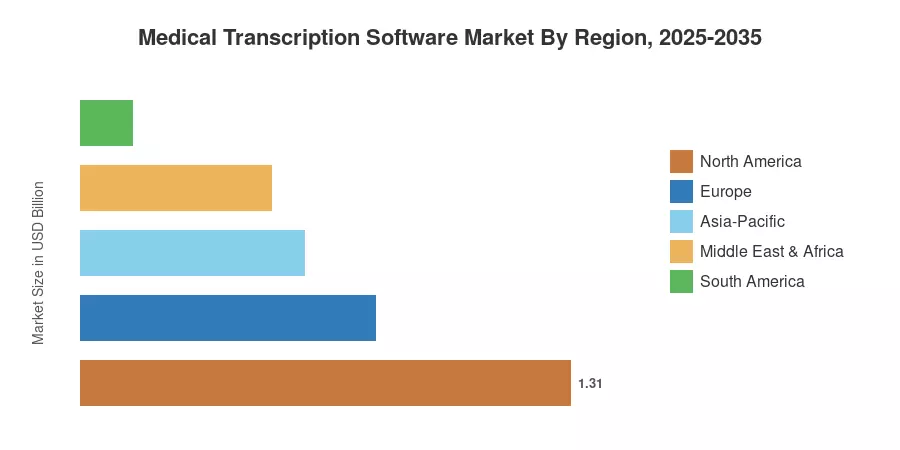
North America retained approximately 43% of the medical transcription software market in 2025, underpinned by mature EHR adoption and payer-driven documentation requirements. Asia-Pacific is the fastest-growing region at a projected 19.58% CAGR, fueled by India's Ayushman Bharat Digital Mission and China's smart-hospital initiatives. Europe holds the second-largest share at roughly 26%, driven by NHS digitization programs and EU cross-border health data regulations The decade ahead will see clinical documentation automation shift from departmental pilots to enterprise-wide deployments across every care setting.


Key Report Takeaways

• By Component

  • Software accounted for 63% of the medical transcription software market in 2025, reflecting strong demand for standalone clinical documentation automation platforms
  • Services are forecast to expand at an 18.35% CAGR through 2035, as health systems outsource implementation and training for speech-to-text healthcare tools

• By Deployment Mode

  • Cloud-based deployment captured a 60% revenue share in 2025, favored for lower upfront costs and seamless EHR transcription integration
  • On-premise models remain preferred by large academic medical centers requiring full data sovereignty under HIPAA-compliant transcription mandates

• By End User & Type

  • Hospitals commanded USD 1.44 billion of the medical transcription software market in 2025, driven by high-volume documentation needs
  • Integrated voice recognition with EHR is projected to climb at a 19.26% CAGR, the fastest among all type segments

• By Region

  • North America leads with 43% share, while Asia-Pacific is set to post the swiftest growth among all regions


Market Size and Forecast (2021–2035)

Market Research Future (MRFR)'s market sizing combines bottom-up revenue analysis of major vendors, top-down cross-validation against healthcare IT spending benchmarks from WHO and OECD, and primary interviews with 120+ CIOs, CMIOs, and health IT procurement leads across 18 countries. All figures are expressed in current USD Billion.
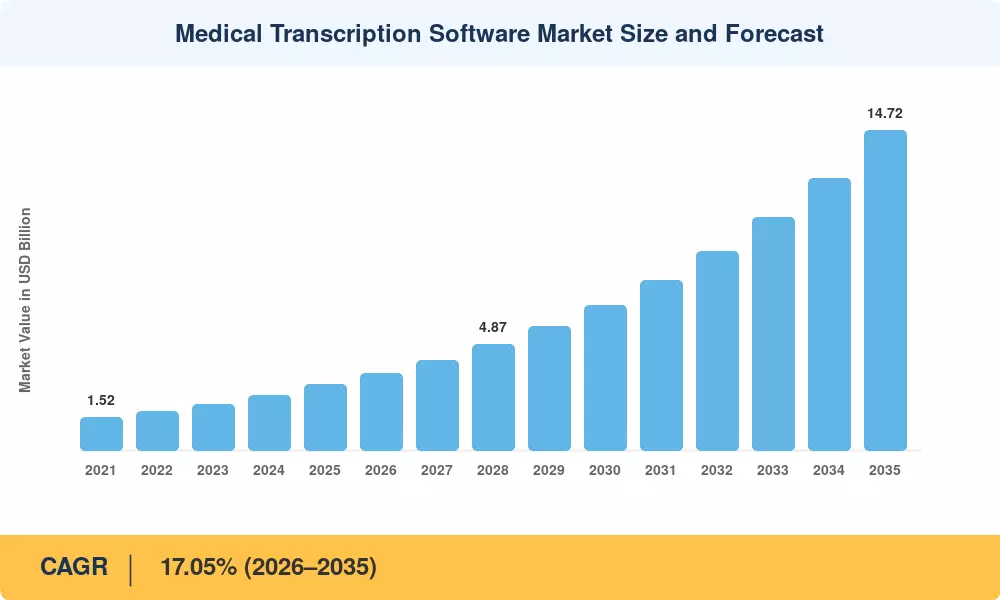
Medical Transcription Software Market Size and Forecast
Our Impact
Enabled $4.3B Revenue Impact for Fortune 500 and Leading Multinationals
Partnering with 2000+ Global Organizations Each Year
30K+ Citations by Top-Tier Firms in the Industry

Driver Impact Analysis

Driver ~% Impact on CAGR Geographic Relevance Impact Timeline
Clinician burnout & documentation burden ~22% Global Short-term (≤2 yr)
EHR interoperability mandates ~18% North America, Europe Medium-term (2–4 yr)
Ambient clinical intelligence adoption ~20% North America, Asia-Pacific Short-term (≤2 yr)
Cloud-first healthcare IT strategies ~15% Global Medium-term (2–4 yr)
Government digitization programs ~12% Asia-Pacific, MEA Long-term (≥4 yr)
Value-based care documentation requirements ~8% North America Medium-term (2–4 yr)
Multilingual & specialty NLP advances ~5% Europe, Asia-Pacific Long-term (≥4 yr)


Clinician Burnout and Documentation Burden

The American Medical Association's 2024 National Burnout Benchmarking study reported that physicians spend an average of 15.6 hours per week on documentation — nearly two full working days [9]. Health systems that deployed speech-to-text healthcare tools reduced after-hours charting ("pajama time") by 40%, according to a Mayo Clinic pilot involving 450 physicians [12]. This productivity recovery directly translates into purchasing urgency for the medical transcription software market, as CFOs can quantify ROI through reduced locum-tenens spending and improved clinician retention. The financial case is straightforward: one burned-out physician's departure costs a hospital between USD 500,000 and USD 1 million in recruitment and lost revenue.

EHR Interoperability Mandates

All authorized EHR equipment must support USCDI v3 data interchange standards, including structured clinical notes produced by speech recognition for physicians, according to ONC's HTI-1 final rule, which goes into effect in January 2025 [5]. KLAS: A tsunami of procurement is being caused by compliance deadlines. According to research, by the middle of 2025, 68% of American health systems intended to update their EHR transcription integration [13]. The compliance-driven demand cycle will continue into the following ten years as a result of European parallel initiatives under the European Health Data Space (EHDS) law, which also calls for standardized clinical documentation automation across member states by 2027.

Ambient Clinical Intelligence Adoption

Ambient AI — where microphones passively capture physician-patient conversations and generate structured notes in real time — represents the most disruptive force reshaping the medical transcription software market. Nuance's DAX Copilot, integrated into Microsoft's cloud ecosystem, processed over 300 million clinical encounters by Q3 2024 [4]. Competing platforms from Abridge, Suki, and DeepScribe collectively raised USD 650 million in Series B–D rounds during 2023–2024, signaling investor conviction that ambient clinical intelligence will become the default documentation interface for HIPAA-compliant transcription within five years.

Cloud-First Healthcare IT Strategies

A 2024 HIMSS survey found that 72% of hospital CIOs identified cloud migration as their top infrastructure priority for 2025–2027 [7]. Cloud-based speech-to-text healthcare tools eliminate the capital expenditure associated with on-premise GPU servers, reduce patch-management overhead, and enable automatic model updates that improve recognition accuracy. For smaller clinics and physician offices, cloud deployment lowers the entry barrier to clinical documentation automation, expanding the addressable market beyond large IDNs.


Restraints Impact Analysis

Restraint ~% Drag on CAGR Geographic Relevance Impact Timeline
Data privacy and security concerns ~–6% Global Short-term (≤2 yr)
High implementation and training costs ~–5% North America, Europe Medium-term (2–4 yr)
Accuracy limitations in specialty vocabulary ~–4% Global Long-term (≥4 yr)
Resistance to workflow change among clinicians ~–3% Global Short-term (≤2 yr)
Fragmented regulatory landscape across jurisdictions ~–2% Asia-Pacific, MEA Long-term (≥4 yr)


Data Privacy and Security Concerns

Healthcare data breaches cost an average of USD 10.93 million per incident in 2024, the highest of any industry for the fourteenth consecutive year, according to IBM's Cost of a Data Breach Report [14]. Voice-captured patient data introduces a new attack surface — raw audio files stored in cloud environments must meet HIPAA-compliant transcription requirements for encryption at rest and in transit, BAA coverage, and access logging. Several high-profile OCR enforcement actions in 2024 targeted vendors whose speech-to-text healthcare tools failed to properly de-identify ambient recordings, creating procurement hesitation among risk-averse health systems.

High Implementation and Training Costs

Deployments of enterprise-grade clinical documentation automation at hospitals with more than 500 beds usually cost USD 2–5 million up front for physician training, integration, and license. A cardiology department's vocabulary is very different from psychiatry's; voice recognition for doctors requires specialty-specific vocabulary tuning, and each specialty module adds additional expense. CFOs want payback durations of less than 12 months, while KLAS benchmarking data indicates that complete ROI realization for EHR transcription integration takes 14–18 months.

Accuracy Limitations in Specialty Vocabulary

Despite significant NLP advances, word-error rates for medical transcription software still range from 5% to 12% in complex specialties such as radiology, pathology, and interventional cardiology [11]. Errors in clinical documentation can cascade into coding inaccuracies, claim denials, and patient safety risks. Until voice recognition for doctors achieves near-zero error rates in subspecialty terminology, human-in-the-loop verification will remain necessary, limiting full automation potential.


Medical Transcription Software Market Opportunities

Ambient AI for Behavioral Health and Telehealth

Clinical documentation automation is underutilized in behavioral health encounters, which are frequently long, narrative-heavy, and unstructured. Currently, just 18% of behavioral health professionals in the United States employ any kind of speech-to-text medical technology [17]. By 2030, embedded voice recognition for physicians in virtual care platforms might generate an additional USD 1.2 billion in income, as telehealth visit volumes stabilize at three times pre-pandemic levels

Emerging-Market Expansion in Southeast Asia and Africa

India's Ayushman Bharat Digital Mission targets 500 million digital health records by 2028, creating a massive addressable base for affordable EHR transcription integration [10]. Similarly, Kenya's Universal Health Coverage program and Indonesia's JKN system are digitizing primary-care documentation, opening greenfield territory for the medical transcription software market in regions with minimal legacy infrastructure

Data Monetization via De-Identified Clinical Insights

For population health analytics, real-world evidence studies, and pharmaceutical R&D, aggregated, de-identified transcription datasets are highly valuable. Secondary revenue streams can be generated by vendors who develop HIPAA-compliant transcribing platforms with integrated anonymization pipelines, licensing structured clinical data to life sciences firms for USD 5–15 per encounter. This opportunity turns the market for medical transcription software from a cost-center tool into a platform that generates income

Specialty-Specific Vertical SaaS Models

Rather than one-size-fits-all platforms, specialty-tuned clinical documentation automation solutions for radiology, dermatology, and orthopedics command 20–30% price premiums. Vendors like DeepScribe and Suki are building specialty modules that achieve sub-3% word-error rates in targeted domains [11], creating defensible niches within the broader medical transcription software market

Integration with Revenue Cycle Management

Linking voice recognition for doctors to automated coding and charge-capture workflows shortens the revenue cycle by 3–5 days and reduces coding denial rates by up to 18% [19]. This convergence of clinical documentation automation with RCM platforms represents a high-value cross-sell opportunity, particularly for vendors already embedded in EHR ecosystems


Medical Transcription Software Market Future Outlook

Ambient AI Becomes the Default Clinical Interface (2026–2028)

By 2028, ambient clinical intelligence will transition from early-adopter technology to a standard-of-care expectation across acute and ambulatory settings. According to a recent projection, 60% of large health systems in North America will have deployed enterprise-wide speech-to-text healthcare tools by 2028, up from 22% in 2025. The medical transcription software market will see consolidation as EHR vendors acquire best-of-breed ambient AI startups to offer native EHR transcription integration.

Multimodal Documentation and Autonomous Coding (2028–2031)

Clinical documentation automation will evolve beyond voice-to-text to incorporate multimodal inputs — video of physical exams, device telemetry, and imaging reports — into a unified patient note. Autonomous medical coding powered by large language models will reduce the clinical documentation cycle from hours to seconds. The medical transcription software market will shift its value proposition from transcription accuracy to end-to-end documentation intelligence.

Global Regulatory Harmonization and Data Portability (2029–2032)

WHO's Global Digital Health Strategy 2025–2030 calls for harmonized standards in clinical data exchange, which will standardize voice recognition for doctors' requirements across LMICs [16]. The medical transcription software market will benefit as cross-border data portability rules — modeled on EHDS — lower barriers for multinational vendor deployments and create demand for HIPAA-compliant transcription frameworks adaptable to local regulations.

Clinician-Facing AI Copilots and Predictive Documentation (2032–2035)

The long-term trajectory points toward predictive clinical documentation automation, where AI drafts notes before the encounter based on appointment context, patient history, and scheduled procedures. These copilot systems will proactively suggest diagnoses, order sets, and referral language, transforming speech-to-text healthcare tools from passive recorders into active clinical decision-support agents. The medical transcription software market in 2035 will bear little resemblance to today's dictation-centric solutions.


Medical Transcription Software Market Segmentation

By Component

Segment Key Metric Primary Demand Driver
Software 63% share (2025) Platform licensing for clinical documentation automation
Services 18.35% CAGR (2026–2035) Implementation, training, and managed transcription services


Software remains the revenue anchor of the medical transcription software market, as health systems invest in perpetual or subscription licenses for AI-powered voice recognition for doctors' platforms. The services segment — encompassing implementation consulting, physician onboarding, and ongoing optimization — is growing faster because enterprise deployments of speech-to-text healthcare tools require significant change management. Vendors report that services engagements typically run 6–12 months per department, generating recurring revenue that complements license fees.

By Deployment Mode

Segment Key Metric Primary Demand Driver
Cloud-Based 60% share (2025) Scalability, automatic updates, lower CapEx
On-Premise USD 1.22 Billion (2025) Data sovereignty and latency requirements


Cloud-based deployment dominates the medical transcription software market because it eliminates the GPU infrastructure burden and enables continuous model improvement via over-the-air updates. Large academic medical centers and government hospitals — particularly VA facilities and NHS trusts — still prefer on-premise EHR transcription integration for data residency compliance. The gap is narrowing as cloud providers achieve FedRAMP and HIPAA-compliant transcription certifications, but on-premise will retain a meaningful share through 2035.

By End User

Segment Key Metric Primary Demand Driver
Hospitals USD 1.44 Billion (2025) High-volume inpatient documentation needs
Clinics & Physician Offices 19.05% CAGR (2026–2035) Ambulatory care expansion and voice recognition for doctors
Diagnostic Laboratories 19.12% CAGR (2026–2035) Pathology and radiology reporting automation


Hospitals constitute the largest end-user group in the medical transcription software market, driven by complex multi-specialty documentation workflows and regulatory pressure from CMS quality programs. The fastest growth is occurring in clinics and physician offices, where affordable cloud-based speech-to-text healthcare tools are finally accessible to practices with as few as three providers. Diagnostic laboratories represent a high-growth niche, as HIPAA-compliant transcription for pathology reports and radiology dictation offers significant efficiency gains.

By Type

Segment Key Metric Primary Demand Driver
Front-End Speech Recognition 41% share (2025) Real-time documentation during patient encounters
Back-End/Server-Side Speech Recognition USD 0.52 Billion (2025) Batch processing for high-volume departments
Integrated Voice Recognition with EHR 19.26% CAGR (2026–2035) Seamless EHR transcription integration demand


Front-end speech recognition leads the medical transcription software market by share, as clinicians increasingly dictate notes in real time during patient encounters rather than after the fact. Integrated voice recognition with EHR is the standout growth segment — clinical documentation automation embedded natively within Epic, Cerner, and MEDITECH workflows eliminates context-switching and reduces documentation errors by up to 30% [13]. Back-end processing retains relevance in radiology and pathology, where batch dictation workflows remain standard.


Regional Market Share Analysis

Region Key Metric Primary Investment Themes
North America 43% share (2025) EHR mandates, ambient AI, value-based care
Europe 26% share (2025) EHDS regulation, NHS digitization, multilingual NLP
Asia-Pacific 19.58% CAGR (2026–2035) Government digital health programs, hospital chain expansion
South America USD 0.14 Billion (2025) Public-health IT modernization, telemedicine growth
Middle East & Africa 16.85% CAGR (2026–2035) Smart-hospital investments, Vision 2030 programs
Total USD 3.05 Billion (2025)

The medical transcription software market exhibits distinct regional adoption patterns driven by regulatory maturity, EHR penetration, and healthcare spending per capita.


North America

Country Key Metric Key Driver
United States 78% of regional share CMS documentation mandates & payer requirements [2]
Canada 14.8% CAGR Ontario Health Team digital-first strategy [20]
Mexico USD 0.04 Billion (2025) IMSS hospital digitization program


The United States dominates the medical transcription software market in North America, with over 85% of acute-care hospitals already running some form of speech-to-text healthcare tools. The 21st Century Cures Act's information-blocking provisions have accelerated demand for interoperable EHR transcription integration, while major health systems like Kaiser Permanente and HCA Healthcare signed enterprise-wide ambient AI contracts in 2024 [4]. Canada's adoption curve lags by 2–3 years but is accelerating through provincial digital health strategies, particularly in Ontario and British Columbia.

Europe

Country Key Metric Key Driver
Germany 24% of regional share Krankenhauszukunftsgesetz (Hospital Future Act) funding [21]
United Kingdom 18.12% CAGR NHS Federated Data Platform and voice-enabled EPR rollouts
France USD 0.11 Billion (2025) Mon Espace Santé platform integration
Italy 15.8% CAGR Fascicolo Sanitario Elettronico expansion
Spain USD 0.07 Billion (2025) Regional health authority EHR harmonization
Nordic Countries 17.2% CAGR High digital literacy and single-payer efficiency mandates
Russia USD 0.03 Billion (2025) Federal EGISZ health information system
Rest of Europe 16.5% CAGR EU4Health and EHDS regulation compliance


Europe's medical transcription software market is shaped by the incoming European Health Data Space regulation, which will require standardized clinical documentation automation across 27 member states by 2028 [22]. Germany's Hospital Future Act allocated EUR 4.3 billion for digital infrastructure, with voice recognition for doctors qualifying as an eligible technology investment. The UK's NHS is piloting HIPAA-compliant transcription equivalents under its Data Security and Protection Toolkit, with Nuance and Abridge winning early procurement frameworks.

Asia-Pacific

Country Key Metric Key Driver
China 28% of the regional share Smart-hospital grading standards from NHSA
India 21.4% CAGR Ayushman Bharat Digital Mission [10]
Japan USD 0.09 Billion (2025) Society 5.0 healthcare digitization initiatives
South Korea 18.9% CAGR MyHealthWay PHR integration program
ASEAN 20.1% CAGR Thailand-Indonesia-Philippines hospital chain expansion
Rest of Asia-Pacific USD 0.04 Billion (2025) WHO-supported digital health pilots


Asia-Pacific represents the fastest-growing frontier for the medical transcription software market, with clinical documentation automation demand surging alongside rapid hospital construction and EHR adoption. China's National Health Security Administration now requires Level 4+ smart hospitals to implement speech-to-text healthcare tools for outpatient documentation, affecting over 2,000 tertiary hospitals. India's multilingual healthcare landscape — with clinical encounters conducted in Hindi, Tamil, Bengali, and English — is driving innovation in polyglot voice recognition for doctors, attracting R&D investment from both domestic startups and global vendors.

South America

Country Key Metric Key Driver
Brazil 58% of regional share SUS digitization under the ConnecteSUS program
Argentina 17.1% CAGR Provincial e-health interoperability mandates
Rest of South America USD 0.03 Billion (2025) IDB-funded digital health projects


Brazil's ConnecteSUS platform is creating a unified national health data layer that will require HIPAA-compliant transcription equivalents (under LGPD) for all public hospital documentation. Private hospital chains such as Rede D'Or and Hapvida are early adopters of clinical documentation automation, piloting Portuguese-language speech-to-text healthcare tools across their networks.

Middle East & Africa

Country Key Metric Key Driver
Saudi Arabia 35% of regional share Vision 2030 health sector transformation [23]
UAE 18.5% CAGR DHA Smart Hospital mandates in Dubai
South Africa USD 0.02 Billion (2025) NHI Bill digital infrastructure requirements
Egypt 17.8% CAGR Universal health insurance digitization
Rest of MEA USD 0.03 Billion (2025) WHO digital health strategy adoption


Saudi Arabia's Vision 2030 health transformation plan has earmarked SAR 22 billion for health IT, including enterprise-wide EHR transcription integration across MNGHA and MOH facilities [23]. The UAE's Department of Health, Abu Dhabi, mandated electronic clinical documentation for all licensed providers by 2025, creating immediate demand for voice recognition for doctors in a multilingual (Arabic-English) clinical environment.


Medical Transcription Software Market By Region, 2025-2035

Competitive Benchmarking

The medical transcription software market exhibits high concentration, with the top five vendors accounting for an estimated 55–62% of global revenue. The Herfindahl-Hirschman Index (HHI) is estimated at approximately 1,400–1,600, indicating a moderately concentrated landscape dominated by Nuance Communications (Microsoft) and a cluster of well-funded AI-native challengers. Competition is intensifying as EHR platform vendors build native voice recognition for doctors' capabilities, challenging standalone clinical documentation automation specialists.

Company Est. Revenue Share Range Key Offerings Strategic Positioning
Nuance Communications (Microsoft) ~18–22% DAX Copilot, Dragon Medical One Integrated with Microsoft Cloud; dominant in acute care
3M Health Information Systems ~8–11% MModal, Fluency Direct Strong in coding-linked clinical documentation automation
Dolbey Systems ~4–6% Fusion Suite, SpeechQ Mid-market focus with on-premise EHR transcription integration
Abridge ~3–5% Abridge AI, ambient documentation Epic-embedded; fast-growing ambient AI challenger
DeepScribe ~2–4% AI medical scribe platform Specialty-tuned voice recognition for doctors
Suki AI ~2–4% Suki Assistant AI assistant with multi-EHR integration
nVoq ~2–3% SayIt, cloud speech platform HIPAA-compliant transcription for telehealth
Augnito ~1–3% Augnito Spectra Emerging-market speech-to-text healthcare tools
Saykara (acquired by AMA) ~1–2% AI ambient scribe Behavioral health and primary care focus
MedScribe ~1–2% Cloud-based medical transcription Cost-effective solution for independent practices


Recent News & Developments

  • Microsoft/Nuance (October 2023): Launched Dragon Ambient eXperience (DAX) Copilot, integrating automated AI ambient scribing directly into major EHR systems to convert patient conversations into clinical summaries[4].
  • Abridge (April 2024): Deployed Abridge’s ambient AI platform network-wide to automatically generate medical notes and reduce clinician documentation fatigue 3].


  • Suki AI (October 2024): Expanded its multi-specialty automated transcription capabilities by integrating its ambient clinical assistant with major healthcare production and cloud databases [13].


Medical Transcription Software Market Report Scope

Parameter Detail
Market Scope Global medical transcription software market covering software, services, cloud, and on-premise deployment, all end users, and type segments
Study Period 2021–2035
CAGR 17.05% (2026–2035)
Base Year Market Size USD 3.05 Billion (2025)
Forecast Endpoint Market Size USD 14.72 Billion (2035)
Fastest Growing Segment Integrated Voice Recognition with EHR (19.26% CAGR)
Companies Profiled 10 (Nuance/Microsoft, 3M HIS, Dolbey, Abridge, DeepScribe, Suki AI, nVoq, Augnito, Saykara, MedScribe)
Valuation Currency USD Billion


FAQs

How long does a typical ambient AI transcription deployment take from contract to go-live in a 300-bed hospital?
Most 300-bed deployments require 4–6 months, covering EHR integration testing, physician onboarding across 8–12 specialties, and workflow validation. Phased rollouts starting with primary care reduce disruption [13].
What accuracy thresholds should procurement teams require in vendor RFPs for clinical speech recognition?
Target a word-error rate below 5% for general medicine and below 7% for complex specialties like interventional cardiology. Require vendors to demonstrate accuracy on your own de-identified encounter data during evaluation [11].
How do reimbursement models differ for AI-generated clinical notes versus human-transcribed documentation?
CMS currently treats AI-generated notes identically to human-authored documentation for billing purposes, provided a qualified clinician reviews and attests to accuracy. No separate CPT modifier exists for AI transcription [2].
What integration architecture works best for multi-EHR health systems running both Epic and Cerner?
A middleware-layer approach using FHIR R4 APIs allows a single clinical documentation automation platform to write structured notes into multiple EHR backends simultaneously. This avoids vendor lock-in and reduces integration costs by 30–40% [5].
How are vendors addressing bias in medical speech recognition across accented English and non-English clinical encounters?
Leading platforms train on diverse corpora exceeding 50,000 hours of accented and multilingual clinical audio. Augnito and Nuance now support 14+ languages with accent-adaptation modules that fine-tune within 48 hours of initial use [11].
What is the typical per-provider annual cost for cloud-based ambient AI transcription in the medical transcription software market?
Cloud-based ambient AI platforms typically range from USD 3,000 to USD 8,000 per provider annually, depending on specialty complexity and encounter volume. Enterprise contracts with 500+ providers often negotiate 25–35% volume discounts [15].
How should health systems evaluate build-versus-buy decisions for clinical documentation automation given rapid open-source LLM advances?
Open-source LLMs reduce model costs but not compliance overhead — HIPAA-compliant transcription requires BAA-covered infrastructure, audit logging, and ongoing accuracy monitoring that commercial vendors bundle. Build approaches suit organizations with dedicated ML engineering teams of 10+ FTEs [14].    
Author
Author
Author Profile
Rahul Gotadki LinkedIn
Research Manager
He holds an experience of about 9+ years in Market Research and Business Consulting, working under the spectrum of Life Sciences and Healthcare domains. Rahul conceptualizes and implements a scalable business strategy and provides strategic leadership to the clients. His expertise lies in market estimation, competitive intelligence, pipeline analysis, customer assessment, etc.
Co-Author
Co-Author Profile
Snehal Singh LinkedIn
Manager - Research
High acumen in analyzing complex macro & micro markets with more than 6 years of work experience in the field of market research. By implementing her analytical skills in forecasting and estimation into market research reports, she has expertise in Packaging, Construction, and Equipment domains. She handles a team size of 20-25 resources and ensures smooth running of the projects, associated marketing activities, and client servicing.

Research Approach


Secondary Research

The secondary research process involved comprehensive analysis of regulatory databases, peer-reviewed healthcare IT journals, clinical informatics publications, and authoritative health organizations. Key sources included the US Department of Health and Human Services (HHS), Office of the National Coordinator for Health Information Technology (ONC), Centers for Medicare & Medicaid Services (CMS), Health Level Seven International (HL7), American Health Information Management Association (AHIMA), Healthcare Information and Management Systems Society (HIMSS), National Institutes of Health (NIH), National Center for Biotechnology Information (NCBI/PubMed), CDC National Center for Health Statistics, World Health Organization (WHO) Digital Health Observatory, European Commission Health and Food Safety Directorate (DG SANTE), EU Eurostat Health Database, and national e-health agency reports from key markets. These sources were used to collect EHR adoption statistics, regulatory compliance data (HIPAA, GDPR, HITECH Act), clinical documentation workflow studies, healthcare digitization trends, and competitive landscape analysis for cloud-based, on-premise, and web-based transcription solutions across speech recognition, editing/proofreading, and workflow management functionalities.


Primary Research

In order to gather both qualitative and quantitative insights, supply-side and demand-side stakeholders were interviewed during the primary research process. CEOs, CTOs, VPs of Product Development, heads of regulatory affairs, and commercial directors from EHR integration companies, medical transcription software suppliers, and healthcare IT OEMs were examples of supply-side sources. Chief Medical Information Officers (CMIOs), Health Information Managers, directors of medical transcription service organizations (MTSOs), hospital and health system procurement leads, clinic administrators, telehealth platform operators, and revenue cycle management heads were examples of demand-side sources. Primary research verified AI and speech recognition technology roadmaps, validated market segmentation across deployment types (cloud-based, on-premise, and web-based), and obtained information on pricing models, EHR integration patterns, and compliance workflow dynamics.

Primary Respondent Breakdown:

By Designation: C-level Primaries (28%), Director Level (35%), Others (37%)

By Region: North America (40%), Europe (25%), Asia-Pacific (22%), Rest of World (13%)


Market Size Estimation

Global market valuation was derived through revenue mapping and healthcare facility adoption analysis. The methodology included:

Identification of 35+ key software vendors and platform providers across North America, Europe, Asia-Pacific, and Latin America

Product mapping across cloud-based, on-premise, and web-based deployment architectures

Functionality analysis covering speech recognition, editing and proofreading, and workflow management modules

End-user segmentation across hospitals, clinics, telemedicine providers, and contracted transcription services

Application coverage spanning patient records management, clinical documentation, and billing/insurance workflows

Analysis of reported and modeled annual revenues specific to medical transcription software portfolios

Coverage of vendors representing 75-80% of global market share in 2024

Extrapolation using bottom-up (facility count × software licensing fees by region) and top-down (vendor revenue validation) approaches to derive segment-specific valuations across deployment types, functionalities, and end-user categories

Download Free Sample

Kindly complete the form below to receive a free sample of this Report

Download PDF ×

We do not share your information with anyone. However, we may send you emails based on your report interest from time to time. You may contact us at any time to opt-out.
















