Medical Transcription Software Market (2026 - 2035)

ID: MRFR/MED/31471-HCR
128 Pages
Rahul Gotadki
Last Updated: July 12, 2026
Medical Transcription Software Market Research Report: Size, Share, Trend Analysis By Deployment Type (On-Premise, Cloud-Based, Web-Based), By Applications (Patient Records Management, Clinical Documentation, Billing and Insurance), By End Users (Hospitals, Clinics, Telemedicine Providers, Contracted Transcription Services), By Functionality (Speech Recognition, Editing and Proofreading, Workflow Management) and By Regional (North America, Europe, South America, Asia Asia-Pacific, Middle East and Africa) - Growth Outlook & Industry Forecast 2025 To 2035
Medical Transcription Software Market
Market Size
Forecast Period2026-2035
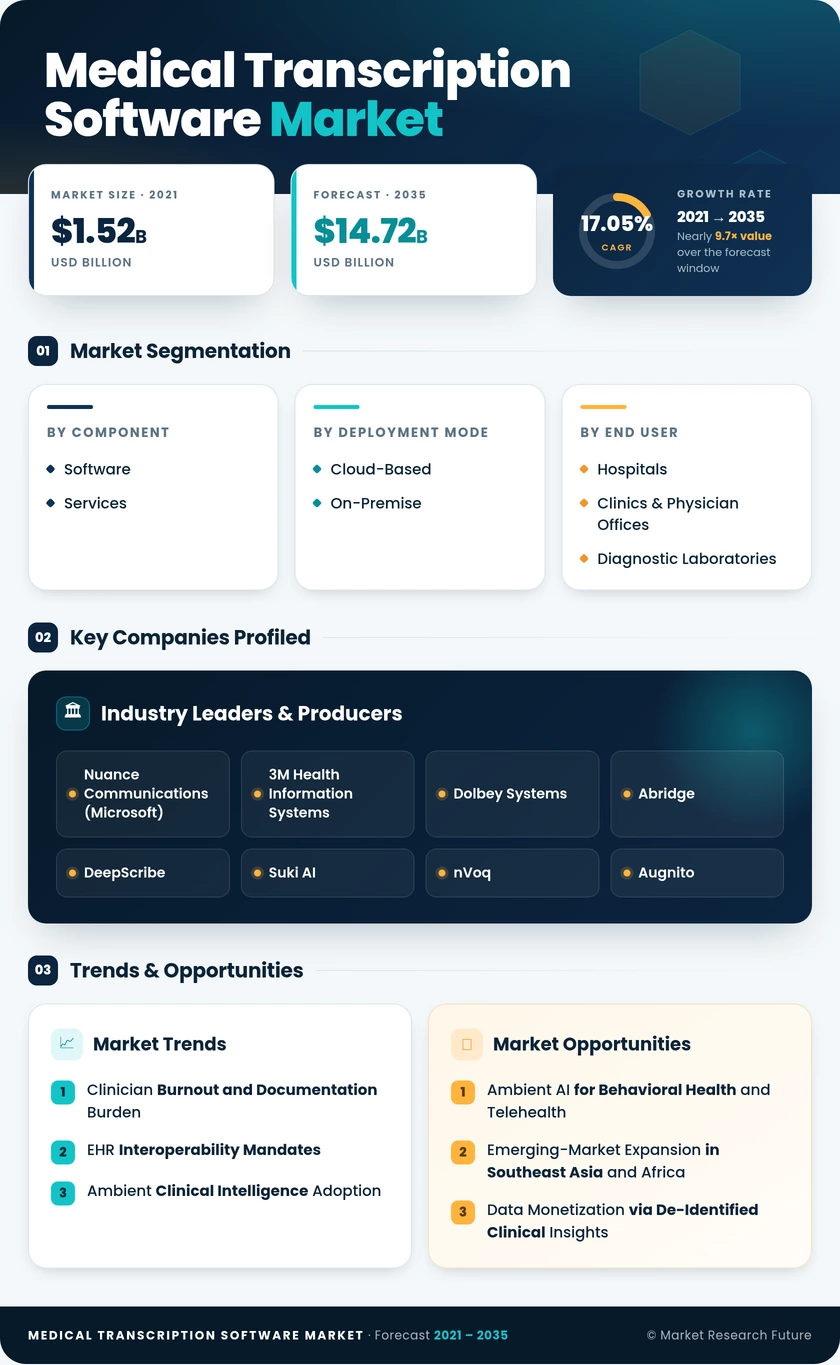
CAGR (2026-2035)17.05%
2025 Market SizeUSD 3.05 Billion
2035 Market SizeUSD 14.72 Billion
Key Players
Nuance Communications
3M Health Information Systems
Dolbey Systems
Abridge
DeepScribe
Suki AI
Opportunities
  • Ambient AI for Behavioral Health and Telehealth
  • Emerging-Market Expansion in Southeast Asia and Africa
  • Data Monetization via De-Identified Clinical Insights
  1. 1 Market Overview |
    1. 1.1 Study Assumptions & Market Definition |
    2. 1.2 Scope of the Study |
    3. 1.3 Research Methodology
  2. 2 Market Summary & Key Takeaways
  3. 3 Market Dynamics |
    1. 3.1 Market Drivers Analysis | |
      1. 3.1.1 Clinician Burnout and Documentation Burden | |
      2. 3.1.2 EHR Interoperability Mandates | |
      3. 3.1.3 Ambient Clinical Intelligence Adoption | |
      4. 3.1.4 Cloud-First Healthcare IT Strategies | |
      5. 3.1.5 Government Digitization Programs | |
      6. 3.1.6 Value-Based Care Documentation Requirements | |
      7. 3.1.7 Multilingual & Specialty NLP Advances |
    2. 3.2 Market Restraints Analysis | |
      1. 3.2.1 Data Privacy and Security Concerns | |
      2. 3.2.2 High Implementation and Training Costs | |
      3. 3.2.3 Accuracy Limitations in Specialty Vocabulary | |
      4. 3.2.4 Resistance to Workflow Change Among Clinicians | |
      5. 3.2.5 Fragmented Regulatory Landscape Across Jurisdictions |
    3. 3.3 Market Opportunity Analysis | |
      1. 3.3.1 Ambient AI for Behavioral Health and Telehealth | |
      2. 3.3.2 Emerging-Market Expansion in Southeast Asia and Africa | |
      3. 3.3.3 Data Monetization via De-Identified Clinical Insights | |
      4. 3.3.4 Specialty-Specific Vertical SaaS Models | |
      5. 3.3.5 Integration with Revenue Cycle Management |
    4. 3.4 Industry Value Chain Analysis |
    5. 3.5 Porter's Five Forces Analysis
  4. 4 Global Medical Transcription Software Market Size & Forecast (2021–2035) |
    1. 4.1 Historical Market Size (2021–2025) |
    2. 4.2 Current & Forecast Market Size (2026–2035) |
    3. 4.3 Market Size by Revenue (USD Billion) |
    4. 4.4 Year-over-Year Growth Analysis
  5. 5 Segmentation Analysis |
    1. 5.1 By Component | |
      1. 5.1.1 Software | |
      2. 5.1.2 Services |
    2. 5.2 By Deployment Mode | |
      1. 5.2.1 Cloud-Based | |
      2. 5.2.2 On-Premise |
    3. 5.3 By End User | |
      1. 5.3.1 Hospitals | |
      2. 5.3.2 Clinics & Physician Offices | |
      3. 5.3.3 Diagnostic Laboratories |
    4. 5.4 By Type | |
      1. 5.4.1 Front-End Speech Recognition | |
      2. 5.4.2 Back-End/Server-Side Speech Recognition | |
      3. 5.4.3 Integrated Voice Recognition with EHR
  6. 6 Regional Analysis |
    1. 6.1 North America | |
      1. 6.1.1 United States | |
      2. 6.1.2 Canada | |
      3. 6.1.3 Mexico |
    2. 6.2 Europe | |
      1. 6.2.1 Germany | |
      2. 6.2.2 United Kingdom | |
      3. 6.2.3 France | |
      4. 6.2.4 Italy | |
      5. 6.2.5 Spain | |
      6. 6.2.6 Nordic Countries | |
      7. 6.2.7 Russia | |
      8. 6.2.8 Rest of Europe |
    3. 6.3 Asia-Pacific | |
      1. 6.3.1 China | |
      2. 6.3.2 India | |
      3. 6.3.3 Japan | |
      4. 6.3.4 South Korea | |
      5. 6.3.5 ASEAN | |
      6. 6.3.6 Rest of Asia-Pacific |
    4. 6.4 South America | |
      1. 6.4.1 Brazil | |
      2. 6.4.2 Argentina | |
      3. 6.4.3 Rest of South America |
    5. 6.5 Middle East & Africa | |
      1. 6.5.1 Saudi Arabia | |
      2. 6.5.2 UAE | |
      3. 6.5.3 South Africa | |
      4. 6.5.4 Egypt | |
      5. 6.5.5 Rest of MEA
  7. 7 Competitive Landscape |
    1. 7.1 Market Share Analysis (2025) |
    2. 7.2 Competitive Benchmarking Matrix |
    3. 7.3 Company Profiles | |
      1. 7.3.1 Nuance Communications (Microsoft) | |
      2. 7.3.2 3M Health Information Systems | |
      3. 7.3.3 Dolby Systems | |
      4. 7.3.4 Abridge | |
      5. 7.3.5 DeepScribe | |
      6. 7.3.6 Suki AI | |
      7. 7.3.7 nVoq | |
      8. 7.3.8 Augnito | |
      9. 7.3.9 Saykara | |
      10. 7.3.10 MedScribe
  8. 8 Future Outlook & Strategic Recommendations (2026–2035) |
    1. 8.1 Near-Term Outlook: Ambient AI Becomes Default (2026–2028) |
    2. 8.2 Medium-Term Outlook: Multimodal Documentation & Autonomous Coding (2028–2031) |
    3. 8.3 Medium-Long-Term Outlook: Global Regulatory Harmonization (2029–2032) |
    4. 8.4 Long-Term Outlook: Clinician-Facing AI Copilots (2032–2035)
  9. 9 Recent Developments & News
  10. 10 Frequently Asked Questions (FAQs)
  11. 11 Report Scope & Methodology |
    1. 11.1 Study Period & Base Year |
    2. 11.2 Data Sources & Citations |
    3. 11.3 Abbreviations
  12. 12 LIST OF TABLES |
  13. TABLE 1 Global Medical Transcription Software Market Size & Forecast, by Revenue (USD Billion), 2021–2035 |
  14. TABLE 2 Global Medical Transcription Software Market – Year-over-Year Growth Analysis, 2021–2035 |
  15. TABLE 3 Market Driver Impact Analysis, 2026–2035 |
  16. TABLE 4 Market Restraint Impact Analysis, 2026–2035 |
  17. TABLE 5 Global Medical Transcription Software Market Size, by Component, 2021–2035 (USD Billion) |
  18. TABLE 6 Global Medical Transcription Software Market Size, by Deployment Mode, 2021–2035 (USD Billion) |
  19. TABLE 7 Global Medical Transcription Software Market Size, by End User, 2021–2035 (USD Billion) |
  20. TABLE 8 Global Medical Transcription Software Market Size, by Type, 2021–2035 (USD Billion) |
  21. TABLE 9 Global Medical Transcription Software Market Size, by Region, 2021–2035 (USD Billion) |
  22. TABLE 10 Regional Market Summary — Key Metrics and Investment Themes, 2025 |
  23. TABLE 11 North America Medical Transcription Software Market Size, by Country, 2021–2035 (USD Billion) |
  24. TABLE 12 Europe Medical Transcription Software Market Size, by Country, 2021–2035 (USD Billion) |
  25. TABLE 13 Asia-Pacific Medical Transcription Software Market Size, by Country, 2021–2035 (USD Billion) |
  26. TABLE 14 South America Medical Transcription Software Market Size, by Country, 2021–2035 (USD Billion) |
  27. TABLE 15 Middle East & Africa Medical Transcription Software Market Size, by Country, 2021–2035 (USD Billion) |
  28. TABLE 16 Competitive Benchmarking Matrix – Medical Transcription Software Market, 2025 |
  29. TABLE 17 Company Profiles – Key Players, Medical Transcription Software Market |
  30. TABLE 18 Recent Developments & Strategic Announcements, 2023–2025 |
  31. TABLE 19 Report Scope & Methodology Summary |
  32. TABLE 20 Detailed Sources and Citations
  33. 13 LIST OF FIGURES |
  34. FIGURE 1 Medical Transcription Software Market Dynamics — Drivers, Restraints, and Opportunities |
  35. FIGURE 2 Industry Value Chain Analysis — Medical Transcription Software Market |
  36. FIGURE 3 Porter's Five Forces Analysis — Medical Transcription Software Market |
  37. FIGURE 4 Global Medical Transcription Software Market Size Trend (USD Billion), 2021–2035 |
  38. FIGURE 5 Market Share by Component, 2025 (%) |
  39. FIGURE 6 Market Share by Deployment Mode, 2025 (%) |
  40. FIGURE 7 Market Share by End User, 2025 (%) |
  41. FIGURE 8 Market Share by Type, 2025 (%) |
  42. FIGURE 9 Regional Market Share, 2025 (%) |
  43. FIGURE 10 North America Market Size Trend (USD Billion), 2021–2035 |
  44. FIGURE 11 Europe Market Size Trend (USD Billion), 2021–2035 |
  45. FIGURE 12 Asia-Pacific Market Size Trend (USD Billion), 2021–2035 |
  46. FIGURE 13 South America Market Size Trend (USD Billion), 2021–2035 |
  47. FIGURE 14 Middle East & Africa Market Size Trend (USD Billion), 2021–2035 |
  48. FIGURE 15 Competitive Landscape — Market Share Distribution, 2025

Segmentation Quick Reference

DimensionSub-SegmentsDominant SegmentFastest Growing Segment
ComponentSoftware, ServicesSoftwareServices
Deployment ModeCloud-Based, On-PremiseCloud-BasedCloud-Based
End UserHospitals, Clinics & Physician Offices, Diagnostic LaboratoriesHospitalsDiagnostic Laboratories
TypeFront-End Speech Recognition, Back-End/Server-Side Speech Recognition, Integrated Voice Recognition with EHRFront-End Speech RecognitionIntegrated Voice Recognition with EHR
GeographyNorth America, Europe, Asia-Pacific, South America, Middle East & AfricaNorth AmericaAsia-Pacific


Market Segmentation Overview

By Component

Sub-SegmentKey Trend
SoftwareAI-powered platforms replacing legacy dictation licenses; shift toward subscription pricing
ServicesGrowing demand for implementation, training, and managed optimization services


The component split reflects a maturing medical transcription software market where platform complexity drives professional services demand alongside core software licensing.

By Deployment Mode

Sub-SegmentKey Trend
Cloud-BasedDominates due to scalability, automatic updates, and lower CapEx requirements
On-PremiseRetained by large academic centers and government hospitals for data sovereignty


Cloud deployment continues to gain share as FedRAMP and HIPAA certifications address the security concerns that historically favored on-premise architectures.

By End User

Sub-SegmentKey Trend
HospitalsLargest segment driven by high-volume multi-specialty documentation needs
Clinics & Physician OfficesFastest-growing ambulatory segment as affordable cloud tools reach small practices
Diagnostic LaboratoriesNiche growth driven by pathology and radiology report automation


Hospital dominance is structural, but the addressable market expansion is occurring in ambulatory and diagnostic settings where voice recognition penetration remains below 30%.

By Type

Sub-SegmentKey Trend
Front-End Speech RecognitionReal-time dictation during encounters is the largest segment by share
Back-End/Server-Side Speech RecognitionBatch processing for radiology and pathology; stable but slower growth
Integrated Voice Recognition with EHRFastest-growing type as native EHR embedding eliminates workflow friction


Integrated EHR voice recognition is reshaping vendor strategies, with major EHR platforms building native capabilities that challenge standalone transcription providers.


Download PDF ×

We do not share your information with anyone. However, we may send you emails based on your report interest from time to time. You may contact us at any time to opt-out.