×
Request Free Sample ×

Kindly complete the form below to receive a free sample of this Report

* Please use a valid business email

Leading companies partner with us for data-driven Insights

clients tt-cursor
Hero Background

Medical Tubing Market

ID: MRFR/CnM/4658-HCR
185 Pages
Priya Nagrale
October 2025

Medical Tubing Market Research Report Information By Material (Plastic, Rubber, And Metal), Structure (Single-Lumen, Multi-Lumen), Application (Bulk Disposable Tubing, Catheters & Cannulas, and Others) and Region - Forecast till 2035

Share:
Download PDF ×

We do not share your information with anyone. However, we may send you emails based on your report interest from time to time. You may contact us at any time to opt-out.

Medical Tubing Market Infographic
Purchase Options

Medical Tubing Market Summary

As per MRFR analysis, the Medical Tubing Market Size was estimated at 2984.76 USD Million in 2024. The Medical Tubing industry is projected to grow from 3282.3 USD Million in 2025 to 8488.99 USD Million by 2035, exhibiting a compound annual growth rate (CAGR) of 9.97 during the forecast period 2025 - 2035.

Key Market Trends & Highlights

The Medical Tubing Market is experiencing a dynamic evolution driven by technological advancements and changing healthcare needs.

  • The market is witnessing a shift towards biocompatible materials, enhancing patient safety and comfort.
  • Integration of smart technologies is becoming prevalent, enabling real-time monitoring and improved patient outcomes.
  • Sustainability is gaining traction, with manufacturers focusing on eco-friendly materials and processes.
  • Rising demand for minimally invasive procedures and increasing prevalence of chronic diseases are key drivers propelling market growth.

Market Size & Forecast

2024 Market Size 2984.76 (USD Million)
2035 Market Size 8488.99 (USD Million)
CAGR (2025 - 2035) 9.97%

Major Players

Medtronic (US), B. Braun Melsungen AG (DE), Teleflex Incorporated (US), Saint-Gobain (FR), Halyard Health (US), Smiths Medical (US), Fischer Medical Technologies (US), Stryker Corporation (US), Vygon (FR)

Medical Tubing Market Trends

The Medical Tubing Market is currently experiencing a dynamic evolution, driven by advancements in technology and increasing demand for high-quality medical devices. The market appears to be influenced by a variety of factors, including the growing prevalence of chronic diseases and the rising need for minimally invasive surgical procedures. As healthcare providers seek to enhance patient outcomes, the emphasis on biocompatible materials and innovative manufacturing processes seems to be gaining traction. Furthermore, the expansion of telemedicine and home healthcare services is likely to propel the demand for specialized tubing solutions that cater to remote patient monitoring and treatment. In addition, regulatory frameworks are evolving, which may impact the Medical Tubing Market significantly. Manufacturers are adapting to stringent quality standards and compliance requirements, which could lead to increased investment in research and development. This focus on quality assurance and product safety is expected to foster innovation, potentially resulting in the introduction of new materials and designs. Overall, the Medical Tubing Market appears poised for growth, with opportunities emerging from technological advancements and changing healthcare paradigms.

Shift Towards Biocompatible Materials

There is a noticeable trend towards the use of biocompatible materials in the Medical Tubing Market. This shift is driven by the need for safer and more effective medical devices that minimize adverse reactions in patients. Manufacturers are increasingly exploring polymers and other materials that meet stringent biocompatibility standards, which may enhance the overall performance of medical tubing.

Integration of Smart Technologies

The integration of smart technologies into medical tubing is emerging as a significant trend. This development involves incorporating sensors and monitoring devices within the tubing, allowing for real-time data collection and patient monitoring. Such innovations could improve patient care by providing healthcare professionals with critical information during procedures.

Focus on Sustainability

Sustainability is becoming a focal point in the Medical Tubing Market, as manufacturers seek to reduce their environmental impact. This trend includes the development of recyclable and biodegradable materials, which may align with global efforts to promote eco-friendly practices in healthcare. The emphasis on sustainability could reshape product offerings and influence consumer preferences.

Medical Tubing Market Drivers

Market Growth Projections

The Global Medical Tubing Market Industry is poised for substantial growth, with projections indicating a market size of 10.6 USD Billion in 2024 and an anticipated increase to 22.3 USD Billion by 2035. This growth trajectory suggests a robust demand for medical tubing driven by various factors, including technological advancements, increased healthcare expenditure, and the rising prevalence of chronic diseases. The compound annual growth rate of 7.02% from 2025 to 2035 further emphasizes the industry's potential for expansion. These figures highlight the importance of medical tubing in the broader context of healthcare innovation and patient care.

Increased Healthcare Expenditure

Global healthcare expenditure is on the rise, which is positively influencing the Global Medical Tubing Market Industry. Governments and private sectors are investing heavily in healthcare infrastructure, leading to an increase in the production and consumption of medical devices that rely on high-quality tubing. For example, the anticipated growth in the market to 22.3 USD Billion by 2035 underscores the correlation between healthcare spending and the demand for medical tubing. This trend is particularly evident in emerging economies, where improving healthcare access and quality is a priority. As a result, manufacturers are strategically positioning themselves to capitalize on this expanding market.

Rising Demand for Medical Devices

The Global Medical Tubing Market Industry is experiencing a surge in demand driven by the increasing prevalence of chronic diseases and the aging population. As healthcare systems evolve, the need for advanced medical devices that utilize high-quality tubing is paramount. For instance, the market is projected to reach 10.6 USD Billion in 2024, reflecting a robust growth trajectory. This demand is likely to be fueled by innovations in minimally invasive surgical techniques, which require specialized tubing solutions. Consequently, manufacturers are focusing on developing materials that enhance biocompatibility and durability, further propelling the growth of the Global Medical Tubing Market Industry.

Regulatory Compliance and Standards

The Global Medical Tubing Market Industry is heavily influenced by stringent regulatory requirements that govern the manufacturing and use of medical devices. Compliance with these regulations ensures the safety and efficacy of medical tubing, which is critical for patient care. Regulatory bodies are continuously updating standards to reflect advancements in technology and materials, thereby necessitating that manufacturers adapt their processes accordingly. This focus on compliance not only enhances product quality but also fosters consumer confidence in medical devices. As the industry evolves, adherence to these regulations will likely drive innovation and growth within the Global Medical Tubing Market Industry.

Technological Advancements in Materials

Innovations in polymer science are significantly impacting the Global Medical Tubing Market Industry. The development of advanced materials such as thermoplastic elastomers and silicone is enabling the production of tubing that meets stringent regulatory standards while offering enhanced performance characteristics. These materials are not only biocompatible but also exhibit superior flexibility and strength, making them ideal for various medical applications. As a result, the market is expected to witness a compound annual growth rate of 7.02% from 2025 to 2035. This growth is indicative of the industry's commitment to integrating cutting-edge technology into medical device manufacturing, thereby enhancing patient outcomes.

Growing Demand for Home Healthcare Solutions

The shift towards home healthcare is reshaping the Global Medical Tubing Market Industry. As patients increasingly prefer receiving care in the comfort of their homes, the demand for medical devices that utilize specialized tubing is rising. This trend is particularly relevant for devices such as infusion pumps and respiratory equipment, which require reliable and safe tubing solutions. The market's growth is indicative of this shift, with projections suggesting a significant increase in demand as more healthcare services transition to home settings. Manufacturers are thus focusing on developing tubing that meets the unique needs of home healthcare applications, further driving the expansion of the Global Medical Tubing Market Industry.
Market Segment Insights

By Application: Fluid Delivery (Largest) vs. Drug Delivery (Fastest-Growing)

The Medical Tubing Market displays a dynamic distribution among its application segments, with fluid delivery holding the largest share. This segment encompasses various applications ranging from intravenous (IV) lines to infusion systems, solidifying its dominance in healthcare. Other notable segments include medical devices, surgical procedures, catheters, and drug delivery systems, which collectively fuel the market's robust expansion, catering to the ever-increasing demand for innovative healthcare solutions.

Fluid Delivery (Dominant) vs. Drug Delivery (Emerging)

Fluid delivery systems are pivotal in the medical tubing market, extensively used in hospitals for intravenous therapy, blood transfusions, and other fluid management applications. Their extensive usage reflects a strong market presence, driven by the growing aging population and the rising incidence of chronic diseases. In contrast, drug delivery systems, although an emerging segment, are rapidly gaining traction due to advances in targeted therapies and personalized medicine. This segment's growth is powered by an increasing need for precise drug administration and improved patient compliance, showcasing a transformative shift towards more sophisticated healthcare solutions.

By Material Type: Polyvinyl Chloride (Largest) vs. Polyurethane (Fastest-Growing)

In the Medical Tubing Market, Polyvinyl Chloride (PVC) holds a significant share, being the most widely used material due to its versatility and cost-effectiveness. It is favored in a variety of applications, including intravenous (IV) tubes, respiratory tubes, and blood bags. Following PVC is Polyurethane, which, while having a smaller current market share, is experiencing rapid growth due to its biocompatibility and enhanced mechanical properties suitable for more complex medical applications. The growth of Polyurethane in the Medical Tubing Market is driven by increasing demand for high-performance materials that offer flexibility, strength, and resistance to fatigue. Additionally, the trend towards more complex and advanced medical devices is propelling the use of specialty materials like Polyurethane. As healthcare technologies continue to evolve, the focus on patient safety and device effectiveness further enhances the adoption of these advanced polymer materials, particularly Polyurethane, projected to grow at a faster rate than traditional choices like PVC.

Polyvinyl Chloride (Dominant) vs. Polyethylene (Emerging)

Polyvinyl Chloride (PVC) remains the dominant player in the Medical Tubing Market due to its extensive utilization in numerous applications, including IV tubes and various types of catheters. Its combination of durability, affordability, and broad applicability makes it a staple in the medical field. In contrast, Polyethylene is emerging as an innovative alternative, particularly in applications that require lower-density materials and improved elasticity. This shift is driven by the increasing demand for more flexible and lighter medical devices, making Polyethylene a material of interest among manufacturers looking to develop high-performance products that enhance patient comfort and usability.

By End Use: Hospitals (Largest) vs. Home Healthcare (Fastest-Growing)

In the Medical Tubing Market, hospitals hold the largest share due to their high demand for diverse medical tubing applications. This includes a variety of procedures, from surgery to diagnostics, requiring specialized tubing that meets stringent regulatory standards. Clinics and ambulatory surgical centers follow, capitalizing on a growing patient base and increasing outpatient services. Conversely, home healthcare, while smaller, is rapidly growing, driven by the shift towards at-home treatments and the aging population requiring ongoing medical care at home.

Hospitals (Dominant) vs. Home Healthcare (Emerging)

Hospitals remain the dominant end-use sector in the Medical Tubing Market, utilizing a wide range of tubing for surgeries, diagnostics, and patient care, thus creating a significant demand for high-performance and specialized products. On the other hand, home healthcare is the emerging segment, benefiting from advances in telemedicine and at-home medical devices. With an increasing preference for non-hospital-based care solutions, home healthcare is witnessing a surge in demand for medical tubing products designed for portability and ease of use, appealing to both patients and providers aiming for convenience and efficiency.

Get more detailed insights about Medical Tubing Market

Regional Insights

North America : Market Leader in Medical Tubing

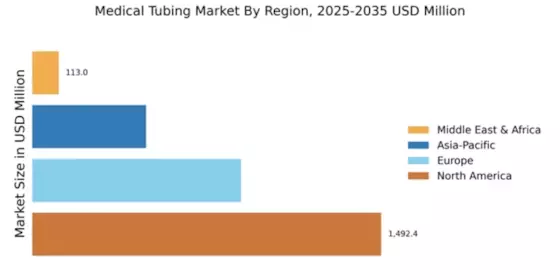
North America is poised to maintain its leadership in the medical tubing market, holding a significant share of 1492.38 million in 2024. The region's growth is driven by increasing healthcare expenditures, technological advancements, and a rising demand for minimally invasive procedures. Regulatory support from agencies like the FDA further catalyzes innovation and compliance, ensuring high-quality standards in medical devices. The competitive landscape is robust, with key players such as Medtronic, Teleflex, and Halyard Health leading the charge. The U.S. remains the largest market, supported by a strong healthcare infrastructure and a focus on R&D. Companies are increasingly investing in advanced materials and manufacturing processes to enhance product performance and meet the evolving needs of healthcare providers and patients alike.

Europe : Emerging Market with Growth Potential

Europe's medical tubing market is valued at 892.27 million, reflecting a growing demand driven by an aging population and increasing chronic diseases. Regulatory frameworks, such as the EU Medical Device Regulation, are enhancing product safety and efficacy, thereby boosting market confidence. The region is also witnessing a shift towards sustainable materials, aligning with environmental regulations and consumer preferences. Leading countries like Germany, France, and the UK are at the forefront of this growth, with a strong presence of companies like B. Braun Melsungen AG and Saint-Gobain. The competitive landscape is characterized by innovation and collaboration, as firms invest in new technologies and partnerships to enhance their product offerings. This dynamic environment positions Europe as a key player in The Medical Tubing.

Asia-Pacific : Rapidly Growing Medical Market

The Asia-Pacific medical tubing market, valued at 487.91 million, is experiencing rapid growth due to increasing healthcare investments and a rising prevalence of chronic diseases. Countries like China and India are driving demand, supported by government initiatives aimed at improving healthcare infrastructure. The region is also witnessing a surge in medical tourism, further boosting the need for advanced medical devices and tubing solutions. The competitive landscape is evolving, with both local and international players vying for market share. Companies are focusing on product innovation and cost-effective solutions to cater to diverse consumer needs. The presence of key players like Teleflex and Stryker Corporation enhances the region's market dynamics, making Asia-Pacific a significant contributor to The Medical Tubing.

Middle East and Africa : Emerging Market with Unique Challenges

The Middle East and Africa medical tubing market is valued at 112.2 million, reflecting a growing interest in healthcare advancements. Factors such as increasing healthcare expenditure and a rising prevalence of lifestyle diseases are driving demand for medical tubing solutions. However, the market faces challenges, including regulatory hurdles and varying healthcare standards across countries, which can impact growth. Countries like South Africa and the UAE are leading the market, supported by investments in healthcare infrastructure and technology. The competitive landscape includes both local manufacturers and international players, striving to meet the unique needs of the region. As healthcare systems evolve, the demand for high-quality medical tubing is expected to rise, presenting opportunities for growth in this emerging market.

Key Players and Competitive Insights

The Medical Tubing Market is characterized by a dynamic competitive landscape, driven by innovation, technological advancements, and increasing demand for high-quality medical devices. Key players such as Medtronic (US), B. Braun Melsungen AG (DE), and Teleflex Incorporated (US) are at the forefront, each adopting distinct strategies to enhance their market positioning. Medtronic (US) focuses on expanding its product portfolio through continuous innovation, while B. Braun Melsungen AG (DE) emphasizes strategic partnerships to bolster its manufacturing capabilities. Teleflex Incorporated (US) appears to be concentrating on digital transformation initiatives to streamline operations and improve customer engagement. Collectively, these strategies contribute to a competitive environment that is increasingly shaped by technological advancements and collaborative efforts.

In terms of business tactics, companies are localizing manufacturing to reduce lead times and optimize supply chains, which is particularly crucial in the context of global disruptions. The market structure is moderately fragmented, with several players vying for market share, yet the influence of major companies remains substantial. This competitive structure allows for a diverse range of products and innovations, catering to various medical applications and customer needs.

In November 2025, Medtronic (US) announced the launch of a new line of biocompatible medical tubing designed for enhanced patient safety and comfort. This strategic move is significant as it not only expands Medtronic's product offerings but also aligns with the growing demand for safer medical devices. The introduction of this innovative tubing is likely to strengthen Medtronic's competitive edge in the market, particularly in surgical applications.

In October 2025, B. Braun Melsungen AG (DE) entered into a partnership with a leading technology firm to develop smart medical tubing solutions that integrate IoT capabilities. This collaboration is indicative of B. Braun's commitment to innovation and positions the company to leverage emerging technologies in its product development. The integration of IoT in medical tubing could enhance monitoring and patient care, thereby potentially transforming the operational landscape.

In September 2025, Teleflex Incorporated (US) completed the acquisition of a smaller medical device company specializing in advanced polymer technologies. This acquisition is likely to bolster Teleflex's capabilities in producing high-performance medical tubing, allowing for greater customization and efficiency in manufacturing processes. Such strategic acquisitions are essential for maintaining competitiveness in a rapidly evolving market.

As of December 2025, current trends in the Medical Tubing Market are increasingly defined by digitalization, sustainability, and the integration of AI technologies. Strategic alliances are becoming more prevalent, enabling companies to pool resources and expertise to drive innovation. The competitive differentiation is expected to evolve, shifting from traditional price-based competition to a focus on technological advancements, product innovation, and supply chain reliability. This transition underscores the importance of adaptability and forward-thinking strategies in navigating the complexities of the market.

Key Companies in the Medical Tubing Market market include

Industry Developments

In April 2024, a heat-shrink tubing bolsters in the medical devices sector, named Cobalt Polymers, allied with HnG Medical for the purpose of selling its tubing products in Asia.

In April 2024, Vyaire Medical, Inc. announced the voluntary recall of their medical tube device named the Vyaire Twin Tube due to the possibility of its nozzle detaching during patient usage and this may pose a choking risk. This recall was classified in the Class I category by the aunty FDA, whereby the use of such devices carries the risk of causing serious injury or even death.

In December 2023, Nordson Corporation unveiled Pharma+ Tubing Retainers, which they claim to be the successful breakthrough in fluid transfer technology. These modern tubing retainers had been meticulously designed to meet the pressing needs of the experts in the biopharma as well as the high-temperature medical industries.

In October 2023, RAUMEDIC AG diversified their product line in biopharmaceuticals fluid processing by newly introducing electricity conducting tubings.

In September 2023, a company whose business revolves around material science solutions, namely TekniPlex, showcased new innovations in tubing in a bid to make significant transformations in the fluid transfer processes during the AMI Medical Tubing Market & Catheters Event.

In July 2023, issues related to labeling and packaging made the Swan-Ganz Double Lumen Monitoring Catheter majorly unsafe which then prompted Edwards Lifesciences to issue a recall for its sale.

In June 2023, TekniPlex proclaimed an intention to bolster Costa Rica's manufacturing capacity through the addition of advanced medical tubing extrusion lines and equipment, alongside a strengthening of the already existent facility.

In April 2023, DuPont partnered with Qosina which led to the ammunition of five additional Liveo biopharmaceutical grade tubing products being successfully added to its pre-existing portfolio of tubing.

Future Outlook

Medical Tubing Market Future Outlook

The Medical Tubing Market is projected to grow at a 9.97% CAGR from 2024 to 2035, driven by technological advancements, increasing healthcare demands, and rising chronic diseases.

New opportunities lie in:

  • Expansion into biodegradable medical tubing solutions
  • Development of customized tubing for specific medical applications
  • Investment in smart tubing technologies with integrated sensors

By 2035, the Medical Tubing Market is expected to achieve substantial growth and innovation.

Market Segmentation

Medical Tubing Market End Use Outlook

  • Hospitals
  • Clinics
  • Home Healthcare
  • Ambulatory Surgical Centers
  • Diagnostic Laboratories

Medical Tubing Market Application Outlook

  • Fluid Delivery
  • Medical Devices
  • Surgical Procedures
  • Drug Delivery
  • Catheters

Medical Tubing Market Material Type Outlook

  • Polyvinyl Chloride
  • Polyurethane
  • Silicone
  • Polyethylene
  • Thermoplastic Elastomers

Report Scope

MARKET SIZE 20242984.76(USD Million)
MARKET SIZE 20253282.3(USD Million)
MARKET SIZE 20358488.99(USD Million)
COMPOUND ANNUAL GROWTH RATE (CAGR)9.97% (2024 - 2035)
REPORT COVERAGERevenue Forecast, Competitive Landscape, Growth Factors, and Trends
BASE YEAR2024
Market Forecast Period2025 - 2035
Historical Data2019 - 2024
Market Forecast UnitsUSD Million
Key Companies ProfiledMedtronic (US), B. Braun Melsungen AG (DE), Teleflex Incorporated (US), Saint-Gobain (FR), Halyard Health (US), Smiths Medical (US), Fischer Medical Technologies (US), Stryker Corporation (US), Vygon (FR)
Segments CoveredApplication, Material Type, End Use
Key Market OpportunitiesAdvancements in biocompatible materials enhance performance in the Medical Tubing Market.
Key Market DynamicsRising demand for biocompatible materials drives innovation and competition in the medical tubing sector.
Countries CoveredNorth America, Europe, APAC, South America, MEA

Market Highlights

Author
Priya Nagrale
Senior Research Analyst

With an experience of over five years in market research industry (Chemicals & Materials domain), I gather and analyze market data from diverse sources to produce results, which are then presented back to a client. Also, provide recommendations based on the findings. As a Senior Research Analyst, I perform quality checks (QC) for market estimations, QC for reports, and handle queries and work extensively on client customizations. Also, handle the responsibilities of client proposals, report planning, report finalization, and execution

Leave a Comment

FAQs

Which is the most important driving force behind the global medical tubing market?

One of the biggest drivers of this global market is the rise of minimally invasive devices.

How is the global tubing market hindered by its biggest restraint?

The International medical tubing market is hindered by government regulations the most.

Where does the global market for medical tubing rank?

The international medical tubing market will remain dominated by North America through 2023 due to the high healthcare expenditure of Canadian and American countries.

The global medical tubing market is currently competitive. How does it compare to other markets?

Medical tubing is extremely competitive in the global market with numerous players resorting to partnerships, expansions, collaborations, and acquisitions.

In what ways does the global medical tubing market currently compete?

There are Saint-Gobain Performance Plastics, Nordson Corporation, RAUMEDIC AG, Teleflex Incorporated, Fine Tubes Ltd., Lubrizol Corporation, Tekni-Plex, and AP Technologies Group Pte. Ltd. Optinova, Putnam Plastics, Davis Standard, Zeus Industrial Products, and others are key players in this market.

Download Free Sample

Kindly complete the form below to receive a free sample of this Report

Compare Licence

×
Features License Type
Single User Multiuser License Enterprise User
Price $4,950 $5,950 $7,250
Maximum User Access Limit 1 User Upto 10 Users Unrestricted Access Throughout the Organization
Free Customization
Direct Access to Analyst
Deliverable Format
Platform Access
Discount on Next Purchase 10% 15% 15%
Printable Versions