Research Methodology on Membrane Separation Materials Market
The research methodology followed for this research report is both primary and secondary research which includes the extensive use of databases like Bloomberg, Hoovers, Factiva, business journals, company reports, newspapers and other authentic sources to arrive at useful data and information on the global membrane separation materials market. The data collected was analyzed through a factor analysis method to arrive at useful insights about the global membrane separation materials market.
1. Secondary Research
Secondary data used for this research covers an extensive range of sector publications, company reports, various databases such as Bloomberg, Hoovers, Factiva, business journals, company reports, newspapers, and various other sources available online such as websites.
Secondary research forms the backbone of our research process and involves a detailed analysis of the current and past market trends and opportunities to identify various macro and micro-economic factors prevalent in the global membrane separation materials market.
Secondary research helps in defining the market structure and dynamics on a broader level and understanding various trends and competitive environments in the global membrane separation materials market. We incorporated industry insights into the research process and used this to get an in-depth understanding of various relationships between various segments of the global membrane separation materials market and its parent ecosystem.
2. Primary Research
The primary research process was conducted to obtain the necessary data and information about the global membrane separation materials market. It was conducted through extensive market surveys of the key players in the industry and in-depth interviews with industry experts, including CEOs, market intelligence professionals, and regional marketing managers.
Primary research was done to assess and validate the data collected through the secondary research process. It also helped in understanding various trends prevailing in the global membrane separation materials market by getting first-hand experience from industry experts.
Approaches Used in this Market Research
Bottom-Up Approach
To obtain the market size of the global membrane separation materials market, the total revenue generated by the key membrane separation materials manufacturers globally was considered. This method was adopted to provide an accurate and conservative estimate of the global membrane separation materials market.
Top-Down Approach
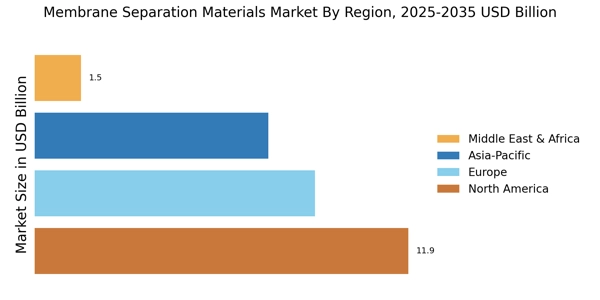
For the forecast of the global membrane separation materials market size in terms of value, a top-down approach was used. We have considered the total market size and regional markets’ sizes to derive the global membrane separation materials market size. After arriving at the overall market size, the total market was divided into several segments and sub-segments, for which the data was collected through primary sources. The market size of respective segments and sub-segments is then cross-referenced with secondary sources to ensure the accuracy of the market estimates and forecast for 2023 to 2030.
Factor Analysis
Factor analysis on the factors influencing the market growth of the global membrane separation materials was conducted which included government policies, favourable end-user environment, environmental regulations, product innovation, and regional trends.
Time-Series Analysis
Time-series analysis was used to analyze the historical trends and to forecast the future movements of the global membrane separation materials market. Historical market data plays an important role in forecasting the future of the market and aiding decision-making.
Data Triangulation Method
The data triangulation method was used to have a clear view of the global membrane separation materials market from different perspectives and verify the data collected through various primary and secondary sources. To provide deeper insights into the market size, demand-side triangulation and supply-side triangulation were conducted.
Demand Side Triangulation
The demand-side triangulation process includes analyzing the sales of the membrane separation materials at various levels such as region, application, product type, end-use industry, and other segments. This helps in assessing the demand for membrane separation materials across different applications, end-use, and geographies.
Supply Side Triangulation
The supply-side triangulation process includes analyzing the production of the membrane separation materials in various levels such as region, production capacity, sales, and other segments. This helps in understanding the supply of membrane separation materials across different regions and the gross production capacity.
As this report caters to the global membrane separation materials market, data triangulation was conducted to offer a comprehensive overview of the global membrane separation materials market. It includes qualitative and quantitative analysis of the various market segments. Qualitative analysis was conducted by the several industrial dynamics such as market trends, market dynamics, product type, supply chain, applications, and regional value chains. The qualitative analysis was done to understand the dynamics of the global membrane separation materials market better. It also helps in understanding the various drivers and restraints and their impact on the global membrane separation materials market.
The quantitative analysis was done to have a better understanding of the market and focus on the various segments and sub-segments. In the quantitative analysis, we have used historical data for the year 2017 to 2022 and estimates for 2023 to 2030 as per the data triangulation process for the global membrane separation materials market. The global membrane separation materials market size obtained was validated by using industry experts' and stakeholders’ views.
Various models were used to estimate and forecast the market size such as Demand-Side Triangulation Model, Supply-Side Triangulation Model, and Top-Down & Bottom-Up Model. This model was used to derive precise figures for the global membrane separation materials market and its various segments.
These models were also used to estimate the market size of different segments and sub-segments of the global membrane separation materials market in terms of value and volume. The final figures were validated and verified using the figures obtained through primary research.