Gas Separation Membrane Market Summary
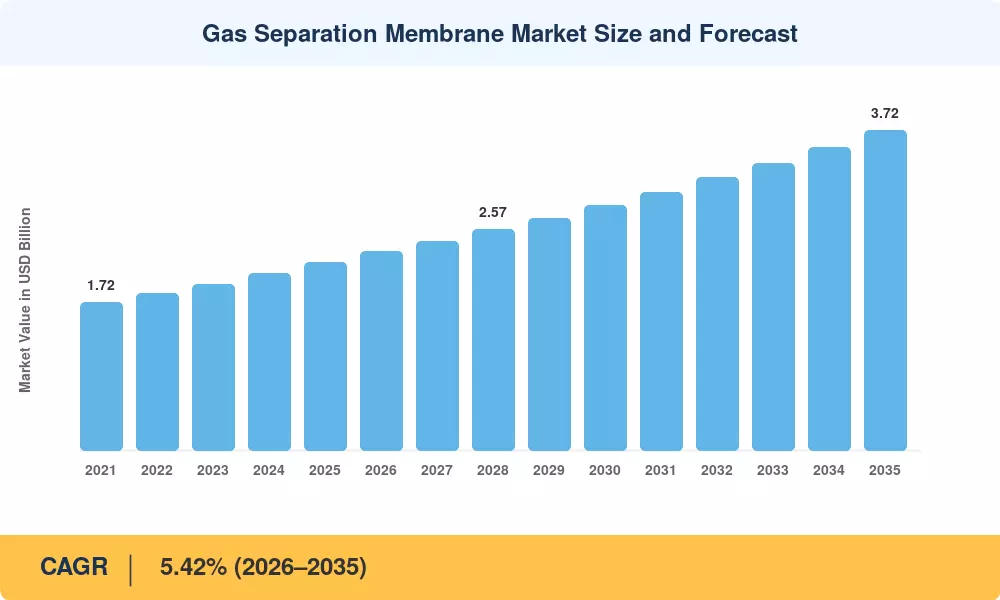
The Gas Separation Membrane Market reached an estimated USD 2.19 billion in 2025 and is projected to grow from USD 2.31 billion in 2026 to USD 3.72 billion by 2035, registering a CAGR of 5.42% during the forecast period (2026–2035). This expansion is anchored in two powerful catalysts: the U.S. Department of Energy's USD 1.2 billion Carbon Capture Demonstration Projects Program [2] and the rapid scaling of global LNG infrastructure, which demands advanced membrane separation technology for gas purification systems at every stage of the value chain. Tightening emissions regulations across OECD nations have elevated industrial gas filtration from a cost center to a compliance imperative.
A meaningful technology shift is reshaping how processors approach selective gas separation. Traditional amine-based scrubbing and pressure swing adsorption units — long the workhorses of carbon dioxide separation and hydrogen separation membranes — are steadily giving way to next-generation polymeric membranes and mixed-matrix membrane architectures. The International Energy Agency estimates that global hydrogen demand will surpass 115 million tonnes by 2030 [3], creating enormous pull for membrane gas processing solutions that offer lower energy penalties and smaller physical footprints than legacy thermal methods. Investments in air separation membranes for on-site nitrogen generation systems have accelerated in parallel, driven by semiconductor and food-packaging demand.
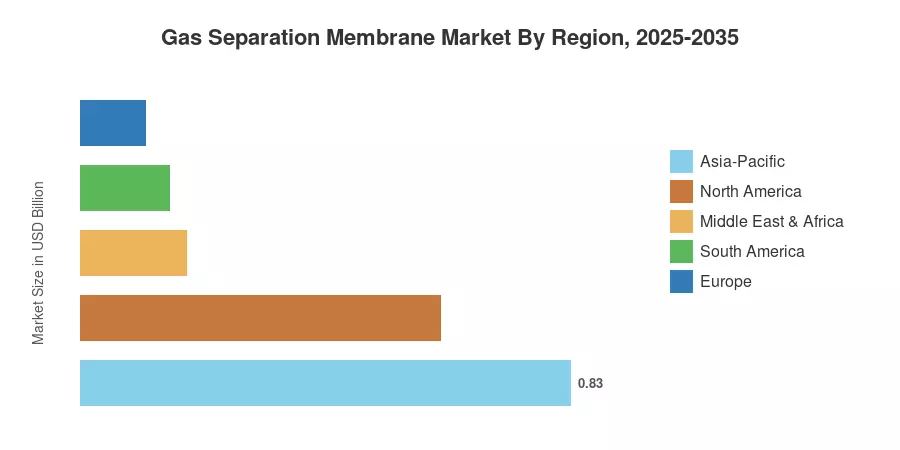
Asia-Pacific commands roughly 38% of the Gas Separation Membrane Market, reinforced by China's petrochemical buildout and India's expanding refinery capacity The region also registers the fastest CAGR at 6.18%, outpacing North America, the second-largest region with approximately 28% share. Europe rounds out the top three, propelled by EU Green Deal mandates on carbon dioxide separation and decarbonization targets. As hydrogen economies mature across all three regions, the Gas Separation Membrane Market is positioned for sustained, policy-backed growth through 2035.
Key Report Takeaways
• By Material Type
- Polyimide and polyamide membranes hold a combined share of approximately 36% of the Gas Separation Membrane Market, benefiting from superior thermal stability and selectivity in hydrogen separation membranes applications
- Cellulose acetate membranes are expanding at a CAGR of 4.8%, driven by cost-effective deployment in natural gas sweetening and carbon dioxide separation projects
- Polysulfone-based polymeric membranes account for roughly USD 0.46 billion, serving broad industrial gas filtration needs across refining and chemical processing
• By Application
- Nitrogen generation and oxygen enrichment represent the largest application segment in the Gas Separation Membrane Market, commanding approximately 32% share, propelled by electronics manufacturing and food preservation demand
- Hydrogen recovery applications are growing at a CAGR of 6.1%, reflecting the global push toward clean hydrogen economies and membrane gas processing
- Carbon dioxide removal is valued at approximately USD 0.39 billion, with adoption accelerating under carbon capture mandates
• By Region
- Asia-Pacific leads the Gas Separation Membrane Market with a 38% share and the fastest regional growth rate
- North America's membrane separation technology adoption is valued at approximately USD 0.61 billion, supported by shale gas processing and LNG export infrastructure
- Europe registers a CAGR of 5.1%, underpinned by EU regulatory mandates for gas purification systems in decarbonized energy networks
Market Size and Forecast (2021–2035)
Market Research Future (MRFR)'s market sizing combines bottom-up revenue modeling from manufacturer shipments, end-user procurement data, and top-down macroeconomic validation against IEA and EIA energy infrastructure projections. Historical figures (2021–2024) are derived from company filings and trade association data, while forecast values (2026–2035) are computed using a calibrated CAGR of 5.42%, cross-checked against pipeline project databases and regional capex announcements for membrane separation technology deployments.