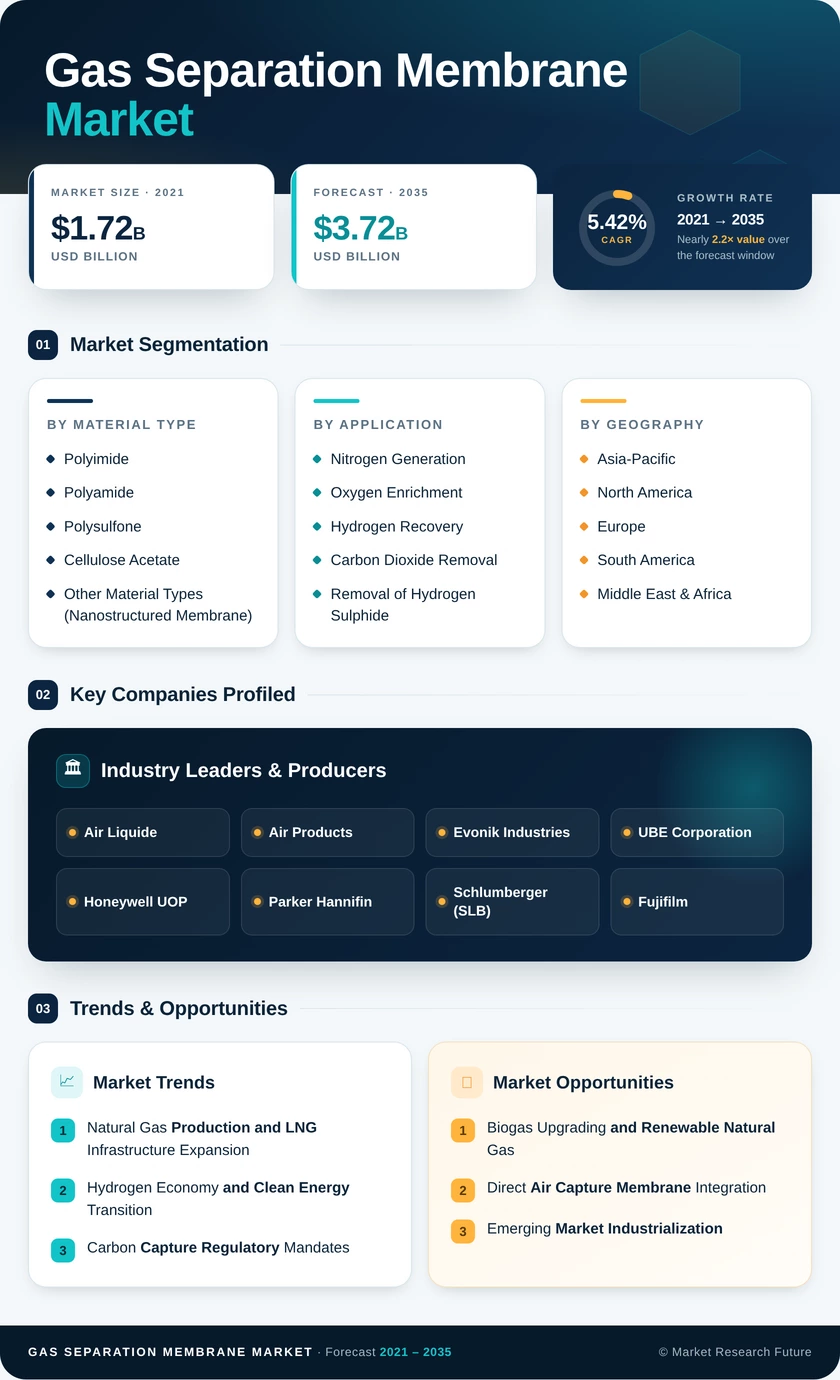
Gas Separation Membrane Market (2026 - 2035)

ID: MRFR/CnM/5727-HCR
111 Pages
Chitranshi Jaiswal
Last Updated: July 14, 2026
Gas Separation Membrane Market Research Report Information By Material Type (Polyimide and Polyamide, Polysulfone, Cellulose Acetate, and Other Material Types (Nanostructured Membrane)), By Application (Nitrogen Generation and Oxygen Enrichment, Hydrogen Recovery, Carbon Dioxide Removal, Removal of Hydrogen Sulphide, and Other Applications (Carbonation)) – Forecast Till 2035
Gas Separation Membrane Market
Market Size
Forecast Period2026-2035
CAGR (2026-2035)5.42%
2025 Market SizeUSD 2.19 Billion
2035 Market SizeUSD 3.72 Billion
Key Players
Air Liquide
Air Products
Evonik Industries
UBE Corporation
Honeywell UOP
Parker Hannifin
Opportunities
  • Biogas Upgrading and Renewable Natural Gas
  • Direct Air Capture Membrane Integration
  • Emerging Market Industrialization
  1. 1 Market Overview |
    1. 1.1 Study Assumptions & Market Definition |
    2. 1.2 Scope of the Study |
    3. 1.3 Research Methodology
  2. 2 Market Summary & Key Takeaways
  3. 3 Market Dynamics |
    1. 3.1 Market Drivers Analysis | |
      1. 3.1.1 Natural Gas Production Growth and LNG Infrastructure Expansion | |
      2. 3.1.2 Hydrogen Economy and Clean Energy Transition | |
      3. 3.1.3 Carbon Capture Regulatory Mandates | |
      4. 3.1.4 Semiconductor-Grade Nitrogen Generation | |
      5. 3.1.5 Food and Beverage Packaging Gas Requirements | |
      6. 3.1.6 Biogas Upgrading and Renewable Natural Gas | |
      7. 3.1.7 Mixed-Matrix Membrane Commercialization |
    2. 3.2 Market Restraints Analysis | |
      1. 3.2.1 High Initial Capital Cost of Membrane Modules | |
      2. 3.2.2 Membrane Fouling and Degradation in Harsh Feeds | |
      3. 3.2.3 Competition from Cryogenic and PSA Alternatives | |
      4. 3.2.4 Limited Membrane Performance at Extreme Temperatures | |
      5. 3.2.5 Skilled Workforce Shortage for Membrane System O&M |
    3. 3.3 Market Opportunity Analysis | |
      1. 3.3.1 Biogas Upgrading and Renewable Natural Gas | |
      2. 3.3.2 Direct Air Capture Membrane Integration | |
      3. 3.3.3 Emerging Market Industrialization | |
      4. 3.3.4 Digital Twins and Predictive Membrane Management | |
      5. 3.3.5 Hydrogen Blending in Natural Gas Grids |
    4. 3.4 Industry Value Chain Analysis |
    5. 3.5 Porter's Five Forces Analysis
  4. 4 Global Gas Separation Membrane Market Size & Forecast (2021–2035) |
    1. 4.1 Historical Market Size (2021–2025) |
    2. 4.2 Current & Forecast Market Size (2026–2035) |
    3. 4.3 Market Size by Revenue (USD Billion) |
    4. 4.4 Year-over-Year Growth Analysis
  5. 5 Segmentation Analysis |
    1. 5.1 By Material Type | |
      1. 5.1.1 Polyimide and Polyamide | |
      2. 5.1.2 Polysulfone | |
      3. 5.1.3 Cellulose Acetate | |
      4. 5.1.4 Other Material Types (Nanostructured Membrane) |
    2. 5.2 By Application | |
      1. 5.2.1 Nitrogen Generation and Oxygen Enrichment | |
      2. 5.2.2 Hydrogen Recovery | |
      3. 5.2.3 Carbon Dioxide Removal | |
      4. 5.2.4 Removal of Hydrogen Sulphide | |
      5. 5.2.5 Other Applications (Carbonation)
  6. 6 Regional Analysis |
    1. 6.1 North America | |
      1. 6.1.1 United States | |
      2. 6.1.2 Canada | |
      3. 6.1.3 Mexico |
    2. 6.2 Europe | |
      1. 6.2.1 Germany | |
      2. 6.2.2 United Kingdom | |
      3. 6.2.3 France | |
      4. 6.2.4 Italy | |
      5. 6.2.5 Spain | |
      6. 6.2.6 Nordic Countries | |
      7. 6.2.7 Russia | |
      8. 6.2.8 Rest of Europe |
    3. 6.3 Asia-Pacific | |
      1. 6.3.1 China | |
      2. 6.3.2 India | |
      3. 6.3.3 Japan | |
      4. 6.3.4 South Korea | |
      5. 6.3.5 ASEAN | |
      6. 6.3.6 Rest of Asia-Pacific |
    4. 6.4 South America | |
      1. 6.4.1 Brazil | |
      2. 6.4.2 Argentina | |
      3. 6.4.3 Rest of South America |
    5. 6.5 Middle East & Africa | |
      1. 6.5.1 Saudi Arabia | |
      2. 6.5.2 UAE | |
      3. 6.5.3 South Africa | |
      4. 6.5.4 Egypt | |
      5. 6.5.5 Rest of MEA
  7. 7 Competitive Landscape |
    1. 7.1 Market Share Analysis (2025) |
    2. 7.2 Competitive Benchmarking Matrix |
    3. 7.3 Company Profiles | |
      1. 7.3.1 Air Liquide | |
      2. 7.3.2 Air Products | |
      3. 7.3.3 Evonik Industries | |
      4. 7.3.4 UBE Corporation | |
      5. 7.3.5 Honeywell UOP | |
      6. 7.3.6 Parker Hannifin | |
      7. 7.3.7 Schlumberger (SLB) | |
      8. 7.3.8 Fujifilm | |
      9. 7.3.9 Membrane Technology and Research (MTR) | |
      10. 7.3.10 DIC Corporation
  8. 8 Future Outlook & Strategic Recommendations (2026–2035) |
    1. 8.1 AI-Optimized Membrane Operations |
    2. 8.2 Hydrogen Economy Maturation |
    3. 8.3 Circular Carbon Economy and CCUS Scaling |
    4. 8.4 Next-Generation Membrane Materials
  9. 9 Recent Developments & News
  10. 10 Frequently Asked Questions (FAQs)
  11. 11 Report Scope & Methodology |
    1. 11.1 Study Period & Base Year |
    2. 11.2 Data Sources & Citations |
    3. 11.3 Abbreviations
  12. 12 LIST OF TABLES |
  13. TABLE 1 Global Gas Separation Membrane Market Size & Forecast, by Revenue (USD Billion), 2021–2035 |
  14. TABLE 2 Global Gas Separation Membrane Market – Year-over-Year Growth Analysis, 2021–2035 |
  15. TABLE 3 Global Gas Separation Membrane Market – Driver Impact Analysis |
  16. TABLE 4 Global Gas Separation Membrane Market – Restraint Impact Analysis |
  17. TABLE 5 Global Gas Separation Membrane Market Size, by Material Type, 2021–2035 |
  18. TABLE 6 Global Gas Separation Membrane Market Size, by Application, 2021–2035 |
  19. TABLE 7 Global Gas Separation Membrane Market Size, by Region, 2021–2035 (USD Billion) |
  20. TABLE 8 North America Gas Separation Membrane Market Size, by Country, 2021–2035 |
  21. TABLE 9 Europe Gas Separation Membrane Market Size, by Country, 2021–2035 |
  22. TABLE 10 Asia-Pacific Gas Separation Membrane Market Size, by Country, 2021–2035 |
  23. TABLE 11 South America Gas Separation Membrane Market Size, by Country, 2021–2035 |
  24. TABLE 12 Middle East & Africa Gas Separation Membrane Market Size, by Country, 2021–2035 |
  25. TABLE 13 Competitive Benchmarking Matrix – Global Gas Separation Membrane Market, 2025 |
  26. TABLE 14 Company Profiles – Key Players, Global Gas Separation Membrane Market |
  27. TABLE 15 Recent Developments & Strategic Announcements, 2023–2025 |
  28. TABLE 16 Report Scope & Methodology Summary |
  29. TABLE 17 Detailed Sources and Citations |
  30. TABLE 18 North America Gas Separation Membrane Market Size, by Material Type, 2021–2035 (USD Billion) |
  31. TABLE 19 North America Gas Separation Membrane Market Size, by Application, 2021–2035 (USD Billion) |
  32. TABLE 20 Europe Gas Separation Membrane Market Size, by Material Type, 2021–2035 (USD Billion) |
  33. TABLE 21 Europe Gas Separation Membrane Market Size, by Application, 2021–2035 (USD Billion) |
  34. TABLE 22 Asia-Pacific Gas Separation Membrane Market Size, by Material Type, 2021–2035 (USD Billion) |
  35. TABLE 23 Asia-Pacific Gas Separation Membrane Market Size, by Application, 2021–2035 (USD Billion) |
  36. TABLE 24 South America Gas Separation Membrane Market Size, by Material Type, 2021–2035 (USD Billion) |
  37. TABLE 25 South America Gas Separation Membrane Market Size, by Application, 2021–2035 (USD Billion) |
  38. TABLE 26 Middle East & Africa Gas Separation Membrane Market Size, by Material Type, 2021–2035 (USD Billion) |
  39. TABLE 27 Middle East & Africa Gas Separation Membrane Market Size, by Application, 2021–2035 (USD Billion)
  40. 13 LIST OF FIGURES |
  41. FIGURE 1 Gas Separation Membrane Market Dynamics Overview |
  42. FIGURE 2 Industry Value Chain Analysis – Gas Separation Membrane Market |
  43. FIGURE 3 Porter's Five Forces Analysis – Gas Separation Membrane Market |
  44. FIGURE 4 Global Gas Separation Membrane Market Size Trend (USD Billion), 2021–2035 |
  45. FIGURE 5 Gas Separation Membrane Market Share, by Material Type, 2025 |
  46. FIGURE 6 Gas Separation Membrane Market Share, by Application, 2025 |
  47. FIGURE 7 Gas Separation Membrane Market Share, by Region, 2025 |
  48. FIGURE 8 North America Gas Separation Membrane Market Size Trend, 2021–2035 |
  49. FIGURE 9 Europe Gas Separation Membrane Market Size Trend, 2021–2035 |
  50. FIGURE 10 Asia-Pacific Gas Separation Membrane Market Size Trend, 2021–2035 |
  51. FIGURE 11 South America Gas Separation Membrane Market Size Trend, 2021–2035 |
  52. FIGURE 12 Middle East & Africa Gas Separation Membrane Market Size Trend, 2021–2035 |
  53. FIGURE 13 Competitive Landscape – Market Share Distribution, 2025 |
  54. FIGURE 14 Competitive Positioning Matrix – Gas Separation Membrane Market

Segmentation Quick Reference

DimensionSub-SegmentsDominant SegmentFastest Growing Segment
By Material TypePolyimide and Polyamide; Polysulfone; Cellulose Acetate; Other Material Types (Nanostructured Membrane)Polyimide and PolyamideCellulose Acetate
By ApplicationNitrogen Generation and Oxygen Enrichment; Hydrogen Recovery; Carbon Dioxide Removal; Removal of Hydrogen Sulphide; Other Applications (Carbonation)Nitrogen Generation and Oxygen EnrichmentHydrogen Recovery
By GeographyAsia-Pacific; North America; Europe; South America; Middle East & AfricaAsia-PacificAsia-Pacific


Market Segmentation Overview

By Material Type

Sub-SegmentKey Trend
Polyimide and PolyamideGrowing adoption in high-temperature hydrogen recovery and refinery gas processing
PolysulfoneCost-effective solution for broad industrial nitrogen generation and oxygen enrichment
Cellulose AcetateExpanding use in natural gas sweetening and European biogas upgrading projects
Other Material Types (Nanostructured Membrane)R&D-stage materials targeting next-generation carbon capture and mixed-gas separation


Polyimide and polyamide materials remain the backbone of the gas separation membrane industry, prized for their chemical inertness and ability to withstand operating temperatures exceeding 300°C. Cellulose acetate is gaining ground in cost-sensitive applications, particularly biogas-to-RNG upgrading in Europe, while nanostructured membranes represent the frontier of materials science, with commercial viability anticipated within the next five to seven years.

By Application

Sub-SegmentKey Trend
Nitrogen Generation and Oxygen EnrichmentSemiconductor and food packaging demand is driving on-site membrane nitrogen system adoption
Hydrogen RecoveryClean hydrogen mandates and refinery optimization fueling rapid growth
Carbon Dioxide RemovalCCUS policy incentives expanding membrane deployment in power and industrial sectors
Removal of Hydrogen SulphideSour gas field development in the Middle East and North America is sustaining demand
Other Applications (Carbonation)Niche beverage and specialty chemical applications with stable but moderate growth


Nitrogen generation and oxygen enrichment led by installed base, with tens of thousands of membrane systems operating globally in electronics, food, and pharmaceutical environments. Hydrogen recovery is the application to watch, driven by USD 1/kg hydrogen cost targets and refinery decarbonization mandates that are channeling billions in investment toward membrane-based purification infrastructure through 2035.


Download PDF ×

We do not share your information with anyone. However, we may send you emails based on your report interest from time to time. You may contact us at any time to opt-out.