Download Free Sample
Kindly complete the form below to receive a free sample of this Report
Metal 3D Printing Services Market Research Report By Technology (Selective Laser Melting, Electron Beam Melting, Binder Jetting, Metal Extrusion, Direct Energy Deposition), By Application (Aerospace, Automotive, Medical, Industrial, Consumer Products), By Material Type (Titanium, Aluminum, Stainless Steel, Nickel Alloys, Cobalt Chrome), By End Use Industry (Aerospace, Automotive, Healthcare, Energy, Manufacturing) And By Region (North America, Europe, Asia-Pacific, And Rest Of The World) – Market Forecast Till 2035.
As per MRFR analysis, the Metal 3D Printing Services Market was estimated at 4.5 USD Billion in 2024. The Metal 3D Printing Services industry is projected to grow from 4.92 USD Billion in 2025 to 12.0 USD Billion by 2035, exhibiting a compound annual growth rate (CAGR) of 9.33% during the forecast period 2025 - 2035.
The Metal 3D Printing Services Market is experiencing robust growth driven by customization and technological advancements.
| 2024 Market Size | 4.5 (USD Billion) |
| 2035 Market Size | 12.0 (USD Billion) |
| CAGR (2025 - 2035) | 9.33% |
GE Additive (US), 3D Systems (US), EOS (DE), Renishaw (GB), Arcam (SE), ExOne (US), SLM Solutions (DE), Materialise (BE), HP (US), Desktop Metal (US)
Our Impact
Enabled $4.3B Revenue Impact for Fortune 500 and Leading Multinationals
Partnering with 2000+ Global Organizations Each Year
30K+ Citations by Top-Tier Firms in the Industry
The Metal 3D Printing Services Market is currently experiencing a transformative phase, characterized by rapid advancements in technology and increasing adoption across various industries. This market appears to be driven by the growing demand for customized solutions, which enable manufacturers to produce complex geometries that traditional methods struggle to achieve. Additionally, the emphasis on sustainability and resource efficiency is likely to propel the market forward, as metal additive manufacturing offers reduced waste and energy consumption compared to conventional techniques. As industries such as aerospace, automotive, and healthcare continue to explore the potential of metal 3D printing, the landscape is evolving to accommodate a wider range of applications and materials. Moreover, the Metal 3D Printing Services Market seems to be influenced by the rising collaboration between technology providers and end-users. This synergy fosters innovation and enhances the development of tailored solutions that meet specific industry needs. Furthermore, the increasing availability of skilled professionals in the field may contribute to the market's growth, as expertise in metal additive manufacturing becomes more prevalent. Overall, the Metal 3D Printing Services Market is poised for significant expansion, driven by technological advancements, sustainability initiatives, and collaborative efforts across sectors.
The demand for customized metal components is on the rise, as industries seek to create intricate designs that traditional manufacturing cannot easily replicate. This trend highlights the capability of metal 3D printing to produce unique geometries, catering to specific requirements.
There is a growing emphasis on sustainable practices within the Metal 3D Printing Services Market. Companies are increasingly recognizing the environmental benefits of additive manufacturing, such as reduced material waste and lower energy consumption, which align with global sustainability goals.
The collaboration between technology providers and end-users is fostering innovation in the Metal 3D Printing Services Market. This partnership encourages the development of tailored solutions that address specific industry challenges, enhancing the overall effectiveness of metal additive manufacturing.
Cost efficiency is a pivotal driver in the Metal 3D Printing Services Market, as companies seek to reduce production costs while maintaining high-quality standards. Traditional manufacturing methods often involve significant material waste and lengthy lead times. In contrast, metal 3D printing minimizes waste by using only the necessary amount of material, which can lead to substantial cost savings. Additionally, the ability to produce complex parts in a single print reduces the need for multiple manufacturing processes, further enhancing cost efficiency. Recent studies indicate that businesses adopting metal 3D printing can achieve up to 50% reduction in production costs compared to conventional methods. This financial incentive is compelling for manufacturers across various sectors, thereby driving the growth of the Metal 3D Printing Services Market.
Sustainability initiatives are increasingly influencing the Metal 3D Printing Services Market as companies strive to reduce their environmental impact. Metal 3D printing is inherently more sustainable than traditional manufacturing methods due to its additive nature, which minimizes waste and energy consumption. Furthermore, the ability to recycle metal powders used in the printing process contributes to a circular economy, aligning with global sustainability goals. Many manufacturers are now prioritizing eco-friendly practices, and this shift is reflected in the growing demand for sustainable metal 3D printing solutions. Reports indicate that the market for sustainable manufacturing practices is expanding, with a notable increase in investments directed towards environmentally friendly technologies. This trend is likely to bolster the Metal 3D Printing Services Market as businesses seek to enhance their sustainability profiles.
The Metal 3D Printing Services Market is experiencing rapid technological advancements that enhance the capabilities of metal additive manufacturing. Innovations in materials, such as high-performance alloys and composites, are expanding the range of applications. Furthermore, advancements in printing technologies, including selective laser melting and electron beam melting, are improving precision and reducing production times. According to recent data, the market for metal 3D printing is projected to grow at a compound annual growth rate of over 25% in the coming years. This growth is driven by the increasing demand for complex geometries and lightweight components in industries such as aerospace and automotive. As these technologies continue to evolve, they are likely to further propel the Metal 3D Printing Services Market, enabling manufacturers to produce parts that were previously unattainable.
The demand for customization and personalization is a significant driver in the Metal 3D Printing Services Market. As industries evolve, there is an increasing need for tailored solutions that meet specific customer requirements. Metal 3D printing allows for the production of bespoke components that can be designed to fit unique specifications, which is particularly valuable in sectors such as healthcare, where custom implants and prosthetics are in high demand. The ability to quickly iterate designs and produce small batches of customized parts enhances the competitive edge of manufacturers. Market analysis suggests that the customization trend is expected to contribute to a substantial portion of the market growth, with personalized products becoming a key differentiator in the Metal 3D Printing Services Market.
Industry collaboration and partnerships are emerging as a crucial driver in the Metal 3D Printing Services Market. As the technology matures, companies are increasingly recognizing the value of collaborating with research institutions, technology providers, and other manufacturers to accelerate innovation. These partnerships facilitate knowledge sharing and resource pooling, enabling participants to tackle complex challenges associated with metal additive manufacturing. Collaborative efforts often lead to the development of new materials, improved processes, and enhanced applications, which can significantly benefit the market. Furthermore, joint ventures and strategic alliances are becoming more common, as companies aim to leverage each other's strengths to capture market opportunities. This collaborative landscape is expected to foster growth and innovation within the Metal 3D Printing Services Market.
In the Metal 3D Printing Services Market, the application segment is predominantly led by the aerospace industry, representing the largest share due to its reliance on advanced manufacturing techniques for complex components and lightweight structures. Following closely are automotive and industrial applications, which are also significant users of metal 3D printing technology, contributing to the market's overall growth. The medical sector, while currently smaller, is rapidly expanding as customized implants and surgical tools gain traction.
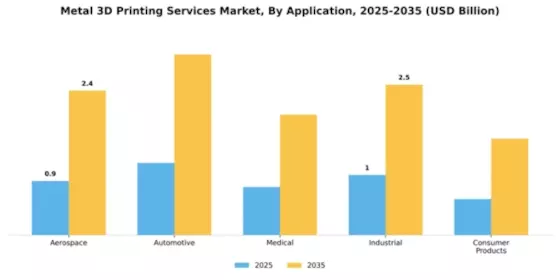
Aerospace: (Dominant) vs. Medical (Emerging)
The aerospace sector stands as the dominant force in the Metal 3D Printing Services Market due to its high demand for precision-engineered parts that enhance performance and reduce weight, leading to improved fuel efficiency. On the other hand, the medical sector is emerging rapidly, leveraging metal 3D printing for producing bespoke implants and prosthetics tailored to individual patients. This segment is driven by technological advancements and an increasing focus on personalized healthcare solutions, making it a key area of interest for future growth in the market.
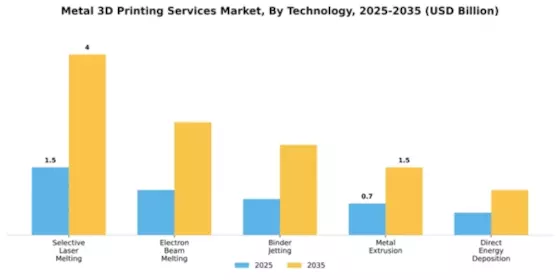
Selective Laser Melting (SLM) holds a significant portion of the Metal 3D Printing Services Market, primarily due to its ability to produce complex geometries with high precision. SLM is widely adopted across various sectors, including aerospace and healthcare, as it promotes the fabrication of intricate components. On the other hand, Electron Beam Melting (EBM) is gaining traction as it offers higher build rates and efficiency, particularly for titanium and other high-value materials that are critical in demanding applications.
Technology: SLM (Dominant) vs. EBM (Emerging)
Selective Laser Melting (SLM) stands out as the dominant technology in the Metal 3D Printing Services Market, known for its precision and versatility in producing detailed metal parts. It utilizes high-powered lasers to melt and fuse powdered metals, allowing for a wide range of applications from prototypes to end-use components. Meanwhile, Electron Beam Melting (EBM) is characterized by its rising adoption due to its efficiency and speed in processing materials, especially in the production of titanium components. EBM operates in a vacuum, enhancing its capability to handle high-performance alloys, making it an emerging choice for sectors that require strong and lightweight materials.
In the Metal 3D Printing Services Market, Titanium holds a significant share due to its strength-to-weight ratio and corrosion resistance, making it the dominant material for aerospace and medical applications. Meanwhile, Aluminum is gaining traction, driven by its lightweight properties and cost-effectiveness, emerging as the fastest-growing segment in the market. Stainless Steel, Nickel Alloys, and Cobalt Chrome also contribute to the market dynamics, appealing to industrial applications where toughness and heat resistance are paramount.
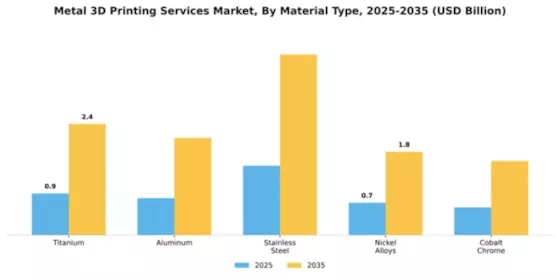
Titanium (Dominant) vs. Aluminum (Emerging)
Titanium, known for its exceptional performance in demanding applications, continues to dominate the Metal 3D Printing Services Market thanks to its unmatched strength, low density, and biocompatibility, particularly in the aerospace and medical sectors. Its high melting point and resistance to extreme conditions make it a favorite for high-performance components. In contrast, Aluminum is rapidly emerging due to its lightweight characteristics, affordability, and adaptability in a variety of applications, including automotive and consumer products. The demand for energy-efficient solutions is propelling Aluminum's growth, highlighting its role in sectors focused on sustainability and cost reduction.
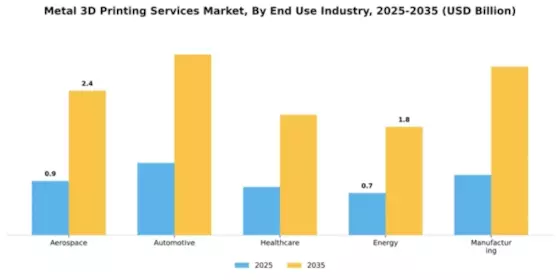
In the Metal 3D Printing Services Market, the aerospace industry holds the largest market share, driven by the demand for lightweight materials and complex geometries that enhance aircraft performance and fuel efficiency. Significant investments in aerospace applications underscore the industry's reliance on advanced manufacturing technologies, with notable contributions from both commercial and defense sectors. Healthcare, on the other hand, is witnessing rapid growth, emphasizing personalized medical devices and implants tailored to individual patients through advanced 3D printing technologies. This sector is capitalizing on the need for rapid prototyping and customization, propelling its development forward.
Aerospace: Dominant vs. Healthcare: Emerging
Aerospace remains the dominant force in the Metal 3D Printing Services Market due to its critical focus on performance-enhancing innovations and stringent regulatory standards, which favor the adoption of advanced manufacturing techniques. This sector benefits from a wide range of applications, including the production of intricate engine components and structural parts, thereby ensuring high-quality standards. Meanwhile, healthcare is emerging as a vital sector, characterized by its shift towards personalized medicine and the production of custom implants and surgical tools. This transition is fueled by ongoing research and increased collaboration between material scientists, orthopedic surgeons, and medical device manufacturers, making healthcare one of the fastest-growing segments in the market.
Get more detailed insights about Metal 3D Printing Services Market Request Free Sample
North America continues to lead the Metal 3D Printing Services Market, holding a significant share of 2.25 billion in 2024. The region's growth is driven by advancements in technology, increasing demand from aerospace and automotive sectors, and supportive government regulations promoting additive manufacturing. The focus on sustainability and cost-effectiveness further fuels market expansion, making it a hub for innovation in 3D printing services. The competitive landscape in North America is robust, featuring key players such as GE Additive, 3D Systems, and HP. These companies are at the forefront of technological advancements, offering cutting-edge solutions that cater to diverse industries. The presence of a strong manufacturing base and a skilled workforce enhances the region's attractiveness for investment in metal 3D printing technologies, solidifying its position as a global leader.
Europe's Metal 3D Printing Services Market is projected to reach 1.5 billion by 2025, driven by increasing adoption across various industries, including healthcare and automotive. The region benefits from strong regulatory support aimed at fostering innovation and sustainability in manufacturing processes. Initiatives from the European Union to promote advanced manufacturing technologies are key catalysts for market growth, enhancing competitiveness and efficiency in production. Leading countries such as Germany, the UK, and France are pivotal in this market, hosting major players like EOS and Renishaw. The competitive landscape is characterized by a mix of established firms and innovative startups, all striving to enhance their technological capabilities. The presence of research institutions and collaborative projects further strengthens the region's position in the global metal 3D printing landscape. "The European Commission is committed to supporting the development of advanced manufacturing technologies to enhance competitiveness in the global market."
The Asia-Pacific region is witnessing rapid growth in the Metal 3D Printing Services Market, projected to reach 0.9 billion by 2025. This growth is fueled by increasing investments in manufacturing technologies and a rising demand for customized solutions across various sectors. Countries like China and Japan are leading the charge, supported by government initiatives aimed at promoting advanced manufacturing practices and enhancing industrial capabilities. China, in particular, is emerging as a key player, with significant investments in 3D printing technologies. The competitive landscape is evolving, with both local and international companies vying for market share. The presence of major players such as Desktop Metal and ExOne further underscores the region's potential, as they expand their operations to meet the growing demand for metal 3D printing services. The focus on innovation and technology adoption is expected to drive further growth in this dynamic market.
The Middle East and Africa region is at the nascent stage of the Metal 3D Printing Services Market, with a projected size of 0.15 billion by 2025. The growth is primarily driven by increasing awareness of additive manufacturing benefits and the need for efficient production methods in various industries. Government initiatives aimed at diversifying economies and promoting technology adoption are key factors supporting market development in this region. Countries like the UAE and South Africa are leading the way, with investments in advanced manufacturing technologies. The competitive landscape is gradually evolving, with local firms beginning to explore metal 3D printing capabilities. The presence of international players is also increasing, as they seek to tap into the emerging opportunities in this region. "The UAE government is actively promoting the adoption of advanced manufacturing technologies to enhance economic diversification and competitiveness."
The Metal 3D Printing Services Market is currently characterized by a dynamic competitive landscape, driven by technological advancements and increasing demand for customized manufacturing solutions. Key players such as GE Additive (US), 3D Systems (US), and EOS (DE) are at the forefront, each adopting distinct strategies to enhance their market positioning. GE Additive (US) focuses on innovation through its advanced metal additive manufacturing technologies, while 3D Systems (US) emphasizes partnerships with aerospace and automotive sectors to expand its application reach. EOS (DE) is leveraging its expertise in industrial 3D printing to cater to a diverse range of industries, thereby shaping a competitive environment that is increasingly reliant on technological differentiation and strategic collaborations.In terms of business tactics, companies are localizing manufacturing to reduce lead times and optimize supply chains, which appears to be a critical factor in maintaining competitiveness. The market structure is moderately fragmented, with several players vying for market share, yet the influence of major companies is substantial. This collective presence of key players fosters an environment where innovation and operational efficiency are paramount, driving the overall growth of the market.In November GE Additive (US) announced a strategic partnership with a leading aerospace manufacturer to develop next-generation components using its advanced metal 3D printing technology. This collaboration is expected to enhance production capabilities and reduce costs, thereby solidifying GE Additive's position as a leader in the aerospace sector. The strategic importance of this partnership lies in its potential to accelerate the adoption of additive manufacturing in high-stakes industries, where precision and reliability are critical.In October 3D Systems (US) launched a new line of metal 3D printers designed specifically for the automotive industry, featuring enhanced speed and precision. This move is indicative of the company's commitment to innovation and its strategy to capture a larger share of the automotive market, which is increasingly turning to additive manufacturing for lightweight and complex components. The introduction of this product line may significantly impact the competitive dynamics within the automotive sector, as manufacturers seek to leverage advanced technologies for improved performance.In September EOS (DE) expanded its operations in Asia by opening a new facility in Singapore, aimed at serving the growing demand for metal 3D printing in the region. This expansion not only enhances EOS's operational footprint but also positions the company to better cater to local markets, which are increasingly adopting additive manufacturing technologies. The strategic importance of this move lies in its potential to strengthen EOS's competitive edge in a rapidly evolving market, where regional presence can significantly influence customer relationships and service delivery.As of December current trends in the Metal 3D Printing Services Market are heavily influenced by digitalization, sustainability, and the integration of AI technologies. Strategic alliances are becoming increasingly vital, as companies recognize the need to collaborate to enhance their technological capabilities and market reach. Looking ahead, competitive differentiation is likely to evolve from traditional price-based competition to a focus on innovation, technological advancements, and supply chain reliability. This shift underscores the importance of adaptability and forward-thinking strategies in navigating the complexities of the market.





The Metal 3D Printing Services Market is projected to grow at a 9.33% CAGR from 2025 to 2035, driven by technological advancements, increased adoption in aerospace, and demand for customized solutions.
New opportunities lie in:
By 2035, the market is expected to be robust, driven by innovation and diverse applications.
| MARKET SIZE 2024 | 4.5(USD Billion) |
| MARKET SIZE 2025 | 4.92(USD Billion) |
| MARKET SIZE 2035 | 12.0(USD Billion) |
| COMPOUND ANNUAL GROWTH RATE (CAGR) | 9.33% (2025 - 2035) |
| REPORT COVERAGE | Revenue Forecast, Competitive Landscape, Growth Factors, and Trends |
| BASE YEAR | 2024 |
| Market Forecast Period | 2025 - 2035 |
| Historical Data | 2019 - 2024 |
| Market Forecast Units | USD Billion |
| Key Companies Profiled | GE Additive (US), 3D Systems (US), EOS (DE), Renishaw (GB), Arcam (SE), ExOne (US), SLM Solutions (DE), Materialise (BE), HP (US), Desktop Metal (US) |
| Segments Covered | Application, Technology, Material Type, End Use Industry |
| Key Market Opportunities | Growing demand for customized metal components in aerospace and automotive sectors drives Metal 3D Printing Services Market expansion. |
| Key Market Dynamics | Technological advancements and competitive pressures drive innovation in the Metal 3D Printing Services market. |
| Countries Covered | North America, Europe, APAC, South America, MEA |
The projected market valuation for the Metal 3D Printing Services Market is expected to reach 12.0 USD Billion by 2035.
The overall market valuation of the Metal 3D Printing Services Market was 4.5 USD Billion in 2024.
The expected CAGR for the Metal 3D Printing Services Market during the forecast period 2025 - 2035 is 9.33%.
The application segments projected to grow include Aerospace, Automotive, Medical, Industrial, and Consumer Products, with valuations ranging from 0.6 to 3.0 USD Billion.
Key technologies driving the market include Selective Laser Melting, Electron Beam Melting, and Binder Jetting, with valuations from 0.5 to 4.0 USD Billion.
The most utilized materials include Stainless Steel, Titanium, and Aluminum, with market valuations ranging from 0.6 to 3.9 USD Billion.
End-use industries contributing to growth include Aerospace, Automotive, Healthcare, Energy, and Manufacturing, with valuations from 0.7 to 2.8 USD Billion.
Key players in the market include GE Additive, 3D Systems, EOS, Renishaw, and SLM Solutions, among others.
Growth appears robust across segments, with Aerospace and Automotive projected to lead, indicating a diverse market landscape.
Factors influencing expansion include technological advancements, increasing demand in various industries, and the versatility of materials used.


Kindly complete the form below to receive a free sample of this Report

“This is really good guys. Excellent work on a tight deadline. I will continue to use you going forward and recommend you to others. Nice job”


“Thanks. It’s been a pleasure working with you, please use me as reference with any other Intel employees.”


“Thanks for sending the report it gives us a good global view of the Betaïne market.”


“Thank you, this will be very helpful for OQS.”


“We found the report very insightful! we found your research firm very helpful. I'm sending this email to secure our future business.”


“I am very pleased with how market segments have been defined in a relevant way for my purposes (such as "Portable Freezers & refrigerators" and "last-mile"). In general the report is well structured. Thanks very much for your efforts.”


“I have been reading the first document or the study, ,the Global HVAC and FP market report 2021 till 2026. Must say, good info! I have not gone in depth at all parts, but got a good indication of the data inside!”


“We got the report in time, we really thank you for your support in this process. I also thank to all of your team as they did a great job.”


“The Automotive 48V ECU Components Procurement Intelligence Study” was a complex project, but the Market Research Future (MRFR) team handled it with quality, agility, and customer-centricity. They delivered all requested data on time and within the agreed scope. The team, including Shubhendra Anand and Rahul Gotadki, was always readily available to clarify questions and swiftly implement necessary adjustments, driving the project to a successful conclusion within a very demanding timeframe.
I would also like to specifically commend Akshay Agarwal for his responsiveness and support at every stage—from our initial inquiry on May 6th through to final delivery on June 18th. His dedication made the entire process seamless.”



