3D Printing Metal Market Summary
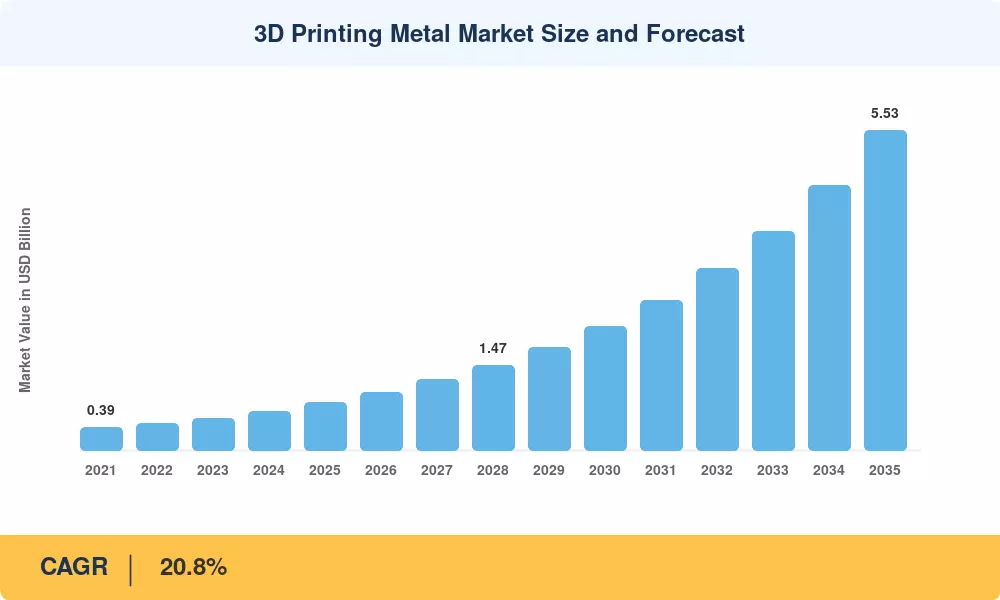
The 3D Printing Metals Market reached an estimated USD 0.83 billion in 2025 and is projected to climb from USD 1.01 billion in 2026 to USD 5.53 billion by 2035, registering a CAGR of 20.8% across the forecast window. Two catalysts anchor this trajectory: defense ministries across NATO nations now mandate on-demand spare-part inventories printed in qualified titanium and nickel superalloys. At the same time, FDA 510(k) clearances for patient-specific orthopedic implants have tripled since 2021 [1]. The capital flowing into powder atomization capacity — exceeding USD 2.4 billion in committed global investments between 2023 and 2025 — signals that supply chains are scaling to meet demand that was previously constrained by feedstock availability [2].
There is a strong movement to change technology afoot. Legacy casting and forging operations spanning decades that supported aerospace and automotive tooling are being replaced by powder-based build technologies that can create geometries hard to produce by subtractive means. A good example of how quickly certification obstacles are slipping away, boosting adoption throughout the 3D Printing Metals Market [3], is the European Space Agency’s decision to certify printed combustion chambers for the Ariane 6 upper-stage engine in 2024. Binder jetting platforms now reach throughput levels that make metal printing possible for mid-volume car brackets, not only prototypes.
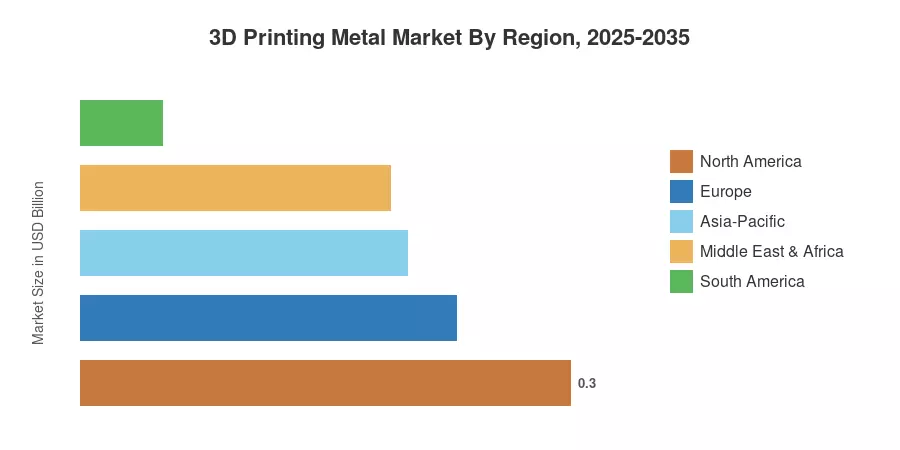
North America is the leading region of the 3D Printing Metals Market with a revenue share of 36.5% in 2025. This is due to concentrated aerospace procurement and a mature service-bureau environment. Asia-Pacific is the fastest expanding region with a 24.6% CAGR through 2035, driven by Chinese and Indian industrial policy that incentivizes local powder production. Europe has the second greatest share with 28.2%, spurred by Germany’s tradition in machine tools and Airbus’s growing range of printed parts. Either supply-chain localization or open-ecosystem coalitions will win the qualification race in the coming decade.
Key Report Takeaways
• By Metal Type
- Titanium alloys captured the largest share of the 3D Printing Metals Market in 2025, commanding 31.4% of total revenue — aerospace fatigue-life requirements remain the primary driver.
- Stainless steel is expanding at the fastest CAGR among established alloys through 2035, benefiting from healthcare instrument demand and lower per-kilogram powder cost.
• By End-User Industry
- Aerospace and defense accounted for 33.5% of the 3D Printing Metals Market in 2025, reflecting high-value, low-volume production economics.
- The automotive segment is registering the fastest growth at a 23.0% CAGR through 2035, led by lightweight bracket and heat-exchanger applications.
• By Geography
- North America led all regions with 36.5% of the 3D Printing Metals Market in 2025, supported by DoD procurement and NASA qualification programs.
- Asia-Pacific is advancing at a 24.6% CAGR through 2035, with China and India investing heavily in domestic atomization capacity.
Market Size and Forecast (2021–2035)
The MRFR estimates are a combination of direct interviews with powder manufacturers, machine OEMs and procurement leaders in end-use industries and secondary datasets from trade associations, patent filings and import-export data. Historical numbers (2021-2024) cover audited revenues from metal powder sales, machine consumables revenues and post-processing services. Forecast values (2026-2035) follow a compound growth model based on contract pipeline visibility and capacity expansion announcements.





















.webp?v=1787579600)
