×
Request Free Sample ×

Kindly complete the form below to receive a free sample of this Report

* Please use a valid business email

Leading companies partner with us for data-driven Insights

clients tt-cursor
Hero Background

Metal cladding Market

ID: MRFR/PCM/7228-HCR
107 Pages
Sakshi Gupta
October 2025

Metal Cladding Market Research Report Information By Material Type (Ceramic, Brick and stone, Metal, Wood, Vinyl, Stucco and Elfs, Fibre Cement, and Concrete and Weatherboard), By Uses (Walls, Roofs, Vents, and Gutters), By Application (Residential and Non-residential), and By Region (North America, Europe, Asia-Pacific, and Rest Of The World) – Market Forecast Till 2035

Share:
Download PDF ×

We do not share your information with anyone. However, we may send you emails based on your report interest from time to time. You may contact us at any time to opt-out.

Metal cladding Market Infographic
Purchase Options

Metal cladding Market Summary

As per MRFR analysis, the Metal cladding Market Size was estimated at 38.19 USD Billion in 2024. The Metal cladding industry is projected to grow from 40.18 USD Billion in 2025 to 66.71 USD Billion by 2035, exhibiting a compound annual growth rate (CAGR) of 5.2 during the forecast period 2025 - 2035.

Key Market Trends & Highlights

The Metal cladding market is poised for substantial growth driven by sustainability and technological advancements.

  • North America remains the largest market for metal cladding, driven by robust construction activities and architectural innovation.
  • The Asia-Pacific region is emerging as the fastest-growing market, fueled by rapid urbanization and infrastructure development.
  • Building facades represent the largest segment in the metal cladding market, while roofing is experiencing the fastest growth due to evolving architectural trends.
  • Sustainability initiatives and regulatory compliance are key drivers propelling the demand for metal cladding solutions across various sectors.

Market Size & Forecast

2024 Market Size 38.19 (USD Billion)
2035 Market Size 66.71 (USD Billion)
CAGR (2025 - 2035) 5.2%

Major Players

Kingspan Group (IE), Alcoa Corporation (US), Nucor Corporation (US), ArcelorMittal (LU), BHP Group (AU), Constellium SE (NL), Cleveland-Cliffs Inc. (US), Hindalco Industries Limited (IN), United States Steel Corporation (US)

Metal cladding Market Trends

the Metal Cladding Market is evolving dynamically, driven by various factors that influence architectural design and construction practices. The increasing emphasis on energy efficiency and sustainability has led to a growing preference for metal cladding materials, which offer durability and aesthetic appeal. Additionally, advancements in manufacturing technologies are enabling the production of innovative metal cladding solutions that cater to diverse architectural styles and functional requirements. As urbanization continues to rise, the demand for modern buildings with enhanced insulation properties is likely to propel the market further. Moreover, the Metal Cladding Market is shifting towards environmentally friendly materials, as stakeholders prioritize sustainable construction practices. This trend is reflected in the increasing adoption of recycled metals and eco-friendly coatings, which not only reduce environmental impact but also enhance the longevity of cladding systems. Furthermore, the integration of smart technologies into metal cladding systems is emerging as a potential game-changer, allowing for improved energy management and building performance. Overall, the Metal cladding Market appears poised for substantial growth, driven by innovation and a commitment to sustainability.

Sustainability Focus

The Metal cladding Market is increasingly influenced by a focus on sustainability. Stakeholders are prioritizing eco-friendly materials and practices, leading to a rise in the use of recycled metals and sustainable coatings. This trend reflects a broader commitment to reducing environmental impact in construction.

Technological Advancements

Innovations in manufacturing processes are shaping the Metal cladding Market. New technologies enable the creation of versatile and high-performance cladding solutions that meet diverse architectural needs. This evolution enhances design possibilities and improves overall building efficiency.

Integration of Smart Technologies

The incorporation of smart technologies into metal cladding systems is gaining traction. These advancements allow for enhanced energy management and building performance, potentially transforming how structures interact with their environment and respond to user needs.

Metal cladding Market Drivers

Market Growth Projections

The Global Metal Cladding Market Industry is projected to experience substantial growth over the next decade. With an estimated market value of 38.2 USD Billion in 2024, the industry is expected to expand to 66.7 USD Billion by 2035. This growth trajectory suggests a compound annual growth rate of 5.2% from 2025 to 2035, driven by various factors including increased construction activities, sustainability trends, and technological advancements. These projections indicate a robust future for the metal cladding sector, highlighting its importance in modern construction practices.

Growing Construction Activities

The Global Metal Cladding Market Industry is experiencing a surge due to increasing construction activities worldwide. As urbanization accelerates, the demand for residential and commercial buildings rises, leading to a greater need for durable and aesthetically pleasing materials. Metal cladding Market, known for its longevity and low maintenance, is becoming a preferred choice among architects and builders. In 2024, the market is projected to reach 38.2 USD Billion, reflecting the industry's robust growth. This trend is likely to continue as more countries invest in infrastructure development, further driving the demand for metal cladding solutions.

Rising Demand for Aesthetic Appeal

The aesthetic appeal of metal cladding is becoming a crucial factor in the Global Metal Cladding Market Industry. Architects and designers are increasingly incorporating metal cladding into their projects to achieve modern and visually striking facades. The versatility of metal materials allows for various finishes and colors, enabling creative expression in building design. As consumer preferences shift towards unique and attractive buildings, the demand for metal cladding is expected to rise. This trend aligns with the overall growth of the construction sector, further solidifying the market's position in the coming years.

Sustainability and Energy Efficiency

Sustainability concerns are increasingly influencing the Global Metal Cladding Market Industry. Metal cladding Market materials, particularly those that are recyclable and energy-efficient, align with the growing emphasis on green building practices. As regulations tighten around energy consumption in buildings, architects and builders are turning to metal cladding for its thermal efficiency and potential to reduce energy costs. This shift not only meets regulatory requirements but also appeals to environmentally conscious consumers. The market's growth trajectory suggests that by 2035, it could reach 66.7 USD Billion, driven by the demand for sustainable construction materials.

Technological Advancements in Manufacturing

Technological advancements in manufacturing processes are significantly impacting the Global Metal Cladding Market Industry. Innovations such as improved coating techniques and automated production lines enhance the quality and efficiency of metal cladding products. These advancements allow for greater customization and design flexibility, catering to diverse architectural needs. As manufacturers adopt cutting-edge technologies, the market is likely to witness increased competition and product differentiation. This dynamic environment may contribute to a compound annual growth rate of 5.2% from 2025 to 2035, indicating a promising future for the industry.

Regulatory Support for Infrastructure Development

Regulatory support for infrastructure development is playing a pivotal role in the Global Metal Cladding Market Industry. Governments worldwide are implementing policies that encourage investment in infrastructure, including housing, commercial spaces, and public facilities. These initiatives often prioritize the use of durable and sustainable materials, such as metal cladding, which meets safety and environmental standards. As a result, the market is poised for growth, with projections indicating a significant increase in demand. This supportive regulatory environment is likely to foster innovation and investment in metal cladding solutions, enhancing the industry's overall landscape.
Market Segment Insights

By Application: Building Facades (Largest) vs. Roofing (Fastest-Growing)

In the metal cladding market, the application segment showcases a diverse distribution among various values. Building facades dominate the sector, driven by the continuous demand for aesthetic and durable exterior finishes in residential and commercial structures. Following closely, roofing has emerged as a significant contributor, harnessing innovations in energy efficiency and climate resilience.

Building Facades (Dominant) vs. Roofing (Emerging)

Building facades stand out as the dominant segment in the metal cladding market, largely due to their role in enhancing the architectural appeal and energy efficiency of buildings. They offer long-lasting protection against elements, making them a preferred choice among architects and builders. In contrast, the roofing segment has seen rapid growth, fueled by advancements in metal roofing technologies that provide improved insulation and sustainability. With a focus on lightweight materials and aesthetic versatility, roofing is becoming increasingly popular for residential and commercial applications alike.

By Material Type: Aluminum (Largest) vs. Steel (Fastest-Growing)

In the Metal Cladding Market, Aluminum holds the largest market share due to its lightweight properties, corrosion resistance, and versatility. It is extensively used in diverse applications, making it the preferred choice in the construction industry. Conversely, Steel is witnessing rapid growth as the fastest-growing material type, primarily driven by the increasing demand for durable and cost-effective building solutions that can withstand harsh environments. As industries evolve, the demand for sustainable and energy-efficient materials continues to shape the market landscape. Steel's properties, including its strength and recyclability, have gained traction, particularly in commercial and industrial applications. Alongside Aluminum's established dominance, the growth of Steel signals a shift towards materials that offer both performance and sustainability in metal cladding solutions.

Aluminum (Dominant) vs. Copper (Emerging)

Aluminum is recognized as the dominant material in the Metal Cladding Market due to its various advantages such as lightweight, high strength-to-weight ratio, and excellent thermal conductivity, which make it ideal for a range of applications from residential to industrial settings. Meanwhile, Copper is emerging as a noteworthy material due to its unique aesthetic appeal and long lifespan, particularly in architectural cladding. Its antimicrobial properties also contribute to its attractiveness in urban environments. While Aluminum continues to lead in volume and application versatility, Copper's growing popularity signals a shift towards premium materials that offer both functionality and enhanced aesthetic qualities in metal cladding designs.

By End Use: Residential (Largest) vs. Commercial (Fastest-Growing)

The metal cladding market showcases various end-use segments including residential, commercial, industrial, institutional, and infrastructure. Among these, the residential sector holds the largest share, driven by the rising demand for modern housing solutions and aesthetic appeal. This segment benefits from increased construction activities and a preference for durable and energy-efficient building materials, leading to its dominance in the market.

Residential (Dominant) vs. Commercial (Emerging)

The residential segment of the metal cladding market is characterized by its focus on providing aesthetic value and energy efficiency to homes. With growing consumer demand for visually appealing yet sustainable materials, residential metal cladding has become a preferred choice for homeowners and builders alike. In contrast, the commercial segment, while currently emerging, is witnessing rapid growth due to increasing investments in commercial infrastructure and a shift towards prefabricated building solutions. The versatility of metal cladding in commercial applications enhances building longevity and contributes to energy savings, paving the way for its swift adoption.

By Installation Method: Mechanical Fastening (Largest) vs. Adhesive Bonding (Fastest-Growing)

In the Metal Cladding Market, the installation methods exhibit a diverse range of applications and preferences. Mechanical Fastening holds a significant share due to its reliability and strength, making it the dominant installation method. Following closely, Adhesive Bonding is rapidly gaining traction, attributed to its ability to provide seamless finishes and reduce thermal bridging, which is critical in modern construction. Other methods, such as Welding, Riveting, and Clipping, occupy smaller market shares but cater to specific niche applications depending on structural requirements. The growth trends in the installation method segment denote a shift towards more efficient and sustainable solutions. The rise of environmentally friendly adhesive technologies is propelling the Adhesive Bonding segment, making it the fastest-growing method. Concurrently, innovations in mechanical fastening technology enhance performance and application flexibility. As industries shift towards lightweight and energy-efficient materials, the demand for diverse installation methods continues to grow, reflecting trends towards sustainability and increased construction efficiency in the metal cladding market.

Mechanical Fastening (Dominant) vs. Adhesive Bonding (Emerging)

Mechanical Fastening is characterized by its ability to provide robust and reliable connections, making it the preferred choice in heavy-load metal cladding applications. It ensures structural integrity and offers ease of installation, thus maintaining its status as the dominant method in the market. On the other hand, Adhesive Bonding is emerging as a competitive alternative, especially in projects requiring aesthetic appeal and thermal efficiency. This method eliminates visible fasteners, allowing for a cleaner look while improving insulation performance. As the focus on energy efficiency rises, Adhesive Bonding is gaining popularity for its role in sustainable building practices. Each installation method caters to different architectural styles and performance specifications, shaping the landscape of the Metal Cladding Market.

By Surface Finish: Anodized (Largest) vs. Polished (Fastest-Growing)

In the Metal cladding market, the surface finish segment is predominantly driven by anodized finishes, which have established themselves as the largest segment due to their excellent durability and aesthetic appeal. Following closely are painted and natural finishes, which also capture significant market shares by appealing to various consumer preferences. Textured finishes, while lower in market share, are gaining traction among specific industries that seek enhanced grip and surface characteristics, further diversifying the market dynamics in this segment.

Anodized (Dominant) vs. Polished (Emerging)

Anodized finishes continue to dominate the market due to their superior corrosion resistance, ability to be dyed in various colors, and lower maintenance requirements, making them a preferred choice for high-end architectural applications. Conversely, polished finishes are emerging rapidly among consumers who prefer a sleek and modern aesthetic. Their reflective properties enhance design appeal, especially in luxury settings. The growth of polished finishes is mainly driven by the rising demand for aesthetic innovations in metal cladding solutions, capturing the attention of architects and designers looking for unique finishes that stand out in competitive markets.

Get more detailed insights about Metal cladding Market

Regional Insights

North America : Market Leader in Metal Cladding

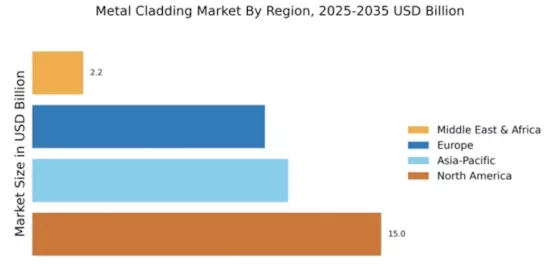
North America is poised to maintain its leadership in the metal cladding market, holding a significant market share of 15.0 in 2024. The region's growth is driven by robust construction activities, increasing demand for energy-efficient buildings, and stringent building codes promoting sustainable materials. Regulatory support for green building initiatives further catalyzes market expansion, making it a key player in the global landscape. The competitive landscape in North America is characterized by the presence of major players such as Alcoa Corporation, Nucor Corporation, and United States Steel Corporation. These companies are investing in innovative technologies and sustainable practices to enhance their product offerings. The U.S. and Canada are the leading countries in this region, with a strong focus on infrastructure development and commercial construction, ensuring a steady demand for metal cladding solutions.

Europe : Emerging Market with Growth Potential

Europe's metal cladding market is projected to grow significantly, with a market size of 10.0 in 2025. The region benefits from increasing investments in infrastructure and a shift towards sustainable construction practices. Regulatory frameworks, such as the EU's Green Deal, are driving demand for energy-efficient building materials, positioning Europe as a key player in the global market. The focus on reducing carbon emissions is further propelling the adoption of metal cladding solutions. Leading countries in Europe include Germany, France, and the UK, where major companies like Kingspan Group and ArcelorMittal are actively involved. The competitive landscape is marked by innovation and collaboration among industry players to meet evolving consumer demands. The presence of stringent regulations ensures that manufacturers prioritize sustainability, enhancing the overall market appeal.

Asia-Pacific : Rapid Growth in Construction Sector

The Asia-Pacific region is witnessing a surge in the metal cladding market, with a projected size of 11.0 in 2025. This growth is fueled by rapid urbanization, increasing construction activities, and a rising focus on modern architectural designs. Countries like China and India are leading the charge, supported by government initiatives aimed at enhancing infrastructure and promoting sustainable building practices. The demand for durable and energy-efficient materials is driving the adoption of metal cladding solutions across the region. China stands out as a dominant player, with significant contributions from local manufacturers and international companies. The competitive landscape is evolving, with key players like Hindalco Industries Limited and Constellium SE expanding their presence. The region's diverse market dynamics and increasing investments in construction projects are expected to sustain growth in the metal cladding sector.

Middle East and Africa : Emerging Market with Unique Challenges

The Middle East and Africa region is gradually developing its metal cladding market, with a size of 2.19 in 2025. The growth is primarily driven by increasing urbanization and infrastructure development, particularly in the Gulf Cooperation Council (GCC) countries. However, challenges such as fluctuating raw material prices and regulatory hurdles may impact market dynamics. The focus on sustainable construction is gaining traction, encouraging the adoption of metal cladding solutions in the region. Leading countries include the UAE and South Africa, where significant investments in construction projects are underway. The competitive landscape features both local and international players, with companies striving to innovate and meet the growing demand. The presence of key players is essential for driving market growth and addressing the unique challenges faced in this region.

Key Players and Competitive Insights

The Metal cladding Market is currently characterized by a dynamic competitive landscape, driven by factors such as increasing demand for energy-efficient building materials, advancements in manufacturing technologies, and a growing emphasis on sustainability. Key players like Kingspan Group (IE), Alcoa Corporation (US), and Nucor Corporation (US) are strategically positioned to leverage these trends. Kingspan Group (IE) focuses on innovation in insulation and energy efficiency, while Alcoa Corporation (US) emphasizes sustainable aluminum production. Nucor Corporation (US) is known for its commitment to recycling and sustainable practices, which collectively shape a competitive environment that prioritizes eco-friendly solutions and technological advancements.

In terms of business tactics, companies are increasingly localizing manufacturing to reduce lead times and optimize supply chains. The market appears moderately fragmented, with several players vying for market share. However, the collective influence of major companies like ArcelorMittal (LU) and BHP Group (AU) suggests a trend towards consolidation, as these firms seek to enhance their operational efficiencies and expand their global reach.

In November 2025, Kingspan Group (IE) announced a partnership with a leading technology firm to develop smart building solutions that integrate AI for energy management. This strategic move is likely to enhance Kingspan's product offerings, positioning the company at the forefront of the digital transformation in the construction sector. By focusing on smart technologies, Kingspan aims to meet the evolving needs of architects and builders seeking innovative solutions.

In October 2025, Alcoa Corporation (US) unveiled a new line of low-carbon aluminum products designed specifically for the construction industry. This initiative not only aligns with global sustainability goals but also strengthens Alcoa's market position as a leader in environmentally responsible manufacturing. The introduction of these products is expected to attract environmentally conscious clients and enhance Alcoa's competitive edge.

In September 2025, Nucor Corporation (US) expanded its production capacity by investing in a new facility dedicated to producing high-performance metal cladding materials. This expansion reflects Nucor's strategy to meet the increasing demand for durable and sustainable building materials. By enhancing its production capabilities, Nucor is likely to solidify its market presence and cater to a broader customer base.

As of December 2025, the Metal cladding Market is witnessing trends such as digitalization, sustainability, and AI integration, which are redefining competitive dynamics. Strategic alliances among key players are becoming increasingly common, fostering innovation and enhancing supply chain reliability. The competitive differentiation is shifting from price-based strategies to a focus on technological advancements and sustainable practices, indicating a transformative phase in the market.

Key Companies in the Metal cladding Market market include

Industry Developments

June 2023. The takeover bid has been completed by Etex, which is based in Belgium, for UK insulation product manufacturer Superglass. This transaction will see the company further grow its European footprint in sustainable insulation materials as well as complement its existing operations as a producer of glass mineral wool and extruded polystyrene through URSA.May 2023: A new exterior cladding system is here! Britten Inc, a leading provider of printing and design solutions, has introduced Tex CladcTM – an innovative approach combining high-strength engineered fabrics with fasteners made from architect-grade metal.

These features represent an innovative solution to traditional perforated metal facades at cheaper rates and also provide a stage for creative engineering planning.March 2023: Cuppa Pizarras, an architectural cladding firm, has developed Cupa Clad, a slate cladding system designed to display the material’s aesthetic beauty while boosting a building’s insulation. A rainscreen application process was adopted by Cupa Pizarras that coupled natural slate with the cementitious backer board where the outboard plane is ventilated, producing the cladding system.

Future Outlook

Metal cladding Market Future Outlook

The Metal cladding Market is projected to grow at a 5.2% CAGR from 2024 to 2035, driven by urbanization, energy efficiency demands, and technological advancements.

New opportunities lie in:

  • Expansion into sustainable metal cladding solutions for green buildings.
  • Development of smart cladding systems integrating IoT technology.
  • Partnerships with construction firms for customized cladding solutions.

By 2035, the Metal cladding Market is expected to achieve robust growth and innovation.

Market Segmentation

Metal cladding Market End Use Outlook

  • Residential
  • Commercial
  • Industrial
  • Institutional
  • Infrastructure

Metal cladding Market Application Outlook

  • Building Facades
  • Roofing
  • Interior Walls
  • Curtain Walls
  • Insulation

Metal cladding Market Material Type Outlook

  • Aluminum
  • Steel
  • Copper
  • Zinc
  • Titanium

Metal cladding Market Surface Finish Outlook

  • Anodized
  • Painted
  • Natural
  • Textured
  • Polished

Metal cladding Market Installation Method Outlook

  • Mechanical Fastening
  • Adhesive Bonding
  • Welding
  • Riveting
  • Clipping

Report Scope

MARKET SIZE 202438.19(USD Billion)
MARKET SIZE 202540.18(USD Billion)
MARKET SIZE 203566.71(USD Billion)
COMPOUND ANNUAL GROWTH RATE (CAGR)5.2% (2024 - 2035)
REPORT COVERAGERevenue Forecast, Competitive Landscape, Growth Factors, and Trends
BASE YEAR2024
Market Forecast Period2025 - 2035
Historical Data2019 - 2024
Market Forecast UnitsUSD Billion
Key Companies ProfiledKingspan Group (IE), Alcoa Corporation (US), Nucor Corporation (US), ArcelorMittal (LU), BHP Group (AU), Constellium SE (NL), Cleveland-Cliffs Inc. (US), Hindalco Industries Limited (IN), United States Steel Corporation (US)
Segments CoveredApplication, Material Type, End Use, Installation Method, Surface Finish
Key Market OpportunitiesGrowing demand for sustainable building materials drives innovation in the Metal cladding Market.
Key Market DynamicsRising demand for energy-efficient building materials drives innovation and competition in the metal cladding market.
Countries CoveredNorth America, Europe, APAC, South America, MEA

Market Highlights

Author
Sakshi Gupta
Research Analyst Level II

I have about two years of experience working in the consumer goods and retail industries and I am a biotech graduate.A tech-savvy analytically focused professional with a strong capabilities in identification, concept generation, and strategy evaluation. I can produce data-driven solutions while fusing unusual viewpoints with original concepts. I have been extensively working on business case studies, competitive & comparative analyses, and strategic reports. My primary areas of experience include client management, financial analysis, supply chain evaluation, market entry strategy evaluation, and estimating and forecasting market size.

Leave a Comment

FAQs

How much is the Metal Cladding market?

The Metal Cladding market size was valued at USD 38.19 Billion in 2024.

What is the growth rate of the Metal Cladding market?

Metal cladding Market is projected to register a CAGR of 5.2% from 2025-2035

Which region held the largest market share in the Metal Cladding market?

Asia Pacific had the largest share in the Metal Claddingmarket

Who are the key players in the Metal Cladding market?

The key players in the Metal Cladding market are Saint Gobain S.A, Dow Du Pont, Tata steel limited, Arconic, Westlake chemicals, Etex group, and James Hardie industries

Which Material Type led the Metal Cladding market?

The Metal Material Type dominated the Metal Cladding market in 2024.

Which Uses had the largest market share in the Metal Cladding market?

The Roofs Uses had the largest share in the Metal Claddingmarket.

Download Free Sample

Kindly complete the form below to receive a free sample of this Report

Compare Licence

×
Features License Type
Single User Multiuser License Enterprise User
Price $4,950 $5,950 $7,250
Maximum User Access Limit 1 User Upto 10 Users Unrestricted Access Throughout the Organization
Free Customization
Direct Access to Analyst
Deliverable Format
Platform Access
Discount on Next Purchase 10% 15% 15%
Printable Versions