×
Request Free Sample ×

Kindly complete the form below to receive a free sample of this Report

* Please use a valid business email

Leading companies partner with us for data-driven Insights

clients tt-cursor
Hero Background

Metal Injection Molding Market

ID: MRFR/PCM/8217-HCR
111 Pages
Snehal Singh
October 2025

Metal Injection Molding Market Research Report By Material (Stainless Steel, Ferrous Alloys, Non-Ferrous Alloys), By Component Type (Precision Components, Complex Geometries, Structural Components), By Industry Vertical (Aerospace & Defense, Medical Devices, Automotive, Electronics, Industrial Machinery), By Production Volume (Low Volume, Medium Volume, High Volume), By Application (High-Strength Applications, Corrosion-Resistant Applications, Wear-Resistant Applications, High-Temperature Applications, Tooling Applications) and By Regio... read more

Share:
Download PDF ×

We do not share your information with anyone. However, we may send you emails based on your report interest from time to time. You may contact us at any time to opt-out.

Metal Injection Molding Market Infographic
Purchase Options

Metal Injection Molding Market Summary

As per MRFR analysis, the Metal Injection Molding Market Size was estimated at 2765.47 USD Million in 2024. The Metal Injection Molding industry is projected to grow from 2883.33 in 2025 to 4376.79 by 2035, exhibiting a compound annual growth rate (CAGR) of 4.26 during the forecast period 2025 - 2035.

Key Market Trends & Highlights

The Metal Injection Molding Market is poised for robust growth driven by technological advancements and increasing demand across various sectors.

  • Technological advancements are enhancing the efficiency and precision of metal injection molding processes.
  • Customization and flexibility in product design are becoming increasingly important to meet diverse consumer needs.
  • Sustainability initiatives are gaining traction, influencing manufacturers to adopt eco-friendly practices in production.
  • The rising demand in the automotive sector and advancements in medical devices are key drivers propelling market growth.

Market Size & Forecast

2024 Market Size 2765.47 (USD Million)
2035 Market Size 4376.79 (USD Million)
CAGR (2025 - 2035) 4.26%

Major Players

Arburg (DE), BASF (DE), Hoganas (SE), PMT (US), MIMtech (US), GKN Powder Metallurgy (GB), Schunk (DE), DWA (US), Sinterit (PL)

Metal Injection Molding Market Trends

The Metal Injection Molding Market is currently experiencing a notable transformation, driven by advancements in technology and increasing demand for complex geometries in various industries. This manufacturing process, which combines the benefits of both plastic injection molding and powder metallurgy, allows for the production of intricate metal parts with high precision and efficiency. As industries such as automotive, aerospace, and medical devices continue to evolve, the need for lightweight and durable components has surged, thereby propelling the growth of this market. Furthermore, the rising emphasis on sustainability and resource efficiency is prompting manufacturers to adopt innovative practices that minimize waste and energy consumption. In addition to technological advancements, the Metal Injection Molding Market is witnessing a shift towards customization and rapid prototyping. Companies are increasingly seeking tailored solutions to meet specific requirements, which has led to the development of more flexible manufacturing processes. This trend is further supported by the integration of digital technologies, such as artificial intelligence and machine learning, which enhance production capabilities and streamline operations. As the market progresses, it appears poised for continued expansion, with potential opportunities emerging in new applications and materials that could redefine the landscape of metal manufacturing.

Technological Advancements

The Metal Injection Molding Market is benefiting from continuous technological innovations that enhance production efficiency and precision. New machinery and techniques are being developed, allowing for the creation of more complex geometries and improved surface finishes. This trend is likely to attract a broader range of industries seeking high-quality metal components.

Customization and Flexibility

There is a growing demand for customized solutions within the Metal Injection Molding Market. Manufacturers are increasingly focusing on providing tailored products to meet specific client needs. This shift towards flexibility in production processes enables quicker turnaround times and fosters stronger relationships between suppliers and customers.

Sustainability Initiatives

Sustainability is becoming a central theme in the Metal Injection Molding Market. Companies are adopting eco-friendly practices, such as reducing waste and utilizing recyclable materials. This trend not only addresses environmental concerns but also appeals to consumers who prioritize sustainable products, potentially enhancing brand loyalty.

Metal Injection Molding Market Drivers

Market Growth Projections

The Global Metal Injection Molding Market Industry is poised for substantial growth, with projections indicating a market size of 4.38 USD Billion by 2035. The anticipated compound annual growth rate of 4.25% from 2025 to 2035 underscores the industry's resilience and adaptability. This growth trajectory is driven by various factors, including technological advancements, increasing demand for lightweight components, and expanding applications across sectors such as automotive and medical devices. As manufacturers continue to innovate and optimize their processes, the market is likely to evolve, presenting new opportunities for stakeholders.

Expanding Automotive Industry

The Global Metal Injection Molding Market Industry is significantly impacted by the expanding automotive sector. As automotive manufacturers seek to improve vehicle performance and reduce emissions, the demand for high-strength, lightweight components is on the rise. Metal injection molding offers a cost-effective solution for producing complex parts that meet these requirements. The automotive industry is projected to be a major contributor to the market's growth, with an anticipated compound annual growth rate of 4.25% from 2025 to 2035. This growth reflects the industry's commitment to innovation and efficiency in manufacturing processes.

Growing Applications in Medical Devices

The Global Metal Injection Molding Market Industry is witnessing a surge in applications within the medical device sector. The ability to produce complex, high-precision components is particularly advantageous for medical instruments and implants. Manufacturers are leveraging metal injection molding to create intricate parts that meet stringent regulatory requirements. For instance, components used in surgical instruments benefit from the durability and biocompatibility offered by metal injection molding. As the demand for advanced medical technologies increases, the market is likely to expand, reflecting the industry's adaptability to meet evolving healthcare needs.

Rising Demand for Lightweight Components

The Global Metal Injection Molding Market Industry experiences a notable increase in demand for lightweight components, particularly in the automotive and aerospace sectors. Manufacturers are increasingly adopting metal injection molding to produce complex geometries that reduce weight without compromising strength. For instance, the automotive industry aims to enhance fuel efficiency by utilizing lighter materials. This trend is projected to contribute significantly to the market's growth, with the industry expected to reach 2.77 USD Billion in 2024. As companies seek innovative solutions to meet regulatory standards and consumer preferences, the adoption of metal injection molding is likely to accelerate.

Sustainability and Environmental Considerations

Sustainability concerns are increasingly influencing the Global Metal Injection Molding Market Industry. As industries strive to reduce their carbon footprint, metal injection molding presents a viable solution due to its efficient material usage and reduced waste generation. The process allows for the recycling of metal powders, aligning with global sustainability goals. Companies are adopting eco-friendly practices, which not only enhance their brand image but also comply with regulatory standards. This shift towards sustainable manufacturing practices is expected to drive market growth, as consumers and businesses alike prioritize environmentally responsible products.

Technological Advancements in Molding Techniques

Technological advancements play a crucial role in shaping the Global Metal Injection Molding Market Industry. Innovations such as improved powder metallurgy and advanced injection molding techniques enhance production efficiency and product quality. These developments enable manufacturers to produce intricate designs with high precision, catering to diverse applications across industries. For example, the integration of automation and robotics in the molding process streamlines operations, reduces labor costs, and minimizes waste. As these technologies continue to evolve, they are expected to drive market growth, with projections indicating a market size of 4.38 USD Billion by 2035.

Market Segment Insights

By Application: Automotive (Largest) vs. Medical Devices (Fastest-Growing)

The Metal Injection Molding Market exhibits a diverse application spectrum, with the automotive sector leading the charge. This segment significantly contributes to the overall market share due to the demand for precision components in vehicle manufacturing, driving innovation and efficiency. Following closely, the medical devices sector is rapidly gaining traction, attributed to the increasing need for high-quality, complex metal parts used in surgical instruments and implants.

Automotive: Dominant vs. Medical Devices: Emerging

The automotive segment remains dominant in the Metal Injection Molding Market, characterized by its ongoing demand for lightweight yet durable components that enhance vehicle performance. As manufacturers seek to optimize production costs and meet stringent safety standards, metal injection molding provides a viable solution to produce intricate designs in mass quantities. In contrast, the medical devices segment is emerging, propelled by advancements in healthcare technology and an aging population. This sector emphasizes precision and biocompatibility, leading to the introduction of innovative materials and manufacturing processes that cater specifically to stringent regulatory requirements.

By End Use: Automotive Components (Largest) vs. Medical Implants (Fastest-Growing)

The Metal Injection Molding market is segmented by end-use applications, with Automotive Components holding the largest share due to the industry's demand for lightweight and durable parts. This segment benefits from the increasing trends towards automation and efficiency in automotive manufacturing, leading to a sustained growth trajectory. Medical Implants have emerged as the fastest-growing segment, attributed to the rising adoption of advanced healthcare technologies and a growing elderly population demanding innovative medical solutions. As the market evolves, the integration of innovative technologies, such as 3D printing and advanced materials, is propelling growth across all segments. Automotive manufacturers are increasingly adopting Metal Injection Molding for complex geometries and weight reduction, while the Medical Implants segment is witnessing heightened investment. Moreover, the rise in consumer demand for electronics leads to the growing importance of Electronic Housings, thus diversifying opportunities within the market.

Automotive Components (Dominant) vs. Medical Implants (Emerging)

Automotive Components dominate the Metal Injection Molding market thanks to their ability to produce intricate, high-strength components required in modern vehicles. This segment encompasses parts crucial for enhancing vehicle performance and safety, positioning it as a key revenue driver. On the other hand, Medical Implants represent an emerging segment, driven by technological advancements in healthcare. This sector demands precision and biocompatibility, allowing for the production of complex shapes and tailored implants that meet patient-specific needs. As health awareness grows, investments in medical research aim for innovative implant solutions, propelling the Medical Implants segment into a significant market position.

By Material Type: Stainless Steel (Largest) vs. Titanium Alloys (Fastest-Growing)

In the Metal Injection Molding Market, stainless steel holds the largest share due to its excellent corrosion resistance, mechanical properties, and versatility in various applications. Carbon steel follows as a significant material type, valued for its strength and cost-effectiveness. Cobalt alloys are appreciated in specialized applications requiring high wear resistance, while titanium alloys, although limited in share, are quickly gaining traction due to their lightweight and high strength-to-weight ratio. Ceramics, while not dominant, are emerging in specific applications where thermal stability and insulation are critical.

Stainless Steel (Dominant) vs. Titanium Alloys (Emerging)

Stainless steel remains the dominant force in the Metal Injection Molding Market, characterized by its ability to resist corrosion and maintain integrity in harsh environments. This material type is widely used in automotive, medical, and consumer goods sectors, due to its versatility and strength. Conversely, titanium alloys represent an emerging segment, driven by their impressive strength-to-weight ratio and excellent biocompatibility, making them ideal for medical implants and aerospace applications. As industries prioritize lightweight materials that offer enhanced performance, titanium alloys are likely to see significant growth, supported by technological advancements in processing methods that lower production costs.

By Production Method: Conventional Metal Injection Molding (Largest) vs. High-Temperature Metal Injection Molding (Fastest-Growing)

The Metal Injection Molding market's production method segment highlights a distinctive distribution of market share. Conventional Metal Injection Molding is the largest segment, favored by manufacturers for its established processes and efficiency in producing complex metal parts. Following closely, High-Temperature Metal Injection Molding is gaining traction, particularly in industries requiring high-performance materials that can withstand extreme conditions, such as aerospace and automotive sectors. Growth trends indicate a dynamic shift in demand, primarily fueled by advancements in technology and continual innovation. High-Temperature Metal Injection Molding is rapidly emerging due to increased performance standards and material requirements in high-stress applications. Moreover, Rising consumer demands for intricate designs and reduced lead times are pushing both conventional and high-temperature methods to adapt and evolve, showcasing their relevance in the competitive landscape.

Conventional Metal Injection Molding (Dominant) vs. Micro Metal Injection Molding (Emerging)

Conventional Metal Injection Molding remains the dominant force within the production method segment, primarily attributed to its extensive experience, reliable performance, and cost-effectiveness in producing medium to large-scale production runs. This method is favored for its versatile applications, supporting various industries, including automotive, electronics, and medical devices. In contrast, Micro Metal Injection Molding is positioned as an emerging method designed for producing miniature components with intricate features and precision. Leveraging advancements in mold technology and materials, micro molding caters to niche markets such as microelectronics and medical implants. While it currently holds a smaller market share, its potential for growth is significant, driven by increasing demand for miniaturization in technological devices.

By Component Type: Gears (Largest) vs. Connectors (Fastest-Growing)

In the Metal Injection Molding Market, gears hold the largest market share due to their critical role in various mechanical applications, driving consistent demand. With their ability to be produced in complex shapes and high precision, gears have established themselves as a preferred choice in different industries including automotive, aerospace, and machinery. Connectors, on the other hand, are emerging rapidly, capitalizing on the growing trend towards miniaturization and lightweight components in electronic devices, resulting in an expanding share within this segment. As industries evolve, the growth of gears in the market is supported by advancements in manufacturing techniques and increasing production speeds. Meanwhile, connectors are gaining traction due to renewed interests in the Internet of Things (IoT) and smart technology, leading to innovations in connector designs. As a result, the market anticipates a diverse range of applications and growing collaboration among manufacturers to meet customized demands, fostering a competitive landscape for both gears and connectors.

Gears (Dominant) vs. Connectors (Emerging)

Gears are a dominant component in the Metal Injection Molding Market, characterized by their strength and ability to endure high wear in demanding applications. Their production through metal injection molding allows for intricate designs that traditional manufacturing methods struggle to achieve. The automotive and aerospace sectors heavily rely on these precision-engineered components, ensuring a robust demand. In contrast, connectors represent an emerging segment fueled by extensive developments in electronic connectivity. With the rise of compact devices and the acceleration of digitalization, connectors are being increasingly innovated to support lighter, more efficient electronic assembly. These two segments, while on different trajectories, play vital roles within the market and cater to distinct, yet overlapping, sectors.

Get more detailed insights about Metal Injection Molding Market

Regional Insights

North America : Market Leader in Molding

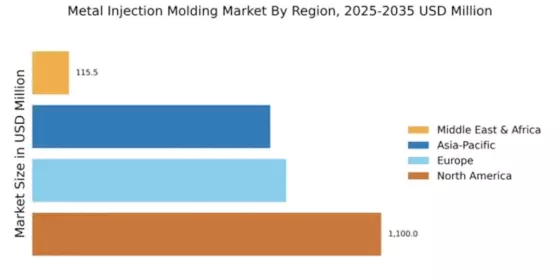
North America is poised to maintain its leadership in the Metal Injection Molding market, holding a significant share of 1100.0. The region's growth is driven by advanced manufacturing technologies, increasing demand for precision components, and supportive regulatory frameworks. The automotive and aerospace sectors are particularly influential, pushing for innovative solutions that enhance efficiency and reduce costs. The competitive landscape is robust, with key players like PMT, MIMtech, and GKN Powder Metallurgy leading the charge. The U.S. stands out as a major contributor, supported by a strong industrial base and investment in R&D. The presence of established companies ensures a dynamic market, fostering innovation and collaboration across sectors.

Europe : Innovation and Sustainability Focus

Europe's Metal Injection Molding market is projected at 800.0, driven by a strong emphasis on sustainability and innovation. Regulatory initiatives aimed at reducing carbon footprints and enhancing product lifecycle management are pivotal. The region's commitment to green technologies and efficient manufacturing processes is reshaping demand, particularly in the automotive and medical sectors. Leading countries like Germany, Sweden, and the UK are at the forefront, with companies such as BASF and Hoganas making significant contributions. The competitive landscape is characterized by a mix of established firms and innovative startups, all striving to meet stringent regulatory standards and consumer expectations. "The European market is increasingly focused on sustainable manufacturing practices," European Commission report.

Asia-Pacific : Emerging Market Potential

The Asia-Pacific region, with a market size of 750.0, is witnessing rapid growth in Metal Injection Molding, driven by industrialization and rising consumer demand. Countries like China and India are leading this growth, supported by government initiatives aimed at boosting manufacturing capabilities. The region's increasing focus on high-quality production and technological advancements is further propelling market expansion. The competitive landscape is evolving, with both local and international players vying for market share. Companies like Schunk and Sinterit are establishing a strong presence, capitalizing on the region's growing demand for precision components. The market is characterized by a blend of traditional manufacturing and innovative practices, positioning Asia-Pacific as a key player in the global landscape.

Middle East and Africa : Untapped Market Opportunities

The Middle East and Africa (MEA) region, with a market size of 115.47, presents untapped opportunities in the Metal Injection Molding sector. The growth is driven by increasing investments in manufacturing and infrastructure, alongside a rising demand for high-quality components in various industries. Regulatory support for local manufacturing initiatives is also a significant catalyst for market development. Countries like South Africa and the UAE are emerging as key players, with a focus on diversifying their economies. The competitive landscape is still developing, with opportunities for both local and international companies to establish a foothold. The presence of innovative firms can drive growth and enhance the region's manufacturing capabilities.

Key Players and Competitive Insights

The Metal Injection Molding Market is characterized by a dynamic competitive landscape, driven by technological advancements and increasing demand for complex geometries in various applications. Key players such as Arburg (DE), BASF (DE), and GKN Powder Metallurgy (GB) are strategically positioned to leverage innovation and operational efficiency. Arburg (DE) focuses on enhancing its production capabilities through the integration of advanced automation technologies, while BASF (DE) emphasizes material development to cater to diverse industry needs. GKN Powder Metallurgy (GB) is actively pursuing partnerships to expand its global footprint, thereby shaping the competitive environment through collaborative innovation.

The market structure appears moderately fragmented, with a mix of established players and emerging companies. Key business tactics include localizing manufacturing to reduce lead times and optimize supply chains. This approach not only enhances responsiveness to market demands but also fosters resilience against potential disruptions. The collective influence of major players is significant, as they drive industry standards and set benchmarks for quality and performance.

In November 2025, GKN Powder Metallurgy (GB) announced a strategic partnership with a leading automotive manufacturer to develop lightweight components using metal injection molding technology. This collaboration is poised to enhance GKN's position in the automotive sector, aligning with the industry's shift towards lightweight materials for improved fuel efficiency. The partnership underscores the importance of innovation in meeting evolving customer demands.

In October 2025, BASF (DE) launched a new line of high-performance materials specifically designed for metal injection molding applications. This initiative reflects BASF's commitment to advancing material science and providing tailored solutions to its clients. The introduction of these materials is likely to strengthen BASF's competitive edge by enabling customers to achieve superior performance in their end products.

In September 2025, Arburg (DE) unveiled a new digital platform aimed at optimizing production processes for metal injection molding. This platform integrates AI-driven analytics to enhance operational efficiency and reduce waste. By adopting such digital solutions, Arburg is positioning itself as a leader in the digital transformation of manufacturing, which is increasingly becoming a critical factor in competitive differentiation.

As of December 2025, current trends in the Metal Injection Molding Market indicate a strong emphasis on sustainability, digitalization, and AI integration. Strategic alliances are becoming more prevalent, as companies recognize the value of collaboration in driving innovation and addressing market challenges. The competitive landscape is shifting from traditional price-based competition to a focus on technological advancements and supply chain reliability. This evolution suggests that companies that prioritize innovation and sustainability will likely emerge as leaders in the market.

Key Companies in the Metal Injection Molding Market market include

Industry Developments

  • Q2 2024: ARC Group Worldwide Announces Appointment of New Chief Executive Officer ARC Group Worldwide, a leading provider of metal injection molding solutions, announced the appointment of a new CEO to drive its next phase of growth and innovation in the MIM sector.
  • Q1 2024: GKN Powder Metallurgy Opens New Metal Injection Molding Market Facility in China GKN Powder Metallurgy inaugurated a new manufacturing facility dedicated to metal injection molding in China, expanding its production capacity to meet growing demand in Asia.
  • Q2 2024: Amphenol Launches New Series of Metal Injection Molded Connectors for Automotive Applications Amphenol introduced a new product line of metal injection molded connectors designed for advanced automotive electronics, targeting increased durability and miniaturization.
  • Q2 2024: Smith Metal Products Announces Strategic Partnership with Medical Device Manufacturer Smith Metal Products entered into a partnership with a major medical device manufacturer to supply precision metal injection molded components for next-generation surgical instruments.
  • Q1 2024: Parmaco Metal Injection Molding Market AG Expands Production Capacity with New Equipment Investment Parmaco Metal Injection Molding Market AG invested in new production equipment to increase output and improve efficiency in its European facilities.
  • Q2 2024: Ernst REINER GmbH & Co. KG Wins Major Contract for Metal Injection Molded Components in Aerospace Sector Ernst REINER GmbH & Co. KG secured a significant contract to supply metal injection molded parts for a leading aerospace company, marking a milestone in its expansion into high-performance sectors.
  • Q1 2024: Sintex a/s Announces Launch of Eco-Friendly Metal Injection Molding Market Feedstock Sintex a/s launched a new eco-friendly feedstock for metal injection molding, aiming to reduce environmental impact and support sustainable manufacturing practices.
  • Q2 2024: Dean Group International Opens New R&D Center for Metal Injection Molding Market Innovation Dean Group International opened a research and development center focused on advancing metal injection molding technologies and developing new materials for industrial applications.
  • Q1 2024: Tanfel Metal Announces Partnership with Electronics Manufacturer for MIM Components Tanfel Metal formed a partnership with a global electronics manufacturer to supply metal injection molded components for consumer electronics devices.
  • Q2 2024: CMG Technologies Secures Funding to Expand Metal Injection Molding Market Operations CMG Technologies received new funding to expand its metal injection molding operations, enabling increased production capacity and development of new product lines.
  • Q1 2024: ATW Companies Announces Acquisition of Precision MIM Manufacturer ATW Companies acquired a precision metal injection molding manufacturer to strengthen its position in the medical and aerospace markets.
  • Q2 2024: ARC Group Worldwide Announces Strategic Alliance with Automotive Supplier ARC Group Worldwide entered into a strategic alliance with a major automotive supplier to co-develop advanced metal injection molded components for electric vehicles.

Future Outlook

Metal Injection Molding Market Future Outlook

The Metal Injection Molding Market is projected to grow at a 4.26% CAGR from 2024 to 2035, driven by advancements in technology, increasing demand for complex geometries, and cost-effective manufacturing solutions.

New opportunities lie in:

  • Expansion into emerging markets with tailored solutions
  • Development of high-performance alloys for specialized applications
  • Integration of automation technologies to enhance production efficiency

By 2035, the Metal Injection Molding Market is expected to achieve robust growth and increased market penetration.

Market Segmentation

Metal Injection Molding Market End Use Outlook

  • Automotive Components
  • Medical Implants
  • Electronic Housings
  • Tooling Applications
  • Industrial Parts

Metal Injection Molding Market Application Outlook

  • Automotive
  • Medical Devices
  • Consumer Electronics
  • Industrial Equipment
  • Aerospace

Metal Injection Molding Market Material Type Outlook

  • Stainless Steel
  • Carbon Steel
  • Cobalt Alloys
  • Titanium Alloys
  • Ceramics

Metal Injection Molding Market Component Type Outlook

  • Gears
  • Brackets
  • Connectors
  • Valves
  • Fasteners

Metal Injection Molding Market Production Method Outlook

  • Conventional Metal Injection Molding
  • High-Temperature Metal Injection Molding
  • Low-Pressure Metal Injection Molding
  • Micro Metal Injection Molding

Report Scope

MARKET SIZE 20242765.47(USD Million)
MARKET SIZE 20252883.33(USD Million)
MARKET SIZE 20354376.79(USD Million)
COMPOUND ANNUAL GROWTH RATE (CAGR)4.26% (2024 - 2035)
REPORT COVERAGERevenue Forecast, Competitive Landscape, Growth Factors, and Trends
BASE YEAR2024
Market Forecast Period2025 - 2035
Historical Data2019 - 2024
Market Forecast UnitsUSD Million
Key Companies ProfiledArburg (DE), BASF (DE), Hoganas (SE), PMT (US), MIMtech (US), GKN Powder Metallurgy (GB), Schunk (DE), DWA (US), Sinterit (PL)
Segments CoveredApplication, End Use, Material Type, Production Method, Component Type
Key Market OpportunitiesAdvancements in sustainable materials enhance growth potential in the Metal Injection Molding Market.
Key Market DynamicsTechnological advancements and increasing demand for precision components drive growth in the Metal Injection Molding Market.
Countries CoveredNorth America, Europe, APAC, South America, MEA

Leave a Comment

FAQs

What is the market size of Metal Injection Molding?

Metal Injection Molding Market is projected to register a CAGR of 4.26% from 2025-2035

What are the key regions contributing to the Metal Injection Molding market growth?

North America and Europe are the dominant regions in the Metal Injection Molding market, collectively accounting for over 60% of the market share.

Which applications are expected to drive the Metal Injection Molding market demand?

The automotive sector is the largest application segment, utilizing Metal Injection Molding for components such as gears, engine parts, and sensors. Other major applications include electronics, medical devices, and consumer products.

Who are the key competitors in the Metal Injection Molding market?

Prominent players in the Metal Injection Molding market include GKN Sinter Metals, Sandvik Additive Manufacturing, Hganäs AB, Parmatech Corporation, and Sumitomo Electric Industries, Ltd. These companies offer a wide range of Metal Injection Molding solutions and cater to various industries.

What are the factors driving the growth of the Metal Injection Molding market?

Factors contributing to the market growth include rising demand for lightweight and complex components, advancements in technology leading to improved precision and efficiency, and increasing adoption in industries such as automotive, aerospace, and medical.

What are the challenges faced by the Metal Injection Molding market?

Challenges include high production costs compared to traditional manufacturing methods, limited availability of raw materials, and the need for specialized expertise and stringent quality control measures.

What are the emerging trends in the Metal Injection Molding market?

Emerging trends include the integration of additive manufacturing technologies, advancements in binder jetting and metal powder injection molding, and the development of new materials and alloys for enhanced properties.

What is the impact of COVID-19 on the Metal Injection Molding market?

The COVID-19 pandemic caused temporary disruptions in supply chains and production schedules. However, the market is expected to recover and continue its growth trajectory as industries resume normal operations and demand for Metal Injection Molding components increases.

What are the regulatory considerations related to Metal Injection Molding?

Metal Injection Molding is subject to various regulatory standards and certifications, such as ISO 9001, ISO 13485, and industry-specific regulations depending on the application. Compliance with these standards ensures product quality, safety, and regulatory adherence.

What are the future growth prospects for the Metal Injection Molding market?

The future of the Metal Injection Molding market looks promising, driven by technological advancements, increasing demand for complex and lightweight components, and expanding applications across various industries. The market is expected to witness steady growth over the coming years.

Download Free Sample

Kindly complete the form below to receive a free sample of this Report

Compare Licence

×
Features License Type
Single User Multiuser License Enterprise User
Price $4,950 $ $7,250
Maximum User Access Limit 1 User Upto 10 Users Unrestricted Access Throughout the Organization
Free Customization
Direct Access to Analyst
Deliverable Format
Platform Access
Discount on Next Purchase 10% 15% 15%
Printable Versions