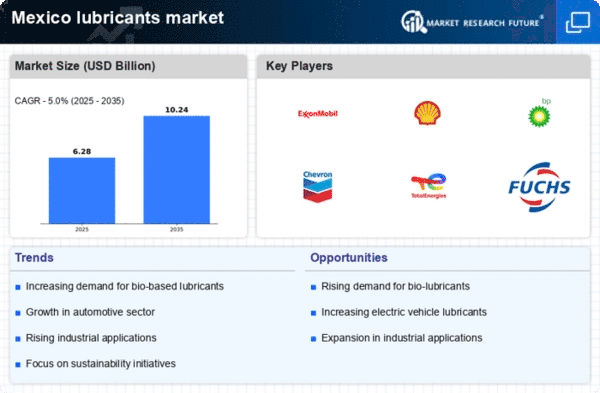
The lubricants market in Mexico is characterized by a competitive landscape that is both dynamic and multifaceted. Key growth drivers include the increasing demand for high-performance lubricants across various sectors, such as automotive, industrial, and marine. Major players like Pemex (MX), Shell (UK), and ExxonMobil (US) are strategically positioned to leverage their extensive distribution networks and brand recognition. Pemex (MX) focuses on local production and supply chain optimization, while Shell (UK) emphasizes innovation in sustainable lubricant formulations. ExxonMobil (US) is actively pursuing digital transformation initiatives to enhance operational efficiency, which collectively shapes a competitive environment that is increasingly reliant on technological advancements and sustainability initiatives.
The market structure appears moderately fragmented, with several key players vying for market share. Localizing manufacturing has emerged as a critical tactic among these companies, allowing them to reduce costs and improve responsiveness to regional demands. Supply chain optimization is also a focal point, as companies seek to enhance their logistics capabilities to ensure timely delivery of products. The collective influence of these key players fosters a competitive atmosphere where agility and adaptability are paramount.
In November 2025, Pemex (MX) announced a strategic partnership with a local technology firm to develop advanced lubricant formulations aimed at reducing environmental impact. This collaboration is significant as it aligns with global sustainability trends and positions Pemex (MX) as a leader in eco-friendly products, potentially enhancing its market share in a growing segment.
In October 2025, Shell (UK) launched a new line of synthetic lubricants designed specifically for electric vehicles, reflecting a proactive approach to the evolving automotive landscape. This move is strategically important as it not only caters to the rising demand for electric vehicles but also reinforces Shell's commitment to innovation and sustainability, thereby strengthening its competitive edge.
In September 2025, ExxonMobil (US) unveiled a digital platform that integrates AI-driven analytics to optimize lubricant performance monitoring for industrial clients. This initiative is crucial as it enhances customer engagement and positions ExxonMobil (US) at the forefront of digital transformation in the lubricants sector, potentially leading to increased customer loyalty and retention.
As of December 2025, current competitive trends indicate a pronounced shift towards digitalization, sustainability, and AI integration within the lubricants market. Strategic alliances are increasingly shaping the landscape, enabling companies to pool resources and expertise to address emerging challenges. Looking ahead, competitive differentiation is likely to evolve from traditional price-based competition to a focus on innovation, technology, and supply chain reliability, underscoring the importance of adaptability in a rapidly changing market.
Leave a Comment