×
Request Free Sample ×

Kindly complete the form below to receive a free sample of this Report

* Please use a valid business email

Leading companies partner with us for data-driven Insights

clients tt-cursor
Hero Background

Micro gas Turbine Market

ID: MRFR/EnP/30335-HCR
128 Pages
Priya Nagrale
October 2025

Micro-Gas Turbine Market Research Report By Technology (Regenerative Micro Gas Turbines, Expansion Micro Gas Turbines, Micro Turbines with Fuel Cells, Hybrid Micro Gas Turbines), By Application (Power Generation, Combined Heat and Power (CHP), Aerospace, Marine, Oil and Gas), By Fuel Type (Natural Gas, Biogas, Propane, Diesel, Hydrogen), By Capacity (Below 30 kW, 30 kW - 100 kW, 100 kW - 300 kW, Above 300 kW), By End User (Industrial, Commercial, Residential, Utility, Military) and By Regional (North America, Europe, South America, Asia-Pac... read more

Share:
Download PDF ×

We do not share your information with anyone. However, we may send you emails based on your report interest from time to time. You may contact us at any time to opt-out.

Micro gas Turbine Market Infographic
Purchase Options

Micro gas Turbine Market Summary

As per MRFR analysis, the Micro gas Turbine Market Size was estimated at 8.81 USD Billion in 2024. The Micro gas turbine industry is projected to grow from 9.52 USD Billion in 2025 to 20.71 USD Billion by 2035, exhibiting a compound annual growth rate (CAGR) of 8.08 during the forecast period 2025 - 2035.

Key Market Trends & Highlights

The Micro Gas Turbine Market is poised for substantial growth driven by technological advancements and a focus on sustainability.

  • Technological advancements are enhancing the efficiency and performance of micro gas turbines, making them more appealing for various applications.
  • The North American region remains the largest market, while the Asia-Pacific region is emerging as the fastest-growing market for micro gas turbines.
  • In the power generation segment, micro gas turbines dominate, whereas the combined heat and power segment is experiencing the fastest growth.
  • Key market drivers include rising demand for decentralized energy generation and increasing investments in energy infrastructure.

Market Size & Forecast

2024 Market Size 8.81 (USD Billion)
2035 Market Size 20.71 (USD Billion)
CAGR (2025 - 2035) 8.08%

Major Players

Capstone Turbine Corporation (US), Solar Turbines Incorporated (US), Ansaldo Energia (IT), General Electric (US), Mitsubishi Power (JP), Rolls-Royce Holdings plc (GB), Siemens Energy (DE), Kawasaki Heavy Industries (JP), Turbine Technologies (US)

Micro gas Turbine Market Trends

The Micro gas Turbine Market is currently experiencing a notable transformation, driven by the increasing demand for efficient and sustainable energy solutions. This market appears to be gaining traction due to its ability to provide decentralized power generation, which is particularly appealing in remote areas and for industrial applications. The versatility of micro gas turbines, which can utilize various fuels, including natural gas and biogas, suggests a growing interest in their adoption across diverse sectors. Furthermore, advancements in technology are likely enhancing the performance and reliability of these systems, making them more attractive to potential users. In addition, the Micro gas Turbine Market seems to be influenced by the global push towards reducing carbon emissions and transitioning to cleaner energy sources. As governments and organizations prioritize sustainability, the role of micro gas turbines in distributed energy systems is becoming increasingly relevant. This trend indicates a shift in how energy is produced and consumed, with micro gas turbines potentially playing a crucial role in achieving energy independence and resilience. Overall, the market appears poised for growth, driven by technological innovations and a favorable regulatory environment that supports cleaner energy initiatives.

Technological Advancements

Recent innovations in micro gas turbine technology are enhancing efficiency and performance. These advancements may lead to improved operational reliability and reduced maintenance costs, making them more appealing to various industries.

Sustainability Focus

The growing emphasis on sustainable energy solutions is driving interest in the Micro gas Turbine Market. As organizations seek to lower their carbon footprints, these systems are increasingly viewed as viable options for clean energy generation.

Decentralized Energy Generation

The trend towards decentralized energy systems is gaining momentum. Micro gas turbines offer flexibility and reliability, making them suitable for remote locations and industrial applications, thus supporting the shift away from traditional centralized power generation.

Micro gas Turbine Market Drivers

Market Growth Projections

The Global Micro-gas Turbine Market Industry is poised for substantial growth, with projections indicating an increase from 0.7 USD Billion in 2024 to 1.47 USD Billion by 2035. This growth trajectory suggests a compound annual growth rate of 6.92% from 2025 to 2035. Such projections reflect the increasing adoption of micro-gas turbines across various sectors, driven by factors such as technological advancements, regulatory support, and rising energy costs. The market's expansion is indicative of a broader shift towards decentralized energy solutions, aligning with global trends in sustainability and energy efficiency.

Increased Focus on Energy Resilience

The Global Micro-gas Turbine Market Industry is witnessing a heightened focus on energy resilience, particularly in the face of climate change and natural disasters. As extreme weather events become more frequent, the reliability of energy supply is increasingly called into question. Micro-gas turbines offer a decentralized and flexible energy solution that can operate independently of the grid, providing critical backup power during outages. This capability is particularly appealing to critical infrastructure sectors such as healthcare and emergency services. The market's growth trajectory, from 0.7 USD Billion in 2024 to 1.47 USD Billion by 2035, indicates a growing recognition of the importance of energy resilience in planning and investment.

Rising Energy Costs and Economic Pressures

Economic factors, particularly rising energy costs, are driving interest in the Global Micro-gas Turbine Market Industry. As traditional energy prices fluctuate, businesses and consumers are seeking alternative solutions to mitigate expenses. Micro-gas turbines provide a viable option for reducing energy costs through localized generation. This trend is particularly evident in industrial sectors where energy consumption is high. By investing in micro-gas turbine technology, organizations can achieve greater energy efficiency and cost savings. The market's projected growth from 0.7 USD Billion in 2024 to 1.47 USD Billion by 2035 reflects the increasing recognition of micro-gas turbines as a strategic response to economic pressures.

Advancements in Micro-gas Turbine Technology

Technological advancements play a crucial role in the Global Micro-gas Turbine Market Industry, enhancing efficiency and performance. Innovations in materials and design have led to improved operational capabilities, enabling micro-gas turbines to operate at higher temperatures and pressures. These advancements not only increase energy output but also reduce emissions, aligning with global sustainability goals. The integration of digital technologies, such as IoT and AI, further optimizes performance and maintenance. As the industry evolves, these technological improvements are expected to attract investments and drive market growth, contributing to the anticipated increase in market value from 0.7 USD Billion in 2024 to 1.47 USD Billion by 2035.

Regulatory Support for Clean Energy Initiatives

The Global Micro-gas Turbine Market Industry benefits significantly from regulatory support aimed at promoting clean energy initiatives. Governments worldwide are implementing policies and incentives to reduce greenhouse gas emissions and transition to cleaner energy sources. This regulatory environment encourages the adoption of micro-gas turbines, which are recognized for their lower emissions compared to traditional fossil fuel-based power generation. As countries commit to achieving net-zero targets, the demand for micro-gas turbines is likely to increase, further propelling market growth. The anticipated rise in market valuation from 0.7 USD Billion in 2024 to 1.47 USD Billion by 2035 underscores the positive impact of these regulatory frameworks.

Growing Demand for Distributed Energy Generation

The Global Micro-gas Turbine Market Industry is experiencing a notable surge in demand for distributed energy generation solutions. This trend is largely driven by the increasing need for energy independence and reliability. Micro-gas turbines offer a decentralized approach to power generation, allowing businesses and communities to produce energy on-site. This is particularly relevant in regions with unreliable grid infrastructure. As of 2024, the market is valued at approximately 0.7 USD Billion, with projections indicating growth to 1.47 USD Billion by 2035. This growth reflects a compound annual growth rate of 6.92% from 2025 to 2035, highlighting the sector's potential for expansion.

Market Segment Insights

By Application: Power Generation (Largest) vs. Combined Heat and Power (Fastest-Growing)

Within the micro gas turbine market, the application segment is notably dominated by Power Generation, which represents a substantial share of the total market. Micro gas turbines are increasingly being adopted in various sectors, due to their efficiency and reliability for small-scale power generation. Following closely, the Combined Heat and Power (CHP) segment is rapidly gaining traction, fueled by the growing demand for energy-efficient solutions that deliver both electricity and thermal energy from a single fuel source, making it a pivotal player in this segment. Growth trends within the micro gas turbine application segment indicate a robust future for both established and emerging technologies. The race for renewable energy solutions and the push towards decentralized energy generation systems are driving the demand for microgrid systems and auxiliary power units. Innovations in efficiency, coupled with government incentives for cleaner energy options, are propelling the growth of CHP systems, establishing them as the fastest-growing application in the market.

Combined Heat and Power (Dominant) vs. Auxiliary Power Units (Emerging)

The Combined Heat and Power (CHP) segment stands out as a dominant force within the micro gas turbine market, renowned for its ability to enhance energy efficiency and lower carbon footprints. By generating electricity while simultaneously capturing by-product heat, CHP systems enable users to realize significant energy savings and operational efficiencies. In contrast, Auxiliary Power Units (APUs) are becoming an emerging avenue within this market. With increasing applications in transportation and mobile energy solutions, APUs offer flexible power sources that can support various platforms from aircraft to ground vehicles. While CHP focuses on efficiency in fixed settings, APUs represent a shift towards versatile, on-demand power applications, marking them as vital for the future landscape of energy solutions.

By End Use: Commercial (Largest) vs. Industrial (Fastest-Growing)

In the Micro gas Turbine Market, the end-use segment is primarily dominated by the commercial sector, accounting for a significant market share due to its diverse applications in buildings, offices, and retail establishments. The industrial segment is also notable, encompassing power generation and cogeneration applications in manufacturing, leading to a strong market presence. The residential and military segments contribute but are comparatively smaller in size, focusing on specific niche applications in energy independence and defense scenarios.

Commercial (Dominant) vs. Industrial (Emerging)

The commercial sector stands out as the dominant end-use segment within the Micro gas Turbine Market, leveraging a broad spectrum of applications including combined heat and power (CHP) systems, which provide energy efficiency and reduce operational costs for businesses. Industrial applications are gaining momentum as an emerging segment, particularly with the rising demand for reliable on-site power generation and reduced emissions within manufacturing processes. This shift highlights a growing inclination towards sustainability, where industrial consumers seek to incorporate micro gas turbines to fulfill stricter environmental regulations while enhancing energy security and efficiency.

By Fuel Type: Natural Gas (Largest) vs. Biogas (Fastest-Growing)

In the Micro Gas Turbine Market, the fuel type segment is primarily dominated by natural gas, which holds a significant portion of the market share, reflecting its popularity and reliability in various applications. Following natural gas, biogas is rapidly gaining traction, notably due to increasing environmental concerns and the drive towards renewable energy sources. Diesel and propane are also present in the market but do not exhibit the same level of demand or growth as their counterparts. The growth trends within the fuel type segment of micro gas turbines are influenced by several key factors. Natural gas continues to benefit from its established infrastructure and competitive pricing, making it a preferred choice for many consumers. Conversely, biogas is emerging as a rapidly growing segment, propelled by technological advancements in resource conversion and a shift in policies favoring clean energy solutions. The adoption of biogas is expected to increase as more companies seek sustainable alternatives for energy production.

Natural Gas (Dominant) vs. Biogas (Emerging)

Natural gas stands out as the dominant fuel type in the micro gas turbine market due to its efficiency, cost-effectiveness, and extensive availability. It is favored in industrial and commercial applications where reliability is crucial. Its established infrastructure contributes to its continued prevalence and serves as a barrier to entry for newer alternatives. On the other hand, biogas is recognized as an emerging fuel option, primarily derived from organic materials. Its growth is driven by the increasing need for sustainable solutions and the incentive structures set by green energy policies. Biogas facilities are often integrated with waste management systems, enabling a dual benefit of waste reduction and energy production. While still a smaller player compared to natural gas, biogas's contribution to the micro gas turbine market is expected to rise significantly in the coming years.

By Technology: Recuperated (Largest) vs. Regenerative (Fastest-Growing)

In the Micro gas Turbine Market, the technology segment showcases diverse options, with Recuperated micro gas turbines holding the largest market share. This segment benefits from their enhanced efficiency, which allows for significant energy savings and reduced emissions compared to their non-recuperative counterparts. Regenerative micro gas turbines, on the other hand, are emerging rapidly, driven by increasing demand for sustainable and efficient energy solutions. Their innovative designs and ability to utilize waste heat contribute to their growing popularity among energy stakeholders. Growth trends within the micro gas turbine segment reflect a robust transformation towards cleaner technologies. The Recuperated turbines remain favored due to established technologies and proven performance in various applications. Conversely, the Regenerative segment is gaining momentum as advancements in materials and design make these systems more economically viable, appealing to industries seeking greener alternatives and aiming for lower operational costs.

Technology: Recuperated (Dominant) vs. Regenerative (Emerging)

The Recuperated technology in micro gas turbines is recognized for its significant energy efficiency and low emissions, making it a dominant choice across various sectors. These turbines capture waste heat from the exhaust and use it to improve efficiency, enhancing their appeal in both commercial and industrial applications. In contrast, Regenerative micro gas turbines embody a more innovative approach, utilizing thermal energy recovery to further optimize performance. As technological advancements continue, regenerative systems are gaining traction for their potential to achieve operational flexibility and lower fuel consumption, positioning them as a key emerging player in the market.

By Size: Small Scale (Largest) vs. Medium Scale (Fastest-Growing)

In the Micro Gas Turbine Market, the size segment is primarily divided into three categories: Small Scale, Medium Scale, and Large Scale. The Small Scale segment captures the largest market share, driven by its widespread application in residential and small-scale commercial settings. Its compact design and reliability make it a preferred choice among consumers, which solidifies its leading position in the market. Conversely, the Medium Scale segment, while smaller in terms of market share, is witnessing rapid growth as businesses and industries increasingly adopt micro gas turbines for decentralized energy solutions and to comply with stricter environmental regulations.

Small Scale (Dominant) vs. Large Scale (Emerging)

The Small Scale segment of the Micro Gas Turbine Market remains dominant due to its adaptability and efficiency in smaller applications. It is particularly favored in off-grid situations and for providing backup power solutions. As energy demands grow, this segment is supported by technological advancements that enhance performance and reduce emissions. In contrast, the Large Scale segment, although currently emerging, is beginning to gain traction as industries seek larger energy solutions that can offer more power output and efficiency. Its growth is fueled by the increasing need for renewable energy sources and large-scale energy infrastructure, positioning it as a significant player in the market.

Get more detailed insights about Micro gas Turbine Market

Regional Insights

North America : Market Leader in Innovation

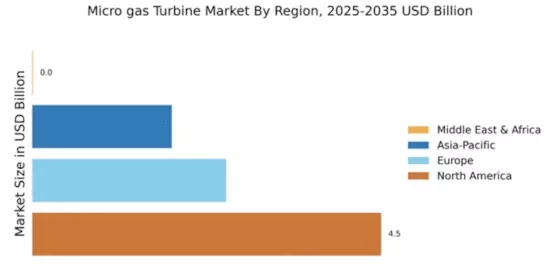
North America is poised to maintain its leadership in the micro gas turbine market, holding a significant share of 4.5 in 2024. The region's growth is driven by increasing demand for clean energy solutions and stringent regulations promoting sustainable practices. The push for energy efficiency and reduced emissions is further catalyzed by government incentives and investments in renewable energy technologies. The competitive landscape is robust, with key players such as Capstone Turbine Corporation, General Electric, and Solar Turbines leading the charge. The U.S. and Canada are at the forefront, leveraging advanced technologies and innovation. The presence of established manufacturers and a growing focus on decentralized energy generation are expected to bolster market growth in the coming years.

Europe : Emerging Market with Potential

Europe is witnessing a burgeoning micro gas turbine market, with a size of 2.5 in 2024. The region's growth is fueled by a strong commitment to renewable energy and sustainability, supported by EU regulations aimed at reducing carbon emissions. The increasing adoption of micro gas turbines in various applications, including combined heat and power (CHP) systems, is a key driver of demand. Leading countries such as Germany, Italy, and the UK are at the forefront of this market, with significant investments in clean energy technologies. Major players like Ansaldo Energia and Siemens Energy are actively contributing to the competitive landscape. The European market is characterized by innovation and collaboration among stakeholders, enhancing the overall growth trajectory.

Asia-Pacific : Rapidly Growing Energy Market

Asia-Pacific is emerging as a significant player in the micro gas turbine market, with a size of 1.8 in 2024. The region's growth is driven by increasing energy demands, urbanization, and a shift towards cleaner energy solutions. Governments are implementing policies to promote renewable energy, which is expected to further boost the adoption of micro gas turbines in various sectors. Countries like Japan and Australia are leading the charge, with key players such as Mitsubishi Power and Kawasaki Heavy Industries making substantial contributions. The competitive landscape is evolving, with a focus on innovation and technological advancements. As the region continues to invest in sustainable energy solutions, the micro gas turbine market is set for significant growth.

Middle East and Africa : Emerging Market with Challenges

The Middle East and Africa region is at the nascent stage of the micro gas turbine market, with a size of 0.01 in 2024. The growth potential is significant, driven by increasing energy demands and a shift towards cleaner energy sources. However, challenges such as regulatory hurdles and infrastructure limitations may impede rapid growth. Governments are beginning to recognize the importance of sustainable energy solutions, which could catalyze market development. Countries like South Africa and the UAE are exploring micro gas turbine technologies to enhance energy efficiency. The competitive landscape is still developing, with few key players currently operating. As investments in renewable energy increase, the region may see a gradual rise in the adoption of micro gas turbines, paving the way for future growth.

Key Players and Competitive Insights

The Micro gas Turbine Market is currently characterized by a dynamic competitive landscape, driven by increasing demand for decentralized energy solutions and a growing emphasis on sustainability. Key players such as Capstone Turbine Corporation (US), General Electric (US), and Siemens Energy (DE) are strategically positioning themselves through innovation and partnerships. Capstone Turbine Corporation (US) focuses on enhancing its product offerings with advanced technologies, while General Electric (US) emphasizes digital transformation to optimize operational efficiency. Siemens Energy (DE) is actively pursuing regional expansion, particularly in emerging markets, which collectively shapes a competitive environment that is increasingly focused on technological advancement and sustainability.

In terms of business tactics, companies are localizing manufacturing and optimizing supply chains to enhance responsiveness to market demands. The competitive structure of the Micro gas Turbine Market appears moderately fragmented, with several key players exerting influence. This fragmentation allows for a diverse range of offerings, yet the collective strategies of major companies are likely to drive consolidation in the future, as they seek to leverage economies of scale and enhance their market presence.

In November 2025, Capstone Turbine Corporation (US) announced a strategic partnership with a leading renewable energy firm to develop hybrid micro gas turbine systems. This collaboration is significant as it aligns with the growing trend towards integrating renewable sources with traditional energy systems, potentially enhancing the efficiency and sustainability of energy production. Such partnerships may also position Capstone as a leader in the hybrid energy solutions segment.

In October 2025, General Electric (US) unveiled a new digital platform aimed at optimizing the performance of micro gas turbines through advanced analytics and AI. This initiative is crucial as it not only enhances operational efficiency but also supports predictive maintenance, thereby reducing downtime and operational costs. The integration of AI into their offerings could provide General Electric with a competitive edge in a market increasingly driven by technological innovation.

In September 2025, Siemens Energy (DE) expanded its manufacturing capabilities in Asia, focusing on the production of micro gas turbines tailored for local markets. This move is indicative of a broader strategy to enhance supply chain reliability and meet the specific energy needs of emerging economies. By localizing production, Siemens Energy may reduce lead times and costs, thereby strengthening its competitive position in the region.

As of December 2025, current trends in the Micro gas Turbine Market are heavily influenced by digitalization, sustainability, and the integration of AI technologies. Strategic alliances are becoming increasingly important, as they enable companies to pool resources and expertise to innovate more effectively. The competitive differentiation is likely to evolve from traditional price-based competition to a focus on technological innovation, reliability, and sustainability. Companies that can successfully navigate these trends may secure a more robust market position in the years to come.

Key Companies in the Micro gas Turbine Market market include

Industry Developments

Recent developments in the Micro-gas Gas Turbine Market have shown significant advancements, driven by the increasing demand for cleaner and more efficient energy solutions. Key players are investing in research and development to enhance the performance and efficiency of micro gas turbines, aligning with global sustainability goals. Innovations in fuel flexibility and hybrid systems are gaining traction as industries seek to reduce carbon footprints. Furthermore, regulatory support for distributed energy generation and renewable integration is creating favorable conditions for Market growth.

Collaborations between technology companies and energy providers are emerging, aiming to provide comprehensive energy solutions. As businesses and governments focus on energy resilience, the Micro-gas Turbine Market is poised for continued expansion, addressing both the challenges of energy security and the imperative for lower emissions. This evolving landscape is attracting investments and fostering innovations that promise to reshape the industry's future dynamics.

Future Outlook

Micro gas Turbine Market Future Outlook

The Micro Gas Turbine Market is projected to grow at an 8.08% CAGR from 2024 to 2035, driven by increasing demand for decentralized energy solutions and advancements in technology.

New opportunities lie in:

  • Development of hybrid micro gas turbine systems for enhanced efficiency.
  • Expansion into emerging markets with tailored energy solutions.
  • Integration of IoT for real-time monitoring and predictive maintenance.

By 2035, the Micro Gas Turbine Market is expected to be robust, driven by innovation and strategic market expansions.

Market Segmentation

Micro gas Turbine Market Size Outlook

  • Small Scale
  • Medium Scale
  • Large Scale

Micro gas Turbine Market End Use Outlook

  • Commercial
  • Industrial
  • Residential
  • Military

Micro gas Turbine Market Fuel Type Outlook

  • Natural Gas
  • Biogas
  • Diesel
  • Propane

Micro gas Turbine Market Technology Outlook

  • Recuperated
  • Regenerative
  • Simple Cycle
  • Combined Cycle

Micro gas Turbine Market Application Outlook

  • Power Generation
  • Combined Heat and Power
  • Auxiliary Power Units
  • Microgrid Systems

Report Scope

MARKET SIZE 20248.81(USD Billion)
MARKET SIZE 20259.52(USD Billion)
MARKET SIZE 203520.71(USD Billion)
COMPOUND ANNUAL GROWTH RATE (CAGR)8.08% (2024 - 2035)
REPORT COVERAGERevenue Forecast, Competitive Landscape, Growth Factors, and Trends
BASE YEAR2024
Market Forecast Period2025 - 2035
Historical Data2019 - 2024
Market Forecast UnitsUSD Billion
Key Companies ProfiledCapstone Turbine Corporation (US), Solar Turbines Incorporated (US), Ansaldo Energia (IT), General Electric (US), Mitsubishi Power (JP), Rolls-Royce Holdings plc (GB), Siemens Energy (DE), Kawasaki Heavy Industries (JP), Turbine Technologies (US)
Segments CoveredApplication, End Use, Fuel Type, Technology, Size
Key Market OpportunitiesGrowing demand for decentralized energy solutions drives innovation in the Micro gas Turbine Market.
Key Market DynamicsRising demand for clean energy solutions drives innovation and competition in the Micro gas Turbine Market.
Countries CoveredNorth America, Europe, APAC, South America, MEA

Leave a Comment

FAQs

What is the expected Market size of the Global microgas Gas Turbine Market in 2032?

The Micro-gas Gas Turbine Market is expected to be valued at 1.21 USD Billion by 2032.

What is the expected CAGR for the Micro-gas Gas Turbine Market from 2024 to 2032?

The expected CAGR for the Micro-gas Gas Turbine Market from 2024 to 2032 is 6.71.

Which region is expected to hold the largest Market share for the Micro-gas Gas Turbine Market by 2032?

North America is expected to hold the largest Market share, valued at 0.45 USD Billion in 2032.

What is the Market value for the Regenerative Micro Gas Turbines segment in 2032?

The Regenerative Micro Gas Turbines segment is expected to be valued at 0.45 USD Billion in 2032.

Which key player in the Micro-gas Gas Turbine Market is known for significant contributions?

Major players in the Market include Capstone Turbine Corporation, General Electric, and Rolls Royce.

Download Free Sample

Kindly complete the form below to receive a free sample of this Report

Compare Licence

×
Features License Type
Single User Multiuser License Enterprise User
Price $4,950 $5,950 $7,250
Maximum User Access Limit 1 User Upto 10 Users Unrestricted Access Throughout the Organization
Free Customization
Direct Access to Analyst
Deliverable Format
Platform Access
Discount on Next Purchase 10% 15% 15%
Printable Versions