×
Request Free Sample ×

Kindly complete the form below to receive a free sample of this Report

* Please use a valid business email

Leading companies partner with us for data-driven Insights

clients tt-cursor
Hero Background

Aircraft Micro Turbine Engines Market

ID: MRFR/AD/8157-CR
164 Pages
Swapnil Palwe
November 2022

Aircraft Micro Turbine Engine Market Research Report Information by Engine Type (Turbojet, Turboshaftand Turboprop), by Application (Vertical Take-Off and Landings {VTOL}, Air Taxis, Cargo Aerial Vehicles {CAVS}, Light Aircraft, Military Unmanned Aerial Vehicle and Others), by Fuel Type (Jet Fuel, Diesel and Others), by End User (Commercial Aviation, Military Aviation and Region (North America, Europe, Asia-Pacific, Middle East & Africa, and South America)—Forecast till 2035

Share:
Download PDF ×

We do not share your information with anyone. However, we may send you emails based on your report interest from time to time. You may contact us at any time to opt-out.

Aircraft Micro Turbine Engines Market Infographic
Purchase Options

Aircraft Micro Turbine Engines Market Summary

As per MRFR analysis, the Aircraft Micro Turbine Engines Market was estimated at 29.8 USD Million in 2024. The Aircraft Micro Turbine Engines industry is projected to grow from 32.4 USD Million in 2025 to 76.0 USD Million by 2035, exhibiting a compound annual growth rate (CAGR) of 8.9 during the forecast period 2025 - 2035.

Key Market Trends & Highlights

The Aircraft Micro Turbine Engines Market is poised for substantial growth driven by sustainability and technological advancements.

  • North America remains the largest market for aircraft micro turbine engines, reflecting a robust demand for innovative aviation solutions.
  • The Asia-Pacific region is emerging as the fastest-growing market, fueled by increasing investments in urban air mobility and advanced aviation technologies.
  • Unmanned Aerial Vehicles dominate the market, while military aviation is experiencing rapid growth due to heightened defense spending.
  • Key market drivers include the rising demand for fuel efficiency and regulatory support for clean aviation initiatives.

Market Size & Forecast

2024 Market Size 29.8 (USD Million)
2035 Market Size 76.0 (USD Million)
CAGR (2025 - 2035) 8.9%

Major Players

Honeywell (US), Rolls-Royce (GB), General Electric (US), Pratt & Whitney (US), Microturbo (FR), Capstone Turbine Corporation (US), KHI Corporation (JP), Turbine Engine Corporation (US), Aerojet Rocketdyne (US)

Aircraft Micro Turbine Engines Market Trends

The Aircraft Micro Turbine Engines Market is currently experiencing a notable transformation, driven by advancements in technology and increasing demand for efficient propulsion systems. These engines, characterized by their compact size and lightweight design, are becoming increasingly popular in various applications, including unmanned aerial vehicles and small aircraft. The market appears to be influenced by a growing emphasis on sustainability, as manufacturers seek to develop engines that minimize environmental impact while maximizing performance. Furthermore, the integration of innovative materials and design methodologies is likely to enhance the overall efficiency and reliability of these engines, making them more appealing to a broader range of customers. In addition to technological advancements, the Aircraft Micro Turbine Engines Market is also shaped by evolving regulatory frameworks and safety standards. As governments and aviation authorities implement stricter emissions regulations, there is a pressing need for cleaner and more efficient propulsion solutions. This trend may encourage manufacturers to invest in research and development, fostering a competitive landscape that prioritizes innovation. Overall, the Aircraft Micro Turbine Engines Market appears poised for growth, with a focus on sustainability, efficiency, and compliance with emerging regulations.

Sustainability Initiatives

The Aircraft Micro Turbine Engines Market is increasingly influenced by sustainability initiatives. Manufacturers are focusing on developing engines that reduce emissions and enhance fuel efficiency. This trend reflects a broader commitment to environmental responsibility within the aviation sector.

Technological Advancements

Technological advancements play a crucial role in shaping the Aircraft Micro Turbine Engines Market. Innovations in materials and design are leading to improved performance and reliability. These developments are likely to attract new customers and applications.

Regulatory Compliance

Regulatory compliance is becoming a significant factor in the Aircraft Micro Turbine Engines Market. Stricter emissions standards are prompting manufacturers to adapt their products to meet these requirements. This trend may drive further investment in research and development.

Aircraft Micro Turbine Engines Market Drivers

Market Growth Projections

The Global Aircraft Micro Turbine Engine Market Industry is poised for substantial growth in the coming years. With projections indicating a market value of 2.24 USD Billion in 2024 and an anticipated increase to 4.76 USD Billion by 2035, the industry is expected to experience a compound annual growth rate (CAGR) of 7.08% from 2025 to 2035. This growth is driven by various factors, including technological advancements, regulatory support, and increasing demand for fuel-efficient solutions. The market dynamics suggest a favorable environment for innovation and investment, positioning micro turbine engines as a critical component of the future aviation landscape.

Growing Demand for Fuel Efficiency

The Global Aircraft Micro Turbine Engine Market Industry is witnessing an increasing demand for fuel-efficient engines. As airlines and private operators seek to reduce operational costs, micro turbine engines, known for their high efficiency and low fuel consumption, are becoming more appealing. This trend is particularly pronounced in the light aircraft segment, where micro turbines can significantly enhance performance. The market is projected to reach 2.24 USD Billion in 2024, reflecting a shift towards sustainable aviation solutions. This growing emphasis on fuel efficiency aligns with global environmental goals, potentially driving further innovation in micro turbine technology.

Rising Popularity of Urban Air Mobility

The concept of urban air mobility is gaining traction, which could significantly impact the Global Aircraft Micro Turbine Engine Market Industry. As cities explore innovative transportation solutions, micro turbine engines are well-suited for the emerging electric vertical takeoff and landing (eVTOL) aircraft. These engines offer a compact design and lightweight characteristics, making them ideal for urban air mobility applications. The potential for rapid deployment and operational efficiency positions micro turbines as a key player in this evolving market. As urban air mobility initiatives expand, the demand for micro turbine engines is likely to increase, driving market growth.

Increased Investment in General Aviation

Investment in general aviation is on the rise, contributing positively to the Global Aircraft Micro Turbine Engine Market Industry. As more individuals and businesses recognize the benefits of private air travel, the demand for light aircraft equipped with micro turbine engines is expected to grow. This segment is particularly attractive due to its versatility and operational cost-effectiveness. The projected compound annual growth rate (CAGR) of 7.08% from 2025 to 2035 indicates a robust market outlook. Increased investment in general aviation infrastructure and services further supports this trend, creating opportunities for manufacturers and suppliers in the micro turbine engine sector.

Regulatory Support for Sustainable Aviation

Regulatory frameworks are increasingly favoring sustainable aviation technologies, which is beneficial for the Global Aircraft Micro Turbine Engine Market Industry. Governments worldwide are implementing stricter emissions regulations and providing incentives for the adoption of cleaner technologies. This regulatory support encourages manufacturers to innovate and develop micro turbine engines that meet or exceed these standards. As a result, the market is expected to grow, potentially reaching 4.76 USD Billion by 2035. The alignment of regulatory policies with industry goals fosters a conducive environment for the development and deployment of micro turbine engines in various aviation applications.

Technological Advancements in Engine Design

Technological advancements are playing a pivotal role in the Global Aircraft Micro Turbine Engine Market Industry. Innovations in materials and manufacturing processes are leading to lighter, more durable engines that can operate at higher temperatures and pressures. These advancements not only improve performance but also extend the lifespan of the engines. For instance, the integration of advanced composites and additive manufacturing techniques is enabling the production of more efficient turbine components. As these technologies continue to evolve, they are likely to attract investment and interest, further propelling market growth and enhancing the competitive landscape.

Market Segment Insights

By Application: Unmanned Aerial Vehicle (Largest) vs. Military Aviation (Fastest-Growing)

The application segment of the Aircraft Micro Turbine Engines Market is primarily dominated by Unmanned Aerial Vehicles (UAVs), which hold the largest share owing to their increasing adoption in various sectors such as surveillance, agriculture, and delivery services. Military Aviation follows as a significant segment, recognized for its robust demand driven by advancements in defense technology and the need for enhanced reconnaissance capabilities. As UAVs continue to gain traction, their comprehensive applications are seeing greater integration into commercial and military operations.

UAV (Dominant) vs. Military Aviation (Emerging)

Unmanned Aerial Vehicles (UAVs) represent the dominant application in the Aircraft Micro Turbine Engines Market, characterized by their versatility and efficiency in meeting diverse operational needs. The ongoing innovation in UAV technology, including improvements in payload capacity and flight endurance, further bolsters their market position. Conversely, Military Aviation is viewed as an emerging segment, rapidly growing due to increased defense spending and the modernization of aerial fleets. The demand for micro turbine engines in military applications is propelled by their compact size, reliability, and lower operational costs, making them attractive for various military missions.

By End Use: Civil Aviation (Largest) vs. Defense (Fastest-Growing)

The Aircraft Micro Turbine Engines Market exhibits a diverse distribution of end-use applications. Civil Aviation represents the largest segment, largely driven by a surge in demand for fuel-efficient engines and eco-friendly aviation solutions. Following closely, the Defense sector has shown significant adoption due to increasing investments in military technology and modernization efforts. Research and Development, alongside Training and Simulation applications, also contribute to the market but take a smaller share compared to the prominent segments. As growth trends advance, the Civil Aviation segment continues to leverage advancements in engine technology, enhancing operational efficiency and reducing carbon footprints. On the other hand, the Defense segment is experiencing rapid expansion, fueled by evolving defense strategies and increased budgets aimed at upgrading military aircraft. This dynamic creates a competitive landscape within the market, as innovations shape future opportunities.

Civil Aviation (Dominant) vs. Research and Development (Emerging)

The Civil Aviation segment stands as the dominant force in the Aircraft Micro Turbine Engines Market, characterized by a focus on sustainable fuel options and noise reduction technologies. As airlines seek to improve fleet efficiency and comply with environmental regulations, their reliance on advanced micro turbine engines grows. Conversely, the Research and Development sector represents an emerging force, with investments channeled towards innovation in engine designs and testing methodologies. This segment thrives on collaboration with aerospace manufacturers and is pivotal in developing next-generation propulsion systems. Both segments play instrumental roles in shaping industry dynamics, with Civil Aviation leading mainstream adoption and R&D driving future technological advancements.

By Engine Type: Single Shaft Engine (Largest) vs. Twin Shaft Engine (Fastest-Growing)

In the Aircraft Micro Turbine Engines Market, the distribution of market share among engine types reveals that the Single Shaft Engine holds the largest share, attributed to its simplicity, high reliability, and maintenance ease. Following closely, the Twin Shaft Engine has been gaining traction, positioning itself as the fastest-growing segment due to its superior performance and efficiency improvements, making it increasingly popular in various applications.

Engine Type: Single Shaft (Dominant) vs. Twin Shaft (Emerging)

The Single Shaft Engine represents a well-established choice in the Aircraft Micro Turbine Engines Market, noted for its compact design and robust performance. This engine type is largely favored for applications requiring high reliability and lower operational costs, making it dominant in various segments. In contrast, the Twin Shaft Engine stands out as an emerging player, particularly among newer aircraft designs, due to its enhanced performance and fuel efficiency. With advancements in technology, it caters to the growing demand for sustainable aviation solutions while providing operational flexibility.

By Fuel Type: Jet Fuel (Largest) vs. Biofuel (Fastest-Growing)

The Aircraft Micro Turbine Engines Market has demonstrated a diverse distribution of fuel types, with Jet Fuel leading significantly due to its widespread use in commercial aviation. This traditional fuel type accounts for a substantial share as it is favored for its high energy density and efficiency. Aviation Gasoline ranks next, being popular amongst general aviation and certain regional aircraft, while Biofuels and Synthetic Fuels are gradually gaining traction as alternatives seeking to reduce carbon emissions and reliance on fossil fuels.

Jet Fuel (Dominant) vs. Biofuel (Emerging)

Jet Fuel continues to dominate the market, largely due to its established infrastructure and extensive use in turbine engines across commercial flights, military applications, and cargo transport. Its high energy density and performance capabilities make it a preferred choice. Alternatively, Biofuels are emerging as a significant trend in the market, driven by increasing regulations targeting greenhouse gas emissions and the aviation industry's push towards sustainable practices. Biofuels, derived from renewable sources, are gaining acceptance as a viable alternative, especially in more environmentally conscious regions. The innovation in adapting biofuels for existing engines is expected to propel this segment further.

By Power Output: Below 100 kW (Largest) vs. 100 kW to 500 kW (Fastest-Growing)

The Aircraft Micro Turbine Engines Market demonstrates a noteworthy power output segmentation. The segment below 100 kW currently holds the largest market share, driven by its widespread application in small UAVs and portable generators. This segment benefits from its ability to deliver efficient and reliable performance in compact designs, catering to a growing demand for lightweight solutions in various aerospace applications. Conversely, the 100 kW to 500 kW segment is recognized as the fastest-growing segment. This growth is propelled by a surge in demand for regional aircraft and the increasing utilization of micro turbines in commercial aviation, highlighting a pivotal shift towards more efficient energy solutions.

Power Output: Below 100 kW (Dominant) vs. Above 500 kW (Emerging)

The segment below 100 kW has established itself as the dominant force within the Aircraft Micro Turbine Engines Market, primarily due to its adaptability in niche applications such as drones and military reconnaissance systems. Its design facilitates easy integration into various platforms, leading to enhanced flexibility and operational efficiency. In contrast, the segment above 500 kW is identified as an emerging segment, catering to larger aircraft requiring robust power outputs for long durations. Although it currently holds a smaller market share, its potential is highlighted by advancements in turbine technologies and increasing investments aimed at improving efficiency and reducing emissions in the aviation sector.

Get more detailed insights about Aircraft Micro Turbine Engines Market

Regional Insights

North America : Market Leader in Innovation

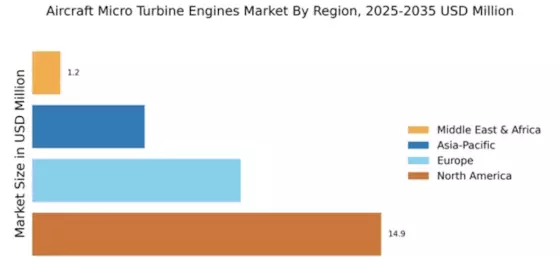
North America continues to lead the Aircraft Micro Turbine Engines market, holding a significant share of 14.9 in 2024. The region's growth is driven by advancements in aerospace technology, increasing demand for fuel-efficient engines, and supportive government regulations promoting innovation. The presence of major manufacturers and a robust supply chain further bolster market expansion, making it a hub for research and development in aviation technology. The competitive landscape is characterized by key players such as Honeywell, General Electric, and Pratt & Whitney, which are at the forefront of technological advancements. The U.S. remains the largest market, supported by a strong defense sector and commercial aviation growth. The focus on sustainable aviation fuels and lightweight materials is expected to enhance the market's growth trajectory, ensuring North America's continued dominance in the global arena.

Europe : Emerging Market with Potential

Europe's Aircraft Micro Turbine Engines market is poised for growth, with a market size of 8.9 in 2024. The region benefits from a strong emphasis on environmental regulations and sustainability, driving demand for efficient and low-emission engines. The European Union's initiatives to reduce carbon emissions in aviation are significant catalysts for market expansion, encouraging innovation and investment in new technologies. Leading countries such as Germany, France, and the UK are home to major players like Rolls-Royce and Microturbo, contributing to a competitive landscape. The presence of established aerospace manufacturers and a growing number of startups focused on micro turbine technology enhance the region's market dynamics. As Europe continues to invest in green aviation technologies, the Aircraft Micro Turbine Engines market is expected to flourish, aligning with regulatory goals for a sustainable future.

Asia-Pacific : Rapidly Growing Aviation Hub

The Asia-Pacific region is witnessing a burgeoning Aircraft Micro Turbine Engines market, with a size of 4.8 in 2024. The growth is fueled by increasing air travel demand, urbanization, and government investments in aviation infrastructure. Countries like China and India are expanding their aerospace sectors, leading to a surge in demand for efficient and compact turbine engines, which are essential for modern aircraft designs. China and Japan are at the forefront of this growth, with significant investments from companies like KHI Corporation and Aerojet Rocketdyne. The competitive landscape is evolving, with both established players and new entrants focusing on innovation and technology advancements. As the region prioritizes modernization and sustainability in aviation, the Aircraft Micro Turbine Engines market is expected to expand significantly, driven by both commercial and defense sectors.

Middle East and Africa : Emerging Market with Challenges

The Middle East and Africa region presents a nascent Aircraft Micro Turbine Engines market, with a size of 1.2 in 2024. The growth potential is significant, driven by increasing investments in aviation infrastructure and a rising number of air travel passengers. However, challenges such as political instability and economic fluctuations may hinder rapid market development. Governments are focusing on enhancing their aviation sectors to attract international investments and improve connectivity. Countries like the UAE and South Africa are leading the way in aviation advancements, with initiatives to modernize their fleets and improve operational efficiencies. The presence of key players is limited, but there is a growing interest from international manufacturers looking to tap into this emerging market. As the region stabilizes, the Aircraft Micro Turbine Engines market is expected to gain traction, supported by regional development plans and international collaborations.

Key Players and Competitive Insights

The Aircraft Micro Turbine Engines Market is currently characterized by a dynamic competitive landscape, driven by technological advancements and increasing demand for fuel-efficient propulsion systems. Key players such as Honeywell (US), Rolls-Royce (GB), and General Electric (US) are strategically positioned to leverage their extensive R&D capabilities and established market presence. Honeywell (US) focuses on innovation in hybrid-electric propulsion systems, while Rolls-Royce (GB) emphasizes sustainability through its commitment to net-zero emissions by 2050. General Electric (US) is enhancing its digital capabilities, integrating AI and data analytics into its engine designs, which collectively shapes a competitive environment that prioritizes technological leadership and environmental responsibility.

In terms of business tactics, companies are increasingly localizing manufacturing to reduce costs and enhance supply chain resilience. The market structure appears moderately fragmented, with a mix of established players and emerging companies vying for market share. This fragmentation allows for diverse strategies, as companies like Microturbo (FR) and Capstone Turbine Corporation (US) focus on niche applications and regional expansions, thereby influencing the overall competitive dynamics.

In November 2025, Rolls-Royce (GB) announced a partnership with a leading aerospace startup to develop next-generation micro turbine engines aimed at urban air mobility. This strategic move is significant as it positions Rolls-Royce at the forefront of the burgeoning urban air mobility sector, potentially capturing a new customer base and enhancing its technological portfolio. The collaboration underscores the importance of innovation and adaptability in a rapidly evolving market.

In October 2025, General Electric (US) unveiled its latest micro turbine engine prototype, which incorporates advanced materials and AI-driven performance optimization. This development is crucial as it not only showcases GE's commitment to cutting-edge technology but also addresses the growing demand for more efficient and reliable engines. The integration of AI is likely to enhance operational efficiency and reduce maintenance costs, further solidifying GE's competitive edge.

In December 2025, Capstone Turbine Corporation (US) secured a contract with a major airline for the supply of its micro turbine engines for regional aircraft. This contract is indicative of the increasing acceptance of micro turbine technology in commercial aviation, suggesting a shift towards more sustainable and efficient propulsion systems. Capstone's focus on renewable energy applications may also attract environmentally conscious customers, enhancing its market position.

As of December 2025, current competitive trends indicate a strong emphasis on digitalization, sustainability, and AI integration within the Aircraft Micro Turbine Engines Market. Strategic alliances are increasingly shaping the landscape, enabling companies to pool resources and expertise to drive innovation. The competitive differentiation is likely to evolve from traditional price-based competition to a focus on technological advancements, reliability, and sustainable practices, reflecting a broader industry shift towards environmentally responsible aviation solutions.

Key Companies in the Aircraft Micro Turbine Engines Market market include

Industry Developments

GE’s strong military portfolio entered the 2022 Farnborough International Airshow. GE. In late June, GE's T901 turboshaft engine, developed as part of the U.S. Army's Improved Turbine Engine Program, finished its First Engine to Test (FETT) campaign (ITEP). On July 2022

The U.S. Department of Energy has chosen Raytheon Technologies for two R&D projects investigating the viability of using hydrogen and ammonia as efficient, carbon-free solutions for generating energy. In the first project, Raytheon Technologies will verify its ability to use hydrogen and hydrogen blends as fuel to run Mitsubishi Power Aero's FT4000 gas turbine unit. The PW4000TM turbofan aviation engine from Pratt & Whitney is available as the FT4000, a land-based version on July 2022

Safran declared a maintenance, repair, and refit (MRO) facility for leading-edge aviation propulsion (LEAP) commercial aircraft engines in India as part of its offset commitments. On July 2022

Williams International has successfully tested its FJ44-4 engine on Williams' experimental flying testbed using 100% Sustainable Aviation Fuel (SAF). The 3.5-hour flight, which took place at a cruise altitude of FL450, left from Williams' flight operations center in Pontiac, Michigan, for destinations in northern Michigan. On April 2021

Aircraft Micro Turbine Engines Market Industry Developments

  • Q2 2024: Honeywell Unveils New Micro Turbine Engine for UAVs at AUVSI XPONENTIAL 2024 Honeywell announced the launch of its latest micro turbine engine designed specifically for unmanned aerial vehicles (UAVs), featuring improved fuel efficiency and reduced emissions. The product was showcased at the AUVSI XPONENTIAL 2024 event, targeting both commercial and defense drone markets.
  • Q2 2024: Rolls-Royce Opens Dedicated Micro Turbine Engine Test Facility in Germany Rolls-Royce inaugurated a new test facility in Dahlewitz, Germany, focused on the development and validation of micro turbine engines for next-generation hybrid-electric and UAV applications. The facility aims to accelerate product development cycles and support European aerospace innovation.
  • Q3 2024: Kratos Defense Secures $50 Million Contract for Micro Turbine Engines for Tactical UAVs Kratos Defense & Security Solutions announced it has been awarded a $50 million contract by a major defense customer to supply micro turbine engines for tactical unmanned aerial vehicles, with deliveries scheduled through 2026.
  • Q3 2024: GE Aerospace Partners with NASA on Advanced Micro Turbine Engine Research GE Aerospace revealed a new partnership with NASA to co-develop advanced micro turbine engine technologies aimed at improving efficiency and reducing emissions in small aircraft and UAVs. The multi-year research agreement will leverage GE’s additive manufacturing capabilities.
  • Q4 2024: Turbotech Raises €20 Million to Scale Production of Hybrid Micro Turbine Engines French aerospace startup Turbotech closed a €20 million funding round led by European investors to expand its manufacturing capacity for hybrid micro turbine engines, targeting the growing market for electric and hybrid-electric aircraft.
  • Q4 2024: Safran Acquires UK-Based Micro Turbine Specialist Rotron Power Safran announced the acquisition of Rotron Power, a UK-based manufacturer of micro turbine engines for UAVs and light aircraft, to strengthen its position in the fast-growing segment of small propulsion systems.
  • Q1 2025: AeroVironment Launches Next-Gen Micro Turbine Engine for Military Drones AeroVironment introduced its next-generation micro turbine engine, designed for extended-range military drones, offering higher power-to-weight ratio and improved reliability for defense applications.
  • Q1 2025: Honeywell Signs Strategic Partnership with Embraer for eVTOL Micro Turbine Integration Honeywell and Embraer announced a strategic partnership to integrate Honeywell’s micro turbine engines into Embraer’s upcoming eVTOL (electric vertical takeoff and landing) aircraft, aiming to enhance range and operational flexibility.
  • Q2 2025: GE Aerospace Appoints New Head of Micro Turbine Engine Division GE Aerospace named Dr. Lisa Chen as the new head of its Micro Turbine Engine Division, tasking her with accelerating innovation and commercialization of micro turbine technologies for UAV and hybrid-electric platforms.
  • Q2 2025: Raytheon Technologies Wins US Air Force Contract for Micro Turbine-Powered Surveillance Drones Raytheon Technologies secured a multi-year contract from the US Air Force to supply micro turbine engines for a new fleet of long-endurance surveillance drones, supporting advanced ISR (intelligence, surveillance, reconnaissance) missions.
  • Q2 2025: Pratt & Whitney Canada Announces New Micro Turbine Engine Production Line Pratt & Whitney Canada announced the opening of a new production line dedicated to micro turbine engines at its Longueuil facility, aiming to meet rising demand from UAV and light aircraft manufacturers.
  • Q2 2025: MT-Propeller and UAV Turbines Inc. Form Joint Venture for European UAV Market MT-Propeller and UAV Turbines Inc. established a joint venture to develop and market micro turbine propulsion systems for the European UAV sector, combining MT-Propeller’s distribution network with UAV Turbines’ engine technology.

Future Outlook

Aircraft Micro Turbine Engines Market Future Outlook

The Aircraft Micro Turbine Engines Market is projected to grow at an 8.9% CAGR from 2024 to 2035, driven by advancements in fuel efficiency, increasing demand for UAVs, and regulatory support for sustainable aviation.

New opportunities lie in:

  • Development of hybrid-electric propulsion systems for regional aircraft.
  • Expansion into emerging markets with tailored micro turbine solutions.
  • Partnerships with aerospace manufacturers for integrated engine systems.

By 2035, the market is expected to be robust, driven by innovation and strategic partnerships.

Market Segmentation

Aircraft Micro Turbine Engines Market End Use Outlook

  • Civil Aviation
  • Defense
  • Research and Development
  • Training and Simulation

Aircraft Micro Turbine Engines Market Fuel Type Outlook

  • Jet Fuel
  • Aviation Gasoline
  • Biofuel
  • Synthetic Fuel

Aircraft Micro Turbine Engines Market Application Outlook

  • Unmanned Aerial Vehicle
  • Commercial Aviation
  • Military Aviation
  • General Aviation

Aircraft Micro Turbine Engines Market Engine Type Outlook

  • Single Shaft Engine
  • Twin Shaft Engine
  • Multi Shaft Engine
  • Turbojet Engine

Aircraft Micro Turbine Engines Market Power Output Outlook

  • Below 100 kW
  • 100 kW to 500 kW
  • Above 500 kW

Report Scope

MARKET SIZE 202429.8(USD Million)
MARKET SIZE 202532.4(USD Million)
MARKET SIZE 203576.0(USD Million)
COMPOUND ANNUAL GROWTH RATE (CAGR)8.9% (2024 - 2035)
REPORT COVERAGERevenue Forecast, Competitive Landscape, Growth Factors, and Trends
BASE YEAR2024
Market Forecast Period2025 - 2035
Historical Data2019 - 2024
Market Forecast UnitsUSD Million
Key Companies ProfiledHoneywell (US), Rolls-Royce (GB), General Electric (US), Pratt & Whitney (US), Microturbo (FR), Capstone Turbine Corporation (US), KHI Corporation (JP), Turbine Engine Corporation (US), Aerojet Rocketdyne (US)
Segments CoveredApplication, End Use, Engine Type, Fuel Type, Power Output
Key Market OpportunitiesAdvancements in lightweight materials enhance efficiency in the Aircraft Micro Turbine Engines Market.
Key Market DynamicsTechnological advancements and regulatory changes drive innovation and competition in the Aircraft Micro Turbine Engines market.
Countries CoveredNorth America, Europe, APAC, South America, MEA

Market Highlights

Author
Swapnil Palwe
Team Lead - Research

With a technical background as Bachelor's in Mechanical Engineering, with MBA in Operations Management , Swapnil has 6+ years of experience in market research, consulting and analytics with the tasks of data mining, analysis, and project execution. He is the POC for our clients, for their consulting projects running under the Automotive/A&D domain. Swapnil has worked on major projects in verticals such as Aerospace & Defense, Automotive and many other domain projects. He has worked on projects for fortune 500 companies' syndicate and consulting projects along with several government projects.

Leave a Comment

FAQs

Which region is driving the market?

The North American region is expected to drive the market during the forecasted period.

What is the growth scope of the market?

The global aircraft micro turbine engine market has been growing rapidly from the past few decades and is expected to reach USD 3,573.3 Million by 2030, at a CAGR of 5.9% during the forecast period.

Who are the key competitors in this market?

Honeywell International Inc., GE Aviation, Rolls-Royce PLC, Kratos Defense & Security Solutions Inc., and Raytheon Technologies Corporation are expected to be the major competitors in the Micro turbine engine market during the projected period.

Which region is guiding the achievement of the market?

The North America region is expected to be the largest market for Micro turbine engine market during the forecast period.

What can limit the expansion of the global market?

High overall temperature of system may slow the growth of the Micro turbine engine market during the forecast period.

Download Free Sample

Kindly complete the form below to receive a free sample of this Report

Compare Licence

×
Features License Type
Single User Multiuser License Enterprise User
Price $4,950 $5,950 $7,250
Maximum User Access Limit 1 User Upto 10 Users Unrestricted Access Throughout the Organization
Free Customization
Direct Access to Analyst
Deliverable Format
Platform Access
Discount on Next Purchase 10% 15% 15%
Printable Versions