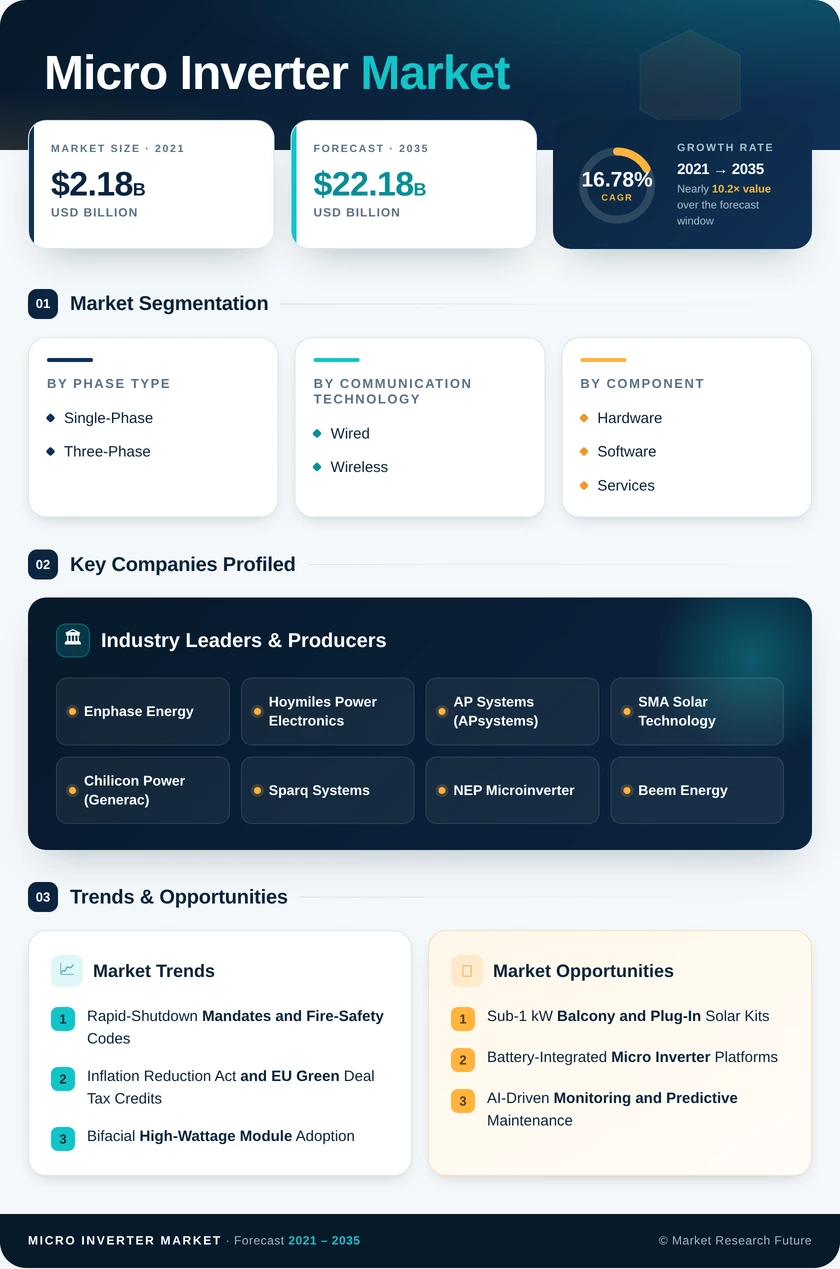
Micro Inverter Market

ID: MRFR/SEM/11086-HCR
200 Pages
Ankit Gupta
Last Updated: June 22, 2026
Micro Inverter Market Size, Share and Research Report By Phase Type (Single-Phase, Three-Phase), By Communication Technology (Wired, Wireless), By Component (Hardware, Software and Services), By Sales Channel (Direct (OEM / Online), Indirect (Distributors / Installers)), By Application (Residential Rooftop, Commercial and Industrial Rooftop, PV Power Plant / Utility-Scale) and By Regional (North America, Europe, South America, Asia Pacific, Middle East and Africa) - Industry Forecast to 2035.
Download PDF ×

We do not share your information with anyone. However, we may send you emails based on your report interest from time to time. You may contact us at any time to opt-out.

  1. 1 Market Overview |
    1. 1.1 Study Assumptions & Market Definition |
    2. 1.2 Scope of the Study |
    3. 1.3 Research Methodology
  2. 2 Market Summary & Key Takeaways
  3. 3 Market Dynamics |
    1. 3.1 Market Drivers Analysis | |
      1. 3.1.1 Rapid-Shutdown & Fire-Safety Codes | |
      2. 3.1.2 IRA / EU Green Deal Tax Incentives | |
      3. 3.1.3 Bifacial High-Wattage Module Adoption | |
      4. 3.1.4 Home Battery Attachment & Hybrid Architectures | |
      5. 3.1.5 SiC/GaN Power-Stage Migration | |
      6. 3.1.6 Distributed-Generation Subsidies in Asia | |
      7. 3.1.7 AC-Module Factory Integration |
    2. 3.2 Market Restraints Analysis | |
      1. 3.2.1 Per-Watt Cost Premium Over String Architectures | |
      2. 3.2.2 Semiconductor Allocation Constraints | |
      3. 3.2.3 Installer Workforce Readiness in Emerging Markets | |
      4. 3.2.4 Limited Three-Phase Product Portfolio | |
      5. 3.2.5 Rooftop Structural Load Constraints |
    3. 3.3 Market Opportunity Analysis | |
      1. 3.3.1 Sub-1 kW Balcony and Plug-In Solar Kits | |
      2. 3.3.2 Battery-Integrated Micro Inverter Platforms | |
      3. 3.3.3 AI-Driven Monitoring and Predictive Maintenance | |
      4. 3.3.4 Emerging-Market Rural Electrification | |
      5. 3.3.5 Commercial Three-Phase Expansion |
    4. 3.4 Industry Value Chain Analysis |
    5. 3.5 Porter's Five Forces Analysis
  4. 4 Global Micro Inverter Market Size & Forecast (2021–2035) |
    1. 4.1 Historical Market Size (2021–2025) |
    2. 4.2 Current & Forecast Market Size (2026–2035) |
    3. 4.3 Market Size by Revenue (USD Billion) |
    4. 4.4 Year-over-Year Growth Analysis
  5. 5 Segmentation Analysis |
    1. 5.1 By Phase Type | |
      1. 5.1.1 Single-Phase | |
      2. 5.1.2 Three-Phase |
    2. 5.2 By Communication Technology | |
      1. 5.2.1 Wired | |
      2. 5.2.2 Wireless |
    3. 5.3 By Component | |
      1. 5.3.1 Hardware | |
      2. 5.3.2 Software and Services |
    4. 5.4 By Sales Channel | |
      1. 5.4.1 Direct (OEM / Online) | |
      2. 5.4.2 Indirect (Distributors / Installers) |
    5. 5.5 By Application | |
      1. 5.5.1 Residential Rooftop | |
      2. 5.5.2 Commercial and Industrial Rooftop | |
      3. 5.5.3 PV Power Plant / Utility-Scale
  6. 6 Regional Analysis |
    1. 6.1 North America | |
      1. 6.1.1 United States | |
      2. 6.1.2 Canada | |
      3. 6.1.3 Mexico |
    2. 6.2 Europe | |
      1. 6.2.1 Germany | |
      2. 6.2.2 United Kingdom | |
      3. 6.2.3 France | |
      4. 6.2.4 Italy | |
      5. 6.2.5 Spain | |
      6. 6.2.6 Nordic Countries | |
      7. 6.2.7 Russia | |
      8. 6.2.8 Rest of Europe |
    3. 6.3 Asia-Pacific | |
      1. 6.3.1 China | |
      2. 6.3.2 India | |
      3. 6.3.3 Japan | |
      4. 6.3.4 South Korea | |
      5. 6.3.5 ASEAN | |
      6. 6.3.6 Rest of Asia-Pacific |
    4. 6.4 South America | |
      1. 6.4.1 Brazil | |
      2. 6.4.2 Argentina | |
      3. 6.4.3 Rest of South America |
    5. 6.5 Middle East & Africa | |
      1. 6.5.1 Saudi Arabia | |
      2. 6.5.2 UAE | |
      3. 6.5.3 South Africa | |
      4. 6.5.4 Egypt | |
      5. 6.5.5 Rest of MEA
  7. 7 Competitive Landscape |
    1. 7.1 Market Share Analysis (2025) |
    2. 7.2 Competitive Benchmarking Matrix |
    3. 7.3 Company Profiles | |
      1. 7.3.1 Enphase Energy | |
      2. 7.3.2 Hoymiles Power Electronics | |
      3. 7.3.3 APsystems | |
      4. 7.3.4 SMA Solar Technology | |
      5. 7.3.5 Chilicon Power (Generac) | |
      6. 7.3.6 Sparq Systems | |
      7. 7.3.7 NEP Microinverter | |
      8. 7.3.8 Beem Energy | |
      9. 7.3.9 TSUN | |
      10. 7.3.10 Deye Inverter Technology
  8. 8 Future Outlook & Strategic Recommendations (2026–2035) |
    1. 8.1 AI-Enabled Fleet Optimization |
    2. 8.2 Platform Economics and Software Monetization |
    3. 8.3 Electrification Supercycle and Load Growth |
    4. 8.4 ESG Reporting and Supply-Chain Traceability
  9. 9 Recent Developments & News
  10. 10 Frequently Asked Questions (FAQs)
  11. 11 Report Scope & Methodology |
    1. 11.1 Study Period & Base Year |
    2. 11.2 Data Sources & Citations |
    3. 11.3 Abbreviations
  12. 12 LIST OF TABLES |
  13. TABLE 1 Global Micro Inverter Market Size & Forecast, by Revenue (USD Billion), 2021–2035 |
  14. TABLE 2 Global Micro Inverter Market — Year-over-Year Growth Analysis, 2021–2035 |
  15. TABLE 3 Driver Impact Analysis — Micro Inverter Market, 2026–2035 |
  16. TABLE 4 Restraint Impact Analysis — Micro Inverter Market, 2026–2035 |
  17. TABLE 5 Regional Market Share Summary — Micro Inverter Market, 2025 |
  18. TABLE 6 North America Micro Inverter Market Size, by Country, 2021–2035 (USD Billion) |
  19. TABLE 7 Europe Micro Inverter Market Size, by Country, 2021–2035 (USD Billion) |
  20. TABLE 8 Asia-Pacific Micro Inverter Market Size, by Country, 2021–2035 (USD Billion) |
  21. TABLE 9 South America Micro Inverter Market Size, by Country, 2021–2035 (USD Billion) |
  22. TABLE 10 Middle East & Africa Micro Inverter Market Size, by Country, 2021–2035 (USD Billion) |
  23. TABLE 11 Global Micro Inverter Market Size, by Phase Type, 2021–2035 (USD Billion) |
  24. TABLE 12 Global Micro Inverter Market Size, by Communication Technology, 2021–2035 (USD Billion) |
  25. TABLE 13 Global Micro Inverter Market Size, by Component, 2021–2035 (USD Billion) |
  26. TABLE 14 Global Micro Inverter Market Size, by Sales Channel, 2021–2035 (USD Billion) |
  27. TABLE 15 Global Micro Inverter Market Size, by Application, 2021–2035 (USD Billion) |
  28. TABLE 16 Competitive Benchmarking Matrix — Global Micro Inverter Market, 2025 |
  29. TABLE 17 Company Profiles — Key Players, Global Micro Inverter Market |
  30. TABLE 18 Recent Developments & Strategic Announcements, 2023–2025 |
  31. TABLE 19 Report Scope & Methodology Summary |
  32. TABLE 20 Detailed Sources and Citations
  33. 13 LIST OF FIGURES |
  34. FIGURE 1 Market Dynamics Overview — Drivers, Restraints & Opportunities |
  35. FIGURE 2 Industry Value Chain — Micro Inverter Market |
  36. FIGURE 3 Porter's Five Forces Analysis — Micro Inverter Market |
  37. FIGURE 4 Global Micro Inverter Market Size Trend (USD Billion), 2021–2035 |
  38. FIGURE 5 Micro Inverter Market Share, by Phase Type, 2025 (%) |
  39. FIGURE 6 Micro Inverter Market Share, by Communication Technology, 2025 (%) |
  40. FIGURE 7 Micro Inverter Market Share, by Component, 2025 (%) |
  41. FIGURE 8 Micro Inverter Market Share, by Sales Channel, 2025 (%) |
  42. FIGURE 9 Micro Inverter Market Share, by Application, 2025 (%) |
  43. FIGURE 10 Micro Inverter Market Share, by Region, 2025 (%) |
  44. FIGURE 11 North America Micro Inverter Market Size, by Country, 2025 (%) |
  45. FIGURE 12 Europe Micro Inverter Market Size, by Country, 2025 (%) |
  46. FIGURE 13 Asia-Pacific Micro Inverter Market Size, by Country, 2025 (%) |
  47. FIGURE 14 South America Micro Inverter Market Size, by Country, 2025 (%) |
  48. FIGURE 15 Middle East & Africa Micro Inverter Market Size, by Country, 2025 (%) |
  49. FIGURE 16 Competitive Landscape — Top-5 Revenue Share, 2025

Segmentation Quick Reference

DimensionSub-SegmentsDominant SegmentFastest Growing Segment
Phase TypeSingle-Phase, Three-PhaseSingle-PhaseThree-Phase
Communication TechnologyWired, WirelessWiredWireless
ComponentHardware, Software, and ServicesHardwareSoftware and Services
Sales ChannelDirect (OEM/Online), Indirect (Distributors/Installers)IndirectDirect
ApplicationResidential Rooftop, Commercial and Industrial Rooftop, PV Power Plant / Utility-ScaleResidential RooftopCommercial and Industrial Rooftop


Market Segmentation Overview

By Phase Type

Sub-SegmentKey Trend
Single-PhaseDominant in residential; 300–500 W units standard for code-compliant rapid-shutdown installations
Three-PhaseFastest growing; >1 kW units gaining traction in C&I for balanced loading and reactive-power support


Single-phase micro inverters continue to serve the residential backbone of the market, while three-phase platforms are unlocking commercial rooftop opportunities that were previously accessible only to string and central inverter vendors.

By Communication Technology

Sub-SegmentKey Trend
WiredPLC-based; reliable on metal rooftops; established in legacy fleets
WirelessZigbee, Wi-SUN, proprietary 2.4 GHz mesh; faster commissioning and retrofit-friendly


Wireless communication is closing the reliability gap with wired solutions, and falling chipset costs are making it the default specification for new product launches from major vendors.

By Component

Sub-SegmentKey Trend
HardwareCore inverter electronics, enclosures, cabling; the majority of current revenue
Software and ServicesMonitoring dashboards, predictive maintenance, and extended warranties, the highest-growth category


Recurring software revenue is reshaping vendor business models from one-time hardware sales to platform-based subscription economics.

By Sales Channel

Sub-SegmentKey Trend
Direct (OEM / Online)Growing via e-commerce and factory-bundled AC modules
Indirect (Distributors / Installers)Still dominant; deep installer relationships drive volume


Direct channels are expanding as manufacturers invest in online storefronts and pre-integrated panel-inverter assemblies that simplify the procurement process.

By Application

Sub-SegmentKey Trend
Residential RooftopLargest segment: driven by code mandates, homeowner energy independence, and battery coupling
Commercial and Industrial RooftopFastest growing; three-phase units and ESG compliance are primary catalysts
PV Power Plant / Utility-ScaleNascent; pilot deployments on shading-prone or irregular-terrain sites


Residential rooftops remain the primary revenue contributor, but commercial and industrial applications are scaling quickly as three-phase product portfolios mature and corporate sustainability mandates push adoption of panel-level monitoring.