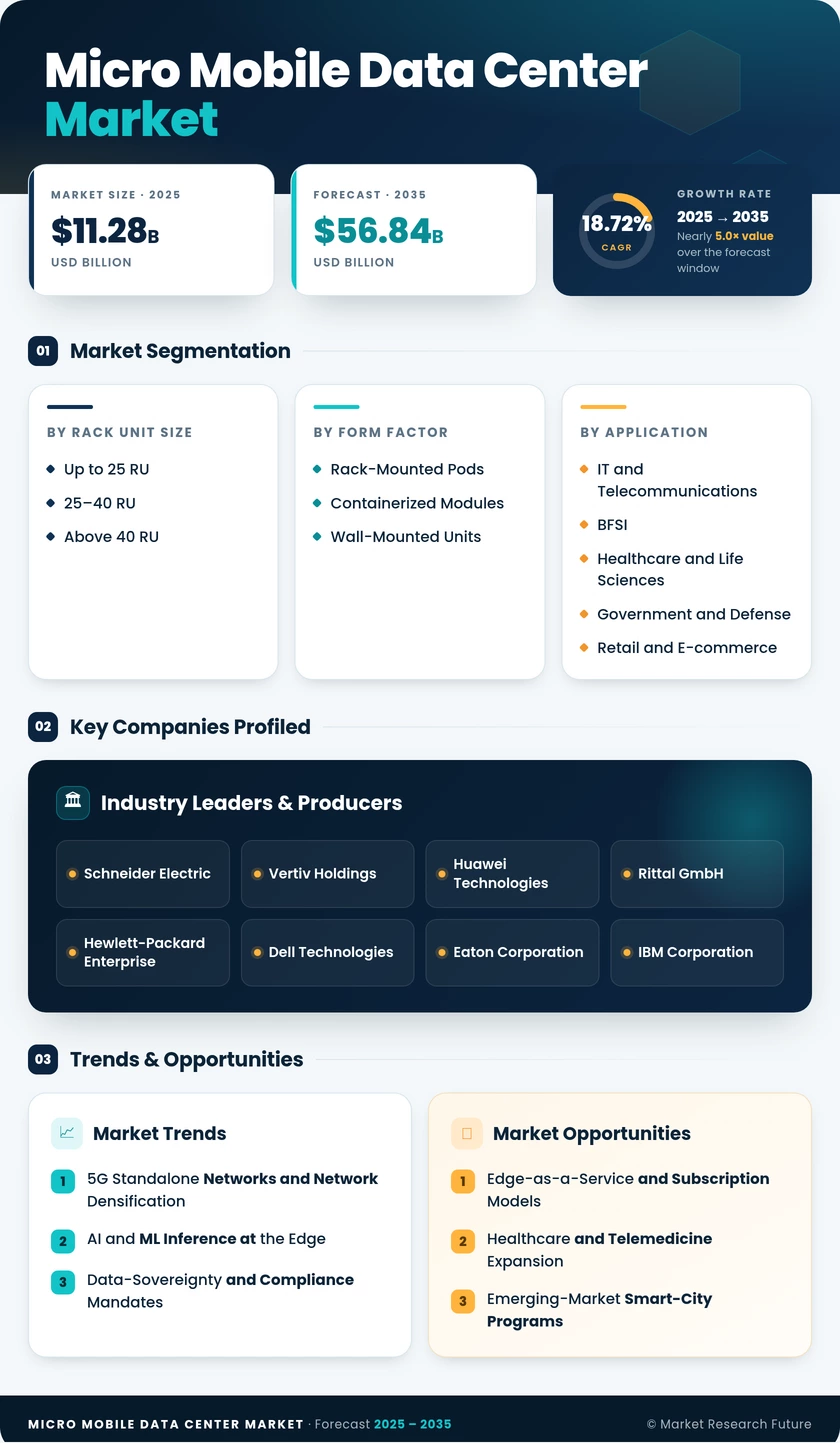
Micro Mobile Data Center Market

ID: MRFR/ICT/2713-HCR
100 Pages
Ankit Gupta
Last Updated: June 17, 2026
Micro Mobile Data Center Market Size, Share and Research Report By Rack Unit Size (Up to 25 RU, 25–40 RU, Above 40 RU), By Form Factor (Rack-Mounted Pods, Containerized Modules, Wall-Mounted Units), By Application (Edge Computing Nodes, Instant / Disaster Recovery, High-Density Networks), By Organization Size (Small and Medium Enterprises, Large Enterprises), By End-User Industry (IT and Telecommunications, BFSI, Healthcare and Life Sciences, Government and Defense, Retail and E-commerce, Energy and Utilities) and By Regional (North America, Europe, South America, Asia Pacific, Middle East and Africa) - Industry Forecast to 2035.
Download PDF ×

We do not share your information with anyone. However, we may send you emails based on your report interest from time to time. You may contact us at any time to opt-out.

  1. 1 Market Overview |
    1. 1.1 Study Assumptions & Market Definition |
    2. 1.2 Scope of the Study |
    3. 1.3 Research Methodology
  2. 2 Market Summary & Key Takeaways
  3. 3 Market Dynamics |
    1. 3.1 Market Drivers Analysis | |
      1. 3.1.1 5G Standalone Networks and Network Densification | |
      2. 3.1.2 AI and ML Inference at the Edge | |
      3. 3.1.3 Data-Sovereignty and Compliance Mandates | |
      4. 3.1.4 Hyperscaler Outage-Driven Resilience Strategies | |
      5. 3.1.5 IoT Device Proliferation | |
      6. 3.1.6 Edge-as-a-Service Business Models | |
      7. 3.1.7 Smart-City and Industry
    2. 4.0 Programs |
    3. 3.2 Market Restraints Analysis | |
      1. 3.2.1 Cost Premium of Compact Server Infrastructure at Small Scale | |
      2. 3.2.2 Skilled Workforce Gaps for Distributed Edge Operations | |
      3. 3.2.3 Physical Security and Environmental Exposure | |
      4. 3.2.4 Cooling Efficiency Constraints in Tropical Regions | |
      5. 3.2.5 Interoperability and Vendor Lock-In Risks |
    4. 3.3 Market Opportunity Analysis | |
      1. 3.3.1 Edge-as-a-Service and Subscription Models | |
      2. 3.3.2 Healthcare and Telemedicine Expansion | |
      3. 3.3.3 Emerging-Market Smart-City Programs | |
      4. 3.3.4 Sovereign AI and GPU-at-the-Edge | |
      5. 3.3.5 Data Monetization Through Distributed Analytics |
    5. 3.4 Industry Value Chain Analysis |
    6. 3.5 Porter's Five Forces Analysis
  4. 4 Global Micro Mobile Data Center Market Size & Forecast (2021–2035) |
    1. 4.1 Historical Market Size (2021–2025) |
    2. 4.2 Current & Forecast Market Size (2026–2035) |
    3. 4.3 Market Size by Revenue (USD Billion) |
    4. 4.4 Year-over-Year Growth Analysis
  5. 5 Segmentation Analysis |
    1. 5.1 By Rack Unit Size | |
      1. 5.1.1 Up to 25 RU | |
      2. 5.1.2 25–40 RU | |
      3. 5.1.3 Above 40 RU |
    2. 5.2 By Form Factor | |
      1. 5.2.1 Rack-Mounted Pods | |
      2. 5.2.2 Containerized Modules | |
      3. 5.2.3 Wall-Mounted Units |
    3. 5.3 By Application | |
      1. 5.3.1 Edge Computing Nodes | |
      2. 5.3.2 Instant / Disaster Recovery | |
      3. 5.3.3 High-Density Networks |
    4. 5.4 By Organization Size | |
      1. 5.4.1 Small and Medium Enterprises | |
      2. 5.4.2 Large Enterprises |
    5. 5.5 By End-User Industry | |
      1. 5.5.1 IT and Telecommunications | |
      2. 5.5.2 BFSI | |
      3. 5.5.3 Healthcare and Life Sciences | |
      4. 5.5.4 Government and Defense | |
      5. 5.5.5 Retail and E-commerce | |
      6. 5.5.6 Energy and Utilities
  6. 6 Regional Analysis |
    1. 6.1 North America | |
      1. 6.1.1 United States | |
      2. 6.1.2 Canada | |
      3. 6.1.3 Mexico |
    2. 6.2 Europe | |
      1. 6.2.1 Germany | |
      2. 6.2.2 United Kingdom | |
      3. 6.2.3 France | |
      4. 6.2.4 Italy | |
      5. 6.2.5 Spain | |
      6. 6.2.6 Nordic Countries | |
      7. 6.2.7 Russia | |
      8. 6.2.8 Rest of Europe |
    3. 6.3 Asia-Pacific | |
      1. 6.3.1 China | |
      2. 6.3.2 India | |
      3. 6.3.3 Japan | |
      4. 6.3.4 South Korea | |
      5. 6.3.5 ASEAN | |
      6. 6.3.6 Rest of Asia-Pacific |
    4. 6.4 South America | |
      1. 6.4.1 Brazil | |
      2. 6.4.2 Argentina | |
      3. 6.4.3 Rest of South America |
    5. 6.5 Middle East & Africa | |
      1. 6.5.1 Saudi Arabia | |
      2. 6.5.2 UAE | |
      3. 6.5.3 South Africa | |
      4. 6.5.4 Egypt | |
      5. 6.5.5 Rest of MEA
  7. 7 Competitive Landscape |
    1. 7.1 Market Share Analysis (2025) |
    2. 7.2 Competitive Benchmarking Matrix |
    3. 7.3 Company Profiles | |
      1. 7.3.1 Schneider Electric | |
      2. 7.3.2 Vertiv Holdings | |
      3. 7.3.3 Huawei Technologies | |
      4. 7.3.4 Rittal GmbH | |
      5. 7.3.5 Hewlett Packard Enterprise | |
      6. 7.3.6 Dell Technologies | |
      7. 7.3.7 Eaton Corporation | |
      8. 7.3.8 IBM Corporation | |
      9. 7.3.9 Zellabox | |
      10. 7.3.10 Cannon Technologies
  8. 8 Future Outlook & Strategic Recommendations (2026–2035) |
    1. 8.1 Autonomous Edge Operations via AIOps |
    2. 8.2 Edge Platform Economics and Marketplace Models |
    3. 8.3 Sustainability and Circular-Economy Design |
    4. 8.4 Sovereign AI and Distributed GPU Clusters
  9. 9 Recent Developments & News
  10. 10 Frequently Asked Questions (FAQs)
  11. 11 Report Scope & Methodology |
    1. 11.1 Study Period & Base Year |
    2. 11.2 Data Sources & Citations |
    3. 11.3 Abbreviations
  12. 12 LIST OF TABLES |
  13. TABLE 1 Global Micro Mobile Data Center Market Size & Forecast, by Revenue (USD Billion), 2021–2035 |
  14. TABLE 2 Global Micro Mobile Data Center Market – Year-over-Year Growth Analysis, 2021–2035 |
  15. TABLE 3 Driver Impact Analysis – Micro Mobile Data Center Market, 2026–2035 |
  16. TABLE 4 Restraint Impact Analysis – Micro Mobile Data Center Market, 2026–2035 |
  17. TABLE 5 Regional Market Share Summary – Micro Mobile Data Center Market, 2025 |
  18. TABLE 6 North America Micro Mobile Data Center Market Size, by Country, 2021–2035 (USD Billion) |
  19. TABLE 7 Europe Micro Mobile Data Center Market Size, by Country, 2021–2035 (USD Billion) |
  20. TABLE 8 Asia-Pacific Micro Mobile Data Center Market Size, by Country, 2021–2035 (USD Billion) |
  21. TABLE 9 South America Micro Mobile Data Center Market Size, by Country, 2021–2035 (USD Billion) |
  22. TABLE 10 Middle East & Africa Micro Mobile Data Center Market Size, by Country, 2021–2035 (USD Billion) |
  23. TABLE 11 Global Micro Mobile Data Center Market Size, by Rack Unit Size, 2021–2035 (USD Billion) |
  24. TABLE 12 Global Micro Mobile Data Center Market Size, by Form Factor, 2021–2035 (USD Billion) |
  25. TABLE 13 Global Micro Mobile Data Center Market Size, by Application, 2021–2035 (USD Billion) |
  26. TABLE 14 Global Micro Mobile Data Center Market Size, by Organization Size, 2021–2035 (USD Billion) |
  27. TABLE 15 Global Micro Mobile Data Center Market Size, by End-User Industry, 2021–2035 (USD Billion) |
  28. TABLE 16 Competitive Benchmarking Matrix – Micro Mobile Data Center Market, 2025 |
  29. TABLE 17 Company Profiles – Key Players, Micro Mobile Data Center Market |
  30. TABLE 18 Recent Developments & Strategic Announcements, 2023–2025 |
  31. TABLE 19 Report Scope & Methodology Summary |
  32. TABLE 20 Detailed Sources and Citations
  33. 13 LIST OF FIGURES |
  34. FIGURE 1 Micro Mobile Data Center Market Dynamics – Drivers, Restraints, Opportunities |
  35. FIGURE 2 Industry Value Chain Analysis – Micro Mobile Data Center Market |
  36. FIGURE 3 Porter's Five Forces Analysis – Micro Mobile Data Center Market |
  37. FIGURE 4 Global Micro Mobile Data Center Market Size Trend & Forecast, 2021–2035 (USD Billion) |
  38. FIGURE 5 Micro Mobile Data Center Market Share, by Rack Unit Size, 2025 (%) |
  39. FIGURE 6 Micro Mobile Data Center Market Share, by Form Factor, 2025 (%) |
  40. FIGURE 7 Micro Mobile Data Center Market Share, by Application, 2025 (%) |
  41. FIGURE 8 Micro Mobile Data Center Market Share, by Organization Size, 2025 (%) |
  42. FIGURE 9 Micro Mobile Data Center Market Share, by End-User Industry, 2025 (%) |
  43. FIGURE 10 Micro Mobile Data Center Market Share, by Region, 2025 (%) |
  44. FIGURE 11 North America Micro Mobile Data Center Market Size, by Country, 2025 (%) |
  45. FIGURE 12 Europe Micro Mobile Data Center Market Size, by Country, 2025 (%) |
  46. FIGURE 13 Asia-Pacific Micro Mobile Data Center Market Size, by Country, 2025 (%) |
  47. FIGURE 14 South America Micro Mobile Data Center Market Size, by Country, 2025 (%) |
  48. FIGURE 15 Middle East & Africa Micro Mobile Data Center Market Size, by Country, 2025 (%) |
  49. FIGURE 16 Competitive Landscape – Micro Mobile Data Center Market Revenue Share, 2025

Segmentation Quick Reference

DimensionSub-SegmentsDominant SegmentFastest Growing Segment
Rack Unit SizeUp to 25 RU, 25–40 RU, Above 40 RU25–40 RUUp to 25 RU
Form FactorRack-Mounted Pods, Containerized Modules, Wall-Mounted UnitsRack-Mounted PodsContainerized Modules
ApplicationEdge Computing Nodes, Instant/Disaster Recovery, High-Density NetworksEdge Computing NodesHigh-Density Networks
Organization SizeSmall and Medium Enterprises, Large EnterprisesSmall and Medium EnterprisesSmall and Medium Enterprises
End-User IndustryIT & Telecom, BFSI, Healthcare & Life Sciences, Government & Defense, Retail & E-commerce, Energy & UtilitiesIT and TelecommunicationsHealthcare and Life Sciences


Market Segmentation Overview

By Rack Unit Size

Sub-SegmentKey Trend
Up to 25 RURising demand from retail branch offices and 5G small-cell co-locations requiring ultra-compact footprints
25–40 RUWorkhorse tier for telecom edge and mixed IT/OT environments; balances density with transportability
Above 40 RUGrowing GPU-dense AI inference workloads are pushing per-rack power beyond 20 kW


The 25–40 RU tier remains the volume leader as telecom operators standardize edge-site templates around mid-range rack configurations, while the above-40 RU category gains share as AI inference and high-performance computing migrate to the edge.

By Form Factor

Sub-SegmentKey Trend
Rack-Mounted PodsIndoor-first design for rapid retrofit of existing server rooms and branch offices
Containerized ModulesRuggedized outdoor deployment; IP55/IP65-rated enclosures for harsh environments
Wall-Mounted UnitsSpace-constrained retail and SME locations; sub-6 kW power envelopes


Containerized modules are the fastest-growing form factor, driven by military, disaster-response, and remote-industrial use cases that require fully self-contained portable data center units deployable within 48 hours.

By Application

Sub-SegmentKey Trend
Edge Computing NodesLatency-sensitive IoT analytics and real-time AI inference at the network periphery
Instant / Disaster RecoveryBusiness-continuity compliance and rapid failover for mission-critical workloads
High-Density NetworksCDN edge caching, cloud gaming, and video-streaming infrastructure


Edge computing nodes dominate by revenue as enterprises prioritize sub-10 ms response times, while high-density network applications grow fastest owing to surging video and gaming traffic.

By Organization Size

Sub-SegmentKey Trend
Small and Medium EnterprisesEdge-as-a-service and subscription models remove capex barriers
Large EnterprisesGlobal standardization of modular micro data center templates across distributed sites


SMEs account for the majority of new deployments as managed-service providers offer turnkey edge solutions that include hardware, software, connectivity, and 24/7 remote monitoring.

By End-User Industry

Sub-SegmentKey Trend
IT and Telecommunications5G RAN virtualization and multi-access edge computing are driving bulk procurement
BFSILow-latency trading, fraud detection, and ATM-network edge processing
Healthcare and Life SciencesReal-time imaging, telemedicine, and AI-assisted diagnostics at the point of care
Government and DefenseTactical edge deployments, sovereign cloud mandates, and classified-data processing
Retail and E-commerceIn-store analytics, dynamic pricing, and inventory optimization at the shelf level
Energy and UtilitiesSmart-grid SCADA, remote pipeline monitoring, renewable-asset optimization


IT and telecommunications remain the largest vertical, while healthcare is poised to be the fastest-growing end-user segment through 2035 as telemedicine adoption scales globally.