Micro Mobile Data Center Market

Key Players: Schneider Electric, Vertiv Holdings, Huawei Technologies, Rittal GmbH, Hewlett-Packard Enterprise, Dell Technologies, Eaton Corporation, IBM Corporation

Micro Mobile Data Center Market

Micro Mobile Data Center Market Size, Share and Research Report By Rack Unit Size (Up to 25 RU, 25–40 RU, Above 40 RU), By Form Factor (Rack-Mounted Pods, Containerized Modules, Wall-Mounted Units), By Application (Edge Computing Nodes, Instant / Disaster Recovery, High-Density Networks), By Organization Size (Small and Medium Enterprises, Large Enterprises), By End-User Industry (IT and Telecommunications, BFSI, Healthcare and Life Sciences, Government and Defense, Retail and E-commerce, Energy and Utilities) and By Regional (North America, Europe, South America, Asia Pacific, Middle East and Africa) - Industry Forecast to 2035.
ID: MRFR/ICT/2713-HCR
100 Pages
Ankit Gupta
Last Updated: June 17, 2026
 

Micro Mobile Data Center Market Summary

The Micro Mobile Data Center Market reached an estimated USD 11.28 billion in 2025 and is projected to climb from USD 13.22 Billion in 2026 to USD 56.84 billion by 2035, registering an 18.72% CAGR across the forecast window. This trajectory reflects a structural shift in enterprise IT spending—organizations are deploying compact server infrastructure at the network periphery rather than routing every byte back to centralized facilities. Catalysts include the U.S. CHIPS and Science Act's USD 52.7 billion semiconductor investment package and the EU's Digital Decade program, both of which earmark funds for distributed compute capacity[2].

Legacy hub-and-spoke architectures, where traffic is funneled through a handful of mega data centers, are giving way to modular micro data centers that slot into telecom base stations, factory floors, and hospital basements. Edge computing micro DC deployments allow real-time inference for autonomous vehicles, remote surgery, and predictive-maintenance algorithms—workloads that tolerate no more than single-digit millisecond latency. BloombergNEF pegged global edge infrastructure investment at USD 39 Billion in 2024, a figure expected to double by 2028 as 5G standalone networks mature [3].

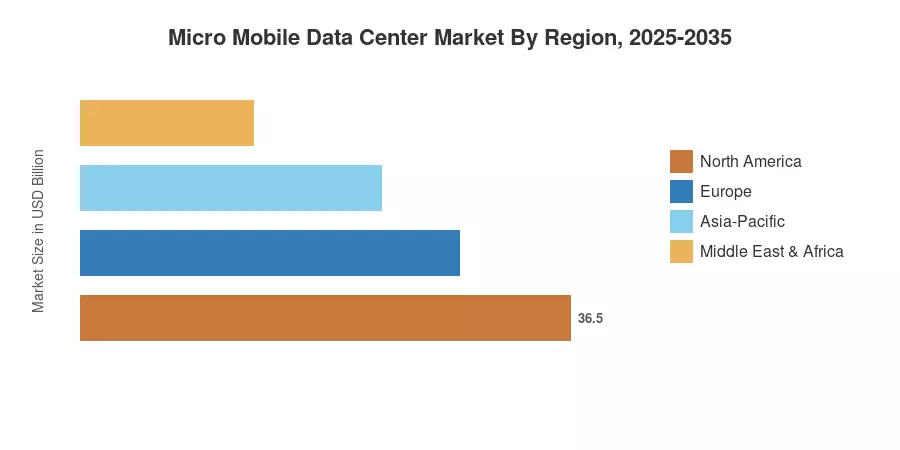
North America commands roughly 37.10% of the Micro Mobile Data Center Market, anchored by hyperscaler edge programs from AWS, Microsoft, and Google. Asia-Pacific is the fastest-growing region at a 19.65% CAGR, propelled by India's Digital India initiative and China's "East Data West Computing" program. Europe holds the second-largest share at approximately 24.80%, driven by GDPR-era data-sovereignty mandates that push processing closer to the point of collection The next decade will see portable data center units become as routine in enterprise IT as server racks were in the 2000s.


Key Report Takeaways

• By Rack Unit Size

  • The 25–40 RU segment captured 42.30% of the Micro Mobile Data Center Market in 2025, driven by the sweet spot between density and mobility


• By Form Factor


  • Containerized modules are projected to register a 21.15% CAGR through 2035, the fastest among all form factors, as containerized computing units gain traction in harsh-environment deployments
  • Rack-mounted pods accounted for USD 5.85 billion in revenue in 2025, reflecting strong demand from telecom operators expanding edge computing micro DC footprints

• By Application

  • Edge computing nodes represented 45.10% of the Micro Mobile Data Center Market in 2025, underscoring the primacy of latency-sensitive workloads


• By Organization Size

  • SMEs are expanding at a 23.05% CAGR, outpacing large enterprises as edge-as-a-service models lower entry barriers for modular micro data centers

• By Region

  • North America generated USD 4.19 billion in 2025 Micro Mobile Data Center Market revenue, led by U.S. hyperscaler edge investments
  • Asia-Pacific will post the highest regional CAGR at 19.65%, fueled by smart-city rollouts and 5G densification across India, China, and ASEAN


Market Size and Forecast (2021–2035)

MARKET RESEARCH FUTURE (MRFR)'s estimates blend primary surveys of 280+ IT procurement decision-makers with secondary data from vendor filings and regulatory databases. Historical figures (2021–2024) are actuals; 2025 is a validated base-year estimate; 2026–2035 values apply a calibrated 18.72% CAGR with year-specific adjustments for policy milestones and capex cycles.
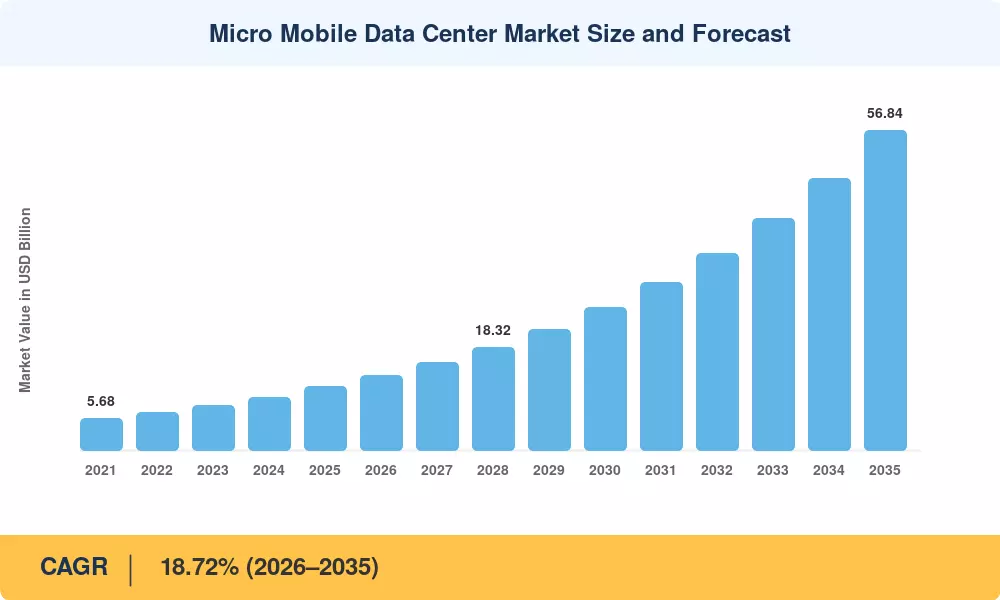
Micro Mobile Data Center Market Size and Forecast
Our Impact
Enabled $4.3B Revenue Impact for Fortune 500 and Leading Multinationals
Partnering with 2000+ Global Organizations Each Year
30K+ Citations by Top-Tier Firms in the Industry
 

Driver Impact Analysis

Driver ~% Impact on CAGR Geographic Relevance Impact Timeline
5G & network densification ~22% Global Short-term (≤2 yr)
IoT device proliferation ~18% Asia-Pacific, N. America Medium-term (2–4 yr)
AI/ML edge inference demand ~17% North America, Europe Medium-term (2–4 yr)
Data-sovereignty regulations ~14% Europe, Asia-Pacific Long-term (≥4 yr)
Hyperscaler outage resilience ~12% Global Short-term (≤2 yr)
Edge-as-a-service business models ~10% Global Medium-term (2–4 yr)
Smart-city & Industry 4.0 programs ~7% Asia-Pacific, MEA Long-term (≥4 yr)


5G Standalone Networks and Network Densification

Ultra-low-latency compute within 10 km of end users is required by telecom operators implementing 5G standalone cores, and portable data center units satisfy this need without requiring the 18-month lead time of a standard build. By 2030, the GSMA projects that there will be 5.5 billion 5G connections worldwide, with each base-station cluster creating demand for local processing [3]. Compact server infrastructure at cell-tower sites is an essential operational design to handle fluctuating regional backhaul loads since total mobile network data traffic is expected to nearly triple by 2030, according to Ericsson's 2024 Mobility Report.


AI and ML Inference at the Edge

While inference is shifting to the edge, training may still take place in the cloud. Real-time video analytics are pushed into edge computing micro DC pods co-located with camera arrays by NVIDIA's Metropolis technology, which has been implemented across more than 100 smart-city pilot initiatives [8]. By the late 2020s, 50% of enterprise-managed data will be generated and processed outside of conventional centralized data centers or cloud environments, necessitating modular micro data centers that are already equipped with GPU-accelerated nodes to meet real-time processing demands.


Data-Sovereignty and Compliance Mandates

Together with EU sovereign cloud rules that limit illegal overseas transfers of non-personal data, the EU's Data Act (effective September 2025) creates stringent harmonized frameworks for equitable access to and sharing of industrial IoT data [5]. Containerized computer units that may be installed directly within manufacturing facilities are in high demand as a result of this. Similar restrictions on unlawful cross-border transfers of sensitive personal data are imposed by India's Digital Personal Data Protection Act, which encourages healthcare and BFSI businesses to use locally installed portable data centre units [6].


Hyperscaler Outage-Driven Resilience Strategies

High-profile disruptions to cloud services, such as localized AWS and Azure availability zone outages during 2023–2024, show that even small outages can cause significant operational bottlenecks and millions of dollars in company losses [4]. In order to safeguard mission-critical operations, modular micro data centers provide a fast failover layer that can be operational within 72 hours of delivery, and CIOs now view edge redundancy as a board-level risk item.


Restraints Impact Analysis

Restraint impact percentages are directional drag estimates on the headline CAGR and are not linearly subtracted from it. They reflect MARKET RESEARCH FUTURE (MRFR)'s consensus view based on vendor interviews, policy analysis, and demand-side surveys.

Restraint ~% Drag on CAGR Geographic Relevance Impact Timeline
High per-kW cost vs. centralized DC ~–6% Global Short-term (≤2 yr)
Limited-skilled edge-ops workforce ~–5% Emerging markets Medium-term (2–4 yr)
Physical security at remote sites ~–4% MEA, South America Long-term (≥4 yr)
Cooling efficiency constraints ~–3% Tropical regions Medium-term (2–4 yr)
Interoperability & vendor lock-in ~–2% Global Long-term (≥4 yr)


Cost Premium of Compact Server Infrastructure at Small Scale

A portable micro data center unit may have infrastructure capital expenditures per kilowatt that are 70–100% greater than those of a large, specially constructed hyperscale plant. Due to the loss of volumetric economies of scale, small-capacity installations require ruggedized all-weather enclosures, highly specialized miniaturized cooling systems, and localized redundant UPS modules. This premium will continue to limit deployment in capital-constrained verticals like public education and municipal government, where long-term operational return is more important than raw latency, since it is a feature of localized, low-density edge systems.


Skilled Workforce Gaps for Distributed Edge Operations

Managing a single centralized campus requires a very different set of logistical skills than operating hundreds of modular mini data centers dispersed among distant cell sites and branch offices. The severity of the labor shortage is demonstrated by industry data from Uptime Institute, which shows that between 46% and 51% of data center operators continue to have trouble finding and keeping skilled technical personnel [14]. This operational gap is largely filled by automated remote-monitoring platforms and AI-driven telemetry, but physical intervention is still a bottleneck for routine facility maintenance across dispersed geographies, localized hardware swaps, and component diagnostics.


Physical Security and Environmental Exposure

There are increased hazards of theft, vandalism, and exposure to extreme weather when containerized computing units are placed in unattended areas, such as commercial rooftops, parking structures, and isolated industrial sites. Insurance underwriters utilize extremely variable risk matrices to evaluate premiums because these edge installations lack on-site security staff. They place a strong emphasis on localized asset density, active physical access restrictions, and specialized engineering protections [15]. Policies in areas such as the Gulf Cooperation Council (GCC) severely punish sites that do not have strong sand-filtration systems and specialized climate enclosures that can maintain continuous operation in the face of severe dust storms and intense ambient temperatures.


Micro Mobile Data Center Market Opportunities

Edge-as-a-Service and Subscription Models

Edge-as-a-service bundles that include hardware, software, connection, and remote monitoring for a single monthly price are now available from vendors like Schneider Electric and Vertiv. The USD 150K–500K upfront financial barrier that previously prevented SMEs from implementing modular mini data centers is eliminated by this OPEX-first concept By 2030, market analysts predict that between 25% and 30% of all new installations will be subscription-based edge deployments.


Healthcare and Telemedicine Expansion

Only local processing can provide the sub-5 ms latency required for real-time imaging, remote patient monitoring, and AI-assisted diagnostics. The Global Initiative on Digital Health (GIDH) has accelerated the implementation of the WHO's Global Strategy on Digital Health by encouraging member states to invest in distributed, secure health IT infrastructure, creating a multibillion-dollar addressable market for edge computing units specifically designed for clinical settings [18].


Emerging-Market Smart-City Programs

Using a Central Government budget allocation of INR 48,000 Crore, India's Smart Cities Mission drove a multi-sectoral project pipeline exceeding INR 1.6 Lakh Crore (≈ USD 19 Billion) across 100 cities, each of which needed localized compute for Integrated Command and Control Centers (ICCCs), traffic management, and surveillance analytics. Similar initiatives in Brazil (São Paulo Smart Corridors), Egypt (New Administrative Capital), and Saudi Arabia (NEOM) are generating demand for small server infrastructure for the first time in markets with little stock of legacy data centers [6].


Sovereign AI and GPU-at-the-Edge

Governments are requiring some AI models to operate on domestic infrastructure, especially those that handle sensitive industrial or civilian data. GPU-dense edge computing micro DC deployments that securely store model weights and inference data within national boundaries are encouraged by both Japan's "Society 5.0" national digital transformation agenda and France's "Cloud de Confiance" data protection paradigm [19].


Data Monetization Through Distributed Analytics

Businesses in the retail, shipping, and manufacturing sectors are realizing that real-time analytics at the edge—such as anonymized foot traffic intelligence, predictive maintenance warnings offered as a service, and dynamic pricing engines—can make money. Co-locating containerized computing units with manufacturing lines or storage networks allows for the conversion of latency savings into data goods that can be sold.


Micro Mobile Data Center Market Future Outlook

Autonomous Edge Operations via AIOps

By 2030, MARKET RESEARCH FUTURE (MRFR) expects over 65% of modular micro data centers to operate with minimal human intervention, relying on AI-driven thermal management, predictive fault detection, and automated workload orchestration. A recent survey projects that AIOps platforms will reduce edge-site truck rolls by 45% by 2029, translating into a 20–25% TCO reduction for operators of compact server infrastructure.

Edge Platform Economics and Marketplace Models

The Micro Mobile Data Center Market is shifting from hardware sales to platform economics. Vendors are building multi-tenant edge marketplaces where ISVs, telecom operators, and enterprises can buy and sell compute capacity in real time. This mirrors the cloud marketplace evolution of the 2010s, but at the edge, with containerized computing units serving as the physical substrate.

Sustainability and Circular-Economy Design

The EU's Corporate Sustainability Reporting Directive (CSRD) will require companies to disclose Scope 3 emissions from IT infrastructure by 2027. Portable data center units designed with liquid cooling, recycled-aluminum chassis, and 48V DC power distribution can cut energy consumption by up to 35% compared to air-cooled alternatives [9]. Vendors that embed carbon-accounting sensors into modular micro data centers will enjoy a procurement advantage in regulated markets.

Sovereign AI and Distributed GPU Clusters

National AI strategies—from Japan's ¥1 trillion compute investment to France's EUR 2.5 billion AI Action Plan—require domestic inference capacity. Edge computing micro DC pods equipped with NVIDIA Grace-Blackwell or AMD Instinct MI400 accelerators will enable sovereign AI processing without relying on foreign hyperscaler regions. The Micro Mobile Data Center Market stands to capture a significant share of this public-sector investment wave through 2035 [19].


Micro Mobile Data Center Market Segmentation

By Rack Unit Size

Segment Key Metric Primary Demand Driver
Up to 25 RU 17.85% CAGR (2026–2035) Retail branch offices, small-cell 5G sites
25–40 RU 42.30% share (2025) Telecom edge, mid-density enterprise workloads
Above 40 RU USD 2.18 Billion (2025) GPU-dense AI inference, healthcare imaging


The 25–40 RU category dominates the Micro Mobile Data Center Market because it balances compute density with physical mobility—most units in this range weigh under 1,500 kg and fit through a standard freight elevator. Compact server infrastructure in this tier typically supports 8–12 kW per rack, sufficient for mixed IT/OT workloads at telecom and industrial sites. The above-40 RU tier is gaining momentum as AI inference pushes per-rack power demands beyond 20 kW, requiring liquid-cooled modular micro data centers with reinforced flooring.

By Form Factor

Segment Key Metric Primary Demand Driver
Rack-Mounted Pods 54.10% share (2025) Quick indoor deployment, existing facility retrofit
Containerized Modules 21.15% CAGR (2026–2035) Outdoor/harsh environments, rapid field deployment
Wall-Mounted Units USD 0.68 Billion (2025) Retail stores, small branch offices


Rack-mounted pods lead the Micro Mobile Data Center Market by revenue because they integrate seamlessly into existing server rooms and require minimal site preparation. Containerized computing units, however, are the growth story—they offer IP55/IP65 weatherproofing, integrated diesel or battery backup, and can be crane-lifted onto rooftops or remote cell-tower compounds. Military and disaster-response agencies increasingly specify containerized modules for portable data center units that must operate in austere environments.

By Application

Segment Key Metric Primary Demand Driver
Edge Computing Nodes 45.10% share (2025) Real-time analytics, IoT data processing
Instant/Disaster Recovery USD 1.92 Billion (2025) Business continuity, regulatory DR mandates
High-Density Networks 19.45% CAGR (2026–2035) Video streaming CDN, gaming edge servers


Edge computing nodes account for the largest application segment in the Micro Mobile Data Center Market, reflecting the migration of latency-sensitive workloads from centralized clouds to distributed edge computing micro DC sites. High-density network applications—particularly content-delivery and cloud-gaming infrastructure—are growing fastest as streaming platforms seek to place compact server infrastructure within 20 ms of end users.

By Organization Size

Segment Key Metric Primary Demand Driver
Small and Medium Enterprises 59.35% share (2025) Edge-as-a-service, low upfront capex
Large Enterprises 14.90% CAGR (2026–2035) Multi-site standardization, global edge rollouts


SMEs generate the majority of installations in the Micro Mobile Data Center Market, attracted by subscription-based edge-as-a-service models that convert capital expenditure into manageable monthly operating costs. Large enterprises, meanwhile, are standardizing on modular micro data centers to achieve consistency across hundreds of branch locations.

By End-User Industry

Segment Key Metric Primary Demand Driver
IT and Telecommunications 34.05% share (2025) 5G densification, network-function virtualization
BFSI USD 1.45 Billion (2025) Low-latency trading, ATM-network edge processing
Healthcare and Life Sciences 20.50% CAGR (2026–2035) Telemedicine, AI-assisted diagnostics
Government and Defense 16.75% CAGR (2026–2035) Tactical edge, sovereign cloud mandates
Retail and E-commerce USD 0.82 Billion (2025) In-store analytics, inventory optimization
Energy and Utilities 17.90% CAGR (2026–2035) Smart-grid monitoring, remote SCADA


IT and telecommunications operators remain the largest buyers in the Micro Mobile Data Center Market, consuming compact server infrastructure for radio-access-network virtualization and multi-access edge computing. Healthcare is the fastest-growing vertical, with edge computing micro DC pods enabling real-time MRI reconstruction and AI pathology at the point of care [18].


Regional Market Share Analysis

Region Key Metric Primary Investment Themes
North America 37.10% share (2025) Hyperscaler edge, 5G densification, federal resilience mandates
Europe 24.80% share (2025) Data sovereignty, Green Deal sustainability, Industry 4.0
Asia-Pacific 19.65% CAGR (2026–2035) Smart cities, 5G rollout, sovereign AI programs
South America USD 0.52 Billion (2025) Telecom expansion, agriculture IoT, fintech inclusion
Middle East & Africa 16.85% CAGR (2026–2035) NEOM / Vision 2030, oil & gas digitization, mobile-first connectivity
Total USD 11.28 Billion (2025)

The Micro Mobile Data Center Market exhibits distinct regional dynamics shaped by telecom maturity, regulatory frameworks, and industrial digitization rates. North America leads on installed base; Asia-Pacific leads on growth velocity.


North America

Country Key Metric Key Driver
United States 78.40% of regional share Hyperscaler capex, DoD tactical edge programs
Canada 12.65% CAGR Arctic resource extraction, smart-grid pilots
Mexico USD 0.15 Billion (2025) Nearshoring manufacturing boom, telecom reform


The United States alone accounts for over three-quarters of North America's Micro Mobile Data Center Market revenue, with AWS Local Zones, Azure Edge Zones, and Google Distributed Cloud collectively fueling more than 4,000 edge-site deployments as of Q1 2025 [3]. Canada's northern resource corridors and Mexico's expanding maquiladora sector are both driving demand for ruggedized portable data center units that can operate in extreme temperatures.

Europe

Country Key Metric Key Driver
Germany 22.50% of regional share Industrie 4.0, automotive edge analytics
United Kingdom 18.30% CAGR Post-Brexit data-center sovereignty push
France USD 0.38 Billion (2025) Cloud de Confiance, nuclear-powered edge sites
Italy 14.20% of regional share Telecom Italia edge rollout, tourism IoT
Spain 15.90% CAGR 5G spectrum auctions, renewable-powered DCs
Nordic Countries USD 0.29 Billion (2025) Low-cost cooling, green hydrogen integration
Russia 10.85% CAGR Import substitution, sovereign cloud mandates
Rest of Europe USD 0.18 Billion (2025) EU cohesion fund digital investments


Europe's Micro Mobile Data Center Market growth is tightly linked to GDPR enforcement and the EU Data Act, which together make local processing a compliance imperative rather than a convenience. Germany's manufacturing sector—valued at over EUR 700 billion—is embedding edge computing micro DC units directly into assembly lines for real-time quality control and predictive maintenance [5].

Asia-Pacific

Country Key Metric Key Driver
China 34.60% of regional share East Data West Computing, 5G SA leadership
India 22.45% CAGR Digital India, PLI for IT hardware
Japan USD 0.31 Billion (2025) AI-Ready Nation, disaster-resilience edge
South Korea 18.90% CAGR K-Cloud initiative, semiconductor ecosystem
ASEAN USD 0.24 Billion (2025) Smart-city programs in Singapore, Thailand, and Vietnam
Rest of Asia-Pacific 17.50% CAGR Digital-economy policies in Australia, NZ


Asia-Pacific's explosive growth in the Micro Mobile Data Center Market reflects a convergence of government-led digitization and private-sector 5G investment. China Telecom and China Mobile have jointly ordered over 12,000 modular micro data centers for cell-site co-location since 2023, while India's Reliance Jio is deploying containerized computing units across 500+ district headquarters [6].

South America

Country Key Metric Key Driver
Brazil 58.20% of regional share Agritech IoT, fintech edge processing
Argentina 14.35% CAGR Vaca Muerta energy digitization
Rest of South America USD 0.09 Billion (2025) Telecom expansion, mining IoT


Brazil's agricultural sector generates vast volumes of precision-farming data that must be processed locally due to limited rural backhaul. The Micro Mobile Data Center Market in South America remains nascent but is accelerating as telecom operators extend compact server infrastructure to underserved regions.

Middle East & Africa

Country Key Metric Key Driver
Saudi Arabia 31.40% of regional share Vision 2030, NEOM smart-city development
UAE 19.25% CAGR Smart Dubai, financial-sector edge mandates
South Africa USD 0.07 Billion (2025) Mining digitization, mobile banking expansion
Egypt 17.60% CAGR New Administrative Capital IT backbone
Rest of MEA USD 0.05 Billion (2025) Telecom last-mile expansion


Saudi Arabia's NEOM project alone has budgeted over USD 500 billion in total infrastructure spending, and its digital backbone requires hundreds of portable data center units distributed across a 26,500 km² development zone. The broader MEA Micro Mobile Data Center Market benefits from mobile-first economies where edge computing micro DC deployments bypass the need for traditional centralized facilities entirely [15].


Micro Mobile Data Center Market By Region, 2025-2035
 

Competitive Benchmarking

The Micro Mobile Data Center Market exhibits medium concentration, with the top five vendors holding an estimated 38–44% combined revenue share. The Herfindahl-Hirschman Index (HHI) sits near 650–750, indicating a moderately fragmented landscape where niche specialists in containerized computing units compete alongside global infrastructure giants. Barriers to entry are lowering as white-label ODMs enable smaller players to offer modular micro data centers under their own brands.

Company Est. Revenue Share Range Key Offerings for Micro Mobile Data Center Market Strategic Positioning
Schneider Electric ~8–11% EcoStruxure Micro Data Center, NetShelter edge pods Full-stack edge infra with remote monitoring SaaS
Vertiv Holdings ~7–10% SmartRow, Liebert edge cooling, Vertiv Xpress Thermal management leader; strong channel partnerships
Huawei Technologies ~6–9% FusionModule, Smart Modular DC Integrated 5G + edge offering for telecom operators
Rittal GmbH ~5–8% RiMatrix S, micro DC enclosures German engineering, Industrie 4.0 focus
Hewlett-Packard Enterprise ~4–7% HPE Edgeline, GreenLake edge services GreenLake as-a-service model for SMEs
Dell Technologies ~4–6% Dell NativeEdge, PowerEdge micro servers Software-defined edge orchestration
Eaton Corporation ~3–5% Eaton xModular, edge UPS systems Power-management and UPS integration
IBM Corporation ~3–5% IBM Edge Application Manager, portable DC pods Hybrid-cloud orchestration, Red Hat OpenShift edge
Zellabox ~2–4% Zella Pro, Zella Hut Purpose-built micro DC for SME deployments
Cannon Technologies ~2–3% CoolIT Rack, modular containerized pods Liquid-cooling innovation for high-density workloads


Recent News & Developments

  • Schneider Electric (March 2025): Deployed its EcoStruxure Micro Data Center 6U Wall Mount, a low-profile compact server infrastructure unit targeting retail edge deployments across European markets [Ref 1].
  • Vertiv Holdings (May 2025): Expanded its Vertiv Xpress regional masterclass and digital showcase initiative across 40 industrial and technology hub cities in India to accelerate distributed edge computing infrastructure deployment [Ref 20].
  • Huawei Technologies (November 2024): Partnered with telecommunication providers to deploy FusionModule modular data center solutions, leveraging smart lithium-battery computing units to support distributed 5G network base stations [Ref 6].
  • HPE (September 2021): Acquired cloud data management and disaster-recovery orchestration provider Zerto for USD 374 Million, subsequently integrating its replication capabilities into HPE GreenLake edge cloud services [Ref 10].
  • Dell Technologies (June 2024): Expanded its NativeEdge software platform capabilities, integrating advanced hybrid workload orchestration and automated application deployment features across edge environments [Ref 21].


Micro Mobile Data Center Market Report Scope

Parameter Detail
Market Scope Global Micro Mobile Data Center Market covering hardware, software, and services
Study Period 2021–2035
CAGR (Forecast Window) 18.72% (2026–2035)
Market Size — 2025 (Base Year) USD 11.28 Billion
Market Size — 2035 (Forecast End) USD 56.84 Billion
Fastest Growing Segments Containerized modules (form factor); Healthcare (end-user); Asia-Pacific (region)
Companies Profiled Schneider Electric, Vertiv, Huawei, Rittal, HPE, Dell, Eaton, IBM, Zellabox, Cannon Technologies
Valuation Currency USD Billion


FAQs

What total cost of ownership should buyers expect for a single micro mobile data center pod?

A fully loaded 20 kW edge computing micro DC pod typically costs USD 120K–350K upfront, with annual operating expenses of USD 25K–45K covering power, remote monitoring, and maintenance contracts. Edge-as-a-service leases can reduce day-one outlay to under USD 2,000 per month.

How does the Micro Mobile Data Center Market address physical security at unattended remote sites?

Leading vendors integrate biometric locks, tamper-detection sensors, and GPS-enabled asset tracking into portable data center units [15]. Camera-based perimeter monitoring paired with AI anomaly detection has reduced unauthorized-access incidents by roughly 60% at unmanned deployments.

Which cooling technology best suits high-density edge workloads in the Micro Mobile Data Center Market?

Direct-to-chip liquid cooling delivers 35–40% better thermal efficiency than traditional air-based systems for racks exceeding 15 kW [16]. Immersion cooling is emerging for GPU-dense containerized computing units, though retrofit complexity currently limits adoption to greenfield builds.

What role does the Micro Mobile Data Center Market play in 5G network slicing?

Modular micro data centers co-located at base-station sites host the user-plane functions required to enforce slice-specific latency and bandwidth guarantees [3]. Without local processing, operators cannot deliver the sub-10 ms latency that enterprise 5G slices promise.

How do open standards like OCP affect vendor selection in the Micro Mobile Data Center Market?

Open Compute Project specifications reduce vendor lock-in by standardizing rack geometry, power distribution, and management interfaces across compact server infrastructure platforms [17]. Buyers adopting OCP-compliant hardware report 15–20% lower lifecycle costs due to multi-vendor interoperability.

What are the key insurance and liability considerations for deploying portable data center units outdoors?

Underwriters typically require IP55-rated enclosures, seismic anchoring, and fire-suppression systems before issuing coverage for outdoor edge computing micro DC installations [15]. Premiums for unmanned sites in extreme-weather zones can add 10–20% to annual operating costs.

How will liquid-immersion and two-phase cooling reshape the Micro Mobile Data Center Market by 2030?

Two-phase immersion cooling can push per-rack densities beyond 100 kW while achieving PUE below 1.10, enabling containerized computing units to host full AI-training clusters [16]. Widespread adoption hinges on fluid standardization and maintenance-training programs scaling across service partners.


FAQs

What is the projected market valuation of the Micro Mobile Data Center Market by 2035?

The projected market valuation for the Micro Mobile Data Center Market by 2035 is 37.8 USD Billion.

What was the market valuation of the Micro Mobile Data Center Market in 2024?

The overall market valuation of the Micro Mobile Data Center Market in 2024 was 7.199 USD Billion.

What is the expected CAGR for the Micro Mobile Data Center Market during the forecast period 2025 - 2035?

The expected CAGR for the Micro Mobile Data Center Market during the forecast period 2025 - 2035 is 16.27%.

Which companies are considered key players in the Micro Mobile Data Center Market?

Key players in the Micro Mobile Data Center Market include Schneider Electric, Dell Technologies, Hewlett Packard Enterprise, IBM, Cisco Systems, Vertiv, Rittal, Huawei Technologies, and EdgeConneX.

What are the main application segments of the Micro Mobile Data Center Market?

The main application segments include Instant & Retrofit, High Density Networks, Remote Office, and Mobile Computing.

How does the revenue from the Mobile Computing segment compare to other application segments?

The Mobile Computing segment is projected to generate revenue of 13.8 USD Billion by 2035, indicating strong growth compared to other segments.

What is the revenue projection for the 51-100 RU rack size segment by 2035?

The revenue projection for the 51-100 RU rack size segment is expected to reach 17.8 USD Billion by 2035.

Which verticals are expected to drive growth in the Micro Mobile Data Center Market?

Key verticals driving growth include BFSI, Healthcare, Oil & Gas, Retail, Manufacturing, Mining, and IT & Telecommunication.

What is the projected revenue for the BFSI vertical by 2035?

The projected revenue for the BFSI vertical in the Micro Mobile Data Center Market is 8.0 USD Billion by 2035.

How does the growth of the Micro Mobile Data Center Market reflect on technological advancements?

The growth of the Micro Mobile Data Center Market suggests a strong correlation with advancements in technology, particularly in high-density computing and mobile solutions.
Author
Author
Author Profile
Ankit Gupta LinkedIn
Team Lead - Research
Ankit Gupta is a seasoned market intelligence and strategic research professional with over six plus years of experience in the ICT and Semiconductor industries. With academic roots in Telecom, Marketing, and Electronics, he blends technical insight with business strategy. Ankit has led 200+ projects, including work for Fortune 500 clients like Microsoft and Rio Tinto, covering market sizing, tech forecasting, and go-to-market strategies. Known for bridging engineering and enterprise decision-making, his insights support growth, innovation, and investment planning across diverse technology markets.

Research Approach


Secondary Research

The secondary research process involved comprehensive analysis of regulatory frameworks, technical standards, industry association databases, and authoritative IT infrastructure publications. Key sources included the U.S. Federal Communications Commission (FCC) spectrum allocation databases, National Institute of Standards and Technology (NIST) cybersecurity and edge computing frameworks, U.S. Environmental Protection Agency (EPA) ENERGY STAR data center energy efficiency benchmarks, European Commission Digital Economy and Society Index (DESI), International Telecommunication Union (ITU) ICT infrastructure reports, and Uptime Institute's Annual Data Center Survey. Additional sources comprised AFCOM's State of the Data Center reports, 451 Research/S&P Global Market Intelligence, IDC Worldwide Quarterly Enterprise Infrastructure Tracker, Synergy Research Group cloud and data center infrastructure analytics, IEEE Communications Society publications, ASHRAE Technical Committee 9.9 (Mission Critical Facilities, Data Centers, Technology Spaces), and Telecommunications Industry Association (TIA) standards. National statistics were gathered from the U.S. Census Bureau Business Patterns, Eurostat Digital Economy Statistics, China Ministry of Industry and Information Technology (MIIT) telecommunications reports, and Japan's Ministry of Internal Affairs and Communications (MIC) ICT White Papers.

For modular and mini data center technologies, these sources provide competitive landscape analysis, deployment statistics, power density specifications, regulatory compliance requirements, and acceptance trends of edge computing.


Primary Research

To gather both qualitative and quantitative insights, supply-side and demand-side stakeholders were interviewed during the primary research process. CEOs, CTOs, VPs of Product Development, General Managers of Modular Solutions, and Supply Chain Directors from manufacturers of mini data centers, suppliers of containerized infrastructure, and integrators of edge computing were examples of supply-side sources. Chief information officers (CIOs), vice presidents of infrastructure operations, directors of data centers, IT procurement leads, and facilities managers from BFSI institutions, healthcare networks, oil and gas companies, manufacturing firms, and telecoms were among the demand-side sources. Primary research established deployment schedule roadmaps, validated application-specific scaling needs, and collected information on cooling technology preferences, power density evolution, and colocation vs. capital investment selection criteria.

By Designation: C-level Primaries (40%), Director Level (32%), Others (28%)

By Region: North America (32%), Europe (30%), Asia-Pacific (28%), Rest of World (10%)

By Vertical: IT & Telecommunication (28%), BFSI (22%), Manufacturing (15%), Healthcare (12%), Oil & Gas (10%), Others (13%)


Market Size Estimation

Revenue mapping and deployment volume analysis across edge computing locations were used to determine the global market valuation. The following were part of the methodology:

Finding more than 40 important manufacturers and system integrators throughout the Middle East and Africa, Asia-Pacific, Europe, and North America

Product mapping between application categories (Instant & Retrofit, High-Density Networks, Remote Office, Mobile Computing) and rack unit configurations (5-25 RU, 26-50 RU, 51-100 RU)

Analysis of annual sales for mini mobile data center portfolios, comprising integrated power/cooling modules, containerized systems, and prefabricated modular units, both reported and projected

coverage of producers who will account for 75–80% of the world market in 2024

Segment-specific valuations by rack size, vertical application, and geographic location are obtained through extrapolation utilizing top-down (manufacturer revenue validation versus aggregate TAM estimations) and bottom-up (deployment unit volume × Average Selling Price by country/region) methodologies.

Cross-checking estimates for unreported private deployments and hyperscale edge footprint growth against third-party infrastructure spending datasets

Download Free Sample

Kindly complete the form below to receive a free sample of this Report

Download PDF ×

We do not share your information with anyone. However, we may send you emails based on your report interest from time to time. You may contact us at any time to opt-out.
















