Research Methodology on Microcontroller Unit Market
This report discusses the global Microcontroller Unit (MCU) market and its primary drivers, restraints, opportunities, threats, and growth trends over the forecast period (2024-2032). To compile this report, this research has employed several primary and secondary research methodologies. This research study examines the global MCU market based on product type, end-user application, and geography.
Primary Research
Primary research includes interviews and surveys conducted with industry experts, opinion leaders, industry insiders, vendors, and organizations from the respective industry verticals. To understand the macro and micro sizes of the market, primary interviews are conducted with a list of participants across several geographies and industries. The primary research consists of primary interviews, surveys, and investor interactions conducted by experienced market professionals and sector analysts. The industry-validated data and information collected through primary sources are used to validate the data and analysis obtained via secondary sources.
Secondary Research
Secondary data sources include the analysis of published data such as company websites, national government documents, printed and electronic databases, trade magazines, the company’s annual reports, and other related websites and reports. Secondary data sources provide a basic understanding of the industry and help in formulating the research questions.
Approach Used
Bottom-Up Approach
In the bottom-up approach, estimations are made at the micro level regarding the different types of products, their prices, and their sales. Sales are estimated for major companies operating in the industry and the total sales are derived from a summation of the individual sales. The sales information, collected from primary and secondary sources, is used in deriving the pre-tax profits of the micro-level product. The next step in this approach is the addition of pre-tax revenues for each product to calculate the market size of the same.
Top-Down Approach
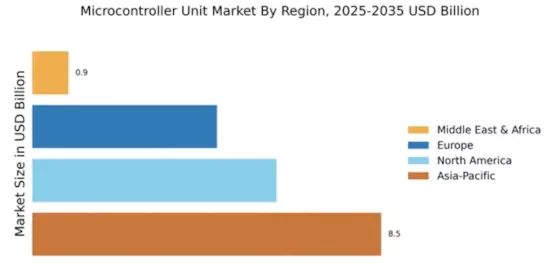
In the top-down approach, the total MCU market size was determined during market breakdown and forecasts were made with inputs from industry experts and industry associations. A comprehensive study of the market has been made to understand the size, share and dynamics of the global MCU market. With the help of this research, the market size is approached in terms of regions such as North America, Europe, Latin America, Asia-Pacific, and the Middle East & Africa.
Factor Analysis
Factor analysis, a statistical method, is used to reduce the number of related factors. This research study covers macroeconomic factors such as population structure, total GDP, disposable income, purchasing power parity, consumer spending, investment pattern, industry structure, economic policies, and others. All these factors, along with their quantitative influence, are analyzed to obtain an overall view of the MCU industry.
Time-Series Analysis
Time-series analysis is conducted to understand the demand and supply-side trends of the global MCU market. Historical and forecast-based trends are estimated to determine the market growth rate over the forecast period. Historical trends of the MCU market are studied in the current report covering calendar years from 2024 to 2032.
Demand-side and Supply-side Data Triangulation
In this research method, both demand-side and supply-side approaches are employed to estimate the total market size. The demand-side approach is employed by estimating the total sales of various types of products in the MCU market. For this evaluation, a detailed analysis of the sales of different types of products in the MCU market is conducted. With the help of this evaluation, an understanding of the overall sales of the different types of products in the MCU market is obtained. The supply-side analysis involves a study of the total number of vendors, region-wise sales of products and services, and end-user industries. Through this method, the company’s products and services, distributors, and clients from various regions are studied and the sales of products and services are estimated for each region.
Data Synthesis
Based on the data collected through both primary and secondary sources, the market size has been estimated for each of the segments and sub-segments of the global MCU market. Accurate calculations and output are made through the method of data triangulation. The market numbers have been estimated based on the sales and delivery of the product across different countries. Additionally, a detailed analysis of market dynamics such as drivers, restraints, trends, and opportunities is included in the report.