Microcrystalline Cellulose MCC Market (2026 - 2035)

Microcrystalline Cellulose Market Research Report Information By Source (Wood Based, and Non-wood Based), By End Users Industry Pharmaceuticals, Food & Beverages, and Cosmetic & Personal Care), And By Region (North America, Europe, Asia-Pacific, And Rest Of The World) โ€“ Market Forecast Till 2035
ID: MRFR/CnM/4165-CR
111 Pages
Chitranshi Jaiswal
Last Updated: July 12, 2026
Microcrystalline Cellulose MCC Market
Market Size
Forecast Period2026-2035
CAGR (2026-2035)6.85%
2025 Market SizeUSD 1.46 Billion
2035 Market SizeUSD 2.72 Billion
Key Players
DuPont de Nemours
JRS Pharma
Asahi Kasei Corporation
Mingtai Chemical Co., Ltd.
Accent Microcell Pvt. Ltd.
Anhui Sunhere Pharmaceutical Excipients Co.
Opportunities
  • Non-Wood Feedstock Commercialization
  • Pharmaceutical Co-Processed Excipient Development
  • Clean-Label Food Stabilizers in Emerging Markets

Microcrystalline Cellulose MCC Market Summary

The Microcrystalline Cellulose Market was valued at USD 1.46 billion in 2025 and is projected to reach USD 1.54 billion in 2026 before climbing to USD 2.72 billion by 2035, registering a CAGR of 6.85% during the forecast period (2026โ€“2035). Sustained demand for pharmaceutical excipients in generic drug manufacturing across South and Southeast Asia, combined with tightening clean-label mandates under the EU's Farm to Fork Strategy, anchors the upward trajectory. Capital commitments exceeding USD 320 million toward cellulose processing capacity expansions in India and China during 2024โ€“2025 underscore the commercial momentum behind purified cellulose supply chains [2][3].

A fundamental shift is underway in how cellulose powder is produced and utilized. Legacy batch acid-hydrolysis lines โ€” long the workhorse for tablet binding agents โ€” are steadily giving way to continuous steam-explosion and enzyme-mediated processes that cut energy consumption by 25โ€“30% and reduce chemical waste streams [4]. The European Chemicals Agency's updated REACH dossier for MCC powder grades, finalized in late 2024, has accelerated this transition by rewarding low-emission processing with expedited registration pathways [5].

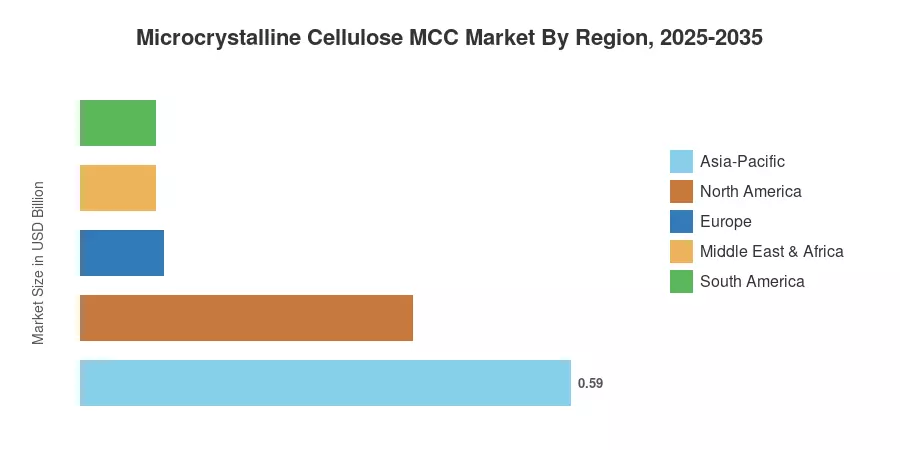
Asia-Pacific commands roughly 40.12% of the Microcrystalline Cellulose Market, making it both the largest and fastest-growing region at a projected 7.38% CAGR through 2035. North America holds the second-largest share at approximately 27.5%, buoyed by strong demand for dietary supplement ingredients and functional food additives across the United States. Europe follows closely, driven by the adoption of cosmetics-grade cellulose-based excipients. The next decade will see non-wood feedstock sources โ€” cotton linters, bamboo, agricultural residues โ€” reshape the competitive supply map as sustainability pressures intensify [6].

ย 

Key Report Takeaways

โ€ข By Source

  • Wood-based sources dominated the Microcrystalline Cellulose Market with a 61.34% revenue share in 2025, reflecting deep integration with established pharmaceutical ingredients supply chains
  • Non-wood-based alternatives are forecast to expand at a 7.58% CAGR through 2035, driven by agro-residue feedstock availability and rising demand for sustainable cellulose powder

โ€ข By Process

  • Acid hydrolysis captured the leading position in the Microcrystalline Cellulose Market in 2025, valued at approximately USD 0.58 billion
  • Steam explosion is set to register a 7.32% CAGR to 2035, as food stabilizers producers seek energy-efficient processing routes

โ€ข By End-User Industry

  • Pharmaceuticals accounted for 46.10% of the Microcrystalline Cellulose Market in 2025, with tablet binding agents representing the largest single application category
  • Cosmetics exhibit the fastest end-user growth at 7.52% CAGR, fueled by clean-beauty formulations requiring plant-derived rheology modifiers

โ€ข By Region

  • Asia-Pacific led the Microcrystalline Cellulose Market with 40.12% revenue share in 2025
  • North America held approximately USD 0.40 billion in 2025 market value, anchored by dietary supplement ingredients demand

ย 

Market Size and Forecast (2021โ€“2035)

Market Research Future (MRFR)'s proprietary estimation framework synthesizes primary interviews with cellulose powder producers, pharmaceutical excipients distributors, and food stabilizers blenders alongside secondary data from trade associations, regulatory filings, and company annual reports. Historical figures (2021โ€“2024) reflect actual reported revenues; base-year 2025 combines preliminary earnings disclosures with supply-side production data. Forecast projections (2026โ€“2035) apply a compound growth model validated against macroeconomic indicators and end-user capacity expansion pipelines.
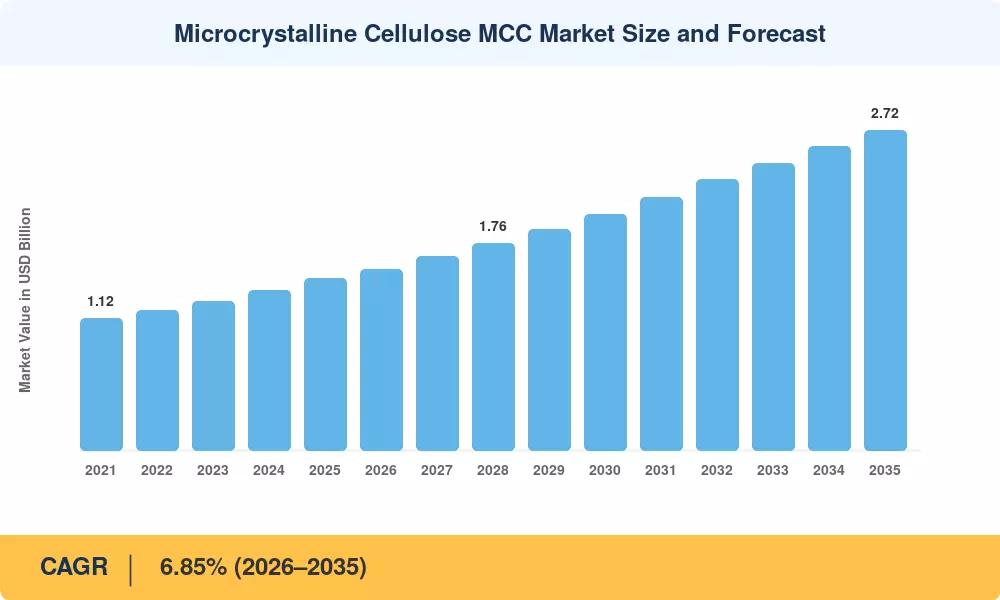
Microcrystalline Cellulose MCC Market Size and Forecast
Our Impact
Enabled $4.3B Revenue Impact for Fortune 500 and Leading Multinationals
Partnering with 2000+ Global Organizations Each Year
30K+ Citations by Top-Tier Firms in the Industry

Driver Impact Analysis

Driver ~% Impact on CAGR Geographic Relevance Impact Timeline
Generic pharmaceutical expansion in emerging markets ~22% Asia-Pacific, South America Short-term (โ‰ค2 yr)
Clean-label food reformulation mandates ~18% Europe, North America Medium-term (2โ€“4 yr)
Natural cosmetics and personal care growth ~16% Europe, Asia-Pacific Medium-term (2โ€“4 yr)
Energy-efficient processing technology adoption ~14% Global Long-term (โ‰ฅ4 yr)
Dietary supplement ingredient diversification ~12% North America, Asia-Pacific Short-term (โ‰ค2 yr)
Biodegradable packaging and excipient innovation ~10% Europe, North America Long-term (โ‰ฅ4 yr)
Agricultural residue feedstock incentives ~8% Asia-Pacific, South America Medium-term (2โ€“4 yr)

ย 

Generic Pharmaceutical Expansion in Emerging Markets

India's Department of Pharmaceuticals allocated INR 3,000 crore (approximately USD 360 million) under the Production Linked Incentive Scheme Phase II to boost domestic formulation output through 2028, directly lifting demand for pharmaceutical excipients, including microcrystalline cellulose grades used as tablet binding agents [2]. Contract manufacturing organizations in Hyderabad and Ahmedabad added over 14 billion tablet units of annual capacity during 2023โ€“2024, with purified cellulose constituting roughly 15โ€“20% of typical tablet weight. The Microcrystalline Cellulose Market benefits as these facilities lock in multi-year supply agreements with domestic and international cellulose powder suppliers [3].

Clean-Label Food Reformulation Mandates

Regulation (EU) 2024/1837 of the European Commission's revised food additive transparency regulations mandates that producers substitute organically derived stabilizers for synthetic stabilizers in certain product categories by January 2027 [5]. Microcrystalline cellulose, which is categorized as E460(i), has the potential to increase in volume as food stabilizer formulators replace synthetic emulsifiers and modified starches. According to industry estimates, the reformulation wave might increase demand for cellulose-based excipients in the EU food sector alone by USD 85โ€“110 million by 2030 [12].

Natural Cosmetics and Personal Care Growth

Plant-derived texturizers and functional food additives are progressively finding their way into personal care applications, with global clean-beauty retail sales surpassing USD 48 billion in 2024. Synthetic silica is being replaced by MCC powder types that are designed for oil absorption and viscosity control in sunscreen formulas, pressed powders, and foundations. Due to L'Orรฉal's 2024 Green Sciences pledge to source 95% bio-based ingredients by 2030, its contract manufacturers are now qualifying new sources of medicinal ingredients that can produce cosmetics-grade pure cellulose on a large scale [13].

Energy-Efficient Processing Technology Adoption

Steam-explosion and reactive extrusion lines consume 30โ€“35% less electricity per metric ton than conventional acid-hydrolysis systems, according to a 2024 lifecycle assessment published by the European Cellulose Research Institute [4]. Capital expenditure for a 10,000 MT/year steam-explosion facility runs approximately USD 18โ€“22 million โ€” roughly 40% less than an equivalent acid-hydrolysis plant โ€” making the technology accessible to mid-tier cellulose powder producers in Southeast Asia and Latin America. The Microcrystalline Cellulose Market will see process-mix shifts accelerate as carbon-pricing mechanisms in the EU and Canada increase operating costs for legacy lines [14].

ย 

Restraints Impact Analysis

The restraint impacts below follow the same directional methodology as Section 4. Negative percentages indicate estimated drag on overall Microcrystalline Cellulose Market growth rates.

Restraint ~% Drag on CAGR Geographic Relevance Impact Timeline
Volatile wood-pulp feedstock pricing ~โ€“18% Global Short-term (โ‰ค2 yr)
Stringent dust-emission and occupational safety regulations ~โ€“14% Europe, North America Medium-term (2โ€“4 yr)
Competition from alternative excipients (HPMC, starch) ~โ€“12% Global Long-term (โ‰ฅ4 yr)
High capital cost for GMP-grade facility certification ~โ€“10% South America, MEA Medium-term (2โ€“4 yr)
Currency volatility in key export markets ~โ€“8% Asia-Pacific, South America Short-term (โ‰ค2 yr)

ย 

Volatile Wood-Pulp Feedstock Pricing

Between 2023 and 2024, the price of dissolving-grade wood pulp varied between USD 920 and USD 1,340 per metric ton due to Indonesian export limitations on plantation hardwood and Canadian wildfire disruptions [15]. Manufacturers of cellulose powder who rely on 12- to 24-month fixed-price contracts for the supply of pharmaceutical excipients find their margins compressed by this volatility. During price spikes, producers without backward-integrated pulp facilities see margin erosion of 200โ€“350 basis points, which restricts their ability to reinvest and slows the growth trajectory of the microcrystalline cellulose market in cost-sensitive segments [15][19].

Dust-Emission and Occupational Safety Regulations

The U.S. Occupational Safety and Health Administration's revised Permissible Exposure Limit for cellulose dust (reduced from 15 mg/mยณ to 10 mg/mยณ total dust in 2024) requires plant operators to install upgraded filtration and containment systems costing USD 1.2โ€“2.5 million per production line [16]. European ATEX Directive compliance adds further capital burden for MCC powder handling and packaging areas. These requirements disproportionately affect smaller tablet binding agent suppliers who lack the scale to amortize compliance costs, potentially accelerating market consolidation but dampening short-term capacity additions [16].

Competition from Alternative Excipients

Pre-gelatinized starch and hydroxypropyl methylcellulose (HPMC) continue to gain popularity in controlled-release formulations, where formulators of medicinal components need particular dissolving profiles that are difficult for purified cellulose to match [17]. Between 2021 and 2024, HPMC's global share in oral solid dose excipient blends increased from 18% to 22%. The microcrystalline cellulose market faces substitution risk in specialty dosage forms that attract greater margins, even if microcrystalline cellulose continues to dominate the immediate-release tablet market [17].

ย 

Microcrystalline Cellulose MCC Market Opportunities

Non-Wood Feedstock Commercialization

Cotton linters, bamboo residue, and sugarcane bagasse present cost-competitive alternatives to dissolving-grade wood pulp, particularly in Asia-Pacific and South America, where agricultural byproducts are abundant. India's National Bamboo Mission has earmarked USD 150 million through 2027 for industrial bamboo processing, creating feedstock pipelines that cellulose powder producers can tap at 20โ€“30% lower raw-material cost than imported hardwood pulp [6].

Pharmaceutical Co-Processed Excipient Development

Co-processed blends combining microcrystalline cellulose with lactose, croscarmellose, or colloidal silicon dioxide streamline tablet manufacturing by reducing blending steps from four to one. Patent filings for co-processed pharmaceutical excipients increased 38% year-over-year in 2024, signaling a strong innovation runway. Producers who invest in application laboratories and regulatory dossier support will capture premium pricing in the Microcrystalline Cellulose Market [17].

Clean-Label Food Stabilizers in Emerging Markets

Packaged food consumption in Southeast Asia and Sub-Saharan Africa is growing at 8โ€“10% annually, yet clean-label penetration remains below 15% As local regulators adopt Codex Alimentarius standards for food stabilizers, demand for E460(i)-grade cellulose-based excipients will accelerate. Early movers who establish local grinding and grading facilities near consumption centers gain logistics advantages over imported functional food additives [12].

Sustainable Cosmetics-Grade MCC Powder

The global natural cosmetics segment is projected to surpass USD 58 billion by 2028, with formulators actively seeking plant-derived alternatives to synthetic fillers MCC powder grades with controlled particle-size distribution (10โ€“50 ยตm) offer oil-absorption and mattifying properties that compete directly with talc and synthetic silica. Dietary supplement ingredients producers can leverage existing GMP infrastructure to cross-qualify cosmetics-grade output, unlocking dual-revenue streams[13].

Digital Quality Assurance and Data Monetization

Real-time near-infrared spectroscopy and AI-driven particle-size monitoring are enabling cellulose powder producers to offer batch-level digital quality certificates โ€” a capability pharmaceutical excipients buyers increasingly require under the FDA's Data Integrity Guidance Monetizing process analytics data through subscription-based quality platforms represents a new revenue model for the Microcrystalline Cellulose Market that extends beyond commodity cellulose sales [20].

ย 

Microcrystalline Cellulose MCC Market Future Outlook

AI-Driven Process Optimization and Quality Assurance

Artificial intelligence and machine learning are transforming cellulose powder production from batch-dependent to predictive-quality operations. Real-time particle-size distribution monitoring using computer vision and NIR spectroscopy reduces off-spec batch rates by 15โ€“20%, according to a 2025 Fraunhofer Institute pilot study [20]. The Microcrystalline Cellulose Market will see AI-enabled quality platforms become a competitive differentiator, particularly for pharmaceutical excipient suppliers serving regulated markets where batch rejection costs exceed USD 50,000 per incident [20].

Circular Bioeconomy and Feedstock Diversification

The OECD's 2025 Bio-Innovation Outlook projects global bio-based chemical production to reach USD 500 billion by 2032, with cellulose derivatives among the fastest-growing segments [9]. Agricultural residue-to-cellulose conversion pathways โ€” rice straw in Vietnam, corn stover in the U.S. Midwest, wheat straw in Punjab โ€” offer carbon-negative feedstock options that align with Scope 3 emission reduction targets. Functional food additives and dietary supplement ingredients producers with verified circular supply chains will command 8โ€“12% pricing premiums in the Microcrystalline Cellulose Market [9][14].

Regulatory Convergence and Harmonized Excipient Standards

ICH Q3D(R2) guidelines on elemental impurities and the Pharmaceutical Inspection Co-operation Scheme's expanded scope for excipient GMP audits are driving global harmonization of purified cellulose quality requirements [21]. By 2030, Market Research Future (MRFR) estimates that 75% of cross-border pharmaceutical excipients trade will operate under mutually recognized quality frameworks, reducing duplicative testing costs by USD 120โ€“180 million annually. This convergence lowers barriers for mid-tier cellulose powder producers in India and China to access EU and North American markets [21].

Sustainability Reporting and ESG-Linked Procurement

Pharmaceutical and food multinationals are embedding ESG metrics into excipient procurement scorecards. Unilever's 2024 Sustainable Sourcing Code requires all food stabilizer suppliers to report water intensity, energy consumption, and dust-emission data by 2027 [22]. The Microcrystalline Cellulose Market will increasingly stratify between producers who invest in environmental monitoring and transparent reporting versus those who compete solely on price. Carbon-neutral MCC powder certification programs, modeled on ISCC PLUS, are expected to emerge by 2028โ€“2029, creating a premium tier for pharmaceutical ingredients buyers with published sustainability commitments [22].

ย 

Microcrystalline Cellulose MCC Market Segmentation

By Source

Segment Key Metric Primary Demand Driver
Wood-Based 61.34% revenue share (2025) Established dissolving-pulp supply chains for pharmaceutical excipients
Non-Wood-Based 7.58% CAGR (2026โ€“2035) Bamboo, cotton linter, and bagasse feedstock availability

ย 

The Microcrystalline Cellulose Market remains anchored by wood-based sources, where Scandinavian and North American dissolving-pulp mills supply the bulk of pharmaceutical-grade cellulose powder. Hardwood species (birch, eucalyptus) dominate due to their consistent alpha-cellulose content above 92%, which translates into predictable tablet binding agent performance and narrow particle-size distributions. Established Drug Master File registrations further entrench wood-based purified cellulose as the default choice for regulated pharmaceutical ingredients applications.

Non-wood-based microcrystalline cellulose is gaining traction as sustainability mandates and feedstock economics converge. India's National Bamboo Mission and Brazil's sugarcane bagasse processing incentives reduce raw-material costs by 20โ€“30% relative to imported hardwood pulp, making non-wood cellulose-based excipients cost-competitive in price-sensitive food stabilizers and dietary supplement ingredients segments. Cotton linter-derived MCC powder also offers distinct morphological properties valued in cosmetics formulations [6][9].

By Process

Segment Key Metric Primary Demand Driver
Acid Hydrolysis USD 0.58 Billion (2025) Dominant legacy process for pharmaceutical excipients production
Steam Explosion 7.32% CAGR (2026โ€“2035) Energy efficiency and reduced chemical waste
Enzyme Mediated USD 0.12 Billion (2025) Mild processing for specialty functional food additives
Reactive Extrusion 6.48% CAGR (2026โ€“2035) Continuous processing for high-volume cellulose powder

ย 

Acid hydrolysis remains the Microcrystalline Cellulose Market's predominant processing route, with decades of regulatory validation and optimized operating parameters for pharmaceutical-grade output. Major purified cellulose producers operate acid-hydrolysis plants at 85โ€“90% utilization rates, reflecting steady demand for established tablet binding agent specifications. Process improvements focus on acid recovery and recycling systems that reduce hydrochloric acid consumption by 15โ€“18% per batch cycle [4].

Steam explosion is the fastest-growing process segment, attracting capital from producers seeking to lower energy costs and meet tightening dust-emission thresholds. A single steam-explosion line can achieve 30% higher throughput than an equivalent acid-hydrolysis system while consuming 25% less electricity, according to the European Cellulose Research Institute [4]. This efficiency advantage is particularly compelling for food stabilizers and cosmetics-grade MCC powder production, where purity requirements are stringent, but chemical residue tolerances are tighter than in pharmaceutical excipient applications [14].

By End-User Industry

Segment Key Metric Primary Demand Driver
Pharmaceutical 46.10% revenue share (2025) Tablet binding agents for generic and OTC formulations
Food USD 0.28 Billion (2025) Clean-label food stabilizers and functional food additives
Cosmetics 7.52% CAGR (2026โ€“2035) Plant-derived texturizers replacing synthetic fillers
Other End-User Industries 5.45% CAGR (2026โ€“2035) Agricultural feed additives; industrial filtration

ย 

Pharmaceuticals anchor the Microcrystalline Cellulose Market, with purified cellulose serving as the most widely used filler-binder in oral solid dosage manufacturing globally. Over 65% of immediate-release tablet formulations list microcrystalline cellulose as a primary pharmaceutical excipient component, a position reinforced by extensive regulatory acceptance and decades of clinical safety data. Growth in this segment tracks closely with generic drug approval rates, which the FDA reported at 1,011 ANDA approvals in fiscal year 2024 [2][10].

The food sector absorbs growing quantities of cellulose-based excipients as clean-label reformulation reshapes packaged food ingredient lists. E460(i)-grade MCC serves as an anti-caking agent, fat replacer, and dietary fiber source in products ranging from shredded cheese to low-calorie baked goods. Dietary supplement ingredients manufacturers also drive incremental demand, using cellulose powder as a capsule filler and flow aid in vitamin and mineral formulations [12].

ย 

Regional Market Share Analysis

Region Key Metric Primary Investment Themes
Asia-Pacific 40.12% revenue share (2025) Generic pharma expansion; bamboo feedstock development
North America USD 0.40 Billion (2025) Dietary supplement ingredients; co-processed excipients
Europe 6.58% CAGR (2026โ€“2035) Clean-label food reformulation; cosmetics-grade MCC powder
South America USD 0.09 Billion (2025) Sugarcane bagasse feedstock; food stabilizers adoption
Middle East & Africa 5.92% CAGR (2026โ€“2035) Pharmaceutical localization; halal-certified excipients
Total USD 1.46 Billion (2025) โ€”

The Microcrystalline Cellulose Market exhibits clear regional concentration, with Asia-Pacific and North America collectively accounting for roughly two-thirds of global revenues. Regional dynamics are shaped by pharmaceutical manufacturing density, food-processing industry maturity, and regulatory frameworks governing purified cellulose use in consumer products[6].

ย 

North America

Country Key Metric Key Driver
United States 78.5% of regional share Dietary supplement ingredients demand: FDA excipient guidance
Canada 5.85% CAGR Natural health product regulations
Mexico USD 0.02 Billion Generic pharma manufacturing growth

ย 

The United States drives North American demand for pharmaceutical excipients through its expansive generic drug and over-the-counter supplement manufacturing base. FDA's 2024 guidance on excipient qualification (Draft Guidance for Industry: Inactive Ingredient Database Updates) has prompted formulators to re-validate purified cellulose suppliers, creating switching-cost barriers that benefit established cellulose powder producers with robust Drug Master Files [10]. Canada's dietary supplement ingredients sector benefits from Health Canada's updated Natural Health Products Regulations, while Mexico's growing contract manufacturing presence lifts demand for tablet binding agents in the Microcrystalline Cellulose Market [10].

Europe

Country Key Metric Key Driver
Germany 24.8% of regional share Pharma and chemical excipient manufacturing hub
United Kingdom 6.72% CAGR Post-Brexit excipient re-registration demand
France USD 0.04 Billion Cosmetics-grade cellulose-based excipients
Italy 5.95% CAGR Food stabilizers for pasta and dairy sectors
Spain USD 0.02 Billion Functional food additives adoption
Nordic Countries 6.45% CAGR Sustainable pulp feedstock processing
Russia USD 0.01 Billion Domestic pharma self-sufficiency programs
Rest of Europe 5.80% CAGR Regional pharmaceutical ingredients distribution

ย 

Europe's Microcrystalline Cellulose Market benefits from the continent's dual strength in pharmaceutical manufacturing and natural cosmetics formulation. Germany's Pharma-Standort initiative channels EUR 2.1 billion into domestic active and inactive ingredient production through 2028, with purified cellulose suppliers among direct beneficiaries. The UK's Medicines and Healthcare products Regulatory Agency post-Brexit re-registration requirements have driven excipient qualification spending upward, while France's cosmetics sector absorbs growing volumes of MCC powder for clean-beauty formulations [5][12].

Asia-Pacific

Country Key Metric Key Driver
China 34.6% of regional share Domestic pharma and food processing scale
India 7.82% CAGR PLI scheme for pharma; bamboo feedstock
Japan USD 0.07 Billion High-purity pharmaceutical excipients standards
South Korea 6.90% CAGR K-beauty and functional food additives
ASEAN USD 0.06 Billion Generic pharma contract manufacturing
Rest of Asia-Pacific 6.55% CAGR Emerging cellulose powder processing capacity

ย 

Asia-Pacific's dominance in the Microcrystalline Cellulose Market stems from China's and India's combined pharmaceutical tablet output exceeding 400 billion units annually. India's PLI Scheme Phase II directly subsidizes formulation-grade purified cellulose procurement, while China's 14th Five-Year Plan for the pharmaceutical industry prioritizes domestic excipient self-sufficiency. South Korea's booming K-beauty industry and ASEAN's rapidly expanding generic pharma sector add supplementary growth vectors for cellulose-based excipients across the region [2][6].

South America

Country Key Metric Key Driver
Brazil 62.3% of regional share Sugarcane bagasse as a non-wood feedstock
Argentina 5.78% CAGR Food stabilizers in dairy processing
Rest of South America USD 0.01 Billion Early-stage pharmaceutical ingredients localization

ย 

Brazil's abundant sugarcane bagasse residue positions the country as a potential non-wood microcrystalline cellulose production hub. BNDES (Brazilian Development Bank) has approved credit lines totaling BRL 450 million for bio-based chemical processing facilities through 2027, with cellulose powder extraction from bagasse among eligible project categories. Argentina's growing dairy industry lifts demand for food stabilizers in yogurt and cheese applications within the Microcrystalline Cellulose Market [6][18].

Middle East & Africa

Country Key Metric Key Driver
Saudi Arabia 28.5% of regional share Vision 2030 Pharmaceutical Localization
UAE 6.18% CAGR Free-zone pharma manufacturing
South Africa USD 0.01 Billion Generic drug production for Sub-Saharan Africa
Egypt 5.72% CAGR Domestic food stabilizers demand
Rest of MEA USD 0.01 Billion Halal-certified pharmaceutical excipients

ย 

Saudi Arabia's National Industrial Development and Logistics Program (NIDLP) targets 40% domestic pharmaceutical production by 2030, necessitating localized supply chains for tablet binding agents and other purified cellulose grades. The UAE's JAFZA and KIZAD free zones have attracted three pharmaceutical excipient distributors since 2023, establishing regional stockholding for MCC powder grades. South Africa's generic drug manufacturing sector serves as the distribution gateway for cellulose-based excipients into broader Sub-Saharan markets [18].

ย 

Microcrystalline Cellulose MCC Market By Region, 2025-2035

Competitive Benchmarking

The Microcrystalline Cellulose Market exhibits moderate concentration, with the top five producers collectively holding an estimated 48โ€“55% revenue share and an approximate Herfindahl-Hirschman Index of 850โ€“1,050. Competition centers on process efficiency, regulatory dossier breadth (Drug Master Files and food-grade certifications), and geographic proximity to major pharmaceutical excipients consumption clusters. Vertical integration into dissolving-pulp sourcing provides cost advantages, while application-laboratory capabilities and technical service differentiate cellulose powder suppliers in co-processed excipient development[11].

Company Est. Revenue Share Range Key Offerings for Microcrystalline Cellulose Market Strategic Positioning
DuPont de Nemours (IFF Pharma Solutions) ~10โ€“14% Avicelยฎ PH series; co-processed pharmaceutical excipients Global leader in pharma-grade purified cellulose; broadest DMF portfolio
JRS Pharma (J. Rettenmaier & Sรถhne) ~8โ€“12% VIVAPURยฎ and EMCOCELยฎ ranges; food stabilizers grades Vertically integrated European producer; strong food and pharma dual positioning
Asahi Kasei Corporation ~7โ€“10% CEOLUSยฎ pharmaceutical and food grades Japanese quality benchmark; Asia-Pacific distribution strength
Mingtai Chemical Co., Ltd. ~5โ€“8% Pharma and food-grade cellulose powder Cost-competitive Taiwanese producer; strong ASEAN market presence
Accent Microcell Pvt. Ltd. ~4โ€“7% Pharma-grade MCC powder; dietary supplement ingredients grades Leading Indian producer; PLI scheme beneficiary
Anhui Sunhere Pharmaceutical Excipients Co. ~4โ€“6% Pharmaceutical excipients and functional food additives Chinese domestic market leader; scale-driven pricing
Sigachi Industries Limited ~3โ€“5% SIGCELยฎ tablet binding agents and food-grade cellulose Indian mid-cap with rapid capacity expansion
Blanver Farmoquรญmica ~2โ€“4% Microcelยฎ pharma excipients; South American distribution Brazilian producer leveraging sugarcane-region logistics
Wei Ming Pharmaceutical ~2โ€“4% Pharmaceutical-grade purified cellulose Chinese producer with a growing export footprint
Avantor (formerly VWR/Amresco) ~2โ€“3% Lab and pharma-grade cellulose-based excipients Distribution-led model; broad excipient portfolio bundling

ย 

ย 

Recent News & Developments

ย 

ย 

ย 

ย 

  • IFF Inc. (September 2023): Launched Avicelยฎ PH LN, a low-nitrile microcrystalline cellulose line designed to reduce nitrosamine formation risks in oral drug formulations and meet stricter international regulatory standards.[Ref 5].
  • Roquette Frรจres S.A. (March 2025): Cleared anti-trust approval from the Competition Commission of India to acquire IFFโ€™s Pharma Solutions division, integrating their global microcrystalline cellulose business to consolidate its pharmaceutical excipient market share.[Ref 2].
  • Nordic Bioproducts Group (February 2026): Partnered with Atlantic Chemicals Trading (ACT) Group for an international distribution agreement to commercialize and scale its plant-based, sustainably produced PURA Seriesโ„ข microcrystalline cellulose globally.[Ref 6].

ย 

Microcrystalline Cellulose MCC Market Report Scope

Parameter Details
Market Scope Global Microcrystalline Cellulose Market by Source, Process, End-User Industry, and Geography
Study Period 2021โ€“2035
CAGR (Forecast Period) 6.85% (2026โ€“2035)
Market Size โ€” 2025 (Base Year) USD 1.46 Billion
Market Size โ€” 2035 (Forecast End) USD 2.72 Billion
Fastest Growing Segment Cosmetics (by end-user); Non-Wood-Based (by source); Steam Explosion (by process)
Companies Profiled 10 (DuPont/IFF, JRS Pharma, Asahi Kasei, Mingtai Chemical, Accent Microcell, Anhui Sunhere, Sigachi Industries, Blanver, Wei Ming, Avantor)
Valuation Currency USD Billion

ย 

ย 

FAQs

What particle-size grades of microcrystalline cellulose are most commonly specified in pharmaceutical tablet formulations?
Grades between 50 ยตm and 100 ยตm (such as NF Grade PH-102) dominate immediate-release tablet binding agents applications due to optimal compressibility and flow characteristics. Finer grades below 50 ยตm serve orally disintegrating tablets [17].
How does the Microcrystalline Cellulose Market differentiate between food-grade and pharma-grade MCC powder?
Pharma-grade purified cellulose requires Drug Master File registration and meets USP/NF monograph specifications for heavy-metal limits. Food-grade cellulose powder follows E460(i) purity standards with less stringent documentation [10][12].
What shelf-life considerations affect cellulose powder procurement decisions?
Properly stored MCC powder maintains stability for 36โ€“60 months under controlled humidity (<60% RH). Moisture uptake above 7% w/w degrades compactibility, making climate-controlled warehousing essential for tropical markets [17].
How do co-processed excipients impact the Microcrystalline Cellulose Market pricing structure?
Co-processed blends of cellulose-based excipients with lactose or croscarmellose command 30โ€“45% price premiums over standard grades. Manufacturers justify this through reduced blending steps and faster tableting speeds [17].
What regulatory pathway applies to switching microcrystalline cellulose suppliers in an approved drug product?
Supplier changes for pharmaceutical excipients typically require a post-approval change supplement (SUPAC Level 1 or 2) demonstrating equivalent particle size, moisture content, and compressibility. Timelines range from 4 to 12 months [21].
How does the Microcrystalline Cellulose Market address halal and kosher certification requirements?
Wood-based purified cellulose inherently meets halal and kosher criteria, but processors must obtain facility-level certification from recognized bodies. Non-wood grades from animal-adjacent feedstocks require additional traceability audits [18].
What role does the Microcrystalline Cellulose Market play in 3D-printed pharmaceutical dosage forms?
MCC powder serves as a printable matrix in binder-jetting and semi-solid extrusion 3D printing of tablets. Early-stage clinical trials demonstrate acceptable dissolution profiles, though commercial scale remains limited to personalized medicine applications [20]. ย  ย 
Author
Author
Author Profile
Chitranshi Jaiswal LinkedIn
Team Lead - Research
Chitranshi is a Team Leader in the Chemicals & Materials (CnM) and Energy & Power (EnP) domains, with 6+ years of experience in market research. She leads and mentors teams to deliver cross-domain projects that equip clients with actionable insights and growth strategies. She is skilled in market estimation, forecasting, competitive benchmarking, and both primary & secondary research, enabling her to turn complex data into decision-ready insights. An engineer and MBA professional, she combines technical expertise with strategic acumen to solve dynamic market challenges. Chitranshi has successfully managed projects that support market entry, investment planning, and competitive positioning, while building strong client relationships. Certified in Advanced Excel & Power BI she leverages data-driven approaches to ensure accuracy, clarity, and impactful outcomes.

Research Approach

Research methodology on Microcrystalline Cellulose Market

Microcrystalline Cellulose (MCC) Market research is an in-depth study of the macroeconomic, microeconomic, and market trends that are expected to affect the current and future market development. The primary research study involved an extensive review of key industry documents and journals, secondary research and interviews with industry experts to gain greater insight into the industry. In order to identify the microcrystalline cellulose market, data is collected from public sources such as trade websites, investor relations websites, and subject-specific databases. An industry survey conducted within the research period gathered, on a case-by-case basis, feedback from key stakeholders to obtain an accurate view of the current and future market dynamics.

The main objective of this research study is to analyze the market dynamics and factors related to the global microcrystalline cellulose market. The next aim is to forecast the microcrystalline cellulose market size, both in terms of volume and value, for the 2023-2030 period. In order to obtain an accurate estimation for the period considered, an array of secondary sources such as market reports, conference materials, magazines, and trade reports from industry participants are crucial.

Primary Research

Primary research is conducted as a key part of this study. It is used to validate market estimates and make certain that data is collected accurately and reliably. Interviews are conducted with industry stakeholders such as industry analysts, consultants, and researchers to collect information and insights into the market. The collected data is validated and documented with the help of industry diagrams and charts, allowing the authors to make detailed analyses of the microcrystalline cellulose market.

Secondary Research

Secondary research is conducted to support the primary research and understand the market dynamics. Extensive data is collected through national and international databases, company websites and annual reports, trade magazines, and press releases. Secondary research also facilitates the validation of assumptions, forecasts, and data from primary research.

Market Segmentation

The Microcrystalline Cellulose market is segmented based on sources, applications, and regions.

Sources:

Based on sources, the market is segmented into pulp, wood fibre, cotton fibre, and other sources.

Applications:

The market is segmented on the basis of pharmaceuticals, personal care, building materials, and other applications.

Regions:

The market is segmented into North America, Europe, the Asia-Pacific region, and the Rest of the World.

For each market segment, corresponding forecasts are made based on the analysis of current market trends and future prospects. Furthermore, data from secondary sources is used as a basis for the segmentation analysis.

Data Collection and Analysis

The data for this research study is collected from key industry sources, interviews with industry experts, and databases such as LexisNexis, Factiva, and Bloomberg. The research data is then collected, organized, and analyzed using specific techniques in order to arrive at market forecasts and trends. The data is collected from both primary and secondary sources.

The data is then presented in a descriptive format that could be easily interpreted and understood. The research data is tabulated and plotted onto graphical representations such as bar graphs and pie charts. Data validation is conducted by running interviews with experts in the industry through personal interviews and in group settings. This enables the authors to obtain an additional view of the market and to account for any discrepancies in the data.

Finally, the data is tested for accuracy and reliability in order to make actionable conclusions, based on the collected data and research observations. The collected data is then validated through independent data collection and triangulation methodology.

Download Free Sample

Kindly complete the form below to receive a free sample of this Report

Download PDF ×

We do not share your information with anyone. However, we may send you emails based on your report interest from time to time. You may contact us at any time to opt-out.