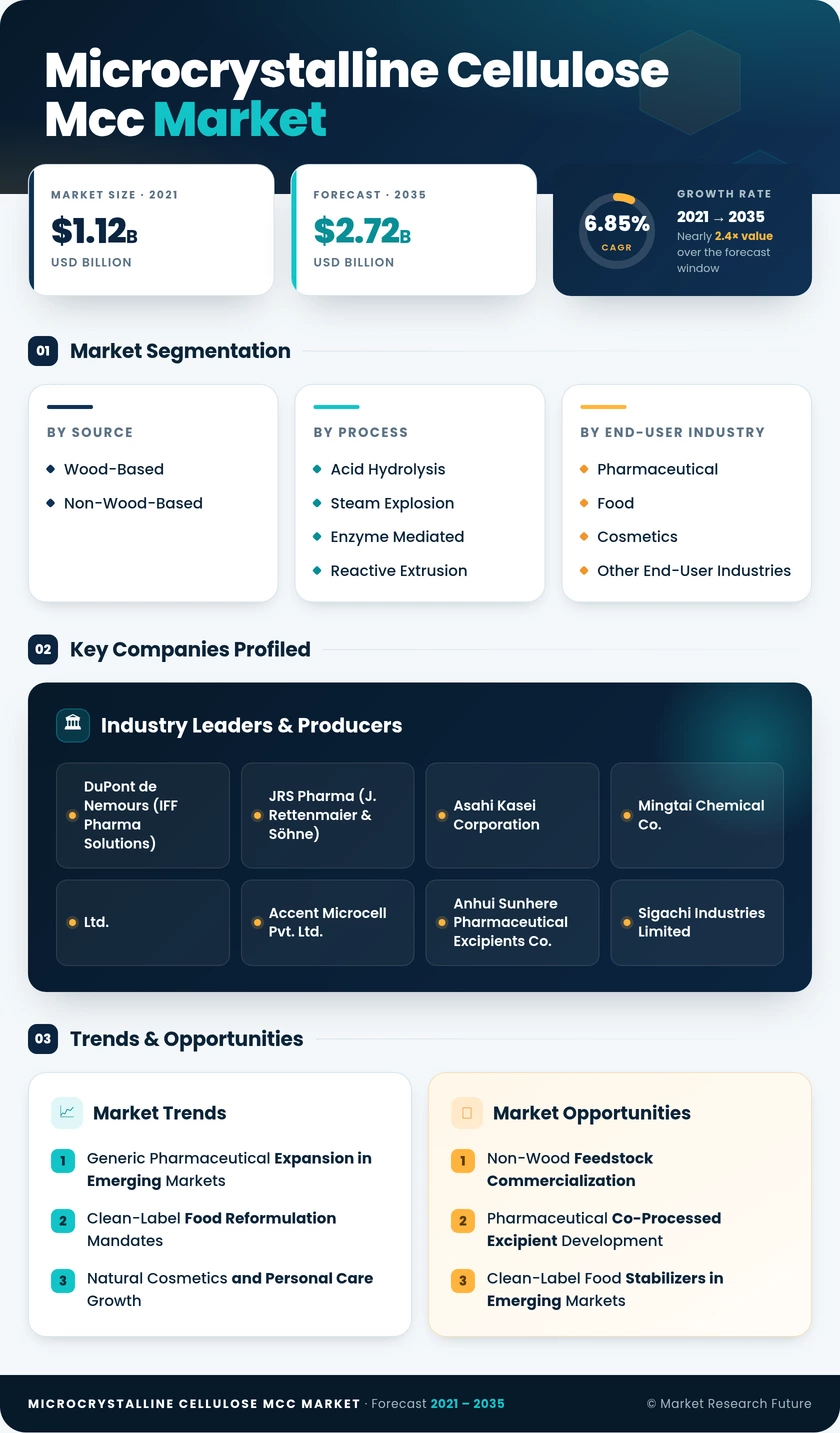
Microcrystalline Cellulose MCC Market (2026 - 2035)

ID: MRFR/CnM/4165-CR
111 Pages
Chitranshi Jaiswal
Last Updated: July 12, 2026
Microcrystalline Cellulose Market Research Report Information By Source (Wood Based, and Non-wood Based), By End Users Industry Pharmaceuticals, Food & Beverages, and Cosmetic & Personal Care), And By Region (North America, Europe, Asia-Pacific, And Rest Of The World) – Market Forecast Till 2035
Microcrystalline Cellulose MCC Market
Market Size
Forecast Period2026-2035
CAGR (2026-2035)6.85%
2025 Market SizeUSD 1.46 Billion
2035 Market SizeUSD 2.72 Billion
Key Players
DuPont de Nemours
JRS Pharma
Asahi Kasei Corporation
Mingtai Chemical Co., Ltd.
Accent Microcell Pvt. Ltd.
Anhui Sunhere Pharmaceutical Excipients Co.
Opportunities
  • Non-Wood Feedstock Commercialization
  • Pharmaceutical Co-Processed Excipient Development
  • Clean-Label Food Stabilizers in Emerging Markets
  1. 1 Market Overview |
    1. 1.1 Study Assumptions & Market Definition |
    2. 1.2 Scope of the Study |
    3. 1.3 Research Methodology
  2. 2 Market Summary & Key Takeaways
  3. 3 Market Dynamics |
    1. 3.1 Market Drivers Analysis | |
      1. 3.1.1 Generic Pharmaceutical Expansion in Emerging Markets | |
      2. 3.1.2 Clean-Label Food Reformulation Mandates | |
      3. 3.1.3 Natural Cosmetics and Personal Care Growth | |
      4. 3.1.4 Energy-Efficient Processing Technology Adoption | |
      5. 3.1.5 Dietary Supplement Ingredient Diversification | |
      6. 3.1.6 Biodegradable Packaging and Excipient Innovation | |
      7. 3.1.7 Agricultural Residue Feedstock Incentives |
    2. 3.2 Market Restraints Analysis | |
      1. 3.2.1 Volatile Wood-Pulp Feedstock Pricing | |
      2. 3.2.2 Stringent Dust-Emission and Occupational Safety Regulations | |
      3. 3.2.3 Competition from Alternative Excipients (HPMC, Starch) | |
      4. 3.2.4 High Capital Cost for GMP-Grade Facility Certification | |
      5. 3.2.5 Currency Volatility in Key Export Markets |
    3. 3.3 Market Opportunity Analysis | |
      1. 3.3.1 Non-Wood Feedstock Commercialization | |
      2. 3.3.2 Pharmaceutical Co-Processed Excipient Development | |
      3. 3.3.3 Clean-Label Food Stabilizers in Emerging Markets | |
      4. 3.3.4 Sustainable Cosmetics-Grade MCC Powder | |
      5. 3.3.5 Digital Quality Assurance and Data Monetization |
    4. 3.4 Industry Value Chain Analysis |
    5. 3.5 Porter's Five Forces Analysis
  4. 4 Global Microcrystalline Cellulose Market Size & Forecast (2021–2035) |
    1. 4.1 Historical Market Size (2021–2025) |
    2. 4.2 Current & Forecast Market Size (2026–2035) |
    3. 4.3 Market Size by Revenue (USD Billion) |
    4. 4.4 Year-over-Year Growth Analysis
  5. 5 Segmentation Analysis |
    1. 5.1 By Source | |
      1. 5.1.1 Wood-Based | |
      2. 5.1.2 Non-Wood-Based |
    2. 5.2 By Process | |
      1. 5.2.1 Acid Hydrolysis | |
      2. 5.2.2 Steam Explosion | |
      3. 5.2.3 Enzyme Mediated | |
      4. 5.2.4 Reactive Extrusion |
    3. 5.3 By End-User Industry | |
      1. 5.3.1 Pharmaceutical | |
      2. 5.3.2 Food | |
      3. 5.3.3 Cosmetics | |
      4. 5.3.4 Other End-User Industries
  6. 6 Regional Analysis |
    1. 6.1 North America | |
      1. 6.1.1 United States | |
      2. 6.1.2 Canada | |
      3. 6.1.3 Mexico |
    2. 6.2 Europe | |
      1. 6.2.1 Germany | |
      2. 6.2.2 United Kingdom | |
      3. 6.2.3 France | |
      4. 6.2.4 Italy | |
      5. 6.2.5 Spain | |
      6. 6.2.6 Nordic Countries | |
      7. 6.2.7 Russia | |
      8. 6.2.8 Rest of Europe |
    3. 6.3 Asia-Pacific | |
      1. 6.3.1 China | |
      2. 6.3.2 India | |
      3. 6.3.3 Japan | |
      4. 6.3.4 South Korea | |
      5. 6.3.5 ASEAN | |
      6. 6.3.6 Rest of Asia-Pacific |
    4. 6.4 South America | |
      1. 6.4.1 Brazil | |
      2. 6.4.2 Argentina | |
      3. 6.4.3 Rest of South America |
    5. 6.5 Middle East & Africa | |
      1. 6.5.1 Saudi Arabia | |
      2. 6.5.2 UAE | |
      3. 6.5.3 South Africa | |
      4. 6.5.4 Egypt | |
      5. 6.5.5 Rest of MEA
  7. 7 Competitive Landscape |
    1. 7.1 Market Share Analysis (2025) |
    2. 7.2 Competitive Benchmarking Matrix |
    3. 7.3 Company Profiles | |
      1. 7.3.1 DuPont de Nemours (IFF Pharma Solutions) | |
      2. 7.3.2 JRS Pharma (J. Rettenmaier & Söhne) | |
      3. 7.3.3 Asahi Kasei Corporation | |
      4. 7.3.4 Mingtai Chemical Co., Ltd. | |
      5. 7.3.5 Accent Microcell Pvt. Ltd. | |
      6. 7.3.6 Anhui Sunhere Pharmaceutical Excipients Co. | |
      7. 7.3.7 Sigachi Industries Limited | |
      8. 7.3.8 Blanver Farmoquímica | |
      9. 7.3.9 Wei Ming Pharmaceutical | |
      10. 7.3.10 Avantor
  8. 8 Future Outlook & Strategic Recommendations (2026–2035) |
    1. 8.1 AI-Driven Process Optimization and Quality Assurance |
    2. 8.2 Circular Bioeconomy and Feedstock Diversification |
    3. 8.3 Regulatory Convergence and Harmonized Excipient Standards |
    4. 8.4 Sustainability Reporting and ESG-Linked Procurement
  9. 9 Recent Developments & News
  10. 10 Frequently Asked Questions (FAQs)
  11. 11 Report Scope & Methodology |
    1. 11.1 Study Period & Base Year |
    2. 11.2 Data Sources & Citations |
    3. 11.3 Abbreviations
  12. 12 LIST OF TABLES |
  13. TABLE 1 Global Microcrystalline Cellulose Market Size & Forecast, by Revenue (USD Billion), 2021–2035 |
  14. TABLE 2 Global Microcrystalline Cellulose Market – Year-over-Year Growth Analysis, 2021–2035 |
  15. TABLE 3 Global Microcrystalline Cellulose Market – Driver Impact Analysis |
  16. TABLE 4 Global Microcrystalline Cellulose Market – Restraint Impact Analysis |
  17. TABLE 5 Global Microcrystalline Cellulose Market Size, by Source, 2021–2035 (USD Billion) |
  18. TABLE 6 Global Microcrystalline Cellulose Market Size, by Process, 2021–2035 (USD Billion) |
  19. TABLE 7 Global Microcrystalline Cellulose Market Size, by End-User Industry, 2021–2035 (USD Billion) |
  20. TABLE 8 Global Microcrystalline Cellulose Market Size, by Region, 2021–2035 (USD Billion) |
  21. TABLE 9 North America Microcrystalline Cellulose Market Size, by Country, 2021–2035 (USD Billion) |
  22. TABLE 10 Europe Microcrystalline Cellulose Market Size, by Country, 2021–2035 (USD Billion) |
  23. TABLE 11 Asia-Pacific Microcrystalline Cellulose Market Size, by Country, 2021–2035 (USD Billion) |
  24. TABLE 12 South America Microcrystalline Cellulose Market Size, by Country, 2021–2035 (USD Billion) |
  25. TABLE 13 Middle East & Africa Microcrystalline Cellulose Market Size, by Country, 2021–2035 (USD Billion) |
  26. TABLE 14 North America Microcrystalline Cellulose Market Size, by Source, 2021–2035 (USD Billion) |
  27. TABLE 15 North America Microcrystalline Cellulose Market Size, by Process, 2021–2035 (USD Billion) |
  28. TABLE 16 North America Microcrystalline Cellulose Market Size, by End-User Industry, 2021–2035 (USD Billion) |
  29. TABLE 17 Europe Microcrystalline Cellulose Market Size, by Source, 2021–2035 (USD Billion) |
  30. TABLE 18 Europe Microcrystalline Cellulose Market Size, by Process, 2021–2035 (USD Billion) |
  31. TABLE 19 Europe Microcrystalline Cellulose Market Size, by End-User Industry, 2021–2035 (USD Billion) |
  32. TABLE 20 Asia-Pacific Microcrystalline Cellulose Market Size, by Source, 2021–2035 (USD Billion) |
  33. TABLE 21 Asia-Pacific Microcrystalline Cellulose Market Size, by Process, 2021–2035 (USD Billion) |
  34. TABLE 22 Asia-Pacific Microcrystalline Cellulose Market Size, by End-User Industry, 2021–2035 (USD Billion) |
  35. TABLE 23 South America Microcrystalline Cellulose Market Size, by Source, 2021–2035 (USD Billion) |
  36. TABLE 24 South America Microcrystalline Cellulose Market Size, by Process, 2021–2035 (USD Billion) |
  37. TABLE 25 South America Microcrystalline Cellulose Market Size, by End-User Industry, 2021–2035 (USD Billion) |
  38. TABLE 26 Middle East & Africa Microcrystalline Cellulose Market Size, by Source, 2021–2035 (USD Billion) |
  39. TABLE 27 Middle East & Africa Microcrystalline Cellulose Market Size, by Process, 2021–2035 (USD Billion) |
  40. TABLE 28 Middle East & Africa Microcrystalline Cellulose Market Size, by End-User Industry, 2021–2035 (USD Billion) |
  41. TABLE 29 Competitive Benchmarking Matrix – Global Microcrystalline Cellulose Market, 2025 |
  42. TABLE 30 Company Profiles – Key Players, Global Microcrystalline Cellulose Market |
  43. TABLE 31 Recent Developments & Strategic Announcements, 2023–2025 |
  44. TABLE 32 Report Scope & Methodology Summary |
  45. TABLE 33 Detailed Sources and Citations
  46. 13 LIST OF FIGURES |
  47. FIGURE 1 Global Microcrystalline Cellulose Market Dynamics — Drivers, Restraints, and Opportunities |
  48. FIGURE 2 Industry Value Chain Analysis — Microcrystalline Cellulose Market |
  49. FIGURE 3 Porter's Five Forces Analysis — Microcrystalline Cellulose Market |
  50. FIGURE 4 Global Microcrystalline Cellulose Market Size Trend & Forecast (USD Billion), 2021–2035 |
  51. FIGURE 5 Global Microcrystalline Cellulose Market Share, by Source, 2025 |
  52. FIGURE 6 Global Microcrystalline Cellulose Market Share, by Process, 2025 |
  53. FIGURE 7 Global Microcrystalline Cellulose Market Share, by End-User Industry, 2025 |
  54. FIGURE 8 Global Microcrystalline Cellulose Market Share, by Region, 2025 |
  55. FIGURE 9 North America Microcrystalline Cellulose Market Share, by Country, 2025 |
  56. FIGURE 10 Europe Microcrystalline Cellulose Market Share, by Country, 2025 |
  57. FIGURE 11 Asia-Pacific Microcrystalline Cellulose Market Share, by Country, 2025 |
  58. FIGURE 12 South America Microcrystalline Cellulose Market Share, by Country, 2025 |
  59. FIGURE 13 Middle East & Africa Microcrystalline Cellulose Market Share, by Country, 2025 |
  60. FIGURE 14 Competitive Landscape — Market Share Analysis, 2025

Segmentation Quick Reference

DimensionSub-SegmentsDominant SegmentFastest Growing Segment
By SourceWood-Based; Non-Wood-BasedWood-BasedNon-Wood-Based
By ProcessAcid Hydrolysis; Steam Explosion; Enzyme Mediated; Reactive ExtrusionAcid HydrolysisSteam Explosion
By End-User IndustryPharmaceutical; Food; Cosmetics; Other End-User IndustriesPharmaceuticalCosmetics
By GeographyAsia-Pacific; North America; Europe; South America; Middle East & AfricaAsia-PacificAsia-Pacific


Market Segmentation Overview

By Source

Sub-SegmentKey Trend
Wood-BasedContinued dominance via established dissolving-pulp supply chains and regulatory acceptance in pharmaceutical excipient applications
Non-Wood-BasedAccelerating adoption driven by bamboo, cotton linter, and sugarcane bagasse feedstock incentives in Asia-Pacific and South America


Wood-based microcrystalline cellulose retains its market leadership owing to consistent alpha-cellulose purity, broad regulatory acceptance, and integrated supply agreements with major dissolving-pulp mills. Non-wood alternatives are closing the gap as governments in India, Brazil, and Southeast Asia subsidize agricultural residue-to-cellulose conversion pathways, offering cost and sustainability advantages for food and cosmetics applications.

By Process

Sub-SegmentKey Trend
Acid HydrolysisLegacy dominant process with ongoing optimization in acid recovery and waste reduction
Steam ExplosionFastest-growing process offering 25–30% energy savings over acid hydrolysis
Enzyme MediatedNiche growth in specialty grades for functional food additives and sensitive cosmetics formulations
Reactive ExtrusionContinuous processing route gaining adoption for high-volume, cost-sensitive cellulose powder production


Acid hydrolysis remains the industry standard for pharmaceutical-grade production, supported by decades of regulatory validation. Steam explosion is rapidly gaining ground as capital costs decrease and energy-efficiency requirements tighten, particularly for food-grade and cosmetics-grade cellulose-based excipients output.

By End-User Industry

Sub-SegmentKey Trend
PharmaceuticalLargest end-user, driven by generic drug expansion and co-processed excipient innovation
FoodClean-label reformulation mandates accelerating E460(i)-grade adoption as food stabilizers
CosmeticsFastest-growing end-user: plant-derived texturizers replacing synthetic fillers in clean-beauty products
Other End-User IndustriesAgricultural feed additives, industrial filtration, and biodegradable packaging applications


Pharmaceutical applications dominate global MCC consumption, with immediate-release tablet formulations accounting for the majority of volume. The food sector is experiencing accelerating demand as packaged food manufacturers adopt purified cellulose as a natural anti-caking agent and fat replacer under tightening clean-label regulations.


 

Download PDF ×

We do not share your information with anyone. However, we may send you emails based on your report interest from time to time. You may contact us at any time to opt-out.