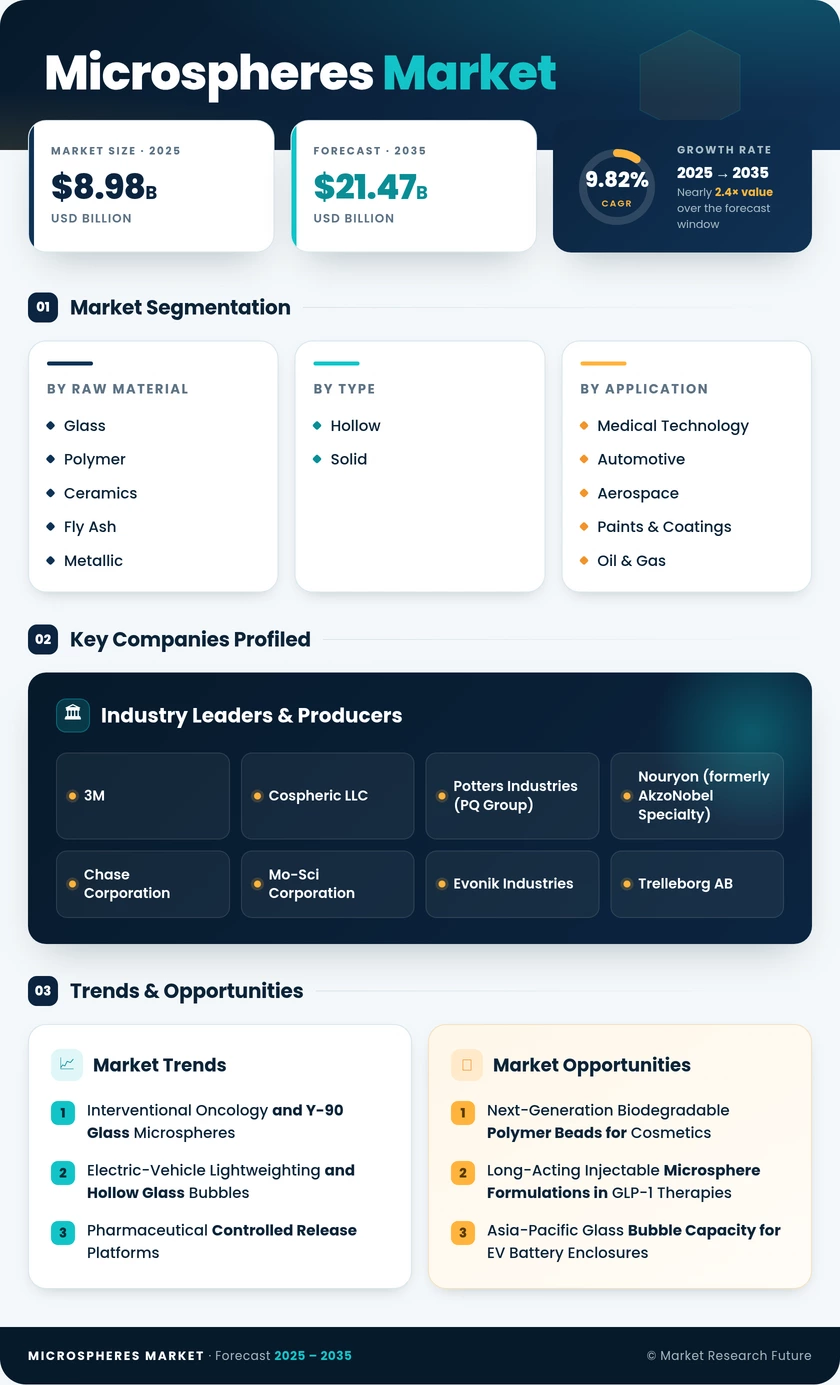
Microspheres Market

ID: MRFR/LS/1667-HCR
80 Pages
Satyendra Maurya
Last Updated: June 05, 2026
Microspheres Market Research Report Information By Material (Synthetic Polymers, and Natural Polymers), By Type (Bioadhesive Microspheres, Magnetic Microspheres, Floating Microspheres, Radioactive Microspheres, and Polymeric Microspheres), By Application (Drug Carriers, Pulmonary Drug Deliveries, and Tissue Regeneration), And, By Region (North America, Europe, Asia-Pacific, And Rest Of The World) –Market Forecast Till 2035
Download PDF ×

We do not share your information with anyone. However, we may send you emails based on your report interest from time to time. You may contact us at any time to opt-out.

  1. 1 Market Overview |
    1. 1.1 Study Assumptions & Market Definition |
    2. 1.2 Scope of the Study |
    3. 1.3 Research Methodology
  2. 2 Market Summary & Key Takeaways
  3. 3 Market Dynamics |
    1. 3.1 Market Drivers Analysis | |
      1. 3.1.1 Interventional Oncology Expansion (Y-90 Glass Microspheres) | |
      2. 3.1.2 Electric-Vehicle Lightweighting Mandates | |
      3. 3.1.3 Pharmaceutical Controlled Release Platforms | |
      4. 3.1.4 Smart-City Road Safety Coatings | |
      5. 3.1.5 Oil & Gas Drilling Fluid Optimization | |
      6. 3.1.6 Biodegradable Polymer Beads Replacing Microplastics | |
      7. 3.1.7 Aerospace Composite Weight Reduction Targets |
    2. 3.2 Market Restraints Analysis | |
      1. 3.2.1 Raw-Material Price Volatility | |
      2. 3.2.2 Europe's Evolving Microplastic Regulation | |
      3. 3.2.3 Manufacturing Precision Barriers in Emerging Markets | |
      4. 3.2.4 Competition from Alternative Lightweight Fillers | |
      5. 3.2.5 Limited Recycling Infrastructure for Composite-Embedded Microspheres |
    3. 3.3 Market Opportunity Analysis | |
      1. 3.3.1 Next-Generation Biodegradable Polymer Beads for Cosmetics | |
      2. 3.3.2 Long-Acting Injectable Microsphere Formulations in GLP-1 Therapies | |
      3. 3.3.3 Asia-Pacific Glass Bubble Capacity for EV Battery Enclosures | |
      4. 3.3.4 Data-Driven Quality Control and Digital Twins | |
      5. 3.3.5 Emerging-Market Infrastructure Coatings |
    4. 3.4 Industry Value Chain Analysis |
    5. 3.5 Porter's Five Forces Analysis
  4. 4 Global Microspheres Market Size & Forecast (2021–2035) |
    1. 4.1 Historical Market Size (2021–2025) |
    2. 4.2 Current & Forecast Market Size (2026–2035) |
    3. 4.3 Market Size by Revenue (USD Billion) |
    4. 4.4 Year-over-Year Growth Analysis
  5. 5 Segmentation Analysis |
    1. 5.1 By Raw Material | |
      1. 5.1.1 Glass | |
      2. 5.1.2 Polymer | |
      3. 5.1.3 Ceramics | |
      4. 5.1.4 Fly Ash | |
      5. 5.1.5 Metallic | |
      6. 5.1.6 Others |
    2. 5.2 By Type | |
      1. 5.2.1 Hollow | |
      2. 5.2.2 Solid |
    3. 5.3 By Application | |
      1. 5.3.1 Medical Technology | |
      2. 5.3.2 Automotive | |
      3. 5.3.3 Aerospace | |
      4. 5.3.4 Paints & Coatings | |
      5. 5.3.5 Oil & Gas | |
      6. 5.3.6 Cosmetics | |
      7. 5.3.7 Composites | |
      8. 5.3.8 Others
  6. 6 Regional Analysis |
    1. 6.1 North America | |
      1. 6.1.1 United States | |
      2. 6.1.2 Canada | |
      3. 6.1.3 Mexico |
    2. 6.2 Europe | |
      1. 6.2.1 Germany | |
      2. 6.2.2 United Kingdom | |
      3. 6.2.3 France | |
      4. 6.2.4 Italy | |
      5. 6.2.5 Spain | |
      6. 6.2.6 Nordic Countries | |
      7. 6.2.7 Russia | |
      8. 6.2.8 Rest of Europe |
    3. 6.3 Asia-Pacific | |
      1. 6.3.1 China | |
      2. 6.3.2 India | |
      3. 6.3.3 Japan | |
      4. 6.3.4 South Korea | |
      5. 6.3.5 ASEAN | |
      6. 6.3.6 Rest of Asia-Pacific |
    4. 6.4 South America | |
      1. 6.4.1 Brazil | |
      2. 6.4.2 Argentina | |
      3. 6.4.3 Rest of South America |
    5. 6.5 Middle East & Africa | |
      1. 6.5.1 Saudi Arabia | |
      2. 6.5.2 UAE | |
      3. 6.5.3 South Africa | |
      4. 6.5.4 Egypt | |
      5. 6.5.5 Rest of MEA
  7. 7 Competitive Landscape |
    1. 7.1 Market Share Analysis (2026) |
    2. 7.2 Competitive Benchmarking Matrix |
    3. 7.3 Company Profiles | |
      1. 7.3.1 3M | |
      2. 7.3.2 Cospheric LLC | |
      3. 7.3.3 Potters Industries (PQ Group) | |
      4. 7.3.4 Nouryon | |
      5. 7.3.5 Chase Corporation | |
      6. 7.3.6 Mo-Sci Corporation | |
      7. 7.3.7 Evonik Industries | |
      8. 7.3.8 Trelleborg AB | |
      9. 7.3.9 Matsumoto Yushi-Seiyaku Co. | |
      10. 7.3.10 Sinosteel Maanshan New Material
  8. 8 Future Outlook & Strategic Recommendations (2026–2035) |
    1. 8.1 AI-Optimized Manufacturing and Quality Assurance |
    2. 8.2 Electrification Supercycle and Lightweight Composites |
    3. 8.3 ESG Reporting and Sustainable Material Sourcing |
    4. 8.4 Platform Economics in Pharmaceutical Microsphere CDMOs
  9. 9 Recent Developments & News
  10. 10 Frequently Asked Questions (FAQs)
  11. 11 Report Scope & Methodology |
    1. 11.1 Study Period & Base Year |
    2. 11.2 Data Sources & Citations |
    3. 11.3 Abbreviations
  12. 12 LIST OF TABLES |
  13. TABLE 1 Global Microspheres Market Size & Forecast, by Revenue (USD Billion), 2021–2035 |
  14. TABLE 2 Global Microspheres Market – Year-over-Year Growth Analysis, 2021–2035 |
  15. TABLE 3 Global Microspheres Market – Driver Impact Analysis, 2026–2035 |
  16. TABLE 4 Global Microspheres Market – Restraint Impact Analysis, 2026–2035 |
  17. TABLE 5 Global Microspheres Market Size, by Raw Material, 2021–2035 (USD Billion) |
  18. TABLE 6 Global Microspheres Market Size, by Type, 2021–2035 (USD Billion) |
  19. TABLE 7 Global Microspheres Market Size, by Application, 2021–2035 (USD Billion) |
  20. TABLE 8 Global Microspheres Market Size, by Region, 2021–2035 (USD Billion) |
  21. TABLE 9 North America Microspheres Market Size, by Country, 2021–2035 (USD Billion) |
  22. TABLE 10 North America Microspheres Market Size, by Raw Material, 2021–2035 (USD Billion) |
  23. TABLE 11 North America Microspheres Market Size, by Type, 2021–2035 (USD Billion) |
  24. TABLE 12 North America Microspheres Market Size, by Application, 2021–2035 (USD Billion) |
  25. TABLE 13 Europe Microspheres Market Size, by Country, 2021–2035 (USD Billion) |
  26. TABLE 14 Europe Microspheres Market Size, by Raw Material, 2021–2035 (USD Billion) |
  27. TABLE 15 Europe Microspheres Market Size, by Type, 2021–2035 (USD Billion) |
  28. TABLE 16 Europe Microspheres Market Size, by Application, 2021–2035 (USD Billion) |
  29. TABLE 17 Asia-Pacific Microspheres Market Size, by Country, 2021–2035 (USD Billion) |
  30. TABLE 18 Asia-Pacific Microspheres Market Size, by Raw Material, 2021–2035 (USD Billion) |
  31. TABLE 19 Asia-Pacific Microspheres Market Size, by Type, 2021–2035 (USD Billion) |
  32. TABLE 20 Asia-Pacific Microspheres Market Size, by Application, 2021–2035 (USD Billion) |
  33. TABLE 21 South America Microspheres Market Size, by Country, 2021–2035 (USD Billion) |
  34. TABLE 22 South America Microspheres Market Size, by Raw Material, 2021–2035 (USD Billion) |
  35. TABLE 23 South America Microspheres Market Size, by Type, 2021–2035 (USD Billion) |
  36. TABLE 24 South America Microspheres Market Size, by Application, 2021–2035 (USD Billion) |
  37. TABLE 25 Middle East & Africa Microspheres Market Size, by Country, 2021–2035 (USD Billion) |
  38. TABLE 26 Middle East & Africa Microspheres Market Size, by Raw Material, 2021–2035 (USD Billion) |
  39. TABLE 27 Middle East & Africa Microspheres Market Size, by Type, 2021–2035 (USD Billion) |
  40. TABLE 28 Middle East & Africa Microspheres Market Size, by Application, 2021–2035 (USD Billion) |
  41. TABLE 29 Competitive Benchmarking Matrix – Global Microspheres Market, 2026 |
  42. TABLE 30 Company Profiles – Key Players, Global Microspheres Market |
  43. TABLE 31 Recent Developments & Strategic Announcements, 2023–2025 |
  44. TABLE 32 Report Scope & Methodology Summary |
  45. TABLE 33 Detailed Sources and Citations
  46. 13 LIST OF FIGURES |
  47. FIGURE 1 Global Microspheres Market Dynamics (Drivers, Restraints, Opportunities) |
  48. FIGURE 2 Industry Value Chain Analysis — Microspheres Market |
  49. FIGURE 3 Porter's Five Forces Analysis — Global Microspheres Market |
  50. FIGURE 4 Global Microspheres Market Size Trend & Forecast (USD Billion), 2021–2035 |
  51. FIGURE 5 Global Microspheres Market Share, by Raw Material (%), 2026 |
  52. FIGURE 6 Global Microspheres Market Share, by Type (%), 2026 |
  53. FIGURE 7 Global Microspheres Market Share, by Application (%), 2026 |
  54. FIGURE 8 Global Microspheres Market Share, by Region (%), 2026 |
  55. FIGURE 9 North America Microspheres Market Share, by Country (%), 2026 |
  56. FIGURE 10 Europe Microspheres Market Share, by Country (%), 2026 |
  57. FIGURE 11 Asia-Pacific Microspheres Market Share, by Country (%), 2026 |
  58. FIGURE 12 South America Microspheres Market Share, by Country (%), 2026 |
  59. FIGURE 13 Middle East & Africa Microspheres Market Share, by Country (%), 2026 |
  60. FIGURE 14 Competitive Landscape — Microspheres Market Revenue Share Distribution, 2026

Segmentation Quick Reference

DimensionSub-SegmentsDominant SegmentFastest Growing Segment
By Raw MaterialGlass, Polymer, Ceramics, Fly Ash, Metallic, OthersGlassGlass
By TypeHollow, SolidHollowHollow
By ApplicationMedical Technology, Automotive, Aerospace, Paints & Coatings, Oil & Gas, Cosmetics, Composites, OthersMedical TechnologyMedical Technology
By GeographyNorth America, Europe, Asia-Pacific, South America, Middle East & AfricaNorth AmericaAsia-Pacific


Market Segmentation Overview

By Raw Material

Sub-SegmentKey Trend
GlassHollow glass bubbles expanding into EV battery enclosures and interventional oncology radioembolization
PolymerPLGA-based biodegradable polymer beads are driving pharma-grade controlled release microspheres growth
CeramicsHigh-temperature applications in aerospace turbine coatings and electronics encapsulants
Fly AshCost-advantaged cenospheres in construction fillers; share declining versus synthetic alternatives
MetallicNiche adoption in additive manufacturing and thermal spray applications
OthersSpecialty silica and carbon microspheres for electronics and research applications


Glass microspheres — particularly hollow borosilicate variants — anchor more than half of the global Microspheres Market revenue, leveraging versatility across weight-sensitive composites, oilfield drilling fluids, and FDA-cleared targeted drug delivery particles. Polymer grades are gaining momentum in pharmaceutical applications as injectable microsphere formulations for long-acting therapies expand clinical pipelines.

By Type

Sub-SegmentKey Trend
HollowDominant across automotive, aerospace, oil & gas; preferred for density reduction and thermal insulation
SolidSpecialized use in retroreflective coatings and matrix carriers for drug-loaded microparticles


Hollow microspheres command over 70% of the global Microspheres Market by revenue, reflecting the cross-industry imperative for lightweight, high-strength filler materials. Solid variants serve precision optical and pharmaceutical niches where uniform sphericity and controlled porosity are more critical than density reduction.

By Application

Sub-SegmentKey Trend
Medical TechnologyY-90 radioembolization and controlled-release microspheres for depot-injection drug delivery
AutomotiveEV lightweighting programs are driving hollow glass microsphere adoption in structural composites
AerospaceSyntactic foams and thermal protection systems requiring engineered microsphere grades
Paints & CoatingsRetroreflective road markings and thermal-insulation paint formulations
Oil & GasDrilling fluid density reduction and cementing applications
CosmeticsBiodegradable polymer beads replacing banned polyethylene microbeads
CompositesIndustrial syntactic foams for marine and construction end uses
OthersElectronics encapsulants, 3D printing fillers, and research-grade calibration beads


Medical technology leads the Microspheres Market in revenue contribution, powered by interventional oncology and a rapidly growing pipeline of injectable microsphere formulations. Automotive is the fastest-rising volume segment as global EV adoption accelerates demand for hollow glass microspheres in battery enclosure and underbody composite applications.