×
Request Free Sample ×

Kindly complete the form below to receive a free sample of this Report

* Please use a valid business email

Leading companies partner with us for data-driven Insights

clients tt-cursor
Hero Background

Military Simulation Virtual Training Market

ID: MRFR/AD/2414-CR
136 Pages
Swapnil Palwe
February 2021

Military Simulation and Virtual Training Market Research Report Information by Platform (Airborne [Jet Flight Simulation and Training, Rotary Flight Simulation and Training and UAV Flight Simulation and Training], Ground [Battlefield Simulation and Training, Combat Simulation and Training, Ground Vehicle Simulation and Training ] and Naval [Ship Bridge Simulation and Training, Submarine Simulation and Training and others]), Training Type (Live, Virtual Reality [VR], Constructive and Gaming Simulation) and by Region Forecast to 2030

Share:
Download PDF ×

We do not share your information with anyone. However, we may send you emails based on your report interest from time to time. You may contact us at any time to opt-out.

Military Simulation Virtual Training Market Infographic
Purchase Options

Military Simulation Virtual Training Market Summary

As per MRFR analysis, the Military Simulation Virtual Training Market was estimated at 29.9 USD Billion in 2024. The Military Simulation Virtual Training industry is projected to grow from 32.7 USD Billion in 2025 to 81.0 USD Billion by 2035, exhibiting a compound annual growth rate (CAGR) of 9.49 during the forecast period 2025 - 2035.

Key Market Trends & Highlights

The Military Simulation Virtual Training Market is experiencing robust growth driven by technological advancements and increasing defense expenditures.

  • The integration of advanced technologies is reshaping training methodologies across military and emergency response sectors.
  • North America remains the largest market, while Asia-Pacific is emerging as the fastest-growing region in military simulation training.
  • Military training continues to dominate the market, with emergency response training rapidly gaining traction due to evolving needs.
  • Rising defense budgets and the integration of artificial intelligence are key drivers propelling market expansion.

Market Size & Forecast

2024 Market Size 29.9 (USD Billion)
2035 Market Size 81.0 (USD Billion)
CAGR (2025 - 2035) 9.49%

Major Players

Lockheed Martin (US), Northrop Grumman (US), Raytheon Technologies (US), BAE Systems (GB), Thales Group (FR), General Dynamics (US), L3Harris Technologies (US), Leonardo (IT), Cubic Corporation (US)

Military Simulation Virtual Training Market Trends

The Military Simulation Virtual Training Market is currently experiencing a notable evolution, driven by advancements in technology and the increasing demand for effective training solutions. Military organizations worldwide are recognizing the value of simulation-based training as it offers a safe and controlled environment for personnel to develop critical skills. This market appears to be influenced by the integration of artificial intelligence and virtual reality, which enhance the realism and effectiveness of training scenarios. Furthermore, the growing emphasis on cost-effective training methods is likely to propel the adoption of virtual training solutions, as they reduce the need for physical resources and logistics associated with traditional training methods. In addition, the Military Simulation Virtual Training Market seems to be expanding due to the rising complexity of modern warfare. As military operations become more intricate, the necessity for comprehensive training programs that can simulate various combat situations becomes increasingly apparent. This trend indicates a shift towards more immersive and interactive training experiences, allowing military personnel to engage in realistic scenarios that prepare them for real-world challenges. Overall, the market is poised for growth as technological innovations continue to reshape the landscape of military training, providing enhanced capabilities and improved outcomes for armed forces globally.

Integration of Advanced Technologies

The Military Simulation Virtual Training Market is witnessing a trend towards the incorporation of advanced technologies such as artificial intelligence and machine learning. These innovations enhance the realism of training scenarios, allowing military personnel to engage in more complex and adaptive environments. This integration not only improves the effectiveness of training but also enables personalized learning experiences tailored to individual needs.

Focus on Cost-Effective Solutions

There is a growing emphasis on cost-effective training solutions within the Military Simulation Virtual Training Market. Organizations are increasingly seeking methods that minimize expenses associated with traditional training, such as travel and equipment costs. Virtual training platforms offer a viable alternative, providing comprehensive training without the logistical challenges of physical exercises.

Shift Towards Immersive Training Experiences

The Military Simulation Virtual Training Market is experiencing a shift towards more immersive training experiences. This trend is characterized by the use of virtual reality and augmented reality technologies, which create engaging and interactive environments for military personnel. Such experiences are designed to replicate real-world scenarios, enhancing the preparedness and adaptability of armed forces in various operational contexts.

Military Simulation Virtual Training Market Drivers

Market Growth Projections

The Global Military Simulation and Virtual Training Industry is projected to experience substantial growth over the coming years. With an estimated market value of 12.5 USD Billion in 2024, the industry is expected to expand significantly, reaching approximately 30 USD Billion by 2035. This growth trajectory indicates a compound annual growth rate of 8.28% from 2025 to 2035. The increasing emphasis on advanced training methodologies, coupled with technological innovations, is likely to drive this expansion. As military organizations worldwide continue to prioritize effective training solutions, the market is poised for robust development in the foreseeable future.

Increasing Defense Budgets

The Global Military Simulation and Virtual Training Industry is experiencing growth driven by rising defense budgets across various nations. Countries are increasingly allocating substantial financial resources to enhance their military capabilities, with a projected market value of 12.5 USD Billion in 2024. This trend is particularly evident in regions such as North America and Asia-Pacific, where governments prioritize advanced training solutions to ensure operational readiness. The emphasis on modernization and technological advancements in military training is likely to propel the market further, as nations seek to adopt innovative simulation technologies to improve training efficiency and effectiveness.

Technological Advancements

Technological advancements play a pivotal role in shaping the Global Military Simulation and Virtual Training Industry. Innovations in virtual reality, augmented reality, and artificial intelligence are transforming traditional training methodologies. These technologies enable immersive training experiences that enhance learning outcomes and operational preparedness. For instance, the integration of AI-driven analytics allows for real-time performance assessments, thereby optimizing training programs. As the market evolves, the adoption of these cutting-edge technologies is expected to drive significant growth, with projections indicating a market expansion to 30 USD Billion by 2035, reflecting a compound annual growth rate of 8.28% from 2025 to 2035.

Focus on Enhanced Operational Readiness

Enhanced operational readiness remains a critical focus for military organizations worldwide, driving growth in the Global Military Simulation and Virtual Training Industry. As geopolitical tensions rise, nations are compelled to ensure their forces are adequately prepared for diverse operational scenarios. Simulation-based training allows for the replication of complex environments and situations, enabling troops to develop essential skills and decision-making capabilities. This focus on readiness is likely to result in increased investments in simulation technologies, further propelling market growth. The emphasis on operational effectiveness underscores the importance of advanced training solutions in maintaining national security.

Rising Adoption of Joint and Coalition Training

The Global Military Simulation and Virtual Training Industry is increasingly influenced by the rising adoption of joint and coalition training among allied forces. Collaborative training exercises enhance interoperability and coordination among multinational military units, which is essential for modern warfare. Simulation technologies facilitate these joint training initiatives by providing a shared virtual environment where forces can practice together, regardless of geographical constraints. This trend is likely to foster greater collaboration and integration among allied nations, thereby driving demand for advanced simulation solutions. The market's evolution in this context reflects the growing recognition of the importance of joint training in contemporary military operations.

Growing Demand for Cost-Effective Training Solutions

The Global Military Simulation and Virtual Training Industry is witnessing a surge in demand for cost-effective training solutions. Traditional training methods often incur high expenses related to logistics, personnel, and equipment. In contrast, simulation-based training offers a more economical alternative, allowing military organizations to conduct realistic training scenarios without the associated costs of live exercises. This shift towards virtual training solutions is particularly relevant in light of budget constraints faced by many defense organizations. As a result, the market is likely to see increased investment in simulation technologies that provide high-quality training while optimizing resource allocation.

Market Segment Insights

By Application: Military Training (Largest) vs. Emergency Response Training (Fastest-Growing)

Within the Military Simulation Virtual Training Market, Military Training currently commands the largest share of the application segment, signifying its critical importance to defense strategies. This segment capitalizes on advanced simulation technologies, leading to highly effective troop training. Emergency Response Training emerges as a rapidly growing segment. The increasing need for realistic emergency scenarios and stringent safety regulations is propelling demand, establishing a noteworthy share that complements traditional military training approaches.

Training Focus: Military Training (Dominant) vs. Emergency Response Training (Emerging)

Military Training stands out as the dominant focus in the Military Simulation Virtual Training Market due to its long-standing implementation in defense forces worldwide. This segment enjoys extensive investment in technology, which enhances training efficacy and operational readiness. In contrast, Emergency Response Training is an emerging focus driven by the rise in natural disasters and healthcare emergencies. This segment is characterized by adaptive training modules that provide first responders with hands-on experience in crisis management, thus preparing them for real-life challenges. As both segments evolve, collaboration between military and civilian training methodologies is becoming more prevalent, enriching overall training outcomes.

By End Use: Defense Forces (Largest) vs. Private Security Firms (Fastest-Growing)

The Military Simulation Virtual Training Market is predominantly driven by Defense Forces, which command a significant market share. This segment encompasses various branches of armed forces, including land, air, and naval units, emphasizing the necessity for realistic training environments. Meanwhile, Private Security Firms represent a burgeoning segment, capitalizing on increasing security concerns globally and the need for advanced training solutions. Together, these segments illustrate a diverse landscape of training needs dictated by varying operational requirements.

Defense Forces (Dominant) vs. Private Security Firms (Emerging)

The Defense Forces segment of the Military Simulation Virtual Training Market is characterized by established budgets and long-term procurement cycles, which ensures consistent investments in advanced training technologies. This segment prioritizes immersive, scenario-based training that aids in operational readiness. In contrast, Private Security Firms are an emerging force in the market, driven by the increasing demand for private security solutions in both urban and remote areas. These firms are increasingly adopting virtual training programs to enhance the skill sets of personnel, focusing on tactical versatility. The adoption rates in this segment are spurred by the rapid evolution of security threats, indicating a shift towards more adaptable training regimens.

By Technology: Virtual Reality (Largest) vs. Simulation Software (Fastest-Growing)

In the Military Simulation Virtual Training Market, the distribution of market share among various technologies reveals that Virtual Reality (VR) stands as the largest segment, capturing significant attention from military organizations for its immersive capabilities. On the other hand, Simulation Software emerges as a critical segment, showcasing remarkable growth as it adapts to the modern needs of military training, emphasizing software solutions that integrate realistic scenarios for enhanced training outcomes. As the demand for advanced training solutions rises, both segments present unique trends: VR is enhanced by innovations in hardware, leading to deeper immersion, while Simulation Software benefits from ongoing developments in AI and machine learning, making training modules more realistic and customizable. This synergy between VR and Simulation Software is redefining training methodologies and strategies within military operations across the globe.

Virtual Reality: Dominant vs. Simulation Software: Emerging

Virtual Reality serves as the dominant technology in the Military Simulation Virtual Training Market due to its ability to provide highly immersive training environments that replicate real-world conditions. This technology allows military personnel to engage in simulated combat scenarios, practice tactical maneuvers, and conduct emergency response drills without the risks associated with live training. Conversely, Simulation Software represents an emerging segment that is gaining momentum as it focuses on the development of sophisticated software solutions that foster realistic training experiences. The flexibility and adaptability of simulation software make it a vital tool in training programs, enabling various scenarios to be tailored to specific mission requirements, thus complementing the immersive nature of Virtual Reality.

By Deployment Mode: Cloud-Based (Largest) vs. Hybrid (Fastest-Growing)

In the Military Simulation Virtual Training Market, deployment mode plays a crucial role in determining user accessibility and operational efficiency. Among the various deployment options, Cloud-Based solutions hold the largest market share due to their ability to offer flexible, scalable training environments without substantial infrastructure investments. In contrast, On-Premises solutions, while having a loyal user base, are gradually losing market traction, primarily due to the higher costs and maintenance required. Hybrid models, which combine both Cloud and On-Premises resources, are also gaining momentum, particularly as they offer the best of both worlds for military training institutions.

Deployment Mode: Cloud-Based (Dominant) vs. Hybrid (Emerging)

Cloud-Based deployment is becoming the dominant mode in military simulation virtual training due to its vast advantages such as ease of access, reduced infrastructure costs, and efficient update cycles. It allows military organizations to conduct training exercises remotely, making simulations more accessible to personnel stationed in various locations. In contrast, the Hybrid model is emerging as a significant player, appealing to organizations seeking the flexibility of the cloud while retaining sensitive training data on-premises. This blend of both environments not only caters to the diverse regulatory and security compliance needs but also supports various training scenarios, enhancing the overall training effectiveness in military settings.

By User Type: Corporate Users (Largest) vs. Government Users (Fastest-Growing)

In the Military Simulation Virtual Training Market, the user type segment reveals a distinct distribution among individual, corporate, and government users. Corporate users hold the largest share, benefitting from substantial investments in virtual training solutions to enhance their personnel's readiness and skills. Meanwhile, government users, supported by increasing defense budgets and modernization initiatives, represent a growing portion of the market. Individual users, though significant, are currently the smallest segment, leveraging these simulations for personal skill enhancement and learning.

Corporate Users (Dominant) vs. Government Users (Emerging)

The corporate user segment stands out as the dominant force in the Military Simulation Virtual Training Market, characterized by significant investments in advanced simulation technologies. Corporations are increasingly recognizing the benefits of virtual training in preparing their workforce, leading to enhanced performance and reduced training costs. Conversely, government users are emerging as a critical segment due to the urgent need for national defense enhancements and operational readiness. This burgeoning segment is rapidly adopting virtual training solutions to address tactical challenges and support soldier training initiatives, reflecting a strategic shift towards high-tech training methodologies in military operations.

Get more detailed insights about Military Simulation Virtual Training Market

Regional Insights

North America : Leading Market Innovators

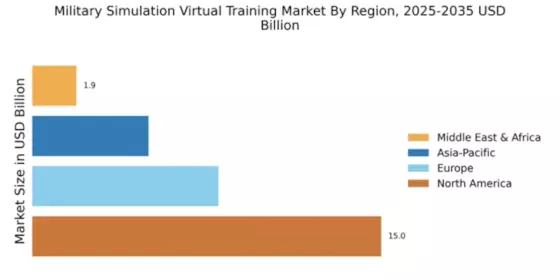
North America is poised to maintain its leadership in the Military Simulation Virtual Training Market, holding a market size of $15.0 billion in 2025. The region benefits from robust defense budgets, technological advancements, and a strong emphasis on training effectiveness. Regulatory support and initiatives aimed at enhancing military readiness further drive demand for simulation technologies. The integration of AI and VR in training programs is also a significant growth catalyst, ensuring that military personnel are well-prepared for modern combat scenarios. The competitive landscape in North America is characterized by the presence of major players such as Lockheed Martin, Northrop Grumman, and Raytheon Technologies. These companies are at the forefront of innovation, developing cutting-edge simulation solutions that cater to the evolving needs of military training. The U.S. government’s commitment to investing in advanced training technologies ensures a favorable environment for growth, making North America a hub for military simulation advancements.

Europe : Emerging Defense Technologies

Europe is witnessing significant growth in the Military Simulation Virtual Training Market, with a market size of $8.0 billion projected for 2025. The region's growth is driven by increasing defense expenditures, collaborative military exercises, and a focus on enhancing operational readiness. Regulatory frameworks promoting interoperability among NATO allies and investments in advanced training technologies are key factors fueling demand. The emphasis on joint training exercises across member states further accelerates the adoption of simulation solutions. Leading countries in Europe, such as the UK, France, and Germany, are investing heavily in military simulation technologies. Companies like BAE Systems and Thales Group are pivotal in this landscape, providing innovative solutions tailored to the needs of European armed forces. The competitive environment is marked by partnerships and collaborations aimed at enhancing training capabilities, ensuring that European nations remain at the forefront of military readiness.

Asia-Pacific : Rapidly Growing Defense Sector

The Asia-Pacific region is emerging as a significant player in the Military Simulation Virtual Training Market, with a projected market size of $5.0 billion by 2025. The growth is driven by increasing defense budgets, geopolitical tensions, and a focus on modernizing military capabilities. Countries in this region are investing in advanced training solutions to enhance their operational effectiveness. Regulatory support for defense modernization initiatives is also a catalyst for market expansion, as nations seek to improve their military readiness through simulation technologies. Key players in the Asia-Pacific market include companies like L3Harris Technologies and Leonardo, which are actively developing innovative training solutions. Countries such as India, Japan, and Australia are leading the charge in adopting military simulation technologies, driven by their strategic defense objectives. The competitive landscape is characterized by collaborations between government and private sectors to enhance training capabilities, ensuring that the region remains competitive in global defense scenarios.

Middle East and Africa : Emerging Defense Investments

The Middle East and Africa region is gradually developing its Military Simulation Virtual Training Market, with a market size of $1.9 billion anticipated by 2025. The growth is primarily driven by increasing defense budgets and a focus on enhancing military capabilities amid regional conflicts. Governments are recognizing the importance of advanced training solutions to improve operational readiness, leading to a rise in investments in simulation technologies. Regulatory frameworks are evolving to support these initiatives, fostering a conducive environment for market growth. Countries like the UAE and South Africa are at the forefront of adopting military simulation technologies, with a growing interest in partnerships with global defense firms. The competitive landscape is characterized by collaborations aimed at enhancing training capabilities, ensuring that military forces in the region are better prepared for modern challenges. The presence of key players is gradually increasing, contributing to the overall development of the market.

Key Players and Competitive Insights

The Military Simulation Virtual Training Market is characterized by a dynamic competitive landscape, driven by technological advancements and increasing defense budgets across various nations. Key players such as Lockheed Martin (US), Northrop Grumman (US), and Raytheon Technologies (US) are at the forefront, focusing on innovation and strategic partnerships to enhance their offerings. These companies are leveraging cutting-edge technologies, including artificial intelligence (AI) and virtual reality (VR), to create immersive training environments that improve operational readiness. Their collective strategies not only foster competition but also push the boundaries of what is achievable in military training simulations.

In terms of business tactics, companies are increasingly localizing manufacturing and optimizing supply chains to enhance efficiency and reduce costs. The market structure appears moderately fragmented, with several players vying for market share. However, the influence of major companies is substantial, as they set industry standards and drive technological advancements. This competitive structure encourages smaller firms to innovate and differentiate their products, contributing to a vibrant market ecosystem.

In November 2025, Lockheed Martin (US) announced a partnership with a leading technology firm to develop next-generation simulation software that integrates AI capabilities. This strategic move is likely to enhance the realism and adaptability of training scenarios, thereby improving the effectiveness of military personnel training. Such collaborations indicate a trend towards integrating advanced technologies into training solutions, which could redefine training methodologies in the military sector.

Similarly, in October 2025, Northrop Grumman (US) unveiled a new virtual training platform designed to simulate complex battlefield environments. This platform utilizes VR and augmented reality (AR) to provide a more immersive experience for trainees. The introduction of this technology suggests a shift towards more interactive and engaging training methods, which may lead to better retention of skills and knowledge among military personnel.

In September 2025, Raytheon Technologies (US) expanded its training capabilities by acquiring a smaller firm specializing in simulation technologies. This acquisition is expected to bolster Raytheon's portfolio and enhance its competitive edge in the market. By integrating the acquired technologies, Raytheon may offer more comprehensive training solutions, thereby attracting a broader client base.

As of December 2025, current trends in the Military Simulation Virtual Training Market include a strong emphasis on digitalization, sustainability, and AI integration. Strategic alliances are increasingly shaping the competitive landscape, as companies recognize the value of collaboration in driving innovation. The focus appears to be shifting from price-based competition to differentiation through technology and supply chain reliability. This evolution suggests that future competitive advantages will hinge on the ability to innovate and adapt to emerging technologies, ultimately enhancing the effectiveness of military training.

Key Companies in the Military Simulation Virtual Training Market market include

Industry Developments

On Jan.11, 2023, SimCentric announced that the Australian Army has licensed its virtual reality training technology, SAF-TAC. Funded by DASA, SAF-TAC can help armed forces improve various key skills in a realistic and immersive environment. Built on the commercial gaming engine, Unreal Engine 4, SAF-TAC uses state-of-the-art gaming technology to provide cost-effective and highly engaging training.

On Nov.14, 2022,  The US Air Force (USAF)  awarded a research and development contract to a medical device manufacturing firm, SimX, for virtual reality medical simulation training. Under the contract terms, SimX will produce an enhanced VR medical simulation training program. SimX will also modify its existing VR medical simulation technology to develop a platform that ensures enhanced flexibility and repeatability for tactical combat casualty care.

On Jul. 20, 2022, BAE Systems and VR simulation company VRAI announced a collaboration to explore the next generation of training for military forces, harnessing the power of VR and AI. At the Farnborough International Airshow, these companies announced that they are working together to develop a single synthetic solution to enable air, land, sea, space, and cyber forces to plug in & train together in one virtual world.

On Feb. 04, 2019, The British Army awarded a new contract to Bohemia Interactive Simulations (BISim) to lead a pilot program examining VR's potential for defense training. BISim is a global developer of advanced military simulation and training software. Under the contract, BISim will use virtual reality, ML, and cloud computing for the Army's Collective Training Transformation Programme (CTTP).

The VRLT Programme will likely help make recommendations on the VR impact, affordability, innovation, and exploitation for UK defense training. The VR In-Land Training (VRLT) Pilot Program is a British Army-led CTTP initiative to explore the use of VR for collective land warfare training and identify its potential benefits and effectiveness for military training and simulation.

Competitive Landscape

The military simulation and virtual training market key players are mentioned below:

CAE, Inc. (U.S.)

Thales Group (France)

L-3 Communications Holdings, Inc. (U.S.)

Lockheed Martin Corporation (U.S.)

Northrop Grumman Corporation (U.S.)

Rheinmetall AG (Germany)

Raytheon Company (U.S.)

Rockwell Collins Inc. (U.S.)

Cubic Corporation (U.S.)

Market Development 

In June 2021, InVeris Training Solutions passed nearby acknowledgment testing for 14 Mobile Weapon Training Simulation Systems (MWTSS) and 73 different EF88 weapon test systems for the Australian Defense Force (ADF). 


Future Outlook

Military Simulation Virtual Training Market Future Outlook

The Military Simulation Virtual Training Market is projected to grow at a 9.49% CAGR from 2024 to 2035, driven by technological advancements, increased defense budgets, and the need for enhanced training methodologies.

New opportunities lie in:

  • Development of AI-driven adaptive training systems
  • Expansion of cloud-based simulation platforms
  • Integration of augmented reality for immersive training experiences

By 2035, the market is expected to be robust, reflecting substantial growth and innovation.

Market Segmentation

Military Simulation Virtual Training Market End Use Outlook

  • Defense Forces
  • Private Security Firms
  • Government Agencies
  • Educational Institutions

Military Simulation Virtual Training Market User Type Outlook

  • Individual Users
  • Corporate Users
  • Government Users

Military Simulation Virtual Training Market Technology Outlook

  • Virtual Reality
  • Augmented Reality
  • Mixed Reality
  • Simulation Software

Military Simulation Virtual Training Market Application Outlook

  • Military Training
  • Civilian Training
  • Emergency Response Training
  • Law Enforcement Training

Military Simulation Virtual Training Market Deployment Mode Outlook

  • On-Premises
  • Cloud-Based
  • Hybrid

Report Scope

MARKET SIZE 2024 29.9(USD Billion)
MARKET SIZE 2025 32.7(USD Billion)
MARKET SIZE 2035 81.0(USD Billion)
COMPOUND ANNUAL GROWTH RATE (CAGR) 9.49% (2024 - 2035)
REPORT COVERAGE Revenue Forecast, Competitive Landscape, Growth Factors, and Trends
BASE YEAR 2024
Market Forecast Period 2025 - 2035
Historical Data 2019 - 2024
Market Forecast Units USD Billion
Key Companies Profiled Lockheed Martin (US), Northrop Grumman (US), Raytheon Technologies (US), BAE Systems (GB), Thales Group (FR), General Dynamics (US), L3Harris Technologies (US), Leonardo (IT), Cubic Corporation (US)
Segments Covered Application, End Use, Technology, Deployment Mode, User Type
Key Market Opportunities Integration of artificial intelligence enhances realism and adaptability in the Military Simulation Virtual Training Market.
Key Market Dynamics Technological advancements drive competitive forces in the Military Simulation Virtual Training Market, enhancing training effectiveness and realism.
Countries Covered North America, Europe, APAC, South America, MEA

Market Highlights

Author
Swapnil Palwe
Team Lead - Research

With a technical background as Bachelor's in Mechanical Engineering, with MBA in Operations Management , Swapnil has 6+ years of experience in market research, consulting and analytics with the tasks of data mining, analysis, and project execution. He is the POC for our clients, for their consulting projects running under the Automotive/A&D domain. Swapnil has worked on major projects in verticals such as Aerospace & Defense, Automotive and many other domain projects. He has worked on projects for fortune 500 companies' syndicate and consulting projects along with several government projects.

Leave a Comment

FAQs

How Military Simulation and Virtual Training Market is Growing??

Military Simulation and Virtual Training Market At A CAGR Of 6.2% From 2020 To 2030.

who are the Top Key vendors in military simulation and virtual training market ?

CAE, Inc. (U.S.),Thales Group (France),L-3 Communications Holdings, Inc. (U.S.),Lockheed Martin Corporation (U.S.),Northrop Grumman Corporation (U.S.),Rheinmetall AG (Germany),Raytheon Company (U.S.),Rockwell Collins Inc. (U.S.),Cubic Corporation (U.S.)

Which factors are poised to drive the market growth?

The massive demand for military simulation and virtual trainings driven by the increase in prominence on maritime security and consequent focus on virtual training for naval operations, which are the market's primary growth inducer.

Which platform is expected to witness the highest growth?

The airborne segment is expected to observe substantial demand over the review period.

Which region is expected to witness the highest growth?

North America is expected to observe substantial demand over the review period.

Download Free Sample

Kindly complete the form below to receive a free sample of this Report

Compare Licence

×
Features License Type
Single User Multiuser License Enterprise User
Price $4,950 $5,950 $7,250
Maximum User Access Limit 1 User Upto 10 Users Unrestricted Access Throughout the Organization
Free Customization
Direct Access to Analyst
Deliverable Format
Platform Access
Discount on Next Purchase 10% 15% 15%
Printable Versions