×
Request Free Sample ×

Kindly complete the form below to receive a free sample of this Report

* Please use a valid business email

Leading companies partner with us for data-driven Insights

clients tt-cursor
Hero Background

Military Surveillance Drones Market

ID: MRFR/AD/3006-CR
140 Pages
Sejal Akre
April 2023

Military Surveillance Drone Market Research Report Information By Drone Type (Fixed Wing Drone, Rotary Blade Drone, Hybrid Drone), By Payload (Electro-Optic/Infrared Sensor, Cameras, Electronic Intelligence, Maritime Patrol Radar, Others), By Technology (Hardware, Software) And By Region (North America, Europe, Asia-Pacific, And Rest Of The World) – Market Forecast Till 2035

Share:
Download PDF ×

We do not share your information with anyone. However, we may send you emails based on your report interest from time to time. You may contact us at any time to opt-out.

Military Surveillance Drones Market Infographic
Purchase Options

Military Surveillance Drones Market Summary

As per MRFR analysis, the Military Surveillance Drones Market Size was estimated at 1231.56 USD Million in 2024. The Military Surveillance Drones industry is projected to grow from 1359.54 in 2025 to 3654.01 by 2035, exhibiting a compound annual growth rate (CAGR) of 10.39 during the forecast period 2025 - 2035.

Key Market Trends & Highlights

The Military Surveillance Drones Market is poised for substantial growth driven by technological advancements and increasing defense budgets.

  • North America remains the largest market for military surveillance drones, reflecting robust defense spending and technological innovation.
  • The Asia-Pacific region is emerging as the fastest-growing market, fueled by escalating geopolitical tensions and modernization efforts.
  • The surveillance segment continues to dominate the market, while the search and rescue segment is experiencing rapid growth due to evolving military strategies.
  • Technological advancements in drone capabilities and increased defense budgets are key drivers propelling market expansion.

Market Size & Forecast

2024 Market Size 1231.56 (USD Million)
2035 Market Size 3654.01 (USD Million)
CAGR (2025 - 2035) 10.39%

Major Players

General Atomics (US), Northrop Grumman (US), Lockheed Martin (US), BAE Systems (GB), Thales Group (FR), Elbit Systems (IL), Textron (US), Leonardo (IT), AeroVironment (US)

Military Surveillance Drones Market Trends

The Military Surveillance Drones Market is currently experiencing a transformative phase, driven by advancements in technology and increasing demand for enhanced surveillance capabilities. Nations across the globe are investing in sophisticated drone systems to bolster their intelligence, reconnaissance, and surveillance operations. This shift is largely influenced by the need for real-time data collection and analysis, which is crucial for strategic decision-making in defense operations. Furthermore, the integration of artificial intelligence and machine learning into drone systems is enhancing their operational efficiency, enabling them to process vast amounts of data swiftly and accurately. In addition to technological advancements, geopolitical tensions and evolving security threats are propelling the growth of the Military Surveillance Drones Market. Countries are recognizing the necessity of maintaining a competitive edge in surveillance capabilities to address potential threats effectively. As a result, there is a noticeable trend towards the development of unmanned aerial vehicles that can operate in diverse environments, including urban and remote areas. This evolution not only reflects the changing landscape of military operations but also indicates a broader acceptance of drone technology in defense strategies worldwide.

Technological Advancements

The Military Surveillance Drones Market is witnessing rapid technological innovations, particularly in areas such as artificial intelligence, sensor technology, and data analytics. These advancements are enhancing the capabilities of drones, allowing for improved surveillance, reconnaissance, and data processing.

Increased Defense Budgets

Many nations are augmenting their defense budgets to incorporate advanced surveillance technologies. This trend reflects a growing recognition of the importance of military drones in modern warfare and intelligence gathering, leading to increased procurement and development efforts.

Geopolitical Tensions

Ongoing geopolitical conflicts and security challenges are driving demand for military surveillance drones. Countries are investing in these technologies to enhance their situational awareness and response capabilities, indicating a shift in defense strategies towards more proactive measures.

Military Surveillance Drones Market Drivers

Rising Defense Budgets Globally

The Global Military Surveillance Drone Market Industry is experiencing growth due to rising defense budgets across various countries. Governments are prioritizing national security and defense modernization, leading to increased funding for advanced military technologies, including surveillance drones. Countries such as India and Russia are significantly boosting their defense expenditures, which in turn fuels demand for sophisticated drone systems. This trend is expected to sustain the market's upward trajectory, as nations seek to enhance their surveillance capabilities. The financial commitment to defense modernization is likely to result in a more competitive landscape for military drone manufacturers.

Increasing Geopolitical Tensions

The Global Military Surveillance Drone Market Industry appears to be driven by escalating geopolitical tensions across various regions. Nations are increasingly investing in advanced surveillance technologies to enhance their defense capabilities. For instance, countries like the United States and China are ramping up their drone programs to monitor potential threats. This trend is likely to contribute to the market's growth, with projections indicating a market value of 1.23 USD Billion in 2024. As nations seek to maintain strategic advantages, the demand for military surveillance drones is expected to rise significantly.

Emerging Markets and Regional Developments

Emerging markets are increasingly becoming pivotal players in the Global Military Surveillance Drone Market Industry. Countries in regions such as Asia-Pacific and the Middle East are investing in drone technology to bolster their defense capabilities. This trend is driven by the need for enhanced surveillance and reconnaissance in response to regional security challenges. As these nations develop their military infrastructure, the demand for surveillance drones is expected to rise. The market's expansion in these regions may lead to new opportunities for manufacturers and suppliers, contributing to a more diversified global market.

Technological Advancements in Drone Capabilities

Technological innovations play a crucial role in shaping the Global Military Surveillance Drone Market Industry. Recent advancements in artificial intelligence, machine learning, and sensor technologies have enhanced the operational capabilities of drones. These developments enable drones to conduct real-time surveillance, gather intelligence, and perform reconnaissance missions with greater efficiency. As a result, military organizations are increasingly adopting these advanced systems. The market is projected to expand, with an anticipated value of 3.65 USD Billion by 2035, reflecting a compound annual growth rate (CAGR) of 10.39% from 2025 to 2035.

Growing Demand for Intelligence, Surveillance, and Reconnaissance (ISR)

The demand for Intelligence, Surveillance, and Reconnaissance (ISR) capabilities is a significant driver of the Global Military Surveillance Drone Market Industry. Military forces worldwide are recognizing the importance of ISR in modern warfare, leading to increased investments in drone technology. Drones equipped with advanced imaging systems and data analytics tools provide critical situational awareness, enabling timely decision-making. This trend is likely to bolster market growth, as military budgets allocate more resources towards ISR capabilities. The anticipated growth trajectory suggests a robust market expansion, aligning with the increasing focus on enhancing national security.

Market Segment Insights

By Application: Surveillance (Largest) vs. Search and Rescue (Fastest-Growing)

In the Military Surveillance Drones Market, the application segment showcases a diverse array of uses including Surveillance, Reconnaissance, Target Acquisition, Border Patrol, and Search and Rescue. Surveillance drones hold the largest market share, as they are extensively used for monitoring and intelligence-gathering operations in various military contexts. Other segments like Reconnaissance and Target Acquisition also contribute significantly but with a smaller share compared to Surveillance. Search and Rescue, while a relatively niche, is gaining traction due to its critical role in missions that require rapid and effective response in emergency situations.

Surveillance (Dominant) vs. Search and Rescue (Emerging)

Surveillance drones are at the forefront of military applications, enabling continuous monitoring of terrain and troop movements. Their sophisticated sensors and imaging technologies provide real-time intelligence, making them indispensable in modern warfare. In contrast, Search and Rescue drones represent an emerging segment, driven by demands for swift response in crisis scenarios. These drones are equipped with advanced capabilities such as thermal imaging and automated navigation, allowing them to perform rescue operations in challenging environments. As military operations increasingly focus on rapid deployment and humanitarian response, both segments are set to evolve, with Surveillance remaining dominant while Search and Rescue adapts to new challenges and technologies.

By End Use: Military (Largest) vs. Defense Agencies (Fastest-Growing)

In the Military Surveillance Drones Market, the Military segment holds the largest share, reflecting its extensive application and reliance on drone technology for reconnaissance and combat support. Defense Agencies closely follow, demonstrating significant investments for enhanced situational awareness and operational efficiency. Other segments such as Government, Private Security, and Research Institutions also contribute to the market, but at a comparatively smaller scale, indicating a focused concentration of demand in military applications. The growth trends within this segment are driven by advances in drone technology, an increasing emphasis on border security, and the need for real-time intelligence. Defense Departments globally are expanding their drone fleets, leading to a surge in demand for military-focused surveillance solutions. Additionally, emerging threats and asymmetric warfare scenarios are pushing these agencies to adopt innovative drone systems, which further propels this segment's expansion.

Military (Dominant) vs. Defense Agencies (Emerging)

The Military segment is a dominant force in the Military Surveillance Drones Market, characterized by robust demand for reliable and sophisticated UAV technology that enhances combat readiness and operational effectiveness. Military drones are designed to perform various functions, including intelligence gathering, surveillance, and reconnaissance, making them indispensable for modern warfare. On the other hand, the Defense Agencies segment is emerging rapidly, driven by increasing government budgets for defense and the necessity to integrate modern surveillance systems. These agencies are focused on harnessing drone technology for homeland security, anti-terrorism efforts, and intelligence operations, marking a strong shift toward advanced surveillance capabilities. As such, both segments play crucial roles in shaping the future landscape of defense and security operations.

By Type: Fixed Wing (Largest) vs. Rotary Wing (Fastest-Growing)

In the Military Surveillance Drones Market, the segment of Fixed Wing drones commands a significant market share, establishing itself as the largest category due to its efficiency, range, and endurance capabilities. These drones are instrumental in conducting extensive surveillance operations, providing critical data for military strategists. In contrast, Rotary Wing drones, while currently smaller in market share, are experiencing rapid growth. Their ability to hover and perform agile maneuvers makes them ideal for tactical missions, thereby attracting increased investment and interest from military forces.

Drones: Fixed Wing (Dominant) vs. Rotary Wing (Emerging)

Fixed Wing drones are characterized by their aerodynamic design, allowing for longer flight durations and wider operational ranges, making them essential for strategic surveillance missions. Their dominance in the market is attributed to their ability to cover expansive areas and provide detailed reconnaissance. On the other hand, Rotary Wing drones, with their vertical take-off and landing capabilities, offer unparalleled versatility in complex terrains. Their emerging position in the market is continuously bolstered by technological advancements, making them increasingly suitable for real-time intelligence and flexible tactical operations. Together, these segments represent a dynamic portion of the military drone landscape, reflecting diverse operational needs.

By Payload Capacity: Medium Weight (Largest) vs. Heavy Weight (Fastest-Growing)

The Military Surveillance Drones market's payload capacity segment shows a significant distribution, with medium weight drones leading the market. Medium weight drones offer a balanced combination of endurance, range, and payload capacity, thus appealing to a wide array of military applications. Following closely, heavy weight drones are gaining traction due to their capability to carry larger surveillance equipment and support more sophisticated operations. They cater to niche requirements, creating a competitive landscape within this segment. In terms of growth, heavy weight drones are emerging as a fast-growing category due to increasing demands for advanced aerial reconnaissance and intelligence. Military forces are increasingly recognizing the advantages of deploying heavy weight drones equipped with enhanced payloads, allowing operations in diverse environments. This trend is driven by technological advancements, rising defense budgets, and the need for superior situational awareness on the battlefield.

Medium Weight: (Dominant) vs. Heavy Weight (Emerging)

In the Military Surveillance Drones market, medium weight drones are currently the dominant player, characterized by their versatility and adaptability for various missions. These drones typically combine sufficient payload capacities with extended flight durations, making them suitable for a wide range of surveillance tasks. On the other hand, heavy weight drones are emerging rapidly, increasingly utilized for more specialized missions that require sophisticated sensor technologies and larger payloads. They are often designed to carry a combination of surveillance, reconnaissance, and communications equipment, making them essential for modern military operations. While medium weight drones serve general purposes effectively, heavy weight drones are positioned to take on complex aerial challenges that require enhanced operational capabilities.

By Technology: Electro-Optical Systems (Largest) vs. Infrared Sensors (Fastest-Growing)

In the Military Surveillance Drones Market, the technology segment is primarily dominated by Electro-Optical Systems, which have captured a significant share due to their versatility and effectiveness in various surveillance roles. These systems provide high-resolution imagery and are essential for reconnaissance missions, making them indispensable in military operations. Following them, Infrared Sensors are emerging as the fastest-growing technology, driven by the need for improved night vision capabilities and enhanced surveillance under adverse weather conditions.

Technology: Electro-Optical Systems (Dominant) vs. Infrared Sensors (Emerging)

Electro-Optical Systems stand out as the dominant technology in Military Surveillance Drones due to their capability to deliver real-time imaging and detailed reconnaissance. These systems are integrated into drones to perform critical missions, including target identification and tracking. Meanwhile, Infrared Sensors represent the emerging technology in this segment, driven by advancements in thermal imaging that allow military drones to operate effectively in limited visibility environments. Both segments are crucial, but Electro-Optical Systems currently outpace Infrared Sensors in adoption, whereas Infrared Sensors are quickly gaining traction due to growing defense budgets and needs for advanced surveillance.

Get more detailed insights about Military Surveillance Drones Market

Regional Insights

North America : Market Leader in Drones

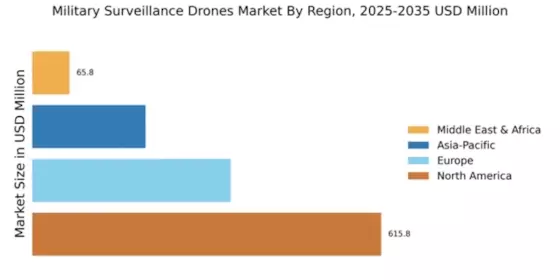
North America continues to lead the Military Surveillance Drones market, holding a significant share of 615.78 million in 2024. The region's growth is driven by increasing defense budgets, technological advancements, and a focus on national security. Regulatory support from government agencies further catalyzes market expansion, as countries prioritize modernizing their military capabilities to address emerging threats. The United States is the primary player in this market, with key companies like General Atomics, Northrop Grumman, and Lockheed Martin leading the charge. The competitive landscape is characterized by continuous innovation and partnerships, ensuring that North America remains at the forefront of military drone technology. The presence of established defense contractors enhances the region's market position, making it a hub for military surveillance solutions.

Europe : Growing Defense Investments

Europe is witnessing a growing interest in Military Surveillance Drones, with a market size of 350.0 million. The region's demand is fueled by increasing defense expenditures and collaborative projects among EU nations aimed at enhancing security. Regulatory frameworks are evolving to support drone integration into military operations, reflecting a commitment to modernizing defense strategies. Leading countries such as the UK, France, and Germany are at the forefront of this market, with companies like BAE Systems and Thales Group playing pivotal roles. The competitive landscape is marked by partnerships and joint ventures, as nations seek to leverage technological advancements. The European market is characterized by a focus on innovation and sustainability, positioning it as a key player in the global military drone sector.

Asia-Pacific : Emerging Powerhouse in Drones

Asia-Pacific is emerging as a significant player in the Military Surveillance Drones market, with a size of 200.0 million. The region's growth is driven by increasing geopolitical tensions and a rising focus on defense modernization. Countries are investing heavily in advanced surveillance technologies to enhance their military capabilities, supported by favorable government policies and funding initiatives. Key players in this region include countries like India, Japan, and Australia, which are actively developing and procuring military drones. The competitive landscape is evolving, with local manufacturers gaining traction alongside established global players. This dynamic environment is fostering innovation and collaboration, positioning Asia-Pacific as a critical market for military surveillance solutions.

Middle East and Africa : Strategic Defense Investments

The Middle East and Africa region is witnessing a burgeoning interest in Military Surveillance Drones, with a market size of 65.78 million. The growth is primarily driven by regional conflicts and the need for enhanced surveillance capabilities. Governments are increasingly recognizing the importance of modernizing their military assets, leading to a rise in defense budgets and procurement of advanced drone technologies. Countries like the UAE and South Africa are leading the charge in adopting military drones, supported by partnerships with global defense contractors. The competitive landscape is characterized by a mix of local and international players, all vying for a share of this emerging market. As security concerns escalate, the demand for military surveillance drones is expected to grow significantly in this region.

Key Players and Competitive Insights

The Military Surveillance Drones Market is currently characterized by a dynamic competitive landscape, driven by technological advancements and increasing defense budgets across various nations. Key players such as General Atomics (US), Northrop Grumman (US), and BAE Systems (GB) are strategically positioned to leverage innovation and partnerships to enhance their market presence. General Atomics (US) focuses on developing advanced drone technologies, while Northrop Grumman (US) emphasizes digital transformation and AI integration in its surveillance systems. BAE Systems (GB) is actively pursuing regional expansion and collaborations to strengthen its operational capabilities, collectively shaping a competitive environment that prioritizes technological superiority and strategic alliances.

In terms of business tactics, companies are increasingly localizing manufacturing and optimizing supply chains to enhance operational efficiency. The market appears moderately fragmented, with several key players exerting considerable influence. This structure allows for a diverse range of offerings, yet the collective strategies of major companies create a competitive atmosphere where innovation and technological advancements are paramount.

In November 2025, Northrop Grumman (US) announced a partnership with a leading AI firm to enhance its drone surveillance capabilities. This collaboration aims to integrate cutting-edge AI algorithms into their existing systems, potentially revolutionizing data analysis and operational efficiency. The strategic importance of this move lies in its potential to provide Northrop Grumman (US) with a competitive edge in the rapidly evolving landscape of military surveillance, where data-driven decision-making is increasingly critical.

In October 2025, BAE Systems (GB) unveiled a new line of surveillance drones designed for multi-domain operations. This launch is significant as it reflects BAE's commitment to innovation and adaptability in meeting the diverse needs of modern military operations. By expanding its product portfolio, BAE Systems (GB) positions itself to capture a larger share of the market, particularly in regions where multi-domain capabilities are becoming essential.

In September 2025, General Atomics (US) secured a contract with a European nation for the supply of its advanced surveillance drones. This contract not only underscores the company's strong international presence but also highlights the growing demand for sophisticated surveillance solutions in Europe. The strategic importance of this contract lies in its potential to enhance General Atomics' (US) reputation as a leading provider of military drones, further solidifying its market position.

As of December 2025, current trends in the Military Surveillance Drones Market indicate a strong emphasis on digitalization, sustainability, and AI integration. Strategic alliances are increasingly shaping the competitive landscape, allowing companies to pool resources and expertise. Looking ahead, competitive differentiation is likely to evolve from traditional price-based competition to a focus on innovation, advanced technology, and supply chain reliability. This shift suggests that companies that prioritize these aspects will be better positioned to thrive in an increasingly complex and demanding market.

Key Companies in the Military Surveillance Drones Market market include

Industry Developments

  • Q2 2024: Northrop Grumman wins $8.8 billion U.S. Army contract for next-generation surveillance drones Northrop Grumman was awarded a multi-year contract by the U.S. Army to develop and supply advanced surveillance drones, focusing on enhanced ISR (Intelligence, Surveillance, Reconnaissance) capabilities for battlefield operations.
  • Q2 2024: Elbit Systems secures $180 million contract to supply tactical surveillance drones to European defense ministry Elbit Systems announced a major contract win to deliver tactical surveillance drones to a European country, with deliveries scheduled to begin in late 2024.
  • Q2 2024: AeroVironment launches new Puma V4 military surveillance drone with extended endurance AeroVironment unveiled the Puma V4, a next-generation surveillance drone designed for military applications, featuring improved flight time and advanced sensor payloads.
  • Q3 2024: General Atomics partners with South Korean defense firm for co-development of surveillance UAVs General Atomics signed a strategic partnership agreement with a South Korean defense company to jointly develop and manufacture surveillance UAVs for regional and export markets.
  • Q3 2024: BAE Systems opens new drone manufacturing facility in the UK to meet rising military surveillance demand BAE Systems inaugurated a state-of-the-art facility dedicated to the production of military surveillance drones, aiming to support increased orders from European and Middle Eastern clients.
  • Q4 2024: Lockheed Martin unveils AI-powered surveillance drone for U.S. Air Force trials Lockheed Martin announced the launch of a new AI-enabled surveillance drone, set to undergo operational testing with the U.S. Air Force in early 2025.
  • Q4 2024: Turkey’s Baykar wins major export contract for military surveillance drones to African nation Baykar, a leading Turkish drone manufacturer, secured a significant export deal to supply military surveillance drones to an African government, expanding its international footprint.
  • Q1 2025: Israel Aerospace Industries announces $250 million contract for long-range surveillance drones Israel Aerospace Industries revealed a new contract to deliver long-range surveillance drones to a foreign defense customer, with deliveries planned through 2026.
  • Q1 2025: Teledyne FLIR launches Black Hornet 4 nano surveillance drone for military reconnaissance Teledyne FLIR introduced the Black Hornet 4, a nano drone designed for covert military surveillance and reconnaissance missions, featuring enhanced imaging and flight capabilities.
  • Q2 2025: U.S. Department of Defense awards $500 million contract to Boeing for next-gen surveillance UAVs Boeing received a substantial contract from the U.S. Department of Defense to develop and deliver next-generation surveillance UAVs, focusing on improved autonomy and sensor integration.
  • Q2 2025: Leonardo partners with Italian Ministry of Defense for new surveillance drone program Leonardo announced a partnership with the Italian Ministry of Defense to co-develop a new line of surveillance drones tailored for European military requirements.
  • Q3 2025: Saab secures contract to supply surveillance drones to Nordic defense alliance Saab won a contract to provide advanced surveillance drones to a coalition of Nordic countries, supporting joint defense and border monitoring initiatives.

Future Outlook

Military Surveillance Drones Market Future Outlook

The Military Surveillance Drones Market is projected to grow at a 10.39% CAGR from 2024 to 2035, driven by technological advancements, increasing defense budgets, and rising demand for intelligence, surveillance, and reconnaissance capabilities.

New opportunities lie in:

  • Integration of AI-driven analytics for real-time data processing
  • Development of hybrid drones for enhanced operational versatility
  • Expansion into emerging markets with tailored surveillance solutions

By 2035, the market is expected to solidify its position as a critical component of modern military operations.

Market Segmentation

Military Surveillance Drones Market Type Outlook

  • Fixed Wing
  • Rotary Wing
  • Hybrid
  • Nano Drones
  • Tactical Drones

Military Surveillance Drones Market End Use Outlook

  • Military
  • Defense Agencies
  • Government
  • Private Security
  • Research Institutions

Military Surveillance Drones Market Technology Outlook

  • Electro-Optical Systems
  • Infrared Sensors
  • Radar Systems
  • Communication Systems

Military Surveillance Drones Market Application Outlook

  • Surveillance
  • Reconnaissance
  • Target Acquisition
  • Border Patrol
  • Search and Rescue

Military Surveillance Drones Market Payload Capacity Outlook

  • Lightweight
  • Medium Weight
  • Heavy Weight
  • Ultra Heavy Weight

Report Scope

MARKET SIZE 20241231.56(USD Million)
MARKET SIZE 20251359.54(USD Million)
MARKET SIZE 20353654.01(USD Million)
COMPOUND ANNUAL GROWTH RATE (CAGR)10.39% (2024 - 2035)
REPORT COVERAGERevenue Forecast, Competitive Landscape, Growth Factors, and Trends
BASE YEAR2024
Market Forecast Period2025 - 2035
Historical Data2019 - 2024
Market Forecast UnitsUSD Million
Key Companies ProfiledGeneral Atomics (US), Northrop Grumman (US), Lockheed Martin (US), BAE Systems (GB), Thales Group (FR), Elbit Systems (IL), Textron (US), Leonardo (IT), AeroVironment (US)
Segments CoveredApplication, End Use, Type, Payload Capacity, Technology
Key Market OpportunitiesIntegration of artificial intelligence enhances operational efficiency in the Military Surveillance Drones Market.
Key Market DynamicsTechnological advancements and regulatory changes drive competition and innovation in the Military Surveillance Drones Market.
Countries CoveredNorth America, Europe, APAC, South America, MEA

Market Highlights

Author
Sejal Akre
Senior Research Analyst

She has over 5 years of rich experience, in market research and consulting providing valuable market insights to client. Hands on expertise in management consulting, and extensive knowledge in domain including ICT, Automotive & Transportation and Aerospace & Defense. She is skilled in Go-to market strategy, industry analysis, market sizing, in depth company profiling, competitive intelligence & benchmarking and value chain amongst others.

Leave a Comment

FAQs

How much is the Military Surveillance Drone market?

The Military Surveillance Drone Market size was valued at USD 1.11562407600485 Billion in 2023.

What is the growth rate of the Military Surveillance Drone market?

The global market is projected to grow at a CAGR of 10.4% from 2025 to 2034.

Which Region held the largest market share in the Military Surveillance Drone market?

North America had the largest share of the global market

Who are the key players in the Military Surveillance Drone market?

The key players in the market areBoeing Airbus Corporation,Lockheed Martin,Northrop Grumman Corporation,Thales Group,and Saab Group.

Which Drone Type led the Military Surveillance Drone market?

The Fixed Wing Drone Surveillance Drone category dominated the market in 2023.

Which Technology had the largest market share in the Military Surveillance Drone market?

The Hardwarehad the largest share in the global market.

Download Free Sample

Kindly complete the form below to receive a free sample of this Report

Compare Licence

×
Features License Type
Single User Multiuser License Enterprise User
Price $4,950 $5,950 $7,250
Maximum User Access Limit 1 User Upto 10 Users Unrestricted Access Throughout the Organization
Free Customization
Direct Access to Analyst
Deliverable Format
Platform Access
Discount on Next Purchase 10% 15% 15%
Printable Versions