Mining Explosives Market (2026 - 2035)

Mining Explosives Market Research Report Information By Type (Bulk Explosives, Packaged Explosives and Others), By Application (Coal Mining, Metal Mining and Quarry & Non-Metal Mining), and By Region (North America, Europe, Asia-Pacific, and Rest of the World) - Forecast Till 2035
ID: MRFR/CnM/5703-CR
111 Pages
Priya Nagrale
Last Updated: July 06, 2026
Mining Explosives Market
Market Size
Forecast Period2026-2035
CAGR (2026-2035)3.85%
2025 Market SizeUSD 14.38 Billion
2035 Market SizeUSD 20.97 Billion
Key Players
Orica Limited
Dyno Nobel
MAXAM
Enaex S.A.
Austin Powder
Solar Industries India
Opportunities
  • Digital Blast-as-a-Service Models
  • African Critical-Mineral Corridor Development
  • Hydrogen-Peroxide-Based Emulsion Formulations

Mining Explosives Market Summary

The mining explosives market reached USD 14.38 billion in 2025 and is projected to grow from USD 14.93 billion in 2026 to USD 20.97 billion by 2035, registering a CAGR of 3.85% during the forecast period (2026–2035). Two converging forces drive this trajectory: governments worldwide are accelerating critical-mineral extraction programs to supply lithium, cobalt, and rare-earth elements needed for battery gigafactories, while simultaneously committing over USD 1.2 trillion to infrastructure renewal programs that require large-scale quarrying [1]. These policy catalysts create durable demand for commercial blasting products across both surface and underground operations.

Technology is reshaping how operators consume explosives. Conventional shock-tube and fuse-based initiation is giving way to electronic detonator systems that offer millisecond-level timing precision, reducing ground vibration by up to 40% and improving fragmentation consistency [2]. Concurrently, mine-site emulsion plants are replacing pre-packaged cartridge supply chains, enabling operators to manufacture sensitized product at the bench and cut logistics costs by an estimated 15–20% per blast cycle [3]. Several tier-one producers have invested over USD 500 million collectively since 2022 in digital blast-design platforms that integrate drill-pattern data, geology models, and real-time detonation analytics.

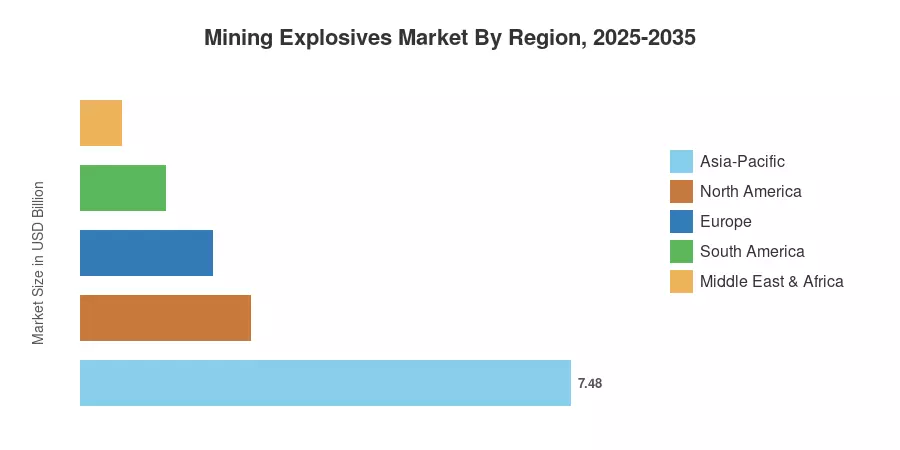
Asia-Pacific dominates the Mining Explosives Market with roughly 52% of global value, anchored by China's thermal-coal output and India's expanding limestone-quarrying sector. The Middle East & Africa region is the fastest-growing geography, posting a projected CAGR of 4.31%, propelled by Saudi Arabia's Vision 2030 mining diversification and accelerating critical-mineral exploration across sub-Saharan Africa. North America holds the second-largest share at approximately 18%, supported by copper and gold expansions in Nevada and British Columbia. As decarbonization agendas intensify demand for transition metals, the Mining Explosives Market is poised for sustained mid-single-digit growth through 2035.


Key Report Takeaways

• By Explosive Type

  • Bulk explosives commanded approximately 69% of the Mining Explosives Market share in 2025, driven by large-scale open-pit operations favoring emulsion-based products.
  • Packaged explosives are forecast to advance at a 4.25% CAGR between 2026 and 2035, supported by growth in narrow-vein underground mining.

• By Initiation System

  • Electronic detonators held roughly 42% of the initiation-system segment in 2025, reflecting operators' shift toward precision timing.
  • Non-electric initiation systems remain the volume leader but face share erosion as regulatory vibration limits tighten globally.

• By Application

  • Coal mining accounted for approximately 62% of the Mining Explosives Market in 2025, though its share is expected to plateau as thermal-coal output declines in OECD nations.
  • Quarry and construction aggregates are set to grow at a 4.37% CAGR through 2035, fueled by global infrastructure spending.

• By Region

  • Asia-Pacific held about 52% of the global Mining Explosives Market value in 2025.
  • The Middle East & Africa region is expected to grow at a 4.31% CAGR through 2035.


Mining Explosives Market Size and Forecast (2021–2035)

Market Research Future's market-size estimates combine primary interviews with explosive manufacturers, distributors, and mine operators alongside secondary data from national mining statistics bureaus, import-export databases, and published company revenues. Historical figures (2021–2024) reflect actual reported shipments; the base year (2025) is estimated from trailing-twelve-month data, and the forecast (2026–2035) applies a compound methodology validated against regional production indices.
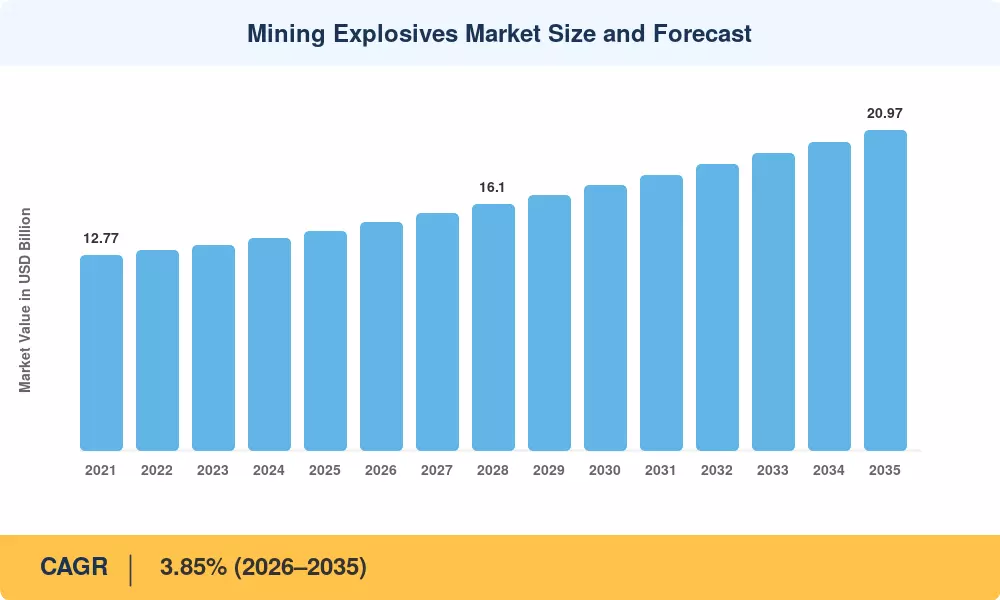
Mining Explosives Market Size and Forecast
Our Impact
Enabled $4.3B Revenue Impact for Fortune 500 and Leading Multinationals
Partnering with 2000+ Global Organizations Each Year
30K+ Citations by Top-Tier Firms in the Industry

Driver Impact Analysis

Driver ~% Impact on CAGR Geographic Relevance Impact Timeline
Critical-mineral extraction for energy transition +0.85% Global Long-term (≥4 yr)
Infrastructure and urbanization spending +0.70% Asia-Pacific, North America Medium-term (2–4 yr)
Electronic detonator regulatory mandates +0.55% Europe, Australia Medium-term (2–4 yr)
Deepening underground mine development +0.40% South America, Africa Long-term (≥4 yr)
On-site emulsion manufacturing expansion +0.35% Asia-Pacific, North America Short-term (≤2 yr)
Coal production in emerging economies +0.30% India, Indonesia Short-term (≤2 yr)
Digital blast optimization platforms +0.25% Global Medium-term (2–4 yr)


Critical-Mineral Extraction for Energy Transition

According to the International Energy Agency, in a net-zero scenario, the demand for nickel will quadruple, and the demand for lithium will surge sixfold by 2030, necessitating significant new hard-rock mining capacity [8]. During the stripping stage, each greenfield lithium or copper project uses 5,000 to 15,000 tonnes of bulk explosives per year. Since 2023, the governments of Australia, Chile, and the Democratic Republic of the Congo have expedited approval for more than 60 critical-mineral projects, totaling an estimated USD 90 billion in capital expenditures [7]. The Mining Explosives Market's addressable volume is directly increased by this spike.


Infrastructure and Urbanization Spending

The US Bipartisan Infrastructure Law budgeted USD 550 billion for roads, bridges, and tunnels, much of which requires aggregate output from quarries [6]. India's Gati Shakti program similarly channels approximately USD 120 billion into logistics routes that demand crushed stone and ballast. Quarrying activities typically burn 0.15–0.25 kg of explosives per tonne of rock produced, translating infrastructure funds directly into blasting-product demand and supporting the Mining Explosives Market expansion in both regions.


Electronic Detonator Regulatory Mandates

Australia's New South Wales and Queensland states have enacted ground-vibration limits below 5 mm/s for blasts within 500 meters of occupied structures, effectively mandating electronic initiation for compliance [2]. The European Union's revised Explosives Precursors Regulation also tightens traceability requirements, favoring electronically logged systems. These regulatory shifts push operators to upgrade from non-electric systems, increasing per-blast expenditure by approximately 12–18% but reducing re-blast rates and community complaints.

Deepening Underground Mine Development

As surface reserves deplete, global average stripping ratios have risen from 3.5:1 in 2015 to an estimated 4.2:1 in 2025 [12]. Deeper underground deposits in South American copper belts and African platinum-group-metal seams require specialized packaged explosives and precisely timed initiation, creating a product-mix shift that carries higher revenue per tonne for the Mining Explosives Market.


Restraints Impact Analysis

Restraint ~% Impact on CAGR Geographic Relevance Impact Timeline
Stringent environmental and safety regulations −0.40% Europe, North America Long-term (≥4 yr)
Thermal-coal phase-down in OECD economies −0.35% Europe, North America Long-term (≥4 yr)
Ammonium nitrate supply-chain security controls −0.25% Global Medium-term (2–4 yr)
Mechanical and continuous mining alternatives −0.20% Australia, Europe Medium-term (2–4 yr)
Currency volatility in emerging-market economies −0.15% South America, Africa Short-term (≤2 yr)


Thermal-Coal Phase-Down in OECD Economies

The Mining Explosives Market's major application category is coal mining; however, under the Powering Past Coal Alliance, OECD governments have pledged to phase out unchecked coal power by 2030 [14]. Germany decommissioned its final hard-coal mine in 2018, and the US Energy Information Administration anticipates a 25% reduction in domestic coal production by 2035. Each percentage-point decline in coal output removes around 80,000–100,000 tonnes of yearly blasting-product consumption from the worldwide demand base [14].


Ammonium Nitrate Supply-Chain Security Controls

Following high-profile storage mishaps, numerous jurisdictions have passed tougher ammonium nitrate handling, storage, and transit laws. Both the EU's updated Seveso III Directive and Australia's Security of Dangerous Substances Act incur high compliance costs, estimated at USD 3–5 per tonne of manufactured goods [15]. The Mining Explosives Market's supply responsiveness is limited by these laws, which raise working capital needs for producers and may cause supplies to distant mine locations to be delayed.


Mechanical and Continuous Mining Alternatives

Continuous miners, road-headers, and tunnel-boring machines are displacing drill-and-blast methods in select underground coal and soft-rock operations. In Australian longwall coal mines, mechanical extraction now handles over 70% of production tonnage, directly reducing explosive consumption per mine [16]. While hard-rock applications remain largely blast-dependent, incremental adoption of non-explosive methods presents a structural headwind.


Mining Explosives Market Opportunities

Digital Blast-as-a-Service Models

Explosives producers are packaging blast-design software, IoT sensor networks, and outcome-based contracts into subscription platforms that guarantee fragmentation and vibration targets. This model shifts revenue from commodity product sales to recurring service fees, potentially increasing per-customer lifetime value by 30–40% [11]. Early adopters in the Mining Explosives Market can lock in multi-year contracts and insulate margins from raw-material volatility.

African Critical-Mineral Corridor Development

Sub-Saharan Africa hosts over 30% of global cobalt reserves and significant lithium deposits in Zimbabwe, the DRC, and Mali [7]. With over USD 15 billion in announced greenfield mining investments across the continent since 2023, explosives demand in the region could double within the decade. Suppliers establishing local emulsion plants and distribution hubs stand to capture first-mover advantage in this rapidly expanding Mining Explosives Market corridor.

Hydrogen-Peroxide-Based Emulsion Formulations

Regulatory pressure on ammonium nitrate has spurred R&D into alternative oxidizer chemistries. Hydrogen-peroxide-sensitized emulsions offer a potentially lower-risk profile for transport and storage while maintaining comparable energy output [18]. If commercialized at scale, these formulations could open new market segments in jurisdictions with restrictive ammonium nitrate policies, representing a differentiated growth path for the Mining Explosives Market.

Quarrying Expansion in Emerging Asian Economies

India's National Infrastructure Pipeline targets USD 1.4 trillion in capital projects by 2030, while Indonesia and Vietnam pursue major expressway and port construction programs [9]. Aggregate demand from these projects will drive quarry blasting volumes upward, creating opportunities for suppliers who can offer cost-effective bulk emulsion and on-site mixing solutions.

Autonomous Drill-and-Blast Integration

Autonomous drilling rigs paired with GPS-guided hole-loading systems are enabling fully digitized blast cycles at major open-pit mines in Australia and Chile [11]. Explosives companies that integrate their products with these autonomous ecosystems — offering compatible electronic detonators and remote-initiation modules — will differentiate in the Mining Explosives Market and command premium pricing.


Mining Explosives Market Future Outlook

Autonomous Drill-and-Blast Ecosystems

By 2030, autonomous haulage and drilling systems are expected to be operational at over 50 major open-pit mines globally, according to the International Council on Mining and Metals [11]. Explosives manufacturers that embed their electronic initiation products and real-time blast-monitoring sensors into these autonomous workflows will transition from commodity suppliers to integrated technology partners within the Mining Explosives Market.

Electrification Supercycle and Metal Demand

The IEA's Global Critical Minerals Outlook estimates that mine output of lithium must triple and copper output must rise by 50% before 2035 to meet net-zero targets [8]. Each new large-scale hard-rock mine entering production adds 5,000–20,000 tonnes of annual blasting-product consumption, creating a structural demand uplift for the Mining Explosives Market over the coming decade.

ESG Reporting and Low-Impact Blasting

Scope 3 emissions disclosure under frameworks such as the IFRS Sustainability Standards will compel miners to report blasting-related carbon footprints by the late 2020s [19]. Explosives companies offering lower-carbon formulations, reduced-NOₓ emulsion chemistries, and verifiable ESG scorecards will gain preferential procurement standing in the Mining Explosives Market.

Regionalized Supply Chains and Nearshoring

Geopolitical tensions and pandemic-era disruptions have prompted major mining houses to localize their explosives supply chains. On-site manufacturing plants, regional emulsion storage depots, and dual-sourcing strategies are becoming standard procurement practice [3]. This trend favors producers with geographically diversified manufacturing footprints and strengthens regional players' positions within the Mining Explosives Market.


Mining Explosives Market Segmentation

By Explosive Type

Segment Key Metric Primary Demand Driver
Bulk Explosives ~69% share (2025) Open-pit coal and metal mining
Packaged Explosives 4.25% CAGR (2026–2035) Underground narrow-vein operations


Bulk explosives — primarily ANFO and emulsion blends — dominate the Mining Explosives Market because large surface mines consume product in volumes that only on-site manufacturing and mobile mixing units can economically serve. Emulsion technology has gained ground over traditional ANFO in wet-hole conditions, as its water-resistant matrix eliminates the need for costly dewatering before loading. The shift toward deeper open-pit benches with higher water tables further accelerates emulsion uptake.

Packaged explosives, including cartridged emulsions and watergel sticks, serve underground and dimension-stone operations where precise charge placement outweighs volume economics. The segment's above-average growth reflects expanding underground development in South American copper and African platinum mines, where narrow-vein geometries require controlled blasting with smaller-diameter products.

By Initiation System

Segment Key Metric Primary Demand Driver
Non-Electric ~48% share (2025) Cost-effective surface blasting
Electronic Detonators 4.62% CAGR (2026–2035) Precision timing and vibration control
Electric Fuse and Det-Cord ~10% share (2025) Legacy systems and secondary initiation


Electronic detonators represent the fastest-growing initiation technology in the Mining Explosives Market, offering programmable delay intervals down to 1-millisecond precision. This capability enables wave-interference blast designs that reduce peak particle velocity, allowing operations near communities to comply with tightening vibration regulations [2]. Non-electric systems retain a plurality share due to lower unit costs and broad availability, but their market position is gradually eroding as electronic pricing declines through scale manufacturing.

By Application

Segment Key Metric Primary Demand Driver
Coal Mining ~62% share (2025) Thermal and metallurgical coal extraction
Metal Mining 4.18% CAGR (2026–2035) Copper, gold, lithium expansion
Quarry and Construction Aggregates 4.37% CAGR (2026–2035) Global infrastructure programs


Coal mining remains the Mining Explosives Market's largest application, though its dominance is gradually declining as OECD thermal-coal output contracts. In contrast, emerging-economy coal producers — particularly India and Indonesia — continue to expand output, partially offsetting OECD declines. Metal mining is emerging as the primary long-term growth driver, with copper, lithium, and rare-earth projects requiring intensive drill-and-blast programs during their multi-year stripping phases.


Regional Market Share Analysis

Region Key Metric Primary Investment Themes
Asia-Pacific ~52% share (2025) Coal, limestone quarrying, critical minerals
North America ~18% share (2025) Copper, gold, infrastructure aggregates
Europe ~14% share (2025) Quarrying, tunneling, environmental compliance
South America ~9% share (2025) Copper, lithium, iron ore
Middle East & Africa 4.31% CAGR (2026–2035) Vision 2030, critical minerals, coal (Mozambique)
Total USD 14.38 Billion (2025)

The regional breakdown of the Mining Explosives Market reflects the geographic distribution of extractive industries, with mineral-rich regions commanding proportionally higher explosives consumption. Five regions shape the competitive landscape, each driven by distinct resource profiles and policy environments.


North America

Country Key Metric Key Driver
US ~72% of regional share Copper/gold expansion in Nevada, Arizona
Canada 3.91% CAGR Oil-sands and potash operations
Mexico USD 0.29 Billion (2025) Silver and zinc mining growth


The US accounts for the majority of North American Mining Explosives Market demand, supported by over USD 14 billion in permitted copper-mine expansions in Arizona and Nevada alone [5]. Canada's Saskatchewan potash producers and Alberta oil-sands operators maintain steady consumption, while Mexico's mining reform agenda is attracting fresh foreign investment into precious-metal extraction.

Europe

Country Key Metric Key Driver
Germany ~16% of regional share Quarrying, tunneling projects
UK 3.52% CAGR Aggregates and infrastructure renewal
France USD 0.22 Billion (2025) Limestone quarrying
Italy ~10% of regional share Marble and aggregate extraction
Spain 3.61% CAGR Metal mining resurgence
Nordic Countries ~18% of regional share Iron ore (Sweden), copper (Finland)
Russia USD 0.35 Billion (2025) Coal and base-metal mining
Rest of Europe ~12% of regional share Diverse quarrying and tunneling


European demand for the Mining Explosives Market centers on quarrying and tunnel construction, with the Nordic countries standing out due to Sweden's LKAB iron-ore operations and Finland's emerging battery-mineral projects [13]. Strict EU vibration and noise directives accelerate electronic detonator adoption, while the continent's thermal-coal phase-out gradually shifts the application mix toward aggregates and metal mining.

Asia-Pacific

Country Key Metric Key Driver
China ~55% of regional share Coal and infrastructure quarrying
India 4.42% CAGR Limestone, coal, highway aggregates
Japan USD 0.21 Billion (2025) Tunneling and quarrying
South Korea ~3% of regional share Infrastructure aggregates
ASEAN 4.15% CAGR Coal (Indonesia), construction (Vietnam)
Rest of Asia-Pacific ~5% of regional share Mongolia, Central Asia mining


China remains the single largest national consumer in the Mining Explosives Market, driven by annual coal output exceeding 4.5 billion tonnes and massive highway and rail infrastructure programs [9]. India is the fastest-growing major market within the region, with limestone quarrying for cement production expanding at over 6% annually and the government's Pradhan Mantri Gati Shakti plan catalyzing unprecedented aggregate demand.

South America

Country Key Metric Key Driver
Brazil ~45% of regional share Iron ore and gold mining
Argentina 4.08% CAGR Lithium triangle development
Rest of South America USD 0.40 Billion (2025) Copper (Chile, Peru)


South America's Mining Explosives Market trajectory is closely tied to the copper and lithium extraction cycles. Chile and Peru collectively represent over 40% of global copper mine output, and new lithium-brine and hard-rock projects in Argentina's Salta and Jujuy provinces are adding incremental explosives demand [12]. Political stability and permitting timelines remain key variables for sustained growth.

Middle East & Africa

Country Key Metric Key Driver
Saudi Arabia ~22% of regional share Vision 2030 mining diversification
UAE 3.78% CAGR Quarrying for construction
South Africa USD 0.32 Billion (2025) Platinum, gold, coal mining
Egypt ~8% of regional share Phosphate and gold extraction
Rest of MEA 4.55% CAGR DRC cobalt, Mozambique coal, Zimbabwe lithium


The Middle East & Africa region posts the highest forecast CAGR for the Mining Explosives Market, anchored by Saudi Arabia's commitment to unlock over USD 1.3 trillion in untapped mineral resources under its geological survey program [10]. Sub-Saharan Africa's critical-mineral exploration boom — spanning cobalt in the DRC, lithium in Zimbabwe, and metallurgical coal in Mozambique — is attracting multinational mining companies and, with them, substantial blasting-product contracts.


Mining Explosives Market By Region, 2025-2035

Competitive Benchmarking

The Mining Explosives Market exhibits high concentration, with the top five companies accounting for an estimated 55–60% of global revenue. The Herfindahl-Hirschman Index (HHI) sits in the moderately concentrated range (~1,800–2,200), reflecting a handful of multinational producers competing alongside a larger tier of regional specialists. Competition centers on technology integration, supply-chain reliability, and long-term service contracts rather than pure price.

Company Est. Revenue Share Range Key Offerings for Mining Explosives Market Strategic Positioning
Orica Limited ~15–18% Bulk emulsions, electronic detonators (WebGen), BlastIQ platform Global technology leader with wireless initiation
Dyno Nobel (IPL) ~10–13% ANFO, emulsions, DynoConsult blasting services Integrated supply and technical services
MAXAM ~7–10% Emulsions, electronic detonators, Riotech blast software European leader with Africa/Latin America expansion
Enaex S.A. ~5–8% Bulk emulsions, Enaex Digital platform South American market leader, Chile copper focus
Austin Powder ~4–6% Packaged explosives, shock-tube systems North American underground and quarry specialist
Solar Industries India ~4–6% Bulk and packaged explosives, detonators Indian market leader, expanding into Africa
AECI Mining Explosives ~3–5% Emulsions, initiating systems, DetNet electronics Southern and East African market leader
EPC Groupe ~3–5% Emulsions, detonators, blasting accessories European and West African presence
BME (Omnia Group) ~2–4% AXXIS electronic detonators, emulsion systems Technology-led African producer
Hanwha Corporation ~2–4% Industrial explosives, detonators Asian market focus with global expansion


Recent News & Developments

  • Innovex 300D, a bulk emulsion mining explosive for surface mining situations impacted by dynamic water, was introduced by BME, a division of Omnia Group, in September 2024. The solution helps mining companies manage operational and environmental difficulties caused by excessive water flow around blast holes.
  • October 2023: A nitrate-free emulsion mining explosive was released by Omnia Group in partnership with Hypex Bio Explosives Technology. The hydrogen peroxide-based explosive attempts to lessen environmental effects compared to standard explosives in mining operations.


Mining Explosives Market Report Scope

Parameter Detail
Market Scope Mining Explosives Market — global and five-region coverage
Study Period 2021–2035
CAGR (Forecast) 3.85% (2026–2035)
Market Size (2025) USD 14.38 Billion
Market Size (2035) USD 20.97 Billion
Fastest Growing Segment Electronic Detonators (by initiation); Quarry & Construction Aggregates (by application)
Companies Profiled 10 (Orica, Dyno Nobel, MAXAM, Enaex, Austin Powder, Solar Industries India, AECI, EPC Groupe, BME, Hanwha)
Valuation Currency USD Billion


FAQs

What total cost of ownership factors should buyers consider when selecting between ANFO and emulsion blasting products?
Emulsion products carry a 20–30% higher unit cost than ANFO but eliminate dewatering expenses and reduce misfires in wet-hole conditions [3]. Buyers should model total drill-and-blast cost per tonne broken, including re-blast frequency and equipment downtime.
How do long-term supply contracts with major producers differ from spot purchasing for mid-tier mines?
Multi-year contracts typically lock in pricing formulas tied to ammonium nitrate indices and guarantee on-site technical support [4]. Spot purchasing offers flexibility but exposes buyers to volatile raw-material surcharges during supply disruptions.
What role does blast-vibration monitoring play in mine permitting near populated areas?
Regulatory agencies increasingly require real-time seismograph data before issuing or renewing blast permits [2]. Mines that deploy continuous monitoring and share data with community stakeholders face fewer permitting delays.
How are wireless electronic detonators changing underground mine-blast safety protocols?
Wireless systems eliminate the need for physical firing lines, allowing personnel to retreat to safe zones before signal transmission [20]. This reduces blast-area exclusion times and improves shift productivity in deep underground operations.
What procurement certifications should buyers verify when sourcing explosives across jurisdictions?
Cross-border purchases require verification of both export licenses from the origin country and import permits aligned with the destination's precursor regulations [15]. Buyers should confirm that suppliers hold current ISO 17025 testing accreditation for product consistency.
How does on-site mobile manufacturing unit (MMU) deployment affect supply-chain resilience for remote mines?
MMUs enable mines located more than 200 km from fixed plants to produce sensitized emulsion at the bench, cutting transport risks and lead times [3]. They require dedicated maintenance crews and raw-material storage infrastructure.
What emerging insurance and liability considerations apply to mines adopting autonomous blast-initiation systems?
Underwriters are developing new policy frameworks that assign liability based on software-decision logs rather than operator actions [11]. Mines should engage insurers early during autonomous-blast pilot phases to clarify coverage terms.    
Author
Author
Author Profile
Priya Nagrale LinkedIn
Senior Research Analyst
With an experience of over five years in market research industry (Chemicals & Materials domain), I gather and analyze market data from diverse sources to produce results, which are then presented back to a client. Also, provide recommendations based on the findings. As a Senior Research Analyst, I perform quality checks (QC) for market estimations, QC for reports, and handle queries and work extensively on client customizations. Also, handle the responsibilities of client proposals, report planning, report finalization, and execution

Research Approach


Secondary Research

The secondary research process involved comprehensive analysis of regulatory databases, industry publications, mining safety journals, and authoritative government and international organizations. Key sources included the US Bureau of Alcohol, Tobacco, Firearms and Explosives (ATF), US Mine Safety and Health Administration (MSHA), US Geological Survey (USGS), European Commission Directorate-General for Internal Market, Industry, Entrepreneurship and SMEs (DG GROW), European Chemicals Agency (ECHA), International Labour Organization (ILO) Mining Safety Database, International Council on Mining and Metals (ICMM), International Society of Explosives Engineers (ISEE), National Mining Association (NMA), Minerals Council of Australia (MCA), China National Coal Association (CNCA), Indian Bureau of Mines (IBM), Australian Bureau of Statistics (ABS), Statistics Canada, Eurostat Industrial Production Database, World Bank Commodity Price Data, United Nations Comtrade Database, and national mining ministry reports from key markets. These sources were used to collect mineral extraction statistics, explosives consumption data, regulatory compliance frameworks, safety incident reports, trade flow analysis, and market landscape assessment for bulk explosives, packaged explosives, emulsions, ANFO, water gels, slurries, and caps & detonators.


Primary Research

In the primary research phase, qualitative and quantitative insights were gathered through interviews with supply-side and demand-side players. Supply-side sources included CEOs, VPs of Manufacturing & Operations, heads of Blasting Technology & Innovation, regulatory compliance officers and commercial directors from explosives manufacturers, blasting service providers and chemical feedstock suppliers. Demand-side sources included chief mining engineers, mine operations managers, procurement leads from large-scale mining corporations (coal, metal and quarry operations), quarry managers and project directors from civil engineering & infrastructure contractors. Primary research validated the segmentation of the market and product development periods, and offered insights on the adoption of blast design, procurement strategies (bulk or packaged explosives), pricing dynamics driven by commodity cycles of ammonium nitrate and fuel oil, and costs of regulatory compliance.

Primary Respondent Breakdown:

By Designation: C-level Primaries (30%), Director Level (32%), Others (38%)

By Region: North America (32%), Europe (30%), Asia-Pacific (28%), Rest of World (10%)


Market Size Estimation

Global market valuation was derived through revenue mapping and explosives consumption volume analysis. The methodology included:

Identification of 50+ key manufacturers and blasting service providers across North America, Europe, Asia-Pacific, Latin America, and Middle East & Africa

Product mapping across bulk explosives (emulsions, ANFO, water gels, slurries), packaged explosives, and initiation systems (caps and detonators)

Analysis of reported and modeled annual revenues specific to mining explosives portfolios

Coverage of manufacturers representing 65–70% of global market share in 2024

Extrapolation using bottom-up (explosives volume consumption × ASP by country/commodity) and top-down (manufacturer revenue validation) approaches to derive segment-specific valuations for coal mining, metal mining, quarry & non-metal mining, and other applications

Download Free Sample

Kindly complete the form below to receive a free sample of this Report

Download PDF ×

We do not share your information with anyone. However, we may send you emails based on your report interest from time to time. You may contact us at any time to opt-out.
















