×
Request Free Sample ×

Kindly complete the form below to receive a free sample of this Report

* Please use a valid business email

Leading companies partner with us for data-driven Insights

clients tt-cursor
Hero Background

Missile Interceptor Market

ID: MRFR/AD/4729-HCR
100 Pages
Sejal Akre
October 2025

Missile Interceptor Market Research Report By Missile Type (Ballistic Missiles, Cruise Missiles, Anti-Ship Missiles, Surface-to-Air Missiles), By Deployment Mode (Land-based, Sea-based, Airborne), By Guidance System (Inertial Navigation System, Positioning System, Command Guidance, Active Radar Guidance), By End User (Military, Defense Contractors, Government Agencies) and By Regional (North America, Europe, South America, Asia Pacific, Middle East and Africa) - Forecast to 2035.

Share:
Download PDF ×

We do not share your information with anyone. However, we may send you emails based on your report interest from time to time. You may contact us at any time to opt-out.

Missile Interceptor Market Infographic
Purchase Options

Missile Interceptor Market Summary

As per MRFR analysis, the Missile Interceptor Market Size was estimated at 40.06 USD Billion in 2024. The Missile Interceptor industry is projected to grow from 41.77 USD Billion in 2025 to 63.46 USD Billion by 2035, exhibiting a compound annual growth rate (CAGR) of 4.27 during the forecast period 2025 - 2035.

Key Market Trends & Highlights

The Missile Interceptor Market is poised for robust growth driven by technological advancements and rising geopolitical tensions.

  • North America remains the largest market for missile interceptors, reflecting substantial defense investments.
  • The Asia-Pacific region is emerging as the fastest-growing market, fueled by increasing military expenditure and regional security concerns.
  • Ballistic missiles dominate the market, while cruise missiles are experiencing rapid growth due to evolving threats.
  • Rising geopolitical tensions and increased military expenditure are key drivers propelling the demand for advanced missile interceptor systems.

Market Size & Forecast

2024 Market Size 40.06 (USD Billion)
2035 Market Size 63.46 (USD Billion)
CAGR (2025 - 2035) 4.27%

Major Players

Lockheed Martin (US), Raytheon Technologies (US), Northrop Grumman (US), BAE Systems (GB), Thales Group (FR), Leonardo (IT), Kongsberg Gruppen (NO), Mitsubishi Heavy Industries (JP), Rafael Advanced Defense Systems (IL)

Missile Interceptor Market Trends

The Missile Interceptor Market is currently experiencing a dynamic evolution, driven by the increasing geopolitical tensions and the necessity for enhanced national security measures. Nations are investing heavily in advanced missile defense systems to counteract potential threats, which has led to a surge in demand for innovative interceptor technologies. This market is characterized by a diverse range of products, including ground-based and sea-based systems, each designed to address specific defense needs. Furthermore, the integration of cutting-edge technologies such as artificial intelligence and machine learning into missile defense systems is reshaping the landscape, potentially improving interception accuracy and response times. In addition to technological advancements, collaboration between governments and defense contractors is becoming more pronounced. Partnerships are forming to develop next-generation interceptors that can adapt to evolving threats. The Missile Interceptor Market is also witnessing a shift towards more flexible and modular systems, allowing for easier upgrades and integration with existing defense infrastructures. As nations prioritize their defense capabilities, the market is poised for continued growth, with an emphasis on innovation and strategic alliances to enhance overall security frameworks.

Technological Advancements

The Missile Interceptor Market is witnessing rapid technological advancements, particularly in the areas of sensor technology and guidance systems. These innovations are enhancing the precision and effectiveness of interceptors, enabling them to engage a wider array of threats with greater reliability.

Increased Defense Budgets

Many countries are allocating larger portions of their defense budgets to missile defense initiatives. This trend reflects a growing recognition of the importance of robust defense systems in maintaining national security and deterring potential aggressors.

International Collaborations

There is a noticeable increase in international collaborations among nations to develop and share missile defense technologies. Such partnerships are fostering knowledge exchange and accelerating the development of advanced interceptor systems, thereby strengthening collective security efforts.

Missile Interceptor Market Drivers

Technological Innovations

Technological advancements play a pivotal role in shaping the Missile Interceptor Market. Innovations in radar systems, guidance technologies, and propulsion mechanisms are enhancing the effectiveness of missile interceptors. The integration of artificial intelligence and machine learning is also revolutionizing target identification and interception strategies. As a result, manufacturers are focusing on developing next-generation interceptors that can engage multiple threats simultaneously. The market is projected to witness a compound annual growth rate of around 6-8% over the next five years, driven by these technological innovations that promise improved accuracy and reliability in missile defense systems.

Rising Geopolitical Tensions

The Missile Interceptor Market is experiencing growth due to escalating geopolitical tensions among nations. Countries are increasingly investing in missile defense systems to safeguard their sovereignty and deter potential threats. For instance, the ongoing conflicts in various regions have prompted nations to enhance their military capabilities, leading to a projected increase in defense spending. According to recent estimates, defense budgets are expected to rise by approximately 3-5% annually, with a significant portion allocated to missile defense systems. This trend indicates a robust demand for advanced missile interceptors, as nations seek to bolster their defense infrastructure against perceived threats.

Increased Military Expenditure

The Missile Interceptor Market is significantly influenced by the rising military expenditure across various nations. Governments are prioritizing defense spending to address emerging security challenges, which includes the procurement of advanced missile defense systems. Recent data indicates that military budgets are expected to reach unprecedented levels, with several countries earmarking substantial funds for missile defense initiatives. This trend is particularly evident in regions facing heightened security threats, where nations are compelled to invest in robust missile interceptor systems to ensure national security. Consequently, this surge in military expenditure is likely to propel the growth of the missile interceptor market.

Strategic Alliances and Partnerships

Strategic alliances and partnerships are becoming increasingly prevalent within the Missile Interceptor Market. Nations are recognizing the importance of collaboration in developing advanced missile defense systems. Joint ventures between countries and defense contractors facilitate knowledge sharing and resource pooling, leading to the creation of more sophisticated interceptors. For example, recent collaborations have resulted in the development of integrated defense systems that enhance interception capabilities. These partnerships not only accelerate technological advancements but also expand market reach, as countries seek to leverage each other's strengths in missile defense. This trend is expected to continue, further driving market growth.

Emerging Threats and Security Challenges

The Missile Interceptor Market is responding to emerging threats and evolving security challenges. The proliferation of ballistic and cruise missiles poses significant risks to national and regional security. As a result, nations are compelled to enhance their missile defense capabilities to counter these threats effectively. The increasing frequency of missile tests by certain states has heightened concerns, prompting governments to invest in advanced interceptor systems. This proactive approach to defense is likely to sustain market growth, as countries prioritize the development and acquisition of missile interceptors to safeguard their territories against potential attacks.
Market Segment Insights

By Type: Ballistic Missiles (Largest) vs. Cruise Missiles (Fastest-Growing)

In the Missile Interceptor Market, the distribution of market share is significantly influenced by the increasing global tensions and the evolution of missile technology. Ballistic missiles represent the largest segment, driven by their strategic importance and extensive deployment in global military arsenals. Meanwhile, cruise missiles, though smaller in share relative to ballistic missiles, are experiencing rapid growth due to advancements in precision strike capabilities and heightened interest from various military forces around the globe. The growth trends for these segments indicate burgeoning advancements in missile defense technologies, with nations investing heavily in developing and deploying state-of-the-art interceptors. The increasing focus on countering evolving threats, such as hypersonic and advanced cruise missiles, is pushing the demand for innovative interception solutions. Furthermore, geopolitical tensions and the need for robust national defense systems are propelling the growth of the cruise missile segment, making them a central focus in modern military strategy.

Ballistic Missiles (Dominant) vs. Anti-Ship Missiles (Emerging)

Ballistic missiles remain dominant in the Missile Interceptor Market due to their strategic significance in military operations, primarily used for long-range engagements and deterrent capabilities. They have undergone technological advancements, enhancing their reliability and effectiveness against various targets. On the other hand, anti-ship missiles represent an emerging segment, gaining traction as naval warfare evolves. With advancements in anti-ship missile technology, nations are increasingly focusing on these systems to counter maritime threats. The effectiveness of anti-ship interceptors is vital as naval operations become more complex, with layered defense systems designed to protect critical assets at sea. The interplay between these segments underscores the necessity for robust interceptor systems across all domains of modern warfare.

By Deployment Mode: Land-based (Largest) vs. Sea-based (Fastest-Growing)

In the Missile Interceptor Market, the deployment mode segment is prominently characterized by land-based systems, which hold the largest market share. These systems are preferred for their strategic advantages, including ease of deployment and extensive coverage capabilities. In contrast, sea-based interceptors are rapidly gaining traction due to advancements in naval technology and the increasing emphasis on maritime security. The balance between these two deployment modes illustrates a dynamic market responding to evolving defense needs.

Land-based (Dominant) vs. Sea-based (Emerging)

Land-based missile interceptors serve as the backbone of national defense strategies, providing robust defensive capabilities against aerial threats. Their fixed installations allow for thorough integration with existing air defense systems, making them an essential component of military strategy. On the other hand, sea-based interceptors are emerging as a formidable alternative, particularly in naval operations. These systems offer mobility, flexibility, and the ability to protect wide maritime areas. As nations prioritize maritime security, the growth of sea-based interceptors is expected to accelerate, capturing an increasing share of the market as technological innovations continue to enhance their effectiveness.

By Guidance System: Inertial Navigation System (Largest) vs. Active Radar Guidance (Fastest-Growing)

In the Missile Interceptor Market, the guidance system segment showcases a diverse array of technologies, primarily including Inertial Navigation Systems, Positioning Systems, Command Guidance, and Active Radar Guidance. The Inertial Navigation System holds the largest share in this market, attributed to its reliability and precision in interception tasks. Meanwhile, Active Radar Guidance is recognized as the fastest-growing alternative, driven by the increasing demand for more sophisticated and resilient missile interception capabilities. A closer inspection of growth trends reveals that advancements in technology and the rising threats in global security have catalyzed the development of guidance systems. As countries invest in upgrading their defense systems, the integration of emerging technologies in missile guidance is expected to propel Active Radar Guidance and other innovative systems forward, enhancing their market presence in the coming years.

Guidance Technology: Inertial Navigation System (Dominant) vs. Command Guidance (Emerging)

The Inertial Navigation System stands out as the dominant technology in the Missile Interceptor Market due to its unwavering reliability and autonomy in navigation. It operates independently of external references, allowing it to perform effectively in a wide range of operational conditions. Conversely, Command Guidance represents an emerging segment that relies heavily on real-time input from an external source, facilitating high accuracy in interception. While still gaining traction, Command Guidance systems are becoming increasingly significant in modern defenses, especially as advancements in communication technology enhance their effectiveness. Both technologies are crucial, albeit serving different strategic roles in missile interception, influencing the overall dynamics of the market.

By End User: Military (Largest) vs. Defense Contractors (Fastest-Growing)

In the Missile Interceptor Market, the military sector represents the largest portion of end users due to ongoing investments in national defense and the modernization of military capabilities. Military forces globally are prioritizing advancements in missile defense systems to counter evolving threats, increasing their share in the market. Meanwhile, defense contractors have emerged as a significant player, capitalizing on government contracts and the need for advanced interceptors designed for various defense scenarios, thus gaining momentum in this sector. The growth trends in this segment reflect an increased emphasis on sophisticated missile defense systems driven by geopolitical tensions and technological advancements. As nations strive to enhance their military readiness, the demand for cutting-edge interceptor solutions is on the rise. Defense contractors are rapidly developing innovations in interception technology, leading to increased market opportunities. Government agencies are also fostering collaboration with both military and contractors for enhanced integration and implementation of missile defense systems, making this segment highly dynamic and growth-oriented.

Military (Dominant) vs. Defense Contractors (Emerging)

The military segment stands as the dominant force within the Missile Interceptor Market, driven by substantial budgets allocated towards enhancing defense capabilities and addressing emerging threats. Military stakeholders prioritize reliability, advanced technology, and strategic collaborations to develop and deploy effective missile interceptors. As these forces seek to modernize their arsenals, they consistently opt for systems that integrate the latest advancements in interception technology. In contrast, defense contractors represent an emerging segment, leveraging innovation and agility to respond to the complex requirements set forth by military agencies. These contractors focus on developing customized, cutting-edge solutions and maintaining strong relationships with government bodies, making them pivotal in the evolving landscape of missile defense.

Get more detailed insights about Missile Interceptor Market

Regional Insights

North America : Defense Innovation Leader

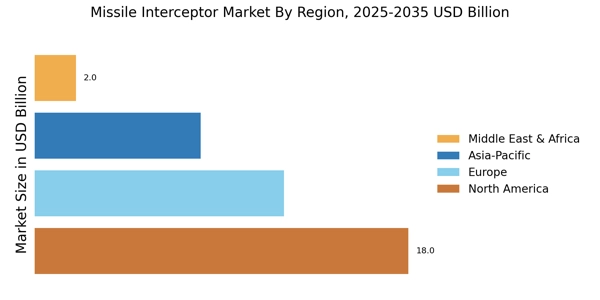
North America remains the largest market for missile interceptors, accounting for approximately 45% of the global share. The region's growth is driven by increasing defense budgets, geopolitical tensions, and advancements in technology. Regulatory support from the U.S. government, including initiatives to enhance missile defense systems, further fuels demand. The focus on homeland security and international collaborations also plays a significant role in market expansion. The United States is the leading country in this sector, with major players like Lockheed Martin, Raytheon Technologies, and Northrop Grumman dominating the landscape. These companies are at the forefront of innovation, developing advanced interceptor systems. The competitive environment is characterized by significant investments in R&D and strategic partnerships, ensuring that North America maintains its leadership in missile defense technology.

Europe : Growing Defense Capabilities

Europe is witnessing a significant increase in the missile interceptor market, holding approximately 30% of the global share. The growth is driven by rising security concerns, particularly in Eastern Europe, and the need for enhanced defense capabilities. Regulatory frameworks, such as the European Defence Fund, are catalyzing investments in advanced missile defense technologies. Collaborative defense initiatives among EU member states are also contributing to market expansion. Key players in Europe include BAE Systems, Thales Group, and Leonardo, which are actively involved in developing cutting-edge interceptor systems. Countries like the UK, France, and Germany are leading the charge, focusing on modernization and integration of defense systems. The competitive landscape is marked by partnerships and joint ventures aimed at enhancing technological capabilities and meeting the evolving security challenges in the region.

Asia-Pacific : Emerging Defense Market

Asia-Pacific is emerging as a significant player in the missile interceptor market, accounting for approximately 20% of the global share. The region's growth is driven by increasing military expenditures, regional conflicts, and the need for advanced defense systems. Countries like Japan and South Korea are investing heavily in missile defense technologies, supported by government initiatives aimed at enhancing national security and regional stability. Leading countries in this region include Japan, South Korea, and India, with key players like Mitsubishi Heavy Industries and Rafael Advanced Defense Systems making substantial contributions. The competitive landscape is characterized by a focus on indigenous development and technology transfer agreements. As regional tensions rise, the demand for effective missile defense systems is expected to continue its upward trajectory, positioning Asia-Pacific as a crucial market in the global defense sector.

Middle East and Africa : Strategic Defense Investments

The Middle East and Africa region is witnessing a growing demand for missile interceptors, holding approximately 5% of the global market share. This growth is driven by escalating regional conflicts, military modernization efforts, and increasing defense budgets. Countries in the Gulf Cooperation Council (GCC) are particularly focused on enhancing their missile defense capabilities, supported by government initiatives and international collaborations to procure advanced systems. Key players in this region include various international firms, with local partnerships becoming increasingly important. Countries like Saudi Arabia and the UAE are leading the charge, investing in advanced interceptor technologies to counter emerging threats. The competitive landscape is evolving, with a mix of established defense contractors and new entrants aiming to capture market share in this strategic sector.

Missile Interceptor Market Regional Image

Key Players and Competitive Insights

The Missile Interceptor Market is characterized by intense competition, driven primarily by advancements in technology, increasing geopolitical tensions, and rising defense budgets worldwide. As nations strive to enhance their defense capabilities against aerial threats, the demand for sophisticated missile interceptor systems continues to grow.

Key players in this market are engaging in strategic collaborations, mergers and acquisitions and investing heavily in research and development to deliver innovative solutions that meet the evolving needs of their customers. The market is witnessing a shift towards multi-layered defense systems that encompass advanced radar, sensor technologies, and interception systems, which are crucial in providing an effective defense shield against various types of missiles.

Moreover, the growing trend of automated defense systems presents both opportunities and challenges for companies, as they must adapt to a rapidly evolving technological landscape while maintaining competitive pricing and product reliability.

Boeing has established itself as a formidable player in the Missile Interceptor Market, owing to its strong technological expertise and extensive experience in the aerospace and defense sector. The company's focus on cutting-edge technologies enables it to develop advanced missile interceptors that can adapt to a range of tactical scenarios, thereby enhancing its attractiveness to military clients.

Boeing's ambitious initiatives in research and development have positioned it to integrate artificial intelligence and machine learning into its missile defense systems, significantly improving responsiveness and effectiveness in intercepting incoming threats.

Furthermore, the company enjoys a robust supply chain and strong partnerships with government agencies and defense organizations worldwide, allowing it to secure significant contracts and maintain a competitive edge. Boeing's commitment to innovation, paired with its established presence in various defense markets, reinforces its strength in the missile interceptor domain.

General Dynamics is another key competitor in the Missile Interceptor Market, recognized for its strategic approach to technological advancements in defense systems. With a commitment to providing reliable and effective solutions, General Dynamics focuses on the design and production of sophisticated missile defense technologies that address the challenges posed by modern aerial threats.

The company emphasizes interoperability, ensuring that its interceptor systems can work seamlessly within various defense architectures and platforms, which is a critical consideration for defense forces worldwide. Moreover, General Dynamics benefits from its deep-rooted relationships with military organizations, which facilitates fruitful collaborations and the successful execution of high-stakes projects.

Its comprehensive understanding of customer needs and an agile response to emerging market demands further empower General Dynamics to remain competitive and innovative within the missile interceptor landscape, solidifying its strategic position in the sector.

Key Companies in the Missile Interceptor Market market include

Industry Developments

Recent developments in the Missile Interceptor Market have been marked by substantial investment from key players such as Raytheon Technologies and Lockheed Martin, aiming to enhance interceptor technologies amid rising geopolitical tensions.

Northrop Grumman has also contributed to advancements through its innovative systems, while Israel Aerospace Industries has been expanding its missile defense capabilities to solidify its market position. Major contracts have been awarded to Boeing and General Dynamics for the deployment of advanced defense systems across various countries.

In the realm of mergers and acquisitions, Honeywell's strategic acquisition of specialized tech firms is noteworthy, reinforcing its competitiveness in missile interceptor technology. Saab AB and Kongsberg Gruppen have made strategic partnerships to bolster their product offerings, enhancing their footprint.

Recent valuations show significant growth in companies like Rheinmetall and Mitsubishi Heavy Industries, as they leverage emerging technologies to meet the increasing demand for stable and reliable missile defense systems.

The market is experiencing dynamic transformations driven by technological advancements, government spending on defense, and international collaborations among key actors, reflecting the escalating need for effective missile interception solutions.

Future Outlook

Missile Interceptor Market Future Outlook

The Missile Interceptor Market is projected to grow at a 4.27% CAGR from 2024 to 2035, driven by increasing geopolitical tensions, technological advancements, and defense budget expansions.

New opportunities lie in:

  • Development of advanced hypersonic missile interceptors
  • Integration of AI for predictive threat analysis
  • Expansion into emerging markets with tailored defense solutions

By 2035, the Missile Interceptor Market is expected to be robust, reflecting strategic advancements and increased global defense investments.

Market Segmentation

Missile Interceptor Market Type Outlook

  • Ballistic Missiles
  • Cruise Missiles
  • Anti-Ship Missiles
  • Surface-to-Air Missiles

Missile Interceptor Market End User Outlook

  • Military
  • Defense Contractors
  • Government Agencies

Missile Interceptor Market Deployment Mode Outlook

  • Land-based
  • Sea-based
  • Airborne

Missile Interceptor Market Guidance System Outlook

  • Inertial Navigation System
  • Positioning System
  • Command Guidance
  • Active Radar Guidance

Report Scope

MARKET SIZE 202440.06(USD Billion)
MARKET SIZE 202541.77(USD Billion)
MARKET SIZE 203563.46(USD Billion)
COMPOUND ANNUAL GROWTH RATE (CAGR)4.27% (2024 - 2035)
REPORT COVERAGERevenue Forecast, Competitive Landscape, Growth Factors, and Trends
BASE YEAR2024
Market Forecast Period2025 - 2035
Historical Data2019 - 2024
Market Forecast UnitsUSD Billion
Key Companies ProfiledMarket analysis in progress
Segments CoveredMarket segmentation analysis in progress
Key Market OpportunitiesAdvancements in artificial intelligence enhance targeting capabilities in the Missile Interceptor Market.
Key Market DynamicsTechnological advancements and geopolitical tensions drive demand for enhanced missile interceptor systems across various defense sectors.
Countries CoveredNorth America, Europe, APAC, South America, MEA

Market Highlights

Author
Sejal Akre
Senior Research Analyst

She has over 5 years of rich experience, in market research and consulting providing valuable market insights to client. Hands on expertise in management consulting, and extensive knowledge in domain including ICT, Automotive & Transportation and Aerospace & Defense. She is skilled in Go-to market strategy, industry analysis, market sizing, in depth company profiling, competitive intelligence & benchmarking and value chain amongst others.

Leave a Comment

FAQs

What is the current valuation of the Missile Interceptor Market as of 2024?

The Missile Interceptor Market was valued at 40.06 USD Billion in 2024.

What is the projected market valuation for the Missile Interceptor Market in 2035?

The projected valuation for the Missile Interceptor Market in 2035 is 63.46 USD Billion.

What is the expected CAGR for the Missile Interceptor Market during the forecast period 2025 - 2035?

The expected CAGR for the Missile Interceptor Market during the forecast period 2025 - 2035 is 4.27%.

Which companies are considered key players in the Missile Interceptor Market?

Key players in the Missile Interceptor Market include Lockheed Martin, Raytheon Technologies, Northrop Grumman, and BAE Systems.

What are the projected revenues for the Ballistic Missiles segment by 2035?

The Ballistic Missiles segment is projected to generate revenues between 10.0 and 15.0 USD Billion by 2035.

How does the revenue for Surface-to-Air Missiles compare to other missile types?

The Surface-to-Air Missiles segment is expected to generate revenues between 15.06 and 26.46 USD Billion, indicating strong market performance.

What is the anticipated revenue range for Land-based missile interceptors by 2035?

Land-based missile interceptors are anticipated to generate revenues between 15.0 and 23.0 USD Billion by 2035.

What guidance systems are projected to have the highest revenue in the Missile Interceptor Market?

The Command Guidance system is projected to generate revenues between 12.0 and 18.0 USD Billion, indicating its importance in the market.

Which end-user segment is expected to contribute the most to the Missile Interceptor Market?

The Military end-user segment is expected to contribute revenues between 15.0 and 24.0 USD Billion by 2035.

What are the revenue projections for the Sea-based missile interceptors segment?

The Sea-based missile interceptors segment is projected to generate revenues between 12.0 and 18.0 USD Billion by 2035.

Download Free Sample

Kindly complete the form below to receive a free sample of this Report

Compare Licence

×
Features License Type
Single User Multiuser License Enterprise User
Price $4,950 $5,950 $7,250
Maximum User Access Limit 1 User Upto 10 Users Unrestricted Access Throughout the Organization
Free Customization
Direct Access to Analyst
Deliverable Format
Platform Access
Discount on Next Purchase 10% 15% 15%
Printable Versions