Download Free Sample
Kindly complete the form below to receive a free sample of this Report
Mobile Device Management Maintenance Market Research Report: Size, Share, Trend Analysis By End User Outlook (Small and Medium Enterprises, Large Enterprises, Government Organizations, Educational Institutions) By Application Outlook (Enterprise Mobility Management, Mobile Application Management, Content Management, Security Management, Device Tracking) By Device Type Outlook (Smartphones, Tablets, Laptops, Wearable Devices) By Service Type Outlook (Consulting Services, Integration Services, Support and Maintenance Services) By Deployment Type Outlook (On-Premises, Cloud-Based, Hybrid), By Region (North America, Europe, APAC, South America, MEA) – Growth Outlook & Industry Forecast To 2035
As per MRFR analysis, the Mobile Device Management Maintenance Market was estimated at 5.2 USD Billion in 2024. The Mobile Device Management Maintenance industry is projected to grow from 5.52 USD Billion in 2025 to 10.1 USD Billion by 2035, exhibiting a compound annual growth rate (CAGR) of 6.22% during the forecast period 2025 - 2035.
The Mobile Device Management Maintenance Market is experiencing robust growth driven by technological advancements and evolving security needs.
| 2024 Market Size | 5.2 (USD Billion) |
| 2035 Market Size | 10.1 (USD Billion) |
| CAGR (2025 - 2035) | 6.22% |
Microsoft (US), VMware (US), IBM (US), Citrix (US), MobileIron (US), Sophos (GB), BlackBerry (CA), ManageEngine (IN), Jamf (US)
Our Impact
Enabled $4.3B Revenue Impact for Fortune 500 and Leading Multinationals
Partnering with 2000+ Global Organizations Each Year
30K+ Citations by Top-Tier Firms in the Industry
The Mobile Device Management Maintenance Market is currently experiencing a transformative phase, driven by the increasing reliance on mobile devices across various sectors. Organizations are recognizing the necessity of maintaining robust management systems to ensure security, compliance, and operational efficiency. As mobile technology evolves, the demand for comprehensive maintenance solutions appears to be growing, suggesting a shift towards more integrated and user-friendly platforms. This trend is likely influenced by the need for businesses to adapt to rapid technological advancements while safeguarding sensitive information. Moreover, the Mobile Device Management Maintenance Market seems to be characterized by a heightened focus on automation and artificial intelligence. These technologies are being integrated into maintenance processes, potentially enhancing the speed and accuracy of device management. Companies are exploring innovative solutions that not only streamline operations but also reduce costs associated with device upkeep. As organizations continue to prioritize digital transformation, the market is poised for further expansion, indicating a promising future for stakeholders involved in mobile device management.
The Mobile Device Management Maintenance Market is witnessing a growing emphasis on security measures. Organizations are prioritizing the protection of sensitive data, leading to the implementation of advanced security protocols within management systems. This trend reflects a broader awareness of cybersecurity threats and the need for robust defenses.
There is a notable trend towards the integration of artificial intelligence and automation within the Mobile Device Management Maintenance Market. These technologies are being utilized to enhance operational efficiency, streamline maintenance processes, and reduce human error, thereby improving overall device management.
The market is experiencing a shift towards cloud-based Mobile Device Management solutions. This transition allows for greater flexibility, scalability, and accessibility, enabling organizations to manage devices remotely and efficiently. As businesses increasingly adopt cloud technologies, this trend is likely to continue.
In the Mobile Device Management Maintenance Market, the escalating concerns surrounding cybersecurity are driving the adoption of advanced management solutions. Organizations are increasingly aware of the vulnerabilities associated with mobile devices, which can serve as entry points for cyber threats. As a result, there is a heightened emphasis on implementing robust security measures within mobile device management frameworks. The market is witnessing a shift towards solutions that not only manage devices but also provide comprehensive security features, such as encryption and threat detection. This trend is likely to continue as businesses prioritize the protection of sensitive data and strive to comply with regulatory requirements, thereby propelling the growth of the Mobile Device Management Maintenance Market.
The proliferation of Internet of Things (IoT) devices is significantly influencing the Mobile Device Management Maintenance Market. As more organizations integrate IoT devices into their operations, the complexity of managing these devices increases. This trend necessitates the development of specialized mobile device management solutions that can accommodate a diverse range of devices and ensure seamless connectivity. The market is expected to expand as businesses seek to implement effective management strategies for their IoT ecosystems, which often include mobile devices. Consequently, the demand for maintenance solutions that can support the unique requirements of IoT devices is likely to rise, further driving the growth of the Mobile Device Management Maintenance Market.
The Mobile Device Management Maintenance Market is significantly influenced by the need for regulatory compliance across various sectors. Organizations are increasingly required to adhere to stringent regulations regarding data protection and privacy, which necessitates the implementation of effective mobile device management strategies. Compliance with regulations such as GDPR and HIPAA compels businesses to adopt comprehensive management solutions that ensure the security and integrity of mobile devices. This trend is likely to drive the demand for maintenance services that can help organizations navigate the complexities of compliance while managing their mobile device fleets. As regulatory scrutiny intensifies, the Mobile Device Management Maintenance Market is expected to grow in response to these evolving requirements.
The Mobile Device Management Maintenance Market is experiencing a notable surge in demand for solutions that facilitate remote work. As organizations increasingly adopt flexible work arrangements, the need for effective management of mobile devices has become paramount. This trend is underscored by the fact that a significant percentage of employees now work remotely, necessitating robust security and management protocols for mobile devices. The market is projected to grow as businesses seek to ensure that their mobile device ecosystems are secure and efficient, thereby driving the need for comprehensive maintenance solutions. Furthermore, the integration of mobile device management systems with existing IT infrastructure is likely to enhance operational efficiency, making it a critical focus area for organizations aiming to optimize their remote work capabilities.
The Mobile Device Management Maintenance Market is witnessing rapid technological advancements that are reshaping the landscape of mobile management solutions. Innovations such as artificial intelligence and machine learning are being integrated into mobile device management systems, enhancing their capabilities and efficiency. These advancements enable organizations to automate routine maintenance tasks, improve device performance, and proactively address potential issues. As technology continues to evolve, the demand for sophisticated mobile device management solutions is likely to increase, driving the growth of the market. Organizations are expected to seek out solutions that leverage these advancements to optimize their mobile device management strategies, thereby contributing to the overall expansion of the Mobile Device Management Maintenance Market.
In the Mobile Device Management Maintenance Market, Enterprise Mobility Management holds the largest market share among the application segments. It primarily focuses on managing mobile devices and applications within the enterprise, ensuring seamless integration with business operations. Mobile Application Management, on the other hand, has emerged as a rapidly growing segment. It focuses on overseeing the entire lifecycle of mobile applications, which is crucial as more organizations adopt mobile solutions. Content Management, Security Management, and Device Tracking also contribute to the ecosystem but with comparatively smaller shares.
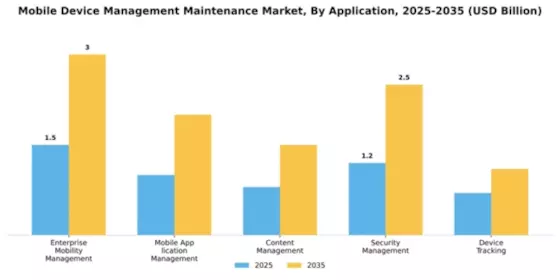
Enterprise Mobility Management (Dominant) vs. Mobile Application Management (Emerging)
Enterprise Mobility Management (EMM) is recognized as the dominant player in the Mobile Device Management Maintenance Market, providing comprehensive solutions that integrate device management, application management, and security. It is essential for organizations looking to maintain control over their mobile environments, offering robust capabilities to manage employee devices and corporate apps. Conversely, Mobile Application Management (MAM) is the emerging segment, characterized by its focus on managing mobile apps specifically. With the increase in remote work and bring-your-own-device (BYOD) policies, MAM helps businesses control application deployment, updates, and security, ensuring that the mobile apps are compliant and secure. Both segments are crucial in addressing the evolving needs of mobile device management.
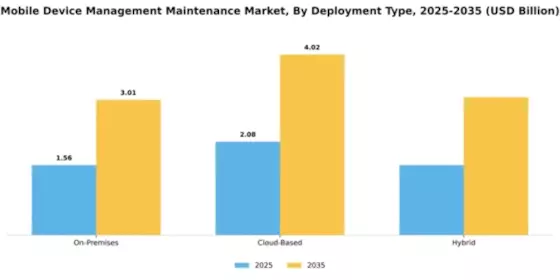
In the Mobile Device Management (MDM) Maintenance Market, the deployment type segment reveals a clear distribution in market share among its key players: On-Premises, Cloud-Based, and Hybrid. The Cloud-Based segment currently holds the largest share, reflecting a trend towards more flexible, scalable solutions. Organizations increasingly prefer this model for its ease of access and reduced maintenance burdens. In contrast, the On-Premises segment, once viewed as the standard, is now facing competitive pressure from Cloud-Based options, causing it to diminish in market share.
On-Premises (Dominant) vs. Hybrid (Emerging)
The On-Premises deployment type in the Mobile Device Management Maintenance Market has traditionally been regarded as the dominant choice among enterprises, offering greater control and security. Businesses that prioritize stringent data governance and compliance often lean towards this approach, as it allows for extensive customization and internal management of resources. On the other hand, the Hybrid model is emerging rapidly, catering to organizations that seek a combination of the flexibility of cloud solutions with the control of on-premises systems. This segment is gaining traction as enterprises recognize the hybrid approach's ability to balance scalability with data security, making it an attractive option for forward-thinking IT departments.
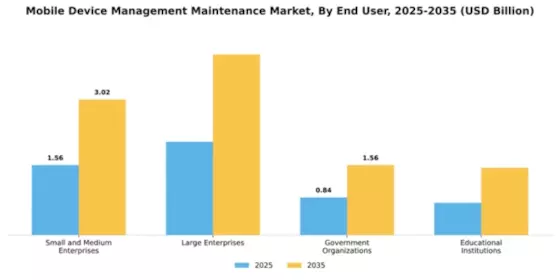
In the Mobile Device Management Maintenance Market, Large Enterprises command the majority share, showcasing their extensive resources and complex operational needs. This segment benefits from the implementation of comprehensive MDM solutions that cater to their diverse device management requirements, ensuring enhanced security and compliance. Conversely, Small and Medium Enterprises (SMEs) are emerging as a significant force, capturing an increasing share of the market as they adopt MDM solutions to streamline operations and enhance productivity on a budget-friendly scale. The growth trends indicate that SMEs are rapidly adapting to mobile device management as a critical element of their IT strategy. Factors such as affordable cloud-based solutions, increased mobile workforce, and the need for robust cybersecurity are driving this shift. Meanwhile, Large Enterprises continue to invest heavily in advanced MDM technologies to safeguard sensitive data and optimize device management, thus solidifying their dominant position .
Large Enterprises: Dominant vs. Small and Medium Enterprises: Emerging
Large Enterprises in the Mobile Device Management Maintenance Market focus on comprehensive solutions that address the complexities of managing numerous devices across varied locations. Their investment in advanced technologies is crucial for maintaining operational efficiency, enhancing security protocols, and meeting compliance regulations. In contrast, Small and Medium Enterprises are rapidly evolving as key players, driven by their need for cost-effective mobile management solutions that do not compromise on security. By leveraging scalable MDM options, SMEs are finding it easier to manage devices and enhance collaboration among teams. This adaptability enables them to implement mobile strategies that align with their growth, allowing for increased agility and competitiveness in the marketplace.
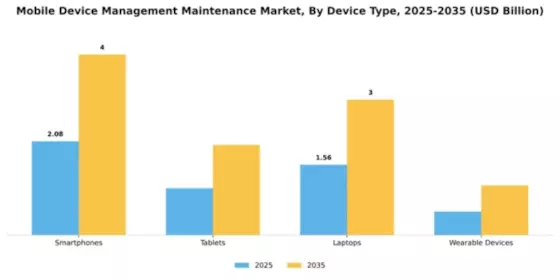
In the Mobile Device Management Maintenance Market, the device type segment showcases a varied distribution of market share among its values. Smartphones dominate this landscape, accounting for the majority of the market share due to their widespread adoption and integration into various business operations. Tablets, while holding a smaller share compared to smartphones, represent a rapid growth trajectory, appealing to sectors that favor a more versatile yet portable device for productivity. As businesses increasingly recognize the need to centralize control over mobile devices, the growth trends among these segments reflect broader technological advancements. The rise of remote work and mobile applications is significantly stimulating the demand for effective management solutions, especially for tablets and laptops. Furthermore, advancements in wearable devices, though currently a smaller segment, are expected to drive innovation and interest, positioning them as an emerging trend in this market.
Smartphones: Dominant vs. Tablets: Emerging
Smartphones are the dominant players in the Mobile Device Management Maintenance Market due to their extensive usage in both personal and enterprise environments. They offer sophisticated features and applications that enhance business productivity and connectivity. This dominance is supported by their continuous advancements in technology, which cater to a growing need for mobile solutions within organizations. On the other hand, tablets are emerging as a versatile option for businesses looking to empower their remote workforce. Their larger screens and functionality make them ideal for tasks that require more visual engagement, thus making them increasingly popular in various sectors. As the demand for efficient mobile management solutions grows, both segments will continue to adapt and evolve to meet the needs of businesses.
In the Mobile Device Management Maintenance Market, the distribution of services is predominantly led by Support and Maintenance Services, which account for the largest share. This segment caters to enterprises' ongoing needs for operational continuity and user support, ensuring devices remain functional and applicable to business purposes. In contrast, Integration Services, while smaller in market share, are experiencing growth due to the increasing demand for cohesive technology ecosystems that streamline operations across various platforms and devices.
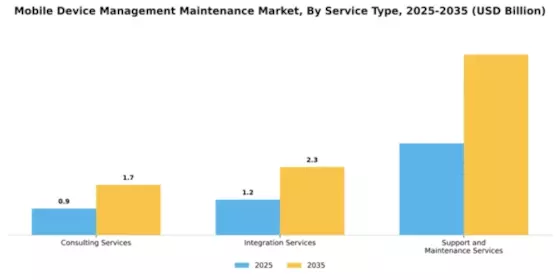
Support and Maintenance Services (Dominant) vs. Integration Services (Emerging)
Support and Maintenance Services have established themselves as a dominant force in the Mobile Device Management Maintenance Market, by providing essential support in troubleshooting, updates, and user assistance. These services are integral in ensuring the smooth operation of mobile devices within organizations, enhancing productivity, and reducing downtime. On the other hand, Integration Services are emerging as a vital component for businesses seeking to interconnect various mobile solutions. With the rise of cloud computing and the need for interoperability among different systems, Integration Services facilitate seamless integration of tools and software, allowing for more efficient workflows. This increasing reliance on interconnected solutions marks Integration Services as a key growth area, appealing to businesses striving for digital transformation.
Get more detailed insights about Mobile Device Management Maintenance Market Request Free Sample
North America continues to lead the Mobile Device Management (MDM) Maintenance Market, holding a significant share of 2.6B in 2025. The region's growth is driven by increasing adoption of mobile devices in enterprises, stringent data security regulations, and the rise of remote work. Companies are investing heavily in MDM solutions to ensure compliance and enhance productivity, making it a critical area for IT investments. The competitive landscape is robust, with key players like Microsoft, VMware, and IBM dominating the market. The U.S. is the primary contributor, supported by a strong technological infrastructure and a high demand for innovative solutions. The presence of established firms and startups alike fosters a dynamic environment, ensuring continuous advancements in MDM technologies.
Europe's Mobile Device Management Maintenance Market is valued at 1.5B in 2025, reflecting a growing demand for secure mobile solutions. Factors such as increasing regulatory requirements for data protection, particularly with GDPR, and the rise of remote work are driving this growth. Organizations are prioritizing MDM solutions to manage their mobile assets effectively and ensure compliance with stringent regulations. Leading countries in this region include Germany, the UK, and France, where major players like Sophos and Citrix are making significant inroads. The competitive landscape is characterized by a mix of established firms and innovative startups, all vying for market share. The European market is poised for further growth as businesses increasingly recognize the importance of mobile device security and management.
The Asia-Pacific region is witnessing a burgeoning Mobile Device Management Maintenance Market, projected at 1.0B in 2025. The growth is fueled by the rapid digital transformation across industries, increasing smartphone penetration, and a rising focus on cybersecurity. Governments are also implementing policies to enhance data security, which is further propelling the demand for MDM solutions in the region. Countries like India, China, and Japan are leading the charge, with a mix of local and international players such as ManageEngine and VMware competing for market share. The competitive landscape is vibrant, with numerous startups emerging to address specific needs in mobile management. As organizations prioritize mobile security, the MDM market in Asia-Pacific is set for significant expansion in the coming years.
The Mobile Device Management Maintenance Market in the Middle East and Africa is currently valued at 0.1B in 2025, indicating a nascent stage with substantial growth opportunities. The region is gradually recognizing the importance of mobile device management, driven by increasing mobile device usage and the need for enhanced security measures. Governments are beginning to implement regulations that encourage businesses to adopt MDM solutions for better data protection. Countries like South Africa and the UAE are at the forefront of this market, with a growing number of local and international players entering the space. The competitive landscape is evolving, with firms looking to capitalize on the increasing demand for mobile security solutions. As awareness grows, the MDM market in the Middle East and Africa is expected to expand significantly in the coming years.
The Mobile Device Management Maintenance Market is currently characterized by a dynamic competitive landscape, driven by the increasing need for secure and efficient management of mobile devices across various sectors. Key players such as Microsoft (US), VMware (US), and IBM (US) are at the forefront, leveraging their technological prowess to enhance service offerings. Microsoft (US) focuses on integrating advanced security features into its MDM solutions, while VMware (US) emphasizes cloud-based management capabilities. IBM (US) is strategically positioning itself through partnerships aimed at expanding its service reach, thereby shaping a competitive environment that is increasingly reliant on innovation and strategic collaborations.In terms of business tactics, companies are increasingly localizing their operations to better serve regional markets, optimizing supply chains to enhance efficiency. The market appears moderately fragmented, with several players vying for market share. This fragmentation is indicative of a competitive structure where key players exert considerable influence, yet there remains ample opportunity for smaller entities to carve out niches through specialized offerings.In November Microsoft (US) announced a significant upgrade to its Intune platform, enhancing its mobile device management capabilities with AI-driven analytics. This strategic move is likely to bolster its competitive edge by providing clients with deeper insights into device usage and security vulnerabilities, thereby addressing the growing demand for data-driven decision-making in device management.In October VMware (US) launched a new initiative aimed at integrating its MDM solutions with emerging IoT technologies. This initiative is poised to expand its market reach, as it aligns with the increasing convergence of mobile device management and IoT, suggesting a forward-thinking approach that could redefine operational efficiencies for enterprises.In September IBM (US) entered into a partnership with a leading telecommunications provider to enhance its mobile device management services. This collaboration is expected to facilitate improved connectivity and security for enterprise clients, indicating a strategic focus on building robust ecosystems that support comprehensive device management solutions.As of December the competitive trends in the Mobile Device Management Maintenance Market are increasingly defined by digitalization, sustainability, and the integration of AI technologies. Strategic alliances are becoming pivotal in shaping the landscape, as companies seek to leverage complementary strengths. The evolution of competitive differentiation appears to be shifting from price-based strategies to a focus on innovation, technological advancement, and supply chain reliability, suggesting that future success will hinge on the ability to adapt to these emerging trends.

The Mobile Device Management Maintenance Market is projected to grow at a 6.22% CAGR from 2025 to 2035, driven by increasing device proliferation and security concerns.
New opportunities lie in:
By 2035, the market is expected to be robust, reflecting substantial growth and innovation.
| MARKET SIZE 2024 | 5.2(USD Billion) |
| MARKET SIZE 2025 | 5.52(USD Billion) |
| MARKET SIZE 2035 | 10.1(USD Billion) |
| COMPOUND ANNUAL GROWTH RATE (CAGR) | 6.22% (2025 - 2035) |
| REPORT COVERAGE | Revenue Forecast, Competitive Landscape, Growth Factors, and Trends |
| BASE YEAR | 2024 |
| Market Forecast Period | 2025 - 2035 |
| Historical Data | 2019 - 2024 |
| Market Forecast Units | USD Billion |
| Key Companies Profiled | Microsoft (US), VMware (US), IBM (US), Citrix (US), MobileIron (US), Sophos (GB), BlackBerry (CA), ManageEngine (IN), Jamf (US) |
| Segments Covered | Application, Deployment Type, End User, Device Type, Service Type |
| Key Market Opportunities | Integration of artificial intelligence for enhanced security and efficiency in the Mobile Device Management Maintenance Market. |
| Key Market Dynamics | Rising demand for enhanced security features drives innovation in Mobile Device Management Maintenance solutions across various sectors. |
| Countries Covered | North America, Europe, APAC, South America, MEA |
The projected market valuation for the Mobile Device Management Maintenance Market is expected to reach 10.1 USD Billion by 2035.
The overall market valuation was 5.2 USD Billion in 2024.
The expected CAGR for the Mobile Device Management Maintenance Market during the forecast period 2025 - 2035 is 6.22%.
Key players in the market include Microsoft, VMware, IBM, Citrix, MobileIron, Sophos, BlackBerry, ManageEngine, and Jamf.
The Enterprise Mobility Management segment is projected to grow from 1.5 USD Billion to 3.0 USD Billion by 2035.
By 2035, the Cloud-Based deployment type is expected to reach 4.02 USD Billion, surpassing the On-Premises valuation of 3.01 USD Billion.
Support and Maintenance Services are projected to grow from 3.1 USD Billion to 6.1 USD Billion by 2035.
The Mobile Application Management segment is expected to grow from 1.0 USD Billion to 2.0 USD Billion by 2035.
The Large Enterprises segment is projected to have the highest valuation, growing from 2.08 USD Billion to 4.02 USD Billion by 2035.
The valuation for wearable devices is expected to increase from 0.52 USD Billion to 1.1 USD Billion by 2035.


Kindly complete the form below to receive a free sample of this Report

“This is really good guys. Excellent work on a tight deadline. I will continue to use you going forward and recommend you to others. Nice job”


“Thanks. It’s been a pleasure working with you, please use me as reference with any other Intel employees.”


“Thanks for sending the report it gives us a good global view of the Betaïne market.”


“Thank you, this will be very helpful for OQS.”


“We found the report very insightful! we found your research firm very helpful. I'm sending this email to secure our future business.”


“I am very pleased with how market segments have been defined in a relevant way for my purposes (such as "Portable Freezers & refrigerators" and "last-mile"). In general the report is well structured. Thanks very much for your efforts.”


“I have been reading the first document or the study, ,the Global HVAC and FP market report 2021 till 2026. Must say, good info! I have not gone in depth at all parts, but got a good indication of the data inside!”


“We got the report in time, we really thank you for your support in this process. I also thank to all of your team as they did a great job.”


“The Automotive 48V ECU Components Procurement Intelligence Study” was a complex project, but the Market Research Future (MRFR) team handled it with quality, agility, and customer-centricity. They delivered all requested data on time and within the agreed scope. The team, including Shubhendra Anand and Rahul Gotadki, was always readily available to clarify questions and swiftly implement necessary adjustments, driving the project to a successful conclusion within a very demanding timeframe.
I would also like to specifically commend Akshay Agarwal for his responsiveness and support at every stage—from our initial inquiry on May 6th through to final delivery on June 18th. His dedication made the entire process seamless.”



