Modular Data Center Market Summary
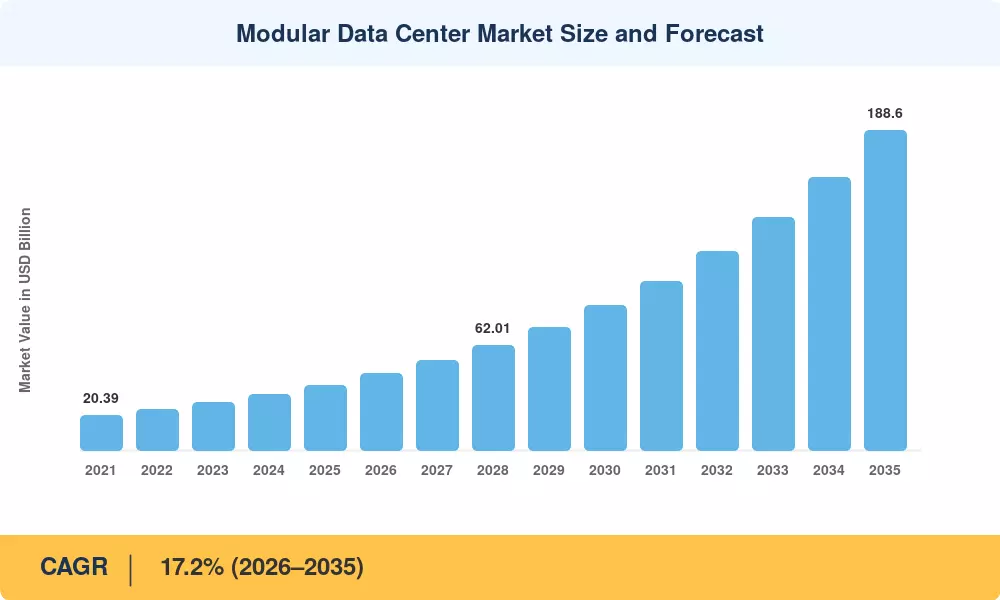
The global Modular Data Center Market was valued at USD 38.50 billion in 2025 and is projected to reach USD 45.20 billion in 2026 before climbing to USD 188.60 billion by 2035, registering a CAGR of 17.2% across the forecast window. Two forces anchor this trajectory: hyperscaler capital expenditure cycles that now exceed USD 200 billion annually worldwide [2], and data-sovereignty mandates — from the EU Data Act to India's DPDP Act — that compel operators to localize compute within national borders, driving demand for rapid-deploy data centers that can be commissioned in 12–16 weeks rather than 18–24 months [3].
A technology shift is rewriting data-center economics. Legacy stick-built facilities, with their rigid floor plans and 2-year construction timelines, are giving way to prefabricated data center assemblies and containerized data center configurations that arrive pre-wired, pre-tested, and factory-integrated with liquid-cooling manifolds rated above 40 kW per rack [4]. The U.S. Department of Energy's 2024 Data Center Optimization Initiative allocated USD 1.2 billion toward energy-efficient modular designs, accelerating the transition from bespoke civil works to scalable modular IT infrastructure [5].
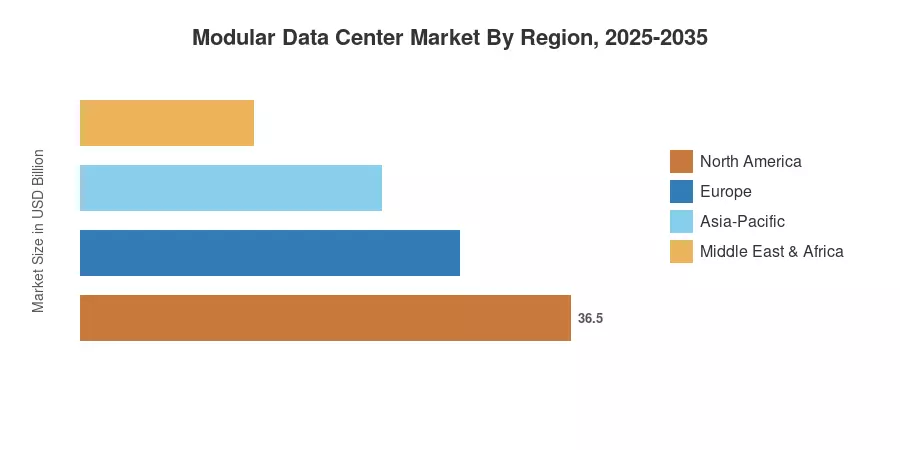
North America held roughly 37% of revenue in 2025, anchored by cloud-region expansions across Virginia, Texas, and Oregon. Asia-Pacific is the fastest-growing region at a projected 18.4% CAGR through 2035, propelled by sovereign-cloud mandates in India, Indonesia, and Japan. Europe captured the second-largest share at approximately 26%, fueled by GDPR-adjacent localization rules and the EU Chips Act's colocation provisions [6]. As AI training clusters and 5G edge nodes proliferate, the Modular Data Center Market is poised for sustained double-digit expansion through the mid-2030s.
Key Report Takeaways
• By Solution
- Functional-module solutions commanded approximately 61% of the Modular Data Center Market revenue in 2025, reflecting demand for turnkey power, cooling, and IT modules.
- Managed services and lifecycle optimization contracts are forecast to grow at a 17.8% CAGR through 2035, as operators shift spend from capital budgets to operating budgets.
• By Application
- Data-center expansion represented roughly 36% of the Modular Data Center Market share in 2025, driven by brownfield capacity augmentation across Tier-1 markets.
- AI/GPU training pods and hyperscale edge workloads are advancing at an 18.2% CAGR, reflecting surging demand for portable data center modules near inference endpoints.
• By Region
- North America maintained a 37% revenue share in 2025, underpinned by hyperscaler campus builds and federal data-sovereignty compliance.
- Asia-Pacific is projected to post an 18.4% CAGR through 2035, fueled by India's Digital India Infrastructure Programme and China's "East Data, West Compute" initiative.
Market Size and Forecast (2021–2035)
MRFR's projections combine bottom-up revenue modeling from vendor disclosures with top-down demand indicators, including hyperscaler capex filings, power-capacity additions tracked by the IEA, and regional permitting data from 42 national regulators.