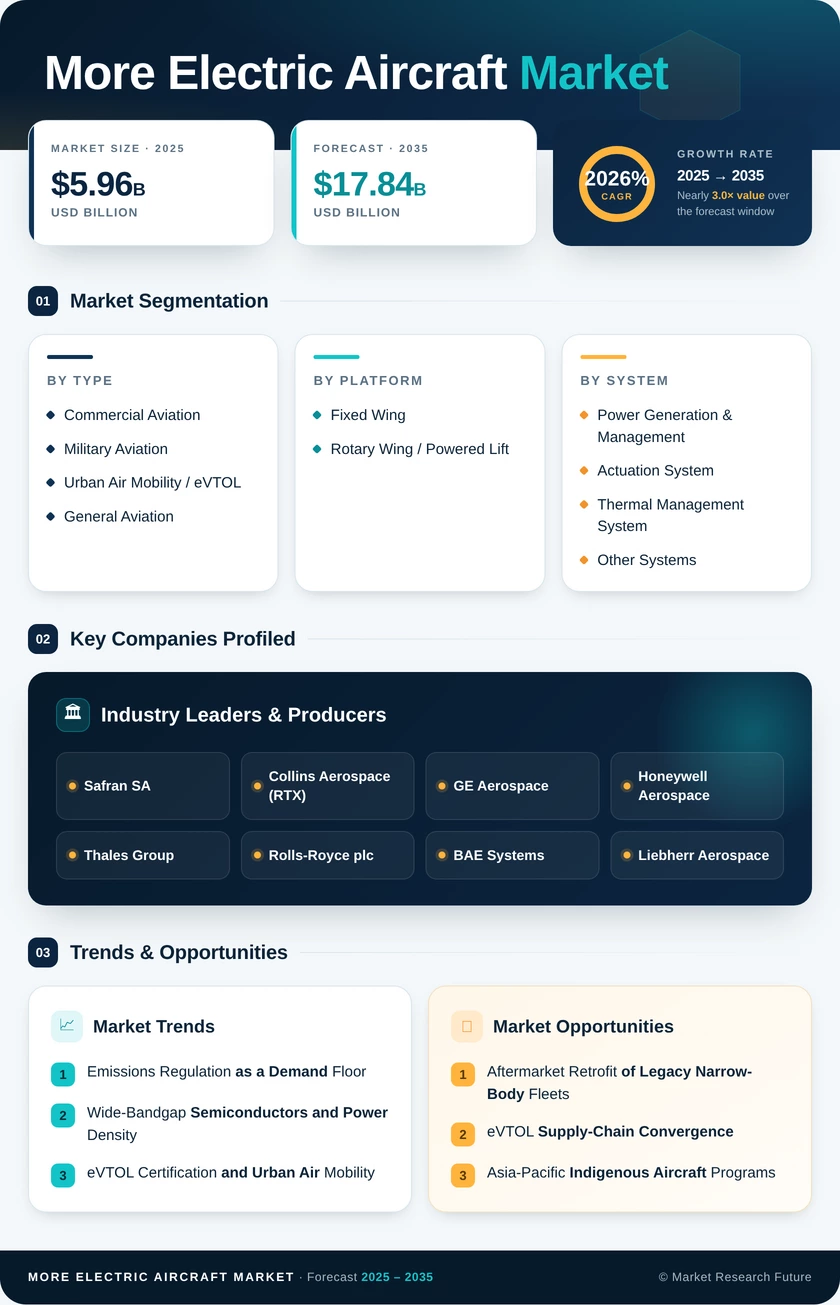
More Electric Aircraft Market

ID: MRFR/AD/0737-CR
110 Pages
Shubham Munde
Last Updated: June 09, 2026
More Electric Aircraft Market Size, Share, Industry Trend & Analysis Research Report Information By Aircraft Type (Commercial Aviation, Military Aviation, Urban Air Mobility / eVTOL, General Aviation), By Platform (Fixed Wing, Rotary Wing / Powered Lift), By System (Power Generation & Management, Actuation System, Thermal Management System, Other Systems), By End User (OEM, Aftermarket), By Geography (North America, Europe, Asia-Pacific, South America, Middle East & Africa) – Forecast Till 2035
Download PDF ×

We do not share your information with anyone. However, we may send you emails based on your report interest from time to time. You may contact us at any time to opt-out.

  1. 1 Market Overview |
    1. 1.1 Study Assumptions & Market Definition |
    2. 1.2 Scope of the Study |
    3. 1.3 Research Methodology
  2. 2 Market Summary & Key Takeaways
  3. 3 Market Dynamics |
    1. 3.1 Market Drivers Analysis | |
      1. 3.1.1 Carbon-Reduction Mandates (CORSIA, EU ETS) | |
      2. 3.1.2 Wide-Bandgap Semiconductor Cost Reduction | |
      3. 3.1.3 eVTOL Certification and Urban Air Mobility Scale-Up | |
      4. 3.1.4 Defense Electrification Programs (NGAD, FCAS) | |
      5. 3.1.5 Rising Jet-Fuel Prices and Hedging Pressure | |
      6. 3.1.6 Aftermarket Retrofit Demand for Legacy Fleets | |
      7. 3.1.7 Solid-State Battery Breakthroughs |
    2. 3.2 Market Restraints Analysis | |
      1. 3.2.1 Certification Timelines for High-Voltage Systems | |
      2. 3.2.2 Thermal Management Challenges at Scale | |
      3. 3.2.3 Battery Energy Density Limitations | |
      4. 3.2.4 Supply-Chain Bottlenecks for Rare-Earth Magnets | |
      5. 3.2.5 High Upfront Integration Costs for Retrofit Programs |
    3. 3.3 Market Opportunity Analysis | |
      1. 3.3.1 Aftermarket Retrofit of Legacy Narrow-Body Fleets | |
      2. 3.3.2 eVTOL Supply-Chain Convergence | |
      3. 3.3.3 Asia-Pacific Indigenous Aircraft Programs | |
      4. 3.3.4 Digital Twin and Predictive-Maintenance Monetization | |
      5. 3.3.5 Emerging-Market Regional Connectivity |
    4. 3.4 Industry Value Chain Analysis |
    5. 3.5 Porter's Five Forces Analysis
  4. 4 Global More Electric Aircraft Market Size & Forecast (2021–2035) |
    1. 4.1 Historical Market Size (2021–2025) |
    2. 4.2 Current & Forecast Market Size (2026–2035) |
    3. 4.3 Market Size by Revenue (USD Billion) |
    4. 4.4 Year-over-Year Growth Analysis
  5. 5 Segmentation Analysis |
    1. 5.1 By Aircraft Type | |
      1. 5.1.1 Commercial Aviation | |
      2. 5.1.2 Military Aviation | |
      3. 5.1.3 Urban Air Mobility / eVTOL | |
      4. 5.1.4 General Aviation | |
      5. 5.1.5 Unmanned Aerial Vehicles (UAV) |
    2. 5.2 By Platform | |
      1. 5.2.1 Fixed Wing | |
      2. 5.2.2 Rotary Wing / Powered Lift |
    3. 5.3 By System | |
      1. 5.3.1 Power Generation & Management | |
      2. 5.3.2 Actuation System | |
      3. 5.3.3 Thermal Management System | |
      4. 5.3.4 Other Systems |
    4. 5.4 By End User | |
      1. 5.4.1 OEM | |
      2. 5.4.2 Aftermarket
  6. 6 Regional Analysis |
    1. 6.1 North America | |
      1. 6.1.1 United States | |
      2. 6.1.2 Canada | |
      3. 6.1.3 Mexico |
    2. 6.2 Europe | |
      1. 6.2.1 Germany | |
      2. 6.2.2 United Kingdom | |
      3. 6.2.3 France | |
      4. 6.2.4 Italy | |
      5. 6.2.5 Spain | |
      6. 6.2.6 Nordic Countries | |
      7. 6.2.7 Russia | |
      8. 6.2.8 Rest of Europe |
    3. 6.3 Asia-Pacific | |
      1. 6.3.1 China | |
      2. 6.3.2 India | |
      3. 6.3.3 Japan | |
      4. 6.3.4 South Korea | |
      5. 6.3.5 ASEAN | |
      6. 6.3.6 Rest of Asia-Pacific |
    4. 6.4 South America | |
      1. 6.4.1 Brazil | |
      2. 6.4.2 Argentina | |
      3. 6.4.3 Rest of South America |
    5. 6.5 Middle East & Africa | |
      1. 6.5.1 Saudi Arabia | |
      2. 6.5.2 UAE | |
      3. 6.5.3 South Africa | |
      4. 6.5.4 Egypt | |
      5. 6.5.5 Rest of MEA
  7. 7 Competitive Landscape |
    1. 7.1 Market Share Analysis (2025) |
    2. 7.2 Competitive Benchmarking Matrix |
    3. 7.3 Company Profiles | |
      1. 7.3.1 Safran SA | |
      2. 7.3.2 Collins Aerospace (RTX) | |
      3. 7.3.3 GE Aerospace | |
      4. 7.3.4 Honeywell Aerospace | |
      5. 7.3.5 Thales Group | |
      6. 7.3.6 Rolls-Royce plc | |
      7. 7.3.7 BAE Systems | |
      8. 7.3.8 Liebherr Aerospace | |
      9. 7.3.9 Moog Inc. | |
      10. 7.3.10 Eaton Aerospace
  8. 8 Future Outlook & Strategic Recommendations (2026–2035) |
    1. 8.1 Megawatt-Class Electric Propulsion Era |
    2. 8.2 Autonomous Operations and AI-Driven Power Management |
    3. 8.3 Supply-Chain Regionalization and Wide-Bandgap Scale-Up |
    4. 8.4 ESG Reporting and Green-Finance Alignment
  9. 9 Recent Developments & News
  10. 10 Frequently Asked Questions (FAQs)
  11. 11 Report Scope & Methodology |
    1. 11.1 Study Period & Base Year |
    2. 11.2 Data Sources & Citations |
    3. 11.3 Abbreviations
  12. 12 LIST OF TABLES |
  13. TABLE 1 Global More Electric Aircraft Market Size & Forecast, by Revenue (USD Billion), 2021–2035 |
  14. TABLE 2 Global More Electric Aircraft Market – Year-over-Year Growth Analysis, 2021–2035 |
  15. TABLE 3 Driver Impact Analysis – More Electric Aircraft Market, 2026–2035 |
  16. TABLE 4 Restraint Impact Analysis – More Electric Aircraft Market, 2026–2035 |
  17. TABLE 5 Regional Market Share Summary – More Electric Aircraft Market, 2025 |
  18. TABLE 6 North America More Electric Aircraft Market Size, by Country, 2021–2035 (USD Billion) |
  19. TABLE 7 Europe More Electric Aircraft Market Size, by Country, 2021–2035 (USD Billion) |
  20. TABLE 8 Asia-Pacific More Electric Aircraft Market Size, by Country, 2021–2035 (USD Billion) |
  21. TABLE 9 South America More Electric Aircraft Market Size, by Country, 2021–2035 (USD Billion) |
  22. TABLE 10 Middle East & Africa More Electric Aircraft Market Size, by Country, 2021–2035 (USD Billion) |
  23. TABLE 11 More Electric Aircraft Market Size, by Aircraft Type, 2021–2035 (USD Billion) |
  24. TABLE 12 More Electric Aircraft Market Size, by Platform, 2021–2035 (USD Billion) |
  25. TABLE 13 More Electric Aircraft Market Size, by System, 2021–2035 (USD Billion) |
  26. TABLE 14 More Electric Aircraft Market Size, by End User, 2021–2035 (USD Billion) |
  27. TABLE 15 Competitive Benchmarking Matrix – More Electric Aircraft Market, 2025 |
  28. TABLE 16 Company Profiles – Key Players, More Electric Aircraft Market |
  29. TABLE 17 Recent Developments & Strategic Announcements, 2023–2025 |
  30. TABLE 18 Report Scope & Methodology – More Electric Aircraft Market |
  31. TABLE 19 Detailed Sources and Citations
  32. 13 LIST OF FIGURES |
  33. FIGURE 1 More Electric Aircraft Market Dynamics — Drivers, Restraints, and Opportunities |
  34. FIGURE 2 Industry Value Chain — More Electric Aircraft Market |
  35. FIGURE 3 Porter's Five Forces Analysis — More Electric Aircraft Market |
  36. FIGURE 4 Global More Electric Aircraft Market Size Trend (USD Billion), 2021–2035 |
  37. FIGURE 5 More Electric Aircraft Market Share, by Aircraft Type, 2025 |
  38. FIGURE 6 More Electric Aircraft Market Share, by Platform, 2025 |
  39. FIGURE 7 More Electric Aircraft Market Share, by System, 2025 |
  40. FIGURE 8 More Electric Aircraft Market Share, by End User, 2025 |
  41. FIGURE 9 More Electric Aircraft Market Revenue Share, by Region, 2025 |
  42. FIGURE 10 North America More Electric Aircraft Market — Country Revenue Split, 2025 |
  43. FIGURE 11 Europe More Electric Aircraft Market — Country Revenue Split, 2025 |
  44. FIGURE 12 Asia-Pacific More Electric Aircraft Market — Country Revenue Split, 2025 |
  45. FIGURE 13 South America More Electric Aircraft Market — Country Revenue Split, 2025 |
  46. FIGURE 14 Middle East & Africa More Electric Aircraft Market — Country Revenue Split, 2025 |
  47. FIGURE 15 Competitive Landscape Positioning Map — More Electric Aircraft Market, 2025

Segmentation Quick Reference

DimensionSub-SegmentsDominant SegmentFastest Growing Segment
Aircraft TypeCommercial Aviation, Military Aviation, Urban Air Mobility / eVTOL, General AviationCommercial AviationUrban Air Mobility / eVTOL
PlatformFixed Wing, Rotary Wing / Powered LiftFixed WingRotary Wing / Powered Lift
SystemPower Generation & Management, Actuation System, Thermal Management System, Other SystemsPower Generation & ManagementActuation System
End UserOEM, AftermarketOEMAftermarket
GeographyNorth America, Europe, Asia-Pacific, South America, Middle East & AfricaNorth AmericaAsia-Pacific


Market Segmentation Overview

By Aircraft Type

Sub-SegmentKey Trend
Commercial AviationWide-body bleed-less architectures and narrow-body electric environmental control adoption
Military AviationSixth-generation fighter power demands exceeding 1 MW per engine
Urban Air Mobility / eVTOLFAA powered-lift certification enabling commercial air-taxi operations
General AviationElectric trainer aircraft entering flight-school fleets


Commercial aviation remains the revenue anchor, driven by mandatory electrification on new-build programs and growing aftermarket retrofit activity. Urban air mobility platforms represent the highest growth trajectory as certification milestones unlock production-scale deployment.

By Platform

Sub-SegmentKey Trend
Fixed WingProgressive increase in onboard electric power from 250 kVA to 1+ MVA on next-generation types
Rotary Wing / Powered LifteVTOL and hybrid helicopter programs are driving distributed electric propulsion adoption


Fixed-wing platforms dominate due to the sheer installed base of commercial and military jets undergoing electrification. Rotary-wing and powered-lift configurations grow faster as new entrants bring certified eVTOL and hybrid helicopter designs to market.

By System

Sub-SegmentKey Trend
Power Generation & ManagementTransition from constant-frequency generators to variable-frequency SiC-based systems
Actuation SystemHydraulic-to-electric actuator swap yielding 20–25% weight reduction per station
Thermal Management SystemTwo-phase cooling and vapor-cycle systems for megawatt-class heat loads
Other SystemsElectric taxiing, electric braking, LED lighting, and e-cabin systems


Power generation and management hardware captures the largest share because every other electrified subsystem depends on upstream power conversion. Electromechanical actuation grows fastest as OEMs prioritize weight savings on primary flight controls.

By End User

Sub-SegmentKey Trend
OEMFactory-installed MEA systems on new-build aircraft programs
AftermarketSTC-based retrofit kits for in-service fleet modernization


OEM integration leads near-term revenue, but the aftermarket segment accelerates as airlines seek immediate fuel savings from legacy fleets without waiting for new-generation deliveries.