Research Methodology on Mountain Bike Market
1. Introduction
The primary objective of this research methodology is to understand the Mountain Bike Market, with an explicit focus on anticipated market growth between 2023-2030. With this aim, the published research methodology helps to penetrate deep into the industry and reveal existing opportunities, while providing accurate insights into the market’s future trajectory. The research gathers data from several sources using a multitude of market-scoping multipliers. It draws significantly from interviews with leading market industry players and vital sources such as trade journals, white papers, annual reports, and databases.
2. Research Objectives
The research study seeks to answer the following specific research questions -
What are the prime drivers, restraints, opportunities and trends prevailing in the global mountain bike market that can influence its course?
Which type of mountain bike segment is going to lead the total market?
How has the mountain bike market been segmented in terms of end-user and region?
What are the existing technological advancements in the global mountain bike market?
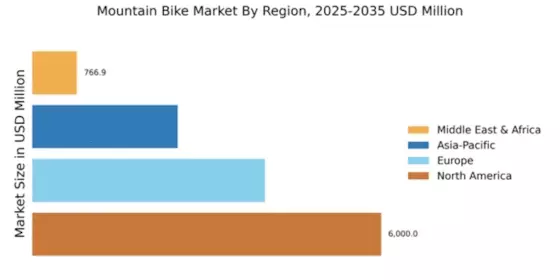
Which geographical regions are expected to have the highest market share in the global mountain bike market?
What are the various strategies being adopted by established players to remain competitive in this market?
3. Research Methodology
The research approach followed while conducting this study is longitudinal, secondary and primary analysis. This study aptly combines different sources of information such as public domain, secondary research, and primary research. The primary and secondary research undertaken helps to understand and qualify the data that is collected. Further, it also helps in formulating points of view that can be accurately absorbed in the final research report.
3.1. Secondary Research
The secondary research is conducted using market research reports and information from market participants, industry organizations, trade journals, and sources such as white papers, and databases. To gain an external perspective, industry experts and stakeholders including Mountain Bike Manufacturers, Suppliers, Distributors & Retailers were interviewed.
3.2. Primary Research
In order to get an accurate assessment of the market, primary survey responses are obtained from concerned industry participants including Mountain Bike Manufacturers, Suppliers, Distributors & Retailers.
The primary research includes data collected through various sources such as -
Interviews with industry experts and stakeholders
Surveys, such as online surveys
Mail-based surveys (both online and offline)
Meetings with Industry Participants (manufacturers, retailers, distributors, suppliers)
3.3 Data Collection
Primary and secondary data sources are used for the data collection. Both qualitative and quantitative data collection techniques are used with the help of various methods that include surveys, interviews, discussions, forums, and focus groups. Appropriate statistical techniques are used for data interpretation.
The qualitative data is analyzed using tools like content analysis, decision-making techniques and categories. After the data collection, the research team collected the data into a single repository.
3.4 Data Validation
The collected data is thoroughly verified and validated by carrying out multiple rounds of primary and secondary research. The primary data is based on the results from interviews, survey responses, and other sources, while secondary data is gathered from books, journals, websites, and press releases. Before the data validation procedure, both primary and secondary sources of data collection are verified for accuracy.
Additionally, the collected data is further verified through a triangulation process to get an unbiased assessment of the market.
3.5 Market Estimation and Forecasting
After data validation is completed, the global Mountain Bike Market is estimated using market size information collected through secondary data sources, and then further cross-examined through primary sources of data.
The market size is further estimated with the help of top-down and bottom-up approaches. The top-down approach is used in estimating the global mountain bike market size, while the bottom-up approach is used in developing the data points for different product categories. Moreover, market estimation based on country and region is also taken into account.
Furthermore, to assess future growth opportunities and make accurate forecasts in terms of value, the CAGR model is used.
4. Assumptions
The following assumptions are considered while conducting this research:
- Most of the market estimates are based on the FX rates of January 2022
- The global market size is estimated considering the estimated number of sales/shipments of mountain bikes worldwide.
- The market size from 2023 to 2030 is estimated in terms of USD million.
- The estimated market size is based on the current trends and technologies in the market.
- For analysing the regional market, the country-level markets are categorized into the regions specified.
- Certain assumptions are taken into consideration for forecasting market growth. The assumptions and parameters used for market estimation are similar to those used for other reports.
- Prices of mountain bikes are assumed to remain stable between 2023 and 2030.