×
Request Free Sample ×

Kindly complete the form below to receive a free sample of this Report

* Please use a valid business email

Leading companies partner with us for data-driven Insights

clients tt-cursor
Hero Background

Nanosensors Market

ID: MRFR/SEM/0611-HCR
110 Pages
Aarti Dhapte
October 2025

Nanosensors Market Research Report Information, By Type (Chemical and Bacterial, Optical, Synthetic, Electrochemical, Mechanical), By Application (Robotics, Healthcare, Food & Beverage, Automotive, Petroleum), By Technology (Wind Turbines, Fuel Cells, Micro Turbines) - Forecast till 2035

Share:
Download PDF ×

We do not share your information with anyone. However, we may send you emails based on your report interest from time to time. You may contact us at any time to opt-out.

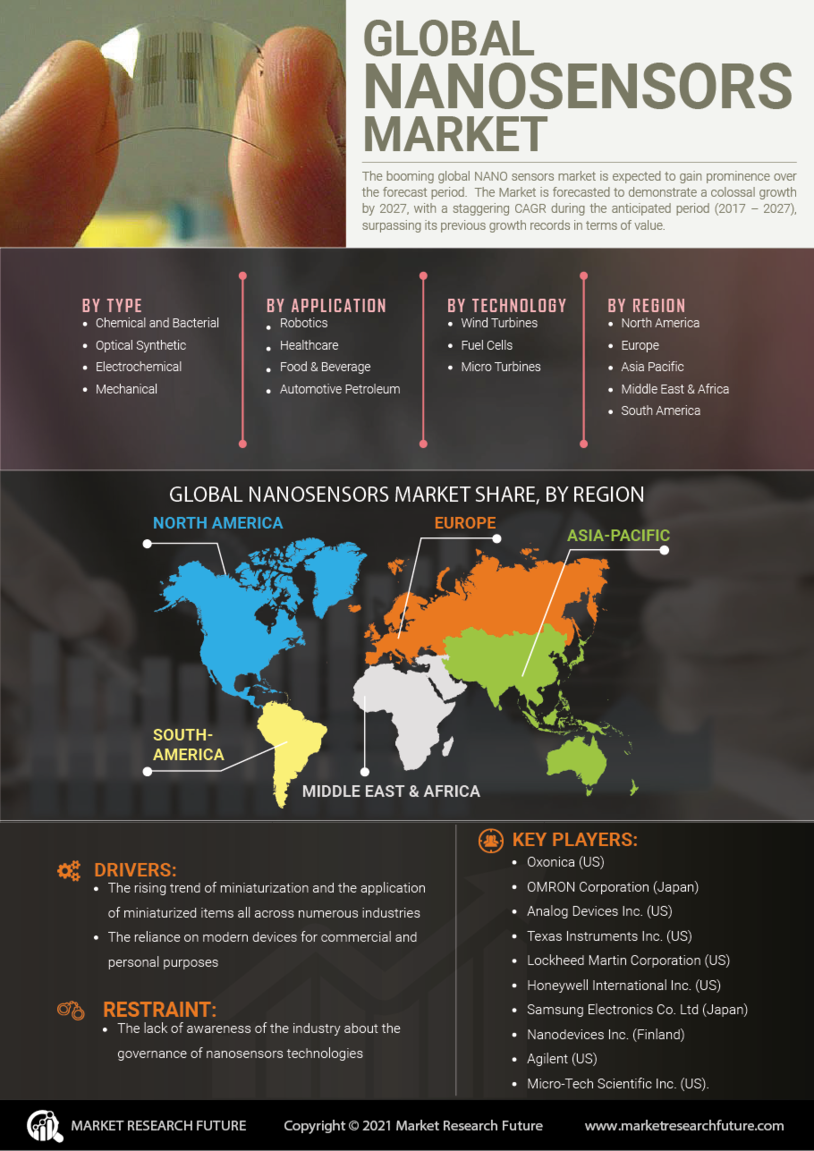
Nanosensors Market Infographic
Purchase Options

Nanosensors Market Summary

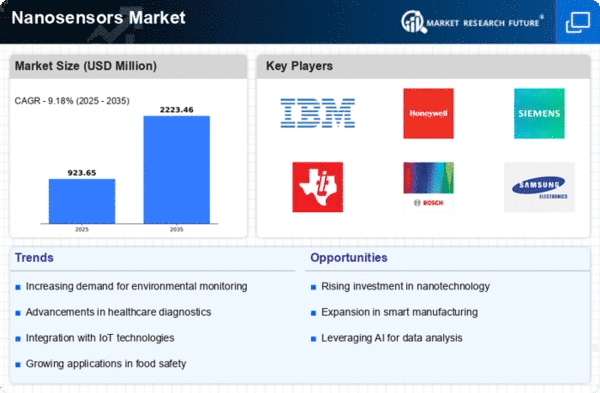
As per MRFR analysis, the Nanosensors Market Size was estimated at 845.99 USD Million in 2024. The Nanosensors industry is projected to grow from 923.67 in 2025 to 2223.46 by 2035, exhibiting a compound annual growth rate (CAGR) of 9.18 during the forecast period 2025 - 2035.

Key Market Trends & Highlights

The Nanosensors Market is poised for substantial growth driven by innovations across various sectors.

  • North America remains the largest market for nanosensors, primarily due to its advanced technological infrastructure.
  • The Asia-Pacific region is currently the fastest-growing market, fueled by increasing investments in nanotechnology and research.
  • Environmental monitoring is the largest segment, reflecting a heightened focus on sustainability and pollution control.
  • Healthcare innovations and advancements in consumer electronics are major drivers propelling the market forward.

Market Size & Forecast

2024 Market Size 845.99 (USD Million)
2035 Market Size 2223.46 (USD Million)
CAGR (2025 - 2035) 9.18%

Major Players

IBM (US), Honeywell (US), Siemens (DE), Texas Instruments (US), Bosch (DE), Samsung (KR), Nanosys (US), NanoComposix (US), Applied Nanotech (US)

Nanosensors Market Trends

The Nanosensors Market is currently experiencing a transformative phase characterized by rapid advancements in technology and increasing applications across various sectors. The integration of nanosensors into healthcare, environmental monitoring, and industrial processes appears to be driving substantial growth. These devices, known for their ability to detect and analyze minute quantities of substances, are becoming essential tools in diagnostics, pollution control, and quality assurance. As industries seek to enhance efficiency and accuracy, the demand for nanosensors is likely to escalate, fostering innovation and competition among manufacturers. Moreover, the ongoing research and development efforts in nanotechnology suggest a promising future for the Nanosensors Market. Emerging trends indicate a shift towards miniaturization and multifunctionality, allowing for the creation of more sophisticated sensors that can perform multiple tasks simultaneously. This evolution not only enhances the performance of nanosensors but also broadens their applicability in diverse fields. As regulatory frameworks evolve and public awareness increases, the market is poised for further expansion, potentially leading to new opportunities and challenges for stakeholders involved in this dynamic sector.

Healthcare Innovations

The Nanosensors Market is witnessing a surge in applications within the healthcare sector. These devices are increasingly utilized for early disease detection, monitoring patient health, and drug delivery systems. Their ability to provide real-time data and precise measurements enhances diagnostic accuracy, which is crucial for effective treatment.

Environmental Monitoring

Another notable trend is the growing use of nanosensors for environmental applications. These sensors are capable of detecting pollutants and hazardous substances at extremely low concentrations. This capability is vital for ensuring compliance with environmental regulations and safeguarding public health.

Industrial Automation

The integration of nanosensors into industrial processes is becoming more prevalent. These sensors facilitate real-time monitoring of production lines, enhancing quality control and operational efficiency. As industries strive for automation and smart manufacturing, the demand for advanced nanosensors is expected to rise.

Nanosensors Market Drivers

Emerging Markets and Global Expansion

The Global NANO Sensors Market Industry is poised for growth due to the emergence of new markets and global expansion strategies. Developing regions are increasingly recognizing the potential of NANO sensors in addressing local challenges, such as pollution and health monitoring. Countries in Asia-Pacific and Latin America are investing in NANO sensor technologies to improve public health and environmental management. This expansion is expected to drive market growth, as the global market adapts to regional needs and preferences. The increasing collaboration between international companies and local firms is likely to enhance the distribution and accessibility of NANO sensor technologies.

Advancements in Healthcare Technologies

The Global NANO Sensors Market Industry is witnessing transformative advancements in healthcare technologies, particularly in diagnostics and monitoring. NANO sensors enable rapid and accurate detection of biomarkers, which is crucial for early disease diagnosis and personalized medicine. For example, NANO sensors can detect glucose levels in diabetic patients with remarkable precision, enhancing patient management. The integration of NANO sensors in wearable devices is also gaining traction, allowing continuous health monitoring. This technological evolution is likely to propel the market, with expectations of reaching 2.23 USD Billion by 2035, driven by the increasing adoption of NANO sensor-based solutions in healthcare.

Rising Demand for Environmental Monitoring

The Global NANO Sensors Market Industry is experiencing a surge in demand for environmental monitoring applications. As governments and organizations increasingly prioritize sustainability, the need for precise and real-time monitoring of pollutants and hazardous substances becomes paramount. NANO sensors, with their high sensitivity and specificity, are well-suited for detecting trace levels of contaminants in air, water, and soil. For instance, NANO sensors can identify toxic gases at parts per billion levels, facilitating timely interventions. This trend is expected to contribute significantly to the market, projected to reach 0.85 USD Billion in 2024, reflecting a growing awareness of environmental issues.

Growing Adoption in Industrial Applications

The Global NANO Sensors Market Industry is benefiting from the growing adoption of NANO sensors in various industrial applications. Industries such as manufacturing, automotive, and aerospace are increasingly utilizing NANO sensors for quality control, process optimization, and safety monitoring. These sensors provide real-time data, enabling companies to enhance operational efficiency and reduce costs. For instance, NANO sensors can monitor structural integrity in aerospace components, ensuring safety and reliability. This trend is expected to sustain a robust growth trajectory, with a projected CAGR of 9.15% from 2025 to 2035, underscoring the importance of NANO sensors in modern industrial practices.

Increased Investment in Research and Development

The Global NANO Sensors Market Industry is experiencing increased investment in research and development, fostering innovation and expanding application areas. Governments and private entities are allocating substantial funds to explore the potential of NANO sensors in fields such as agriculture, food safety, and energy management. For example, NANO sensors are being developed to monitor soil health and optimize fertilizer usage, contributing to sustainable agriculture practices. This influx of investment is likely to accelerate technological advancements and broaden the scope of NANO sensor applications, thereby enhancing market growth and competitiveness.

Market Segment Insights

By Application: Environmental Monitoring (Largest) vs. Healthcare (Fastest-Growing)

In the Nanosensors Market, Environmental Monitoring holds the largest share, reflecting its critical role in detecting pollutants and monitoring environmental conditions. Following closely, Healthcare is emerging as the fastest-growing segment, driven by the increasing demand for advanced diagnostics and personalized medical solutions. Both segments benefit from the global push towards sustainability and health safety, showcasing the varying priorities across industries dealing with critical challenges.

Environmental Monitoring (Dominant) vs. Healthcare (Emerging)

Environmental Monitoring has established itself as a dominant application within the Nanosensors Market due to its pivotal role in air and water quality assessment, which is essential for public health and safety. Its application spans various sectors, such as government regulatory compliance and consumer awareness. In contrast, Healthcare represents an emerging segment poised for rapid growth, propelled by innovations aimed at improving point-of-care diagnostics and disease management. Companies are actively investing in nanosensors to enhance the sensitivity of detection methods, outperforming traditional solutions. The interplay between these segments highlights a balanced prioritization of ecological sustainability and health advancements by industries.

By End Use: Consumer Electronics (Largest) vs. Healthcare Devices (Fastest-Growing)

In the Nanosensors Market, the 'End Use' segment is notably diverse, with significant contributions from various applications. Consumer Electronics holds the largest market share, driven by the increasing integration of advanced sensor technologies in devices such as smartphones, wearables, and smart home products. On the other hand, Healthcare Devices are marking their presence as a crucial category, demonstrating rapid adoption as medical technologies evolve and the demand for precision diagnostics rises. Growth trends indicate that the Automotive and Aerospace sectors are also beginning to leverage nanosensors for enhanced functionalities, focusing on safety and efficiency. Consumer Electronics remains strong due to consumer demand for smarter devices, while Healthcare Devices are expanding swiftly, driven by innovations in personalized medicine and real-time health monitoring, addressing the increasing need for proactive healthcare solutions.

Consumer Electronics (Dominant) vs. Healthcare Devices (Emerging)

Consumer Electronics is recognized as the dominant player in the Nanosensors Market, characterized by widespread applications in mobile devices, wearables, and IoT gadgets. This segment's strength lies in its ability to integrate sensors that can enhance user experiences, improve energy efficiency, and provide new functionalities. As technology evolves, consumer expectations have driven manufacturers to innovate continuously, resulting in an increasing demand for nanosensors that can perform various tasks, including environmental monitoring and biometric sensing. In contrast, Healthcare Devices are emerging rapidly, spurred by advancements in diagnostics and therapeutic applications. The integration of nanosensors in medical devices facilitates cutting-edge developments in patient monitoring and drug delivery systems. As global health trends emphasize personalized and precision medicine, the demand for innovative healthcare solutions incorporating nanosensors ensures their status as an emerging segment within the market. Both segments illustrate unique opportunities for growth, reflecting trends in technology and consumer needs.

By Type: Chemical Nanosensors (Largest) vs. Biological Nanosensors (Fastest-Growing)

In the Nanosensors Market, Chemical Nanosensors currently hold the largest market share, thanks to their extensive applications in environmental monitoring and industrial processes. This segment benefits from the demand for precise chemical analysis and rapid detection capabilities. Meanwhile, Biological Nanosensors are emerging as the fastest-growing segment, largely driven by advancements in healthcare diagnostics and monitoring, where their unique sensitivity to biological substances provides valuable insights.

Chemical Nanosensors (Dominant) vs. Biological Nanosensors (Emerging)

Chemical Nanosensors are characterized by their ability to detect and analyze chemical substances with unparalleled precision, making them highly sought after in sectors like environmental and food safety. Their established market presence is supported by a wide array of applications. Conversely, Biological Nanosensors are revolutionizing healthcare by enabling real-time monitoring of disease markers and pathogens, appealing to the burgeoning personalized medicine field. As these sensors continue to evolve, they are likely to capture significant attention and investment, positioning them as a vital component of future healthcare innovation.

By Material: Carbon Nanotubes (Largest) vs. Metal Oxides (Fastest-Growing)

The Nanosensors Market showcases a diverse material composition with Carbon Nanotubes leading in market share due to their outstanding electrical and mechanical properties, making them ideal for various applications. Metal Oxides are rapidly gaining traction, propelled by their unique sensing capabilities and compatibility with various substrates. Their share is increasing as innovations drive their usage in sectors like healthcare, environmental monitoring, and electronics, reflecting the dynamic nature of this segment.

Carbon Nanotubes (Dominant) vs. Metal Oxides (Emerging)

Carbon Nanotubes are at the forefront of the Nanosensors Market, recognized for their exceptional conductivity and strength, making them pivotal in developing high-performance sensors. Their dominance derives from their versatility across numerous applications, ensuring a robust demand. Conversely, Metal Oxides represent an emerging trend within the market due to their affordability and ease of functionalization. The growing adoption of Metal Oxide nanosensors in various fields, including gas detection and biosensing, highlights their evolving role and potential to capture a more significant market share as technology advances.

By Technology: Electrochemical (Largest) vs. Optical (Fastest-Growing)

The Nanosensors Market is primarily segmented into Electrochemical, Optical, Thermal, and Magnetic technologies, with Electrochemical sensors leading the market due to their widespread application in chemical detection and monitoring. Their robustness and accuracy make them indispensable in healthcare and environmental monitoring. Conversely, Optical nanosensors are rapidly gaining market share as they offer enhanced sensitivity and the ability to detect a wider range of analytes, positioning them as a dynamic and growing segment within the industry.

Nanosensors Technology: Electrochemical (Dominant) vs. Optical (Emerging)

Electrochemical nanosensors have established themselves as the dominant technology in the Nanosensors Market, primarily due to their reliability and accuracy in various applications, including biomedical diagnostics, environmental sensing, and industrial monitoring. These sensors leverage electrochemical reactions to provide real-time data and are known for their cost-effectiveness and ease of integration. In contrast, Optical nanosensors are emerging rapidly, characterized by their ability to detect changes at the molecular level through light interaction. This technology is touted for its potential in advanced applications such as point-of-care diagnostics and pollution monitoring, driven by increased demand for high-performance sensors and the push for miniaturization in various industries.

Get more detailed insights about Nanosensors Market

Regional Insights

North America : Innovation and Leadership Hub

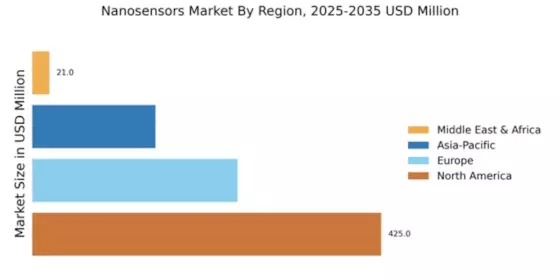
North America continues to lead the nanosensors market, holding a significant share of 425.0M in 2024. The region's growth is driven by robust investments in R&D, particularly in sectors like healthcare and environmental monitoring. Regulatory support from agencies such as the EPA and FDA fosters innovation, ensuring compliance with safety standards while promoting technological advancements. The increasing demand for smart devices and IoT applications further propels market expansion. The competitive landscape in North America is characterized by the presence of major players like IBM, Honeywell, and Texas Instruments. These companies are at the forefront of developing cutting-edge nanosensor technologies, catering to diverse industries. The U.S. remains the largest market, followed by Canada, where government initiatives encourage the adoption of nanosensor solutions. This dynamic environment positions North America as a key player in The Nanosensors.

Europe : Emerging Technology Landscape

Europe's nanosensors market is projected to reach 250.0M by 2025, driven by increasing demand for advanced materials and smart technologies. The region benefits from strong regulatory frameworks that promote research and development, particularly in the automotive and healthcare sectors. Initiatives from the European Commission aim to enhance the competitiveness of European industries, fostering innovation in nanosensor applications. The growing focus on sustainability and environmental monitoring also contributes to market growth. Leading countries in Europe include Germany, France, and the UK, where companies like Siemens and Bosch are making significant strides in nanosensor technology. The competitive landscape is marked by collaborations between academia and industry, enhancing the development of innovative solutions. The presence of key players and supportive government policies positions Europe as a vital region in The Nanosensors.

Asia-Pacific : Rapidly Growing Market

Asia-Pacific is witnessing rapid growth in the nanosensors market, projected to reach 150.0M by 2025. The region's expansion is fueled by increasing industrialization, urbanization, and a rising demand for smart technologies. Countries like China and India are investing heavily in R&D, supported by government initiatives aimed at fostering innovation. The regulatory environment is evolving, with a focus on safety and environmental standards, which is crucial for market growth. China stands out as a leader in the region, with significant contributions from companies like Samsung and various local startups. The competitive landscape is characterized by a mix of established players and emerging firms, driving innovation and technological advancements. As the region continues to embrace nanosensor technologies, Asia-Pacific is set to become a key player in the global market.

Middle East and Africa : Emerging Market Potential

The Middle East and Africa (MEA) region is gradually emerging in the nanosensors market, with a projected size of 20.99M by 2025. The growth is driven by increasing investments in technology and infrastructure, particularly in sectors like oil and gas, healthcare, and environmental monitoring. Governments in the region are recognizing the potential of nanosensors to enhance operational efficiency and safety, leading to supportive regulatory frameworks that encourage innovation. Countries like South Africa and the UAE are at the forefront of adopting nanosensor technologies, with local companies exploring applications in various industries. The competitive landscape is still developing, but the presence of international players is fostering growth. As awareness of the benefits of nanosensors increases, the MEA region is poised for significant advancements in this market.

Key Players and Competitive Insights

The Nanosensors Market is currently characterized by a dynamic competitive landscape, driven by rapid technological advancements and increasing demand across various sectors, including healthcare, environmental monitoring, and consumer electronics. Key players such as IBM (US), Honeywell (US), and Siemens (DE) are strategically positioning themselves through innovation and partnerships, which collectively enhance their market presence. IBM (US) focuses on integrating artificial intelligence with nanosensor technology, while Honeywell (US) emphasizes sustainability in its product offerings. Siemens (DE) is leveraging its extensive industrial expertise to develop nanosensors that improve operational efficiency in manufacturing processes, thereby shaping a competitive environment that prioritizes technological integration and sustainability.

In terms of business tactics, companies are increasingly localizing manufacturing to reduce supply chain vulnerabilities and optimize operational efficiency. The market structure appears moderately fragmented, with a mix of established players and emerging startups. This fragmentation allows for diverse innovations and competitive strategies, as key players like Texas Instruments (US) and Bosch (DE) also engage in strategic collaborations to enhance their product portfolios and market reach.

In November 2025, IBM (US) announced a partnership with a leading healthcare provider to develop nanosensors capable of real-time monitoring of patient vitals. This collaboration is significant as it not only showcases IBM's commitment to healthcare innovation but also positions the company at the forefront of the growing telehealth market. The integration of nanosensors in patient monitoring systems could potentially revolutionize how healthcare providers manage patient care, indicating a shift towards more personalized and responsive healthcare solutions.

In October 2025, Honeywell (US) launched a new line of environmentally friendly nanosensors designed for air quality monitoring. This strategic move aligns with global sustainability trends and reflects Honeywell's commitment to addressing environmental challenges. By focusing on eco-friendly solutions, Honeywell is likely to attract a broader customer base, particularly among environmentally conscious consumers and businesses, thereby enhancing its competitive edge in the market.

In September 2025, Siemens (DE) unveiled a nanosensor technology that enhances predictive maintenance in industrial applications. This innovation is crucial as it allows manufacturers to anticipate equipment failures before they occur, thereby reducing downtime and operational costs. Siemens' focus on integrating nanosensors into existing industrial systems indicates a strategic direction towards enhancing productivity and efficiency in manufacturing, which is increasingly vital in today's competitive landscape.

As of December 2025, current trends in the Nanosensors Market are heavily influenced by digitalization, sustainability, and the integration of artificial intelligence. Strategic alliances among key players are shaping the competitive landscape, fostering innovation and collaboration. The shift from price-based competition to a focus on technological advancement and supply chain reliability is evident, suggesting that future competitive differentiation will hinge on the ability to innovate and adapt to evolving market demands.

Key Companies in the Nanosensors Market market include

Industry Developments

August 2021: Omron has announced the release of the "VTS10 Series PCB Inspection System," the industry's first imaging and artificial intelligence technology that automates the electronic substrate inspection process, removing the need for specialized skills to meet the demands of fifth-generation mobile communications, electric vehicles, and autonomous driving.

September 2021: Texas Instruments announced a collaboration with Delta Electronics they release a technology that extends the power of Gallium Nitride (GaN) technology to Delta Electronics' energy-efficient data center server power supply.

Future Outlook

Nanosensors Market Future Outlook

The Nanosensors Market is projected to grow at a 9.18% CAGR from 2024 to 2035, driven by advancements in technology, increasing demand in healthcare, and environmental monitoring.

New opportunities lie in:

  • Development of nanosensor-integrated smart packaging solutions for food safety.
  • Expansion into wearable health monitoring devices utilizing nanosensor technology.
  • Creation of nanosensor-based environmental monitoring systems for industrial applications.

By 2035, the Nanosensors Market is expected to achieve substantial growth, reflecting its critical role in various industries.

Market Segmentation

Nanosensors Market Type Outlook

  • Chemical Nanosensors
  • Biological Nanosensors
  • Physical Nanosensors
  • Optical Nanosensors

Nanosensors Market End Use Outlook

  • Consumer Electronics
  • Automotive
  • Aerospace
  • Healthcare Devices
  • Industrial Equipment

Nanosensors Market Material Outlook

  • Carbon Nanotubes
  • Metal Oxides
  • Nanoparticles
  • Graphene

Nanosensors Market Technology Outlook

  • Electrochemical
  • Optical
  • Thermal
  • Magnetic

Nanosensors Market Application Outlook

  • Environmental Monitoring
  • Healthcare
  • Food Safety
  • Industrial
  • Military

Report Scope

MARKET SIZE 2024845.99(USD Million)
MARKET SIZE 2025923.67(USD Million)
MARKET SIZE 20352223.46(USD Million)
COMPOUND ANNUAL GROWTH RATE (CAGR)9.18% (2024 - 2035)
REPORT COVERAGERevenue Forecast, Competitive Landscape, Growth Factors, and Trends
BASE YEAR2024
Market Forecast Period2025 - 2035
Historical Data2019 - 2024
Market Forecast UnitsUSD Million
Key Companies ProfiledIBM (US), Honeywell (US), Siemens (DE), Texas Instruments (US), Bosch (DE), Samsung (KR), Nanosys (US), NanoComposix (US), Applied Nanotech (US)
Segments CoveredApplication, End Use, Type, Material, Technology
Key Market OpportunitiesIntegration of Nanosensors in smart healthcare devices enhances real-time monitoring and diagnostics capabilities.
Key Market DynamicsTechnological advancements drive competitive forces, enhancing nanosensor applications across various industries and reshaping market dynamics.
Countries CoveredNorth America, Europe, APAC, South America, MEA

Market Highlights

Author
Aarti Dhapte
Team Lead - Research

She holds an experience of about 6+ years in Market Research and Business Consulting, working under the spectrum of Information Communication Technology, Telecommunications and Semiconductor domains. Aarti conceptualizes and implements a scalable business strategy and provides strategic leadership to the clients. Her expertise lies in market estimation, competitive intelligence, pipeline analysis, customer assessment, etc.

Leave a Comment

FAQs

How much is the NANO Sensors market?

The global NANO Sensor market size was valued at USD 0.85 billion in 2024.

What is the growth rate of the NANO Sensor market?

The global market is projected to grow at a CAGR of 9.18% during the forecast period, 2025 to 2035.

Which region held the largest market share in the NANO Sensors market?

North America had the largest share of the global NANO Sensor market.

Who are the key players in the NANO Sensors market?

The key players in the market are OMRON Corporation, Analog devises Inc, Lockheed Martin Corporation, Texas Instruments Inc, Honeywell International Inc, Agilent Technologies Inc, Medtronic, Universal Biosensors Inc, Hoffman-La Roche Ltd, and Bruker Corporation.

Which product type led the market of NANO sensors?

The Electrochemical Nano sensor category dominated the market in 2022.

Which Application had the largest market share in the market?

Healthcare had the largest share in the global market for NANO Sensors.

Download Free Sample

Kindly complete the form below to receive a free sample of this Report

Compare Licence

×
Features License Type
Single User Multiuser License Enterprise User
Price $4,950 $5,950 $7,250
Maximum User Access Limit 1 User Upto 10 Users Unrestricted Access Throughout the Organization
Free Customization
Direct Access to Analyst
Deliverable Format
Platform Access
Discount on Next Purchase 10% 15% 15%
Printable Versions