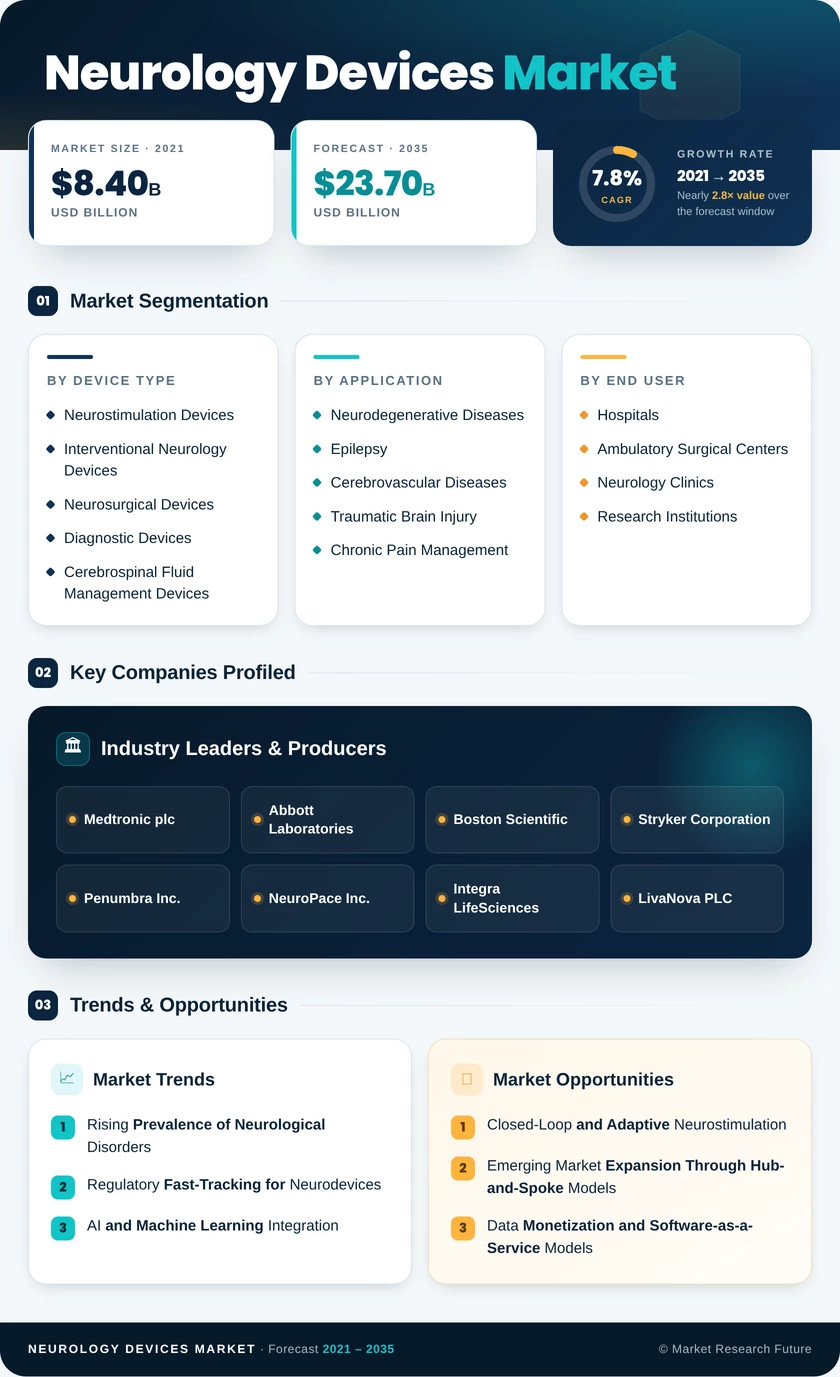
Neurology Devices Market (2026 - 2035)

ID: MRFR/HC/8290-HCR
90 Pages
Rahul Gotadki
Last Updated: July 14, 2026
Neurology Devices Market Trends, Growth and Size Analysis By Product (Neurostimulation, Interventional Neurology, CSF Management, Neurosurgery Devices), End User (Hospitals & Clinics, Specialty Center) and Region (Americas, Europe, Asia-Pacific, Middle East & Africa) - Growth & Industry Forecast 2025 To 2035.
Neurology Devices Market
Market Size
Forecast Period2026-2035
CAGR (2026-2035)7.8%
2025 Market SizeUSD 11.2 Billion
2035 Market SizeUSD 23.7 Billion
Key Players
Medtronic plc
Abbott Laboratories
Boston Scientific
Stryker Corporation
Penumbra Inc.
NeuroPace Inc.
Opportunities
  • Closed-Loop and Adaptive Neurostimulation
  • Emerging Market Expansion Through Hub-and-Spoke Models
  • Data Monetization and Software-as-a-Service Models
  1. 1 Market Overview |
    1. 1.1 Study Assumptions & Market Definition |
    2. 1.2 Scope of the Study |
    3. 1.3 Research Methodology
  2. 2 Market Summary & Key Takeaways
  3. 3 Market Dynamics |
    1. 3.1 Market Drivers Analysis | |
      1. 3.1.1 Rising Prevalence of Neurological Disorders | |
      2. 3.1.2 Regulatory Fast-Tracking for Neurodevices | |
      3. 3.1.3 AI and Machine Learning Integration | |
      4. 3.1.4 Expanding Reimbursement Coverage | |
      5. 3.1.5 Aging Global Population | |
      6. 3.1.6 Growth in Minimally Invasive Neurosurgery | |
      7. 3.1.7 Telemedicine and Remote Monitoring Adoption |
    2. 3.2 Market Restraints Analysis | |
      1. 3.2.1 High Device and Procedure Costs | |
      2. 3.2.2 Stringent Regulatory Requirements | |
      3. 3.2.3 Limited Trained Neurology Specialists | |
      4. 3.2.4 Cybersecurity and Data Privacy Risks | |
      5. 3.2.5 Reimbursement Uncertainty in Emerging Markets |
    3. 3.3 Market Opportunity Analysis | |
      1. 3.3.1 Closed-Loop and Adaptive Neurostimulation | |
      2. 3.3.2 Emerging Market Expansion Through Hub-and-Spoke Models | |
      3. 3.3.3 Data Monetization and Software-as-a-Service Models | |
      4. 3.3.4 Non-Invasive Brain Stimulation in Outpatient Settings | |
      5. 3.3.5 AI-Powered Predictive Diagnostics |
    4. 3.4 Industry Value Chain Analysis |
    5. 3.5 Porter's Five Forces Analysis
  4. 4 Global Neurology Devices Market Size & Forecast (2021–2035) |
    1. 4.1 Historical Market Size (2021–2025) |
    2. 4.2 Current & Forecast Market Size (2026–2035) |
    3. 4.3 Market Size by Revenue (USD Billion) |
    4. 4.4 Year-over-Year Growth Analysis
  5. 5 Segmentation Analysis |
    1. 5.1 By Device Type | |
      1. 5.1.1 Neurostimulation Devices | |
      2. 5.1.2 Interventional Neurology Devices | |
      3. 5.1.3 Neurosurgical Devices | |
      4. 5.1.4 Diagnostic Devices | |
      5. 5.1.5 Cerebrospinal Fluid Management Devices |
    2. 5.2 By Application | |
      1. 5.2.1 Neurodegenerative Diseases | |
      2. 5.2.2 Epilepsy | |
      3. 5.2.3 Cerebrovascular Diseases | |
      4. 5.2.4 Traumatic Brain Injury | |
      5. 5.2.5 Chronic Pain Management |
    3. 5.3 By End User | |
      1. 5.3.1 Hospitals | |
      2. 5.3.2 Ambulatory Surgical Centers | |
      3. 5.3.3 Neurology Clinics | |
      4. 5.3.4 Research Institutions
  6. 6 Regional Analysis |
    1. 6.1 North America | |
      1. 6.1.1 United States | |
      2. 6.1.2 Canada | |
      3. 6.1.3 Mexico |
    2. 6.2 Europe | |
      1. 6.2.1 Germany | |
      2. 6.2.2 United Kingdom | |
      3. 6.2.3 France | |
      4. 6.2.4 Rest of Europe |
    3. 6.3 Asia-Pacific | |
      1. 6.3.1 China | |
      2. 6.3.2 Japan | |
      3. 6.3.3 India | |
      4. 6.3.4 South Korea | |
      5. 6.3.5 Rest of Asia-Pacific |
    4. 6.4 South America | |
      1. 6.4.1 Brazil | |
      2. 6.4.2 Argentina | |
      3. 6.4.3 Rest of South America |
    5. 6.5 Middle East & Africa | |
      1. 6.5.1 UAE | |
      2. 6.5.2 Saudi Arabia | |
      3. 6.5.3 Rest of Middle East & Africa
  7. 7 Competitive Landscape |
    1. 7.1 Market Share Analysis (2025) |
    2. 7.2 Competitive Benchmarking Matrix |
    3. 7.3 Company Profiles | |
      1. 7.3.1 Medtronic plc | |
      2. 7.3.2 Abbott Laboratories | |
      3. 7.3.3 Boston Scientific Corporation | |
      4. 7.3.4 Stryker Corporation | |
      5. 7.3.5 Penumbra Inc. | |
      6. 7.3.6 NeuroPace Inc. | |
      7. 7.3.7 Integra LifeSciences Holdings | |
      8. 7.3.8 LivaNova PLC | |
      9. 7.3.9 Natus Medical (Natus) | |
      10. 7.3.10 MicroPort Scientific Corporation
  8. 8 Future Outlook & Strategic Recommendations (2026–2035) |
    1. 8.1 AI-Native Device Platforms (2026–2029) |
    2. 8.2 Miniaturization and Biocompatible Materials (2027–2031) |
    3. 8.3 Decentralized Neurological Care (2028–2033) |
    4. 8.4 Regulatory Harmonization and Global Standards (2030–2035)
  9. 9 Recent Developments & News
  10. 10 Frequently Asked Questions (FAQs)
  11. 11 Report Scope & Methodology |
    1. 11.1 Study Period & Base Year |
    2. 11.2 Data Sources & Citations |
    3. 11.3 Abbreviations
  12. 12 LIST OF TABLES |
  13. TABLE 1 Global Neurology Devices Market Size & Forecast, by Revenue (USD Billion), 2021–2035 |
  14. TABLE 2 Global Neurology Devices Market – Year-over-Year Growth Analysis, 2021–2035 |
  15. TABLE 3 Global Neurology Devices Market – Driver Impact Analysis |
  16. TABLE 4 Global Neurology Devices Market – Restraint Impact Analysis |
  17. TABLE 5 Global Neurology Devices Market Size, by Device Type, 2021–2035 (USD Billion) |
  18. TABLE 6 Global Neurology Devices Market Size, by Application, 2021–2035 (USD Billion) |
  19. TABLE 7 Global Neurology Devices Market Size, by End User, 2021–2035 (USD Billion) |
  20. TABLE 8 Global Neurology Devices Market Size, by Region, 2021–2035 (USD Billion) |
  21. TABLE 9 North America Neurology Devices Market Size, by Country, 2021–2035 (USD Billion) |
  22. TABLE 10 Europe Neurology Devices Market Size, by Country, 2021–2035 (USD Billion) |
  23. TABLE 11 Asia-Pacific Neurology Devices Market Size, by Country, 2021–2035 (USD Billion) |
  24. TABLE 12 South America Neurology Devices Market Size, by Country, 2021–2035 (USD Billion) |
  25. TABLE 13 Middle East & Africa Neurology Devices Market Size, by Country, 2021–2035 (USD Billion) |
  26. TABLE 14 North America Neurology Devices Market Size, by Device Type, 2021–2035 (USD Billion) |
  27. TABLE 15 North America Neurology Devices Market Size, by Application, 2021–2035 (USD Billion) |
  28. TABLE 16 North America Neurology Devices Market Size, by End User, 2021–2035 (USD Billion) |
  29. TABLE 17 Europe Neurology Devices Market Size, by Device Type, 2021–2035 (USD Billion) |
  30. TABLE 18 Europe Neurology Devices Market Size, by Application, 2021–2035 (USD Billion) |
  31. TABLE 19 Europe Neurology Devices Market Size, by End User, 2021–2035 (USD Billion) |
  32. TABLE 20 Asia-Pacific Neurology Devices Market Size, by Device Type, 2021–2035 (USD Billion) |
  33. TABLE 21 Asia-Pacific Neurology Devices Market Size, by Application, 2021–2035 (USD Billion) |
  34. TABLE 22 Asia-Pacific Neurology Devices Market Size, by End User, 2021–2035 (USD Billion) |
  35. TABLE 23 South America Neurology Devices Market Size, by Device Type, 2021–2035 (USD Billion) |
  36. TABLE 24 South America Neurology Devices Market Size, by Application, 2021–2035 (USD Billion) |
  37. TABLE 25 South America Neurology Devices Market Size, by End User, 2021–2035 (USD Billion) |
  38. TABLE 26 Middle East & Africa Neurology Devices Market Size, by Device Type, 2021–2035 (USD Billion) |
  39. TABLE 27 Middle East & Africa Neurology Devices Market Size, by Application, 2021–2035 (USD Billion) |
  40. TABLE 28 Middle East & Africa Neurology Devices Market Size, by End User, 2021–2035 (USD Billion) |
  41. TABLE 29 Competitive Benchmarking Matrix – Global Neurology Devices Market, 2025 |
  42. TABLE 30 Company Profiles – Key Players, Global Neurology Devices Market |
  43. TABLE 31 Recent Developments & Strategic Announcements, 2023–2025 |
  44. TABLE 32 Report Scope & Methodology Summary |
  45. TABLE 33 Detailed Sources and Citations
  46. 13 LIST OF FIGURES |
  47. FIGURE 1 Global Neurology Devices Market Dynamics Overview |
  48. FIGURE 2 Industry Value Chain Analysis – Neurology Devices Market |
  49. FIGURE 3 Porter's Five Forces Analysis – Neurology Devices Market |
  50. FIGURE 4 Global Neurology Devices Market Size Trend (USD Billion), 2021–2035 |
  51. FIGURE 5 Global Neurology Devices Market Share, by Device Type (%), 2025 |
  52. FIGURE 6 Global Neurology Devices Market Share, by Application (%), 2025 |
  53. FIGURE 7 Global Neurology Devices Market Share, by End User (%), 2025 |
  54. FIGURE 8 Global Neurology Devices Market Share, by Region (%), 2025 |
  55. FIGURE 9 North America Neurology Devices Market Size Trend (USD Billion), 2021–2035 |
  56. FIGURE 10 Europe Neurology Devices Market Size Trend (USD Billion), 2021–2035 |
  57. FIGURE 11 Asia-Pacific Neurology Devices Market Size Trend (USD Billion), 2021–2035 |
  58. FIGURE 12 South America Neurology Devices Market Size Trend (USD Billion), 2021–2035 |
  59. FIGURE 13 Middle East & Africa Neurology Devices Market Size Trend (USD Billion), 2021–2035 |
  60. FIGURE 14 Competitive Landscape – Market Share Distribution (%), 2025

Segmentation Quick Reference

DimensionSub-SegmentsDominant SegmentFastest Growing Segment
By Device TypeNeurostimulation Devices, Interventional Neurology Devices, Neurosurgical Devices, Diagnostic Devices, Cerebrospinal Fluid Management DevicesNeurostimulation DevicesInterventional Neurology Devices
By ApplicationNeurodegenerative Diseases, Epilepsy, Cerebrovascular Diseases, Traumatic Brain Injury, Chronic Pain ManagementNeurodegenerative DiseasesEpilepsy
By End UserHospitals, Ambulatory Surgical Centers, Neurology Clinics, Research InstitutionsHospitalsAmbulatory Surgical Centers


Market Segmentation Overview

By Device Type

Sub-SegmentKey Trend
Neurostimulation DevicesExpanding indications from movement disorders to psychiatric conditions; rechargeable and MRI-conditional designs gaining share
Interventional Neurology DevicesMechanical thrombectomy adoption is accelerating; expanded stroke treatment time windows are driving procedural volumes.
Neurosurgical DevicesShift toward robotic-assisted and image-guided platforms; integration with intraoperative MRI suites.
Diagnostic DevicesHigh-density sensor arrays replacing legacy systems; AI-enhanced automated interpretation algorithms
Cerebrospinal Fluid Management DevicesProgrammable valves with telemetric pressure monitoring; reduction in revision surgery rates


Device type segmentation reflects the clinical workflow from diagnosis through intervention and chronic disease management. Neurostimulation devices command the largest share due to their applicability across multiple therapeutic areas and the recurring revenue from pulse generator replacements. Interventional neurology devices are growing fastest as stroke centers worldwide expand their thrombectomy-capable infrastructure.

By Application

Sub-SegmentKey Trend
Neurodegenerative DiseasesMulti-modal device approaches combining stimulation with biomarker monitoring for personalized therapy.
EpilepsyClosed-loop responsive stimulation systems demonstrating sustained seizure reduction in drug-resistant populations
Cerebrovascular DiseasesExtended time-window protocols and mobile stroke unit deployment are increasing device-eligible patient pools.
Traumatic Brain InjuryAdvanced intracranial pressure monitoring and portable diagnostic tools for field and emergency settings
Chronic Pain ManagementNon-opioid neuromodulation mandates driving payer interest in spinal cord and dorsal root ganglion stimulation.


Application segmentation mirrors the epidemiological burden of neurological conditions globally. Neurodegenerative diseases dominate by prevalence, while epilepsy applications are growing at the fastest rate due to the clinical success of responsive neurostimulation platforms and expanding regulatory approvals.

By End User

Sub-SegmentKey Trend
HospitalsConcentration of high-acuity neurosurgical and interventional procedures; capital equipment upgrade cycles
Ambulatory Surgical CentersMigration of lower-complexity neurostimulation implants to outpatient settings for cost efficiency
Neurology ClinicsDiagnostic-focused purchasing; growth in specialist-run outpatient monitoring services
Research InstitutionsGrant-funded procurement tied to government neuroscience research budgets and academic consortia


Hospitals will remain the primary revenue channel due to the capital-intensive nature of neurosurgical and interventional procedures. Ambulatory surgical centers represent the fastest-growing channel as select neurostimulation and pain management procedures shift to outpatient protocols, driven by payer preference for lower-cost settings.


Download PDF ×

We do not share your information with anyone. However, we may send you emails based on your report interest from time to time. You may contact us at any time to opt-out.