×
Request Free Sample ×

Kindly complete the form below to receive a free sample of this Report

* Please use a valid business email

Leading companies partner with us for data-driven Insights

clients tt-cursor
Hero Background

Next Generation Network Oss Bs Market

ID: MRFR/ICT/24987-HCR
111 Pages
Aarti Dhapte
October 2025

Next Generation Network Oss Bs Market Research Report: By Deployment Model (Cloud-based, On-premises), By Functionality (Network Management, Performance Monitoring, Fault Management, Service Assurance), By Segment (5G Networks, Wireless Networks, Wireline Networks), By Analytics (Real-time Analytics, Historical Analytics, Predictive Analytics), By Use Case (Network Optimization, Fault Detection, Performance Improvement, Service Assurance) and By Regional (North America, Europe, South America, Asia Pacific, Middle East and Africa) - Forecas... read more

Share:
Download PDF ×

We do not share your information with anyone. However, we may send you emails based on your report interest from time to time. You may contact us at any time to opt-out.

Next Generation Network Oss Bs Market
 Infographic
Purchase Options

Next Generation Network Oss Bs Market Summary

As per MRFR analysis, the Next Generation Network OSS/BSS Market Size was estimated at 21.54 USD Billion in 2024. The Next Generation Network Oss Bs industry is projected to grow from 23.71 USD Billion in 2025 to 62.01 USD Billion by 2035, exhibiting a compound annual growth rate (CAGR) of 10.09 during the forecast period 2025 - 2035.

Key Market Trends & Highlights

The Next Generation Network OSS/BSS market is poised for substantial growth driven by technological advancements and evolving customer needs.

  • The market experiences increased automation, enhancing operational efficiency across various segments.
  • AI integration is becoming a pivotal trend, enabling smarter decision-making and improved service delivery.
  • A pronounced focus on customer experience is reshaping service offerings, particularly among telecommunications service providers.
  • Rising demand for 5G infrastructure and the emergence of IoT applications are key drivers propelling growth in both North America and Asia-Pacific.

Market Size & Forecast

2024 Market Size 21.54 (USD Billion)
2035 Market Size 62.01 (USD Billion)
CAGR (2025 - 2035) 10.09%

Major Players

Nokia (FI), Ericsson (SE), Cisco Systems (US), Huawei Technologies (CN), ZTE Corporation (CN), NEC Corporation (JP), Ciena Corporation (US), Juniper Networks (US), Fujitsu (JP)

Next Generation Network Oss Bs Market Trends

The Next Generation Network Oss Bs Market is currently experiencing a transformative phase characterized by the integration of advanced technologies and evolving consumer demands. This market appears to be shifting towards more agile and flexible operational support systems, which are essential for managing the complexities of modern telecommunications networks. As service providers strive to enhance customer experiences, the emphasis on automation and artificial intelligence is becoming increasingly pronounced. These developments suggest a potential for improved efficiency and reduced operational costs, which may attract further investments in this sector. Moreover, the growing trend of digital transformation across various industries is likely to drive the adoption of Next Generation Network Oss Bs solutions. Organizations are recognizing the necessity of adapting to rapidly changing market conditions, which necessitates robust and scalable network management solutions. The convergence of IT and telecommunications is fostering an environment where innovative solutions can thrive, potentially leading to new business models and revenue streams. As the market evolves, stakeholders must remain vigilant to emerging trends and technologies that could reshape the landscape of network operations and support services.

Increased Automation

The Next Generation Network Oss Bs Market is witnessing a notable shift towards automation. This trend indicates that organizations are increasingly adopting automated processes to enhance operational efficiency. By minimizing manual interventions, companies can streamline their workflows, reduce errors, and improve service delivery.

AI Integration

Artificial intelligence is becoming a pivotal component within the Next Generation Network Oss Bs Market. The integration of AI technologies appears to facilitate better decision-making and predictive analytics. This capability may empower service providers to anticipate network issues and optimize resource allocation.

Focus on Customer Experience

Enhancing customer experience is emerging as a primary focus in the Next Generation Network Oss Bs Market. Companies are prioritizing solutions that enable personalized services and faster response times. This trend suggests a shift towards customer-centric strategies that aim to foster loyalty and satisfaction.

Next Generation Network Oss Bs Market Drivers

Rising Demand for Enhanced Connectivity

The Global Next Generation Network Oss Bs Market Industry experiences a surge in demand for enhanced connectivity solutions. As businesses and consumers increasingly rely on high-speed internet and seamless communication, the need for advanced operational support systems becomes paramount. In 2024, the market is projected to reach 21.4 USD Billion, driven by the proliferation of IoT devices and the expansion of 5G networks. This demand is likely to accelerate as organizations seek to optimize their network performance and improve customer experiences, indicating a robust growth trajectory for the industry.

Market Segment Insights

By Application: Service Assurance (Largest) vs. Performance Management (Fastest-Growing)

The application segment in the Next Generation Network OSS/BSS Market reveals that Service Assurance holds the largest market share, significantly benefitting from the increasing demand for seamless service delivery and improved customer satisfaction. Following closely, Performance Management is emerging as a key player, bolstered by the need for enhanced application performance and operational efficiency in network management.

Service Assurance: (Dominant) vs. Performance Management (Emerging)

Service Assurance has established itself as the dominant application segment in the Next Generation Network OSS/BSS Market, focusing on ensuring optimal service quality and reliability for end-users. This segment involves proactive monitoring and management of network services, adopting advanced analytics and automation techniques to swiftly resolve issues and enhance customer experience. On the other hand, Performance Management, labeled as an emerging segment, is rapidly gaining traction as businesses prioritize performance optimization. Leveraging data-driven insights, organizations are enhancing their operational abilities, reducing downtime, and improving overall network efficiency, positioning this segment for significant growth in the coming years.

By End Use: Telecommunications Service Providers (Largest) vs. Cloud Service Providers (Fastest-Growing)

In the Next Generation Network OSS/BSS market, the distribution of market share among end-use segments varies significantly. Telecommunications Service Providers hold the largest portion of the market, driven by their need for advanced operational and business support systems to manage complex networks. Enterprises, Government Agencies, and Cloud Service Providers follow, each contributing to the evolving landscape as they adopt digital transformation strategies. The dynamic nature of the market highlights the critical role that each segment plays in the overall development of OSS/BSS solutions.

Telecommunications Service Providers (Dominant) vs. Cloud Service Providers (Emerging)

Telecommunications Service Providers are the dominant force in the Next Generation Network OSS/BSS market. They utilize sophisticated systems to optimize operations, enhance customer experience, and ensure regulatory compliance. This segment is characterized by a strong focus on innovative solutions to manage vast networks and improve service delivery. On the other hand, Cloud Service Providers represent an emerging segment that is rapidly gaining traction. They leverage the scalability and flexibility of cloud-based systems to meet diverse client needs, making them agile players. The adoption of cloud technologies allows these providers to offer cost-effective and efficient OSS/BSS solutions, highlighting a trend towards integrated and decentralized operations.

By Deployment Type: Cloud-Based (Largest) vs. Hybrid (Fastest-Growing)

In the Next Generation Network OSS/BSS market, deployment types are pivotal in shaping the service delivery landscape. The current distribution indicates that the Cloud-Based segment leads in market share, as businesses increasingly favor the scalability, flexibility, and cost-effectiveness of cloud solutions. This segment's dominance is bolstered by the transition of organizations to modernized, digital-first infrastructures that require robust and adaptable network management capabilities. Conversely, the Hybrid deployment is rapidly gaining traction, appealing to enterprises looking to leverage both on-premises security and cloud agility, which has resulted in a steady increase in its market presence.

Deployment Type: Cloud-Based (Dominant) vs. Hybrid (Emerging)

The Cloud-Based deployment type stands out in the Next Generation Network OSS/BSS market, primarily due to its extensive capabilities including streamlined operations, enhanced collaboration, and reduced IT overhead costs. Organizations are embracing cloud solutions for their ability to provide real-time insights and rapid deployment of services without the complexities associated with traditional infrastructure. On the other hand, the Hybrid model is emerging as a viable alternative, combining the best of both worlds by allowing organizations to maintain critical operations on-premises while leveraging the cloud for additional scalability and resilience. This dual approach supports organizations in optimizing their resource allocation, ensuring compliance, and responding swiftly to changing market demands.

By Technology: Artificial Intelligence (Largest) vs. Machine Learning (Fastest-Growing)

In the Next Generation Network OSS/BSS market, Artificial Intelligence (AI) holds a prominent position as the largest segment, shaping the future of operational and business support systems. It contributes significantly to network optimization, enhancing customer experience, and driving automation across various processes. Meanwhile, Machine Learning (ML) is emerging as the fastest-growing segment, attracting interest for its ability to analyze vast amounts of data and improve service quality through predictive analytics.

Technology: AI (Dominant) vs. ML (Emerging)

Artificial Intelligence is redefining the Next Generation Network OSS/BSS landscape with its ability to process and analyze information at unprecedented speeds, allowing for smarter decision-making and efficient resource allocation. Companies leveraging AI are not only improving operational efficiencies but also creating more responsive customer engagement models. In contrast, Machine Learning is positioned as an emerging powerhouse, rapidly gaining traction as businesses seek to harness its capabilities for data-driven insights. By continually learning from data inputs, ML algorithms are helping organizations to enhance their service delivery and adapt to changing market demands, marking it as a crucial element in the digital transformation journey.

By Service Type: Consulting Services (Largest) vs. Integration Services (Fastest-Growing)

The service type segment in the Next Generation Network OSS BS market is prominently driven by consulting services, which hold a significant share due to increasing demand for strategic guidance in network optimization and digital transformation initiatives. Integration services follow as a crucial component, facilitating seamless operational synergy between advanced networks and existing infrastructure, thus ensuring continuity and compatibility across various platforms. Support and maintenance services also play a key role, ensuring reliability and performance but constitute a smaller segment compared to the leading two.

Consulting Services (Dominant) vs. Integration Services (Emerging)

Consulting services stand out in the Next Generation Network OSS BS market as the dominant segment, driven by organizations seeking expertise to navigate complex network challenges and embrace emerging technologies. With a focus on tailored solutions, consulting services help businesses formulate strategies that align with their long-term objectives. In contrast, integration services are categorized as emerging, fueled by the rapid evolution of technology and the necessity to integrate newer systems with legacy infrastructures. This integration ensures that organizations can maximize their technology investments, adapt to changing market conditions, and embrace innovative solutions efficiently.

Get more detailed insights about Next Generation Network Oss Bs Market

Regional Insights

North America : Market Leader in Innovation

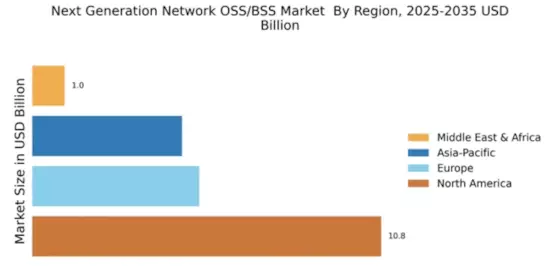
North America is poised to maintain its leadership in the Next Generation Network OSS/BSS market, holding a significant market share of $10.77B in 2025. The region's growth is driven by rapid technological advancements, increasing demand for high-speed connectivity, and supportive regulatory frameworks. Investments in 5G infrastructure and cloud-based solutions are further propelling market expansion, making it a hub for innovation and development. The competitive landscape is characterized by major players such as Cisco Systems, Ericsson, and Nokia, which are at the forefront of technological advancements. The U.S. and Canada are leading countries, with substantial investments in network infrastructure. The presence of key players ensures a robust ecosystem, fostering collaboration and innovation. As the market evolves, North America is expected to continue attracting investments, solidifying its position as a global leader in Next Generation Network solutions.

Europe : Emerging Market with Potential

Europe is witnessing a growing demand for Next Generation Network OSS/BSS solutions, with a market size of $5.15B projected for 2025. The region's growth is fueled by increasing digitalization, regulatory support for 5G deployment, and a focus on enhancing network efficiency. European governments are actively promoting initiatives to improve connectivity, which is expected to drive market expansion in the coming years. Leading countries in this region include Germany, the UK, and France, where major players like Nokia and Ericsson are heavily invested. The competitive landscape is evolving, with a mix of established companies and emerging startups. The presence of regulatory bodies ensures compliance and fosters innovation, creating a conducive environment for market growth. "The European Commission aims to ensure that all households have access to high-speed internet by 2025," highlights the commitment to enhancing network infrastructure.

Asia-Pacific : Rapid Growth and Adoption

The Asia-Pacific region is rapidly emerging as a significant player in the Next Generation Network OSS/BSS market, with a projected market size of $4.62B by 2025. The growth is driven by increasing internet penetration, rising mobile data consumption, and government initiatives to enhance digital infrastructure. Countries like China and India are leading the charge, with substantial investments in 5G technology and smart city projects. China, Japan, and India are the leading countries in this market, with key players such as Huawei and ZTE Corporation dominating the landscape. The competitive environment is marked by aggressive pricing strategies and innovation. As the region continues to embrace digital transformation, the demand for advanced network solutions is expected to surge, positioning Asia-Pacific as a critical market for future growth.

Middle East and Africa : Emerging Market with Challenges

The Middle East and Africa (MEA) region is gradually developing its Next Generation Network OSS/BSS market, with a projected size of $1.0B by 2025. The growth is driven by increasing mobile connectivity, government initiatives to enhance digital infrastructure, and a rising demand for broadband services. However, challenges such as regulatory hurdles and varying levels of technological adoption across countries may impact growth. Leading countries in the MEA region include South Africa, the UAE, and Nigeria, where investments in telecommunications infrastructure are on the rise. The competitive landscape features both local and international players, with companies like NEC Corporation and Fujitsu making significant inroads. As the region continues to evolve, the demand for innovative network solutions is expected to grow, presenting opportunities for market players.

Key Players and Competitive Insights

The Next Generation Network Oss Bs Market is characterized by a dynamic competitive landscape, driven by rapid technological advancements and increasing demand for efficient network management solutions. Key players such as Nokia (FI), Ericsson (SE), and Cisco Systems (US) are at the forefront, each adopting distinct strategies to enhance their market positioning. Nokia (FI) emphasizes innovation through its investments in AI and machine learning, aiming to optimize network performance and reduce operational costs. Meanwhile, Ericsson (SE) focuses on strategic partnerships, collaborating with telecom operators to expand its service offerings and enhance customer experience. Cisco Systems (US) is leveraging its strong presence in cybersecurity to integrate secure network solutions, thereby addressing growing concerns over data privacy and security in network operations.

The market structure appears moderately fragmented, with several players vying for market share. Key business tactics include localizing manufacturing to reduce supply chain vulnerabilities and optimizing logistics to enhance service delivery. This competitive environment is shaped by the collective influence of major companies, which are increasingly adopting agile methodologies to respond to market demands swiftly.

In November 2025, Huawei Technologies (CN) announced a significant investment in a new R&D facility in Europe, aimed at developing next-generation OSS/BSS solutions. This strategic move is likely to bolster Huawei's capabilities in the region, allowing it to better serve local telecom operators and enhance its competitive edge against Western rivals. The establishment of this facility underscores Huawei's commitment to innovation and regional expansion, potentially reshaping the competitive dynamics in Europe.

In October 2025, ZTE Corporation (CN) launched a new cloud-based OSS platform designed to streamline network operations for telecom providers. This platform integrates advanced analytics and automation features, which may significantly improve operational efficiency and reduce costs for service providers. ZTE's focus on cloud solutions reflects a broader industry trend towards digital transformation, positioning the company favorably in a market increasingly driven by cloud technologies.

In September 2025, Ciena Corporation (US) entered into a strategic partnership with a leading telecom operator to co-develop next-generation network solutions. This collaboration is expected to enhance Ciena's product offerings and expand its market reach, particularly in the North American region. Such partnerships are indicative of a growing trend where companies seek to leverage each other's strengths to drive innovation and improve service delivery.

As of December 2025, the competitive trends in the Next Generation Network Oss Bs Market are increasingly defined by digitalization, sustainability, and AI integration. Strategic alliances are becoming pivotal in shaping the landscape, as companies recognize the need to collaborate to stay ahead. The shift from price-based competition to a focus on innovation, technology, and supply chain reliability is evident, suggesting that future competitive differentiation will hinge on the ability to deliver cutting-edge solutions that meet evolving customer needs.

Key Companies in the Next Generation Network Oss Bs Market market include

Industry Developments

The Next Generation Network OSS/BSS market is anticipated to grow steadily over the forecast period, driven by the increasing adoption of 5G and other next-generation technologies. Key market trends include the growing demand for real-time network visibility and control, the need for automation and orchestration to manage complex network environments, and the convergence of OSS and BSS systems. Major players in the market include Nokia, Ericsson, Huawei, and Amdocs. Recent news developments include the launch of new OSS/BSS solutions by vendors, such as Nokia's AVA Cognitive Operations Suite and Ericsson's Operations Orchestration Center.

The market is expected to face challenges such as the lack of skilled professionals and the need for integration with legacy systems. Despite these challenges, the overall outlook for the Next Generation Network OSS/BSS market remains positive.

Future Outlook

Next Generation Network Oss Bs Market Future Outlook

The Next Generation Network OSS/BSS Market is projected to grow at a 10.09% CAGR from 2024 to 2035, driven by digital transformation, increased demand for automation, and enhanced customer experience.

New opportunities lie in:

  • Development of AI-driven analytics platforms for real-time decision-making.
  • Integration of 5G technology to enhance service delivery and operational efficiency.
  • Expansion of cloud-based OSS/BSS solutions for scalable and flexible operations.

By 2035, the market is expected to achieve substantial growth, positioning itself as a leader in digital transformation.

Market Segmentation

Next Generation Network Oss Bs Market End Use Outlook

  • Telecommunications Service Providers
  • Enterprises
  • Government Agencies
  • Cloud Service Providers

Next Generation Network Oss Bs Market Technology Outlook

  • Artificial Intelligence
  • Machine Learning
  • Big Data Analytics
  • Internet of Things

Next Generation Network Oss Bs Market Application Outlook

  • Network Management
  • Service Assurance
  • Fault Management
  • Performance Management
  • Configuration Management

Next Generation Network Oss Bs Market Service Type Outlook

  • Consulting Services
  • Integration Services
  • Support and Maintenance Services

Next Generation Network Oss Bs Market Deployment Type Outlook

  • On-Premises
  • Cloud-Based
  • Hybrid

Report Scope

MARKET SIZE 202421.54(USD Billion)
MARKET SIZE 202523.71(USD Billion)
MARKET SIZE 203562.01(USD Billion)
COMPOUND ANNUAL GROWTH RATE (CAGR)10.09% (2024 - 2035)
REPORT COVERAGERevenue Forecast, Competitive Landscape, Growth Factors, and Trends
BASE YEAR2024
Market Forecast Period2025 - 2035
Historical Data2019 - 2024
Market Forecast UnitsUSD Billion
Key Companies ProfiledNokia (FI), Ericsson (SE), Cisco Systems (US), Huawei Technologies (CN), ZTE Corporation (CN), NEC Corporation (JP), Ciena Corporation (US), Juniper Networks (US), Fujitsu (JP)
Segments CoveredApplication, End Use, Deployment Type, Technology, Service Type
Key Market OpportunitiesIntegration of artificial intelligence for enhanced operational efficiency in the Next Generation Network Oss Bs Market.
Key Market DynamicsTechnological advancements and regulatory changes drive competitive dynamics in the Next Generation Network Operations Support Systems market.
Countries CoveredNorth America, Europe, APAC, South America, MEA

Leave a Comment

FAQs

What is the projected CAGR of the Next Generation Network Oss Bs Market?

The Next Generation Network Oss Bs Market is projected to grow at a CAGR of 10.92% from 2025 to 2034.

What is the expected valuation of the Next Generation Network Oss Bs Market in 2034?

The Next Generation Network Oss Bs Market is expected to reach a valuation of USD 56.32 billion by 2034.

What are the key applications of Next Generation Network Oss Bs?

Key applications of Next Generation Network Oss Bs include network management, service assurance, and performance monitoring.

Who are the major competitors in the Next Generation Network Oss Bs Market?

Major competitors in the Next Generation Network Oss Bs Market include Huawei, Ericsson, Nokia, and ZTE.

Which regions are expected to drive growth in the Next Generation Network Oss Bs Market?

Asia Pacific and North America are expected to be the major growth drivers for the Next Generation Network Oss Bs Market.

What are the challenges faced by the Next Generation Network Oss Bs Market?

Challenges faced by the Next Generation Network Oss Bs Market include the high cost of implementation and the need for skilled professionals.

What are the opportunities for growth in the Next Generation Network Oss Bs Market?

Opportunities for growth in the Next Generation Network Oss Bs Market include the increasing demand for network automation and the growing adoption of cloud-based solutions.

What is the expected impact of 5G technology on the Next Generation Network Oss Bs Market?

5G technology is expected to drive growth in the Next Generation Network Oss Bs Market by increasing the demand for network management and optimization solutions.

What are the latest trends in the Next Generation Network Oss Bs Market?

Latest trends in the Next Generation Network Oss Bs Market include the adoption of artificial intelligence and machine learning for network management.

What are the key factors driving the growth of the Next Generation Network Oss Bs Market?

Key factors driving the growth of the Next Generation Network Oss Bs Market include the increasing complexity of networks and the need for improved network visibility and control.

Download Free Sample

Kindly complete the form below to receive a free sample of this Report

Compare Licence

×
Features License Type
Single User Multiuser License Enterprise User
Price $4,950 $ $7,250
Maximum User Access Limit 1 User Upto 10 Users Unrestricted Access Throughout the Organization
Free Customization
Direct Access to Analyst
Deliverable Format
Platform Access
Discount on Next Purchase 10% 15% 15%
Printable Versions