Nickel Metal Hydride (NiMH) Battery Market Summary
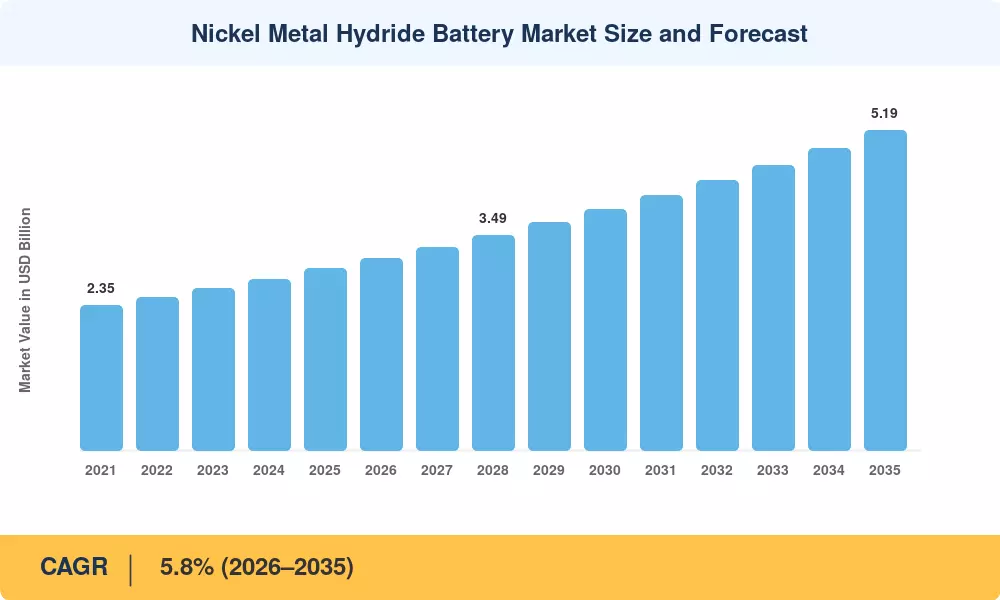
The Nickel Metal Hydride Battery Market reached an estimated USD 2.95 billion in 2025 and is projected to grow from USD 3.12 billion in 2026 to USD 5.19 billion by 2035, registering a CAGR of 5.8% during the forecast period. This trajectory is anchored in sustained demand from hybrid electric vehicle programs — Toyota alone delivered over 2.8 million HEV units globally in 2024 — and expanding industrial energy storage applications where NiMH chemistry's safety profile and wide operating temperature range outperform alternatives [1]. Government mandates in Japan and the EU pushing fleet-average CO₂ reductions below 95 g/km continue to channel OEM investment into hybrid powertrains that rely heavily on NiMH battery packs [2].
A quiet but important technology shift is reshaping the Nickel Metal Hydride Battery Market. While lithium-ion dominates headlines, NiMH cells have undergone meaningful improvements in energy density — reaching 100 Wh/kg in advanced prismatic formats — and cycle life now regularly exceeds 1,500 full discharge cycles. Panasonic's 2024 announcement of a next-generation low-self-discharge NiMH platform, backed by an estimated USD 180 million R&D commitment, signals that manufacturers see a durable future for this chemistry in applications where abuse tolerance and recyclability matter more than gravimetric energy density [3].
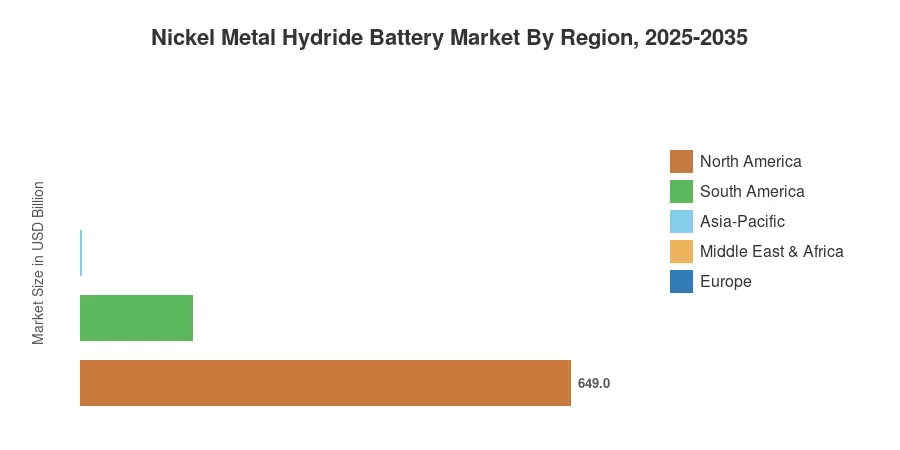
Asia-Pacific commands roughly 48% of the Nickel Metal Hydride Battery Market, driven by Japan's legacy manufacturing base and China's expanding HEV production. North America holds an estimated 22% share, supported by consumer electronics demand and Toyota's Kentucky battery plant. Europe contributes approximately 20%, propelled by strict emissions standards and growing industrial backup power adoption. The decade ahead will see the Nickel Metal Hydride Battery Market benefit from circular-economy regulations that favor NiMH's high recyclability rates over chemistries dependent on scarce raw materials [4].
Key Report Takeaways
• By Battery Type
- Prismatic NiMH cells hold an estimated 44% share of the Nickel Metal Hydride Battery Market, driven by automotive OEM specifications for hybrid battery packs.
- Cylindrical cells are growing at a CAGR of 6.3% as consumer electronics and power tool applications expand capacity requirements.
- Button cells contribute approximately USD 210 million in revenue, serving medical devices and specialty instrumentation.
• By Application
- Automotive applications account for roughly 52% of the Nickel Metal Hydride Battery Market, reflecting the dominance of HEV powertrains.
- Consumer electronics segments are projected to reach USD 1.18 billion by 2035, fueled by rechargeable AA/AAA replacement cycles.
• By Region
- The Asia-Pacific Nickel Metal Hydride Battery Market is expanding at a CAGR of 6.4%, led by Japanese and Chinese manufacturing scale.
- North America's share stands at approximately 22%, underpinned by Toyota's U.S. HEV battery operations and growing industrial demand.
- Europe's Nickel Metal Hydride Battery Market is valued at an estimated USD 590 million in 2025, shaped by EU emissions mandates.
Nickel Metal Hydride Battery Market Size and Forecast (2021–2035)
Market sizing combines bottom-up revenue analysis from manufacturer shipments with top-down validation against trade databases and OEM procurement disclosures. Historical figures (2021–2024) draw on customs data, company annual reports, and verified industry association statistics. Forecast values (2026–2035) apply a regression-adjusted CAGR anchored to EV production outlooks, consumer electronics shipment projections, and industrial battery replacement cycles [5].