Nickel Cadmium Battery Market (2026 - 2035)

Nickel Cadmium Battery Market Size, Share & Growth Analysis Report By Battery Type (Vented/Flooded, Sealed, Cylindrical, Prismatic, Sub-C and Specialty Formats), By Capacity Range (Above 10 Ah, 3 to 10 Ah, Below 3 Ah), By Application (Industrial, Military and Defense, Medical Devices, Power Tools and Engineering Equipment, Consumer Electronics) and By Regional (North America, Europe, South America, Asia Pacific, Middle East and Africa) – Industry Growth & Forecast to 2035
ID: MRFR/EnP/20714-HCR
128 Pages
Shubhendra Anand
Last Updated: June 29, 2026
Nickel Cadmium Battery Market
Market Size
Forecast Period2026-2035
CAGR (2026-2035)5.4%
2025 Market SizeUSD 1.87 Billion
2035 Market SizeUSD 3.16 Billion
Key Players
Saft
EnerSys
GS Yuasa Corporation
Hoppecke Batterien GmbH
Panasonic Holdings
Sichuan Changhong New Energy
Opportunities
  • Closed-Loop Recycling Networks
  • Telecom Tower Backup in Emerging Markets
  • Digital Battery Management Platforms

Nickel Cadmium Battery Market Summary

The global Nickel Cadmium Battery Market was valued at USD 1.87 billion in 2025 and is projected to reach USD 3.16 billion by 2035, expanding at a 5.4% CAGR during the 2026–2035 forecast window. Sustained demand from industrial standby power installations, aviation starter systems, and defense electronics underpins this trajectory. Government mandates requiring certified backup energy for critical infrastructure—including the U.S. FAA's Technical Standard Order C173 for aircraft batteries and the EU Battery Regulation (2023/1542) introducing mandatory recycling quotas—continue to channel procurement budgets toward nickel-cadmium chemistry [1][2].

While increasing lithium-ion degradation has squeezed consumer-grade addressable quantities, nickel-cadmium cells still have unique benefits in extreme-temperature conditions (–40 °C to +70 °C) and deep-discharge cycling applications. Combined tenders in Europe and India for vented nickel-cadmium systems were above USD 340 million in 2023–2024, highlighting the chemistry’s staying power in safety-certified sectors [3][4], such as railway signaling networks.

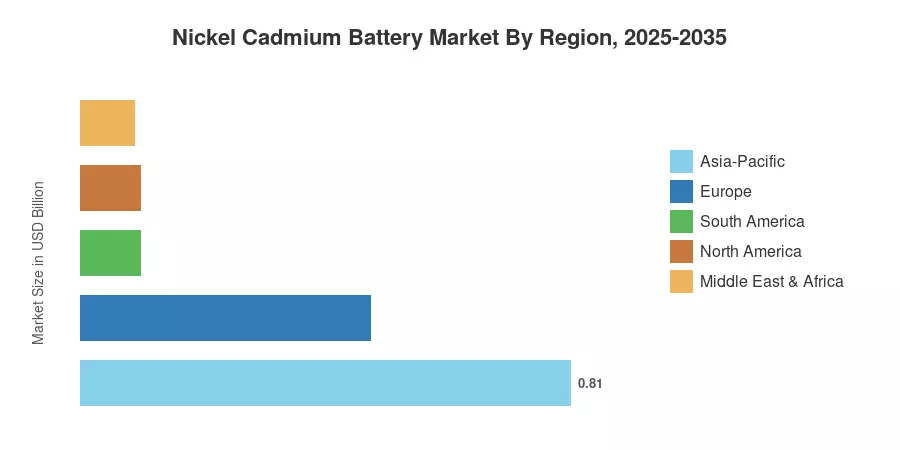
The Asia-Pacific nickel-cadmium battery market accounted for 43.4% of the market in 2024, with Chinese manufacturing and the Indian railways’ electrification projects adding to the size of the market. Aerospace OEM clusters in France and Germany led Europe, which accounted for 25.8% and ranked second. Defense modernization spending is anticipated to fuel North America’s CAGR to 5.2% through 2035. How manufacturers balance the cost of complying with recycling regulations with margins in an increasingly restrictive regulatory environment will help determine the next decade.

Key Report Takeaways

• By Battery Type

  • Vented/flooded configurations held a 38.2% share of the nickel-cadmium battery market in 2024, anchored by industrial and rail installations.
  • Sub-C and specialty formats are forecast to grow at a 6.4% CAGR through 2035, the fastest among all battery types.

• By Application

  • Military and defense applications are poised to expand at a 6.6% CAGR to 2035, driven by NATO and Indo-Pacific procurement cycles.
  • Industrial installations retained a 48.3% share of the nickel-cadmium battery market in 2024.

• By Geography

  • Asia-Pacific generated a 43.4% revenue share in 2024 and is projected to advance at a 6.3% CAGR through 2035.
  • North America is set to register a 5.2% CAGR, buoyed by FAA-certified aviation battery replacements and grid-edge deployments.


Market Size and Forecast (2021–2035)

Market Research Future (MRFR) sizing approach includes primary interviews with battery OEMs, Tier-1 component suppliers and institutional procurement agencies across 22 countries. Historical data (2021-2024) is based on customs trade statistics, firm annual reports, and verified cargo volumes; the forecast period (2026-2035) is based on scenario-based econometric modeling calibrated against infrastructure investment pipelines and deadlines for regulation adoption.
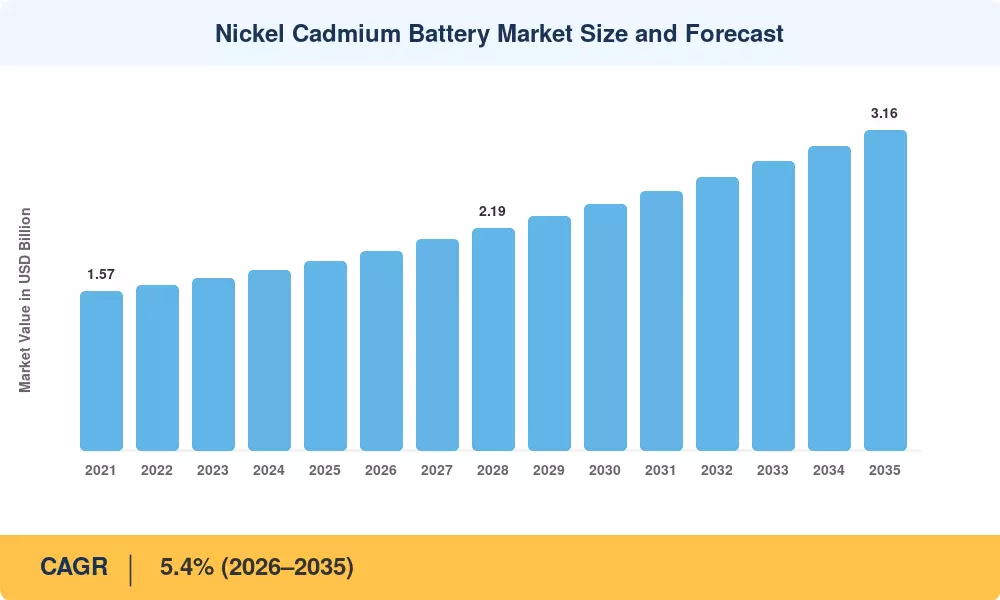
Nickel Cadmium Battery Market Size and Forecast
Our Impact
Enabled $4.3B Revenue Impact for Fortune 500 and Leading Multinationals
Partnering with 2000+ Global Organizations Each Year
30K+ Citations by Top-Tier Firms in the Industry

Driver Impact Analysis

Driver ~% Impact on CAGR Geographic Relevance Impact Timeline
Industrial standby & UPS demand +1.3% Global Long-term
Defense modernization programs +1.1% North America, Europe Medium-term
Railway signaling electrification +0.9% Asia-Pacific, Europe Medium-term
Aviation battery certification cycles +0.7% North America, Europe Short-term
Extreme-temperature application growth +0.5% Middle East, Nordic Long-term
Recycling infrastructure investment +0.4% Europe, Asia-Pacific Long-term
Telecom tower backup in emerging markets +0.3% South America, Africa Medium-term


Industrial Standby and UPS Demand

Power utilities and data center operators continue to specify nickel-cadmium (Ni-Cd) for stationary backup in environments where a 15–20 year service life and tolerance for high ambient temperatures outweigh upfront cost premiums. While lithium-ion solutions are increasingly adopted, Ni-Cd maintains a specialized niche in high-temperature industrial settings where complex thermal management for lithium-ion adds significant infrastructure costs. The broader global stationary battery storage market reached approximately USD 56 billion in 2025 and is projected to experience a compound annual growth rate (CAGR) of over 20% through 2030, driven by grid stability needs. Within the industrial segment, Ni-Cd remains a robust choice for mission-critical facilities in extreme climates.


Defense Modernization Programs

NATO member states collectively raised defense spending to 2.3% of GDP in 2024 [6], accelerating procurement of portable power systems, man-portable radio batteries, and submarine starter cells. The U.S. Department of Defense allocated USD 1.9 billion to battery-related programs across FY2024–FY2025, with nickel-cadmium specified for legacy platform maintenance and arctic-rated field equipment. These cycles guarantee recurring revenue because defense-qualified chemistries face multi-year requalification timelines that deter rapid substitution.

Railway Signaling Electrification

Electrified rail networks require fail-safe trackside batteries immune to deep discharge and temperature extremes. Europe's Shift2Rail program and India's Mission Raftar collectively represent over USD 6 billion in signaling upgrades through 2030 [4][10]. Nickel-cadmium remains the default chemistry for European EN 50272-2 compliant installations, ensuring a captive demand stream even as lithium-ion solutions seek certification.

Aviation Battery Certification

The aviation sector maintains a strict "regulatory moat" for battery systems governed by the FAA’s TSO-C173 and EASA’s ETSO-C173. These standards mandate rigorous minimum performance requirements for nickel-cadmium and lead-acid batteries used in aircraft emergency power systems, engine starting, and auxiliary power units (APUs). Because re-certifying new chemistries for flight-critical applications involves extensive airworthiness testing and multi-year development cycles, Ni-Cd suppliers benefit from long-term maintenance and replacement demand cycles across the existing narrowbody and widebody commercial aircraft fleets.


Restraints Impact Analysis

Restraint impact percentages are directional estimates of headwinds affecting overall market growth. They do not offset driver percentages on a one-to-one basis.

Restraint ~% Impact on CAGR Geographic Relevance Impact Timeline
Cadmium toxicity regulations –0.9% Europe, North America Long-term
Lithium-ion cost erosion –0.7% Global Medium-term
EU Battery Regulation compliance costs –0.5% Europe Short-term
Memory effect perception –0.3% Global Long-term
Limited consumer-electronics addressable market –0.2% Global Long-term


Cadmium Toxicity and Environmental Regulation

The EU's Restriction of Hazardous Substances (RoHS) Directive grants exemptions for industrial and defense nickel-cadmium batteries, yet periodic review cycles—most recently the 2024 Commission evaluation—create regulatory uncertainty that chills capital expenditure [8]. In North America, EPA Toxics Release Inventory reporting obligations add administrative costs of roughly USD 1.2–1.8 million per manufacturing site annually. Producers without vertically integrated recycling operations face growing compliance exposure as extended producer responsibility (EPR) frameworks expand across jurisdictions.

Lithium-Ion Price Erosion

Lithium-ion cell prices fell below USD 100/kWh in 2024 for the first time, according to BloombergNEF [12], eroding nickel-cadmium competitiveness in portable power tools and consumer electronics. This price compression has effectively closed the nickel-cadmium battery market to new consumer-grade entrants, confining growth to industrial, defense, and aviation verticals where safety certification and extreme-environment performance still command premium pricing.

EU Battery Regulation Compliance

Regulation (EU) 2023/1542 mandates digital battery passports, minimum recycled-content thresholds, and carbon-footprint declarations from February 2027 [1]. Smaller NiCd producers estimate compliance investment at EUR 3–5 million per product line, potentially driving consolidation among mid-tier manufacturers.


Nickel Cadmium Battery Market Opportunities

Closed-Loop Recycling Networks

Cadmium recovery rates already exceed 99.5% in modern hydrometallurgical plants [8]. Producers that build or acquire recycling capacity can convert regulatory pressure into a competitive advantage by securing low-cost cadmium feedstock while satisfying EU minimum recycled-content mandates. Saft and EnerSys have both announced closed-loop recycling expansions through 2026.

Telecom Tower Backup in Emerging Markets

Sub-Saharan Africa and South Asia collectively plan 185,000 new telecom tower installations between 2025 and 2030 [9], many in off-grid locations where ambient temperatures routinely exceed 45 °C. Nickel-cadmium's temperature resilience positions it as a superior alternative to lead-acid and a cost-effective substitute for lithium-ion in these deployments, offering a new addressable segment within the nickel-cadmium battery market.

Digital Battery Management Platforms

Battery-as-a-service models and IoT-enabled condition monitoring are emerging in industrial standby applications. Integrating predictive analytics with vented pocket plate NiCd battery installations enables utilities to shift from time-based to condition-based maintenance, extending replacement cycles by 15–20% and creating recurring software revenue for OEMs.

Aerospace Fleet Replacement Cycles

Over 12,000 narrowbody aircraft globally carry NiCd emergency power units nearing end-of-life replacement windows between 2026 and 2032 [11]. OEMs with FAA and EASA certification can capture this replacement wave, which represents a high-margin, specification-locked revenue stream.

Military Electrification in Indo-Pacific

Rising defense budgets across India, South Korea, Japan, and Australia—collectively exceeding USD 230 billion in 2024 [6]—are driving procurement of ruggedized portable power systems. Nickel-cadmium remains the chemistry of record for extreme-cold and high-vibration military platforms, opening new contract volume in the nickel-cadmium battery market.


Nickel Cadmium Battery Market Future Outlook

Recycling-Driven Competitive Restructuring

The EU's mandatory recycled-content thresholds—16% recovered cadmium by 2031, rising to 26% by 2036 [1]—will favor vertically integrated manufacturers. Producers without in-house hydrometallurgical capacity may exit or consolidate, shrinking the competitive field and improving pricing discipline within the nickel-cadmium battery market over the coming decade.

Digital Twin and Predictive Maintenance Integration

Industrial battery banks are increasingly monitored via IoT sensors feeding digital-twin platforms. The IEA estimates that predictive maintenance reduces unplanned downtime costs by 25–30% in critical infrastructure [16]. For NiCd installations with 20-year design lives, condition-based monitoring extends economic viability and defers replacement CapEx, reinforcing chemistry loyalty.

Defense Electrification and Autonomous Systems

Autonomous underwater vehicles (AUVs), uncrewed ground vehicles, and field-deployable radar systems increasingly require batteries rated for –50 °C operation and high-G shock loads. The U.S. DoD's FY2026 budget request includes USD 2.4 billion for next-generation portable power [6], a share of which will flow to nickel-cadmium suppliers holding existing qualification approvals.

ESG Reporting and Circular-Economy Narratives

Corporate ESG disclosures now cover Scope 3 battery supply chains. Nickel-cadmium's nearly 100% recyclability rate and established take-back infrastructure position it favorably in lifecycle-assessment scoring compared to lithium-ion chemistries still building end-of-life pathways [8][17]. Companies that publicize closed-loop recycling metrics will likely strengthen their standing with institutional procurement committees.


Nickel Cadmium Battery Market Segmentation

By Battery Type

Segment Key Metric Primary Demand Driver
Vented/Flooded 38.2% share (2024) Rail signaling; utility standby
Sealed USD 0.34 Billion (2025) Medical devices; portable instruments
Cylindrical 4.9% CAGR Power tools; legacy consumer
Prismatic USD 0.21 Billion (2025) Aviation; military packs
Sub-C and Specialty Formats 6.4% CAGR Cordless equipment; emerging designs


Vented/flooded cells dominate the nickel-cadmium battery market because their robust plate construction tolerates decades of float-charge service in substations, rail trackside cabinets, and airport ground-power units. This format's open-vent gas management allows repeated overcharge without capacity degradation, a trait unmatched by sealed alternatives in large-scale standby roles.

Sub-C and specialty formats, meanwhile, are gaining traction in niche medical and instrumentation applications where compact form factors and high-rate discharge capability justify the premium. Growth in this segment is the fastest across all battery types as designers seek reliable, temperature-tolerant cells for portable diagnostic equipment and emergency lighting modules.

By Capacity Range

Segment Key Metric Primary Demand Driver
Above 10 Ah 51.2% share (2024) Industrial standby; rail; aviation
3 to 10 Ah USD 0.38 Billion (2025) Defense portable systems; medical
Below 3 Ah 4.7% CAGR Consumer and specialty instruments


The above-10 Ah class reflects the Nickel Cadmium Battery Market's structural tilt toward large-format industrial and infrastructure applications. Cells in the 50–1,000 Ah range serve utility substations, while 10–50 Ah modules dominate aircraft and military platforms.

By Application

Segment Key Metric Primary Demand Driver
Industrial 48.3% share (2024) UPS; rail; utility backup
Military and Defense 6.6% CAGR Ruggedized portable power; submarines
Medical Devices USD 0.09 Billion (2025) Defibrillators; surgical tools
Power Tools and Engineering Equipment 4.3% CAGR Cordless drills; test instruments
Consumer Electronics USD 0.06 Billion (2025) Legacy devices; declining segment


Industrial installations account for nearly half of global demand because nickel-cadmium offers unparalleled reliability in float-charge standby service. Military and defense represent the fastest-growing application segment within the Nickel Cadmium Battery Market, propelled by procurement modernization across NATO, the Indo-Pacific Quad alliance, and Middle Eastern defense ministries.


Regional Market Share Analysis

Region Key Metric Primary Investment Themes
North America 5.2% CAGR (2026–2035) Defense modernization; aviation MRO
Europe 25.8% revenue share (2024) Rail signaling; recycling mandates
Asia-Pacific 43.4% revenue share (2024) Manufacturing scale; rail electrification
South America USD 0.10 Billion (2025) Telecom backup; mining power
Middle East & Africa 4.8% CAGR (2026–2035) Telecom towers; oil & gas standby
Total USD 1.87 Billion (2025)

The Nickel Cadmium Battery Market exhibits distinct regional dynamics shaped by regulatory frameworks, industrial infrastructure maturity, and defense spending trajectories.


North America

Country Key Metric Key Driver
United States 62% of regional revenue DoD procurement; FAA battery cycles
Canada 5.3% CAGR Arctic defense installations
Mexico 14% of regional revenue Manufacturing re-shoring


U.S. defense spending accounted for over 60% of regional Nickel Cadmium Battery Market demand, with the Pentagon's FY2025 battery sustainment budget exceeding USD 1.1 billion across legacy platforms [6]. Canada's Arctic sovereignty programs and Mexico's growing electronics manufacturing corridor provide secondary growth vectors.

Europe

Country Key Metric Key Driver
Germany 22% of regional revenue Industrial automation; rail backup
United Kingdom 5.0% CAGR Offshore energy standby
France 19% of regional revenue Aerospace OEM cluster (Saft, Airbus)
Italy USD 0.05 Billion (2025) Rail network modernization
Spain 4.6% CAGR Renewable-grid backup
Nordic Countries 12% of regional revenue Arctic telecom; defense
Russia USD 0.04 Billion (2025) Military and industrial legacy demand
Rest of Europe 4.3% CAGR EU Battery Regulation compliance investments


France and Germany collectively anchor the European nickel-cadmium battery market revenues. Saft's Bordeaux facility remains one of the world's largest sintered-plate NiCd production sites, while Deutsche Bahn's signaling modernization program sustains steady German procurement through 2030 [4][10].

Asia-Pacific

Country Key Metric Key Driver
China 38% of regional revenue Manufacturing base; export volume
India 6.8% CAGR Railway signaling electrification
Japan 18% of regional revenue Aerospace and automotive legacy
South Korea 5.9% CAGR Defense electronics
ASEAN USD 0.07 Billion (2025) Telecom backup expansion
Rest of Asia-Pacific 4.9% CAGR Mining and industrial standby


China's Sichuan Changhong and several Shenzhen-based manufacturers dominate global NiCd cell production volume, exporting over 40% of output [14]. India represents the fastest-growing country-level opportunity: Indian Railways' USD 335 million battery procurement pipeline through 2027 positions the Nickel Cadmium Battery Market for accelerated penetration across the subcontinent [4].

South America

Country Key Metric Key Driver
Brazil 54% of regional revenue Telecom infrastructure; mining
Argentina 4.5% CAGR Lithium mining standby power
Rest of South America USD 0.02 Billion (2025) Distributed power systems


Brazil's telecom regulator Anatel mandated 48-hour backup power for rural cell towers in 2023, creating a captive demand stream for robust battery chemistries that withstand high humidity and temperature cycling [9].

Middle East & Africa

Country Key Metric Key Driver
Saudi Arabia 28% of regional revenue NEOM smart-city backup systems
UAE 5.1% CAGR Oil & gas standby power
South Africa 24% of regional revenue Mining and rail
Egypt 4.7% CAGR Telecom expansion
Rest of MEA USD 0.02 Billion (2025) Off-grid telecom towers


High ambient temperatures across the Gulf states and sub-Saharan Africa favor nickel-cadmium over lithium-ion in outdoor telecom and oil-field backup applications. Saudi Arabia's NEOM and The Line mega-projects incorporate industrial-grade battery backup specifications that align with NiCd performance characteristics [15].


Nickel Cadmium Battery Market By Region, 2025-2035

Competitive Benchmarking

The Nickel Cadmium Battery market is moderately concentrated, with the top five producers projected to account for 45-55% of worldwide revenues. While the Herfindahl-Hirschman Index (HHI) research indicates a reasonably competitive structure, the entrance hurdles are considerable, given the cadmium handling permits, defense certification periods, and the recycling infrastructure required.

Company Est. Revenue Share Range Key Offerings Strategic Positioning
Saft (TotalEnergies) ~12–16% Industrial vented cells; aviation packs Vertically integrated recycling; aerospace OEM partnerships
EnerSys ~8–12% Alcad-brand vented/pocket plate cells Rail and utility focus; global service network
GS Yuasa Corporation ~7–10% Aviation and industrial sealed/vented cells Japanese aerospace OEM supply; hybrid technology R&D
Hoppecke Batterien GmbH ~5–8% Industrial standby; rail signaling cells German engineering; EU rail certification
Panasonic Holdings ~5–7% Sealed cylindrical cells; legacy consumer Brand recognition; diversified battery portfolio
Sichuan Changhong New Energy ~4–7% High-volume vented and sealed cells Cost leadership: Chinese domestic and export scale
BYD Company ~3–5% Industrial NiCd modules; emerging formats Cross-chemistry portfolio; vertical integration
Ultralife Corporation ~2–4% Military-grade battery systems U.S. DoD qualified supplier; ruggedized designs
Power Sonic Corporation ~2–3% Sealed NiCd for standby and emergency Distribution breadth; replacement market focus
Highpower Technology ~1–3% Sub-C cells; custom pack assemblies OEM contract manufacturing; specialty formats


Recent News & Developments


  • European Commission (February 2024): Published delegated acts under Regulation 2023/1542 detailing digital battery passport data requirements effective February 2027 [1].


  • markets [14].
  • GODSON Technology (September 2024): GODSON Technology released test data showing that nickel-cadmium cells retained 90% of their capacity after 500 cycles at −30 °C, bolstering performance claims for extreme-temperature projects.


Nickel Cadmium Battery Market Report Scope

Parameter Detail
Market Scope Global Nickel Cadmium Battery Market across battery type, capacity, application, and geography
Study Period 2021–2035
CAGR 5.4% (2026–2035)
Base Year Market Size USD 1.87 Billion (2025)
Forecast Endpoint USD 3.16 Billion (2035)
Fastest Growing Segment Sub-C and Specialty Formats (6.4% CAGR)
Companies Profiled 10
Valuation Currency USD Billion


FAQs

What total cost of ownership factors should procurement teams weigh when specifying nickel-cadmium for standby applications?
A 20-year NiCd installation typically costs 30–40% less on a per-cycle basis than lead-acid alternatives due to minimal maintenance and fewer replacements [7]. Factor in recycling fees, which vary by jurisdiction, when modeling lifecycle costs.
How does the nickel-cadmium battery market address cadmium supply-chain concentration risk?
Over 80% of primary cadmium is a byproduct of zinc refining, tying supply to zinc market dynamics [8]. Closed-loop recycling is increasingly de-risking feedstock availability for major producers.
Which certification barriers protect the nickel-cadmium battery market from lithium-ion substitution in aviation?
FAA TSO-C173 and EASA ETSO-C173 require chemistry-specific qualification testing spanning 18–36 months [2]. This timeline deters rapid switchover and locks incumbent NiCd suppliers into airframe programs.
What role do digital battery passports play in reshaping competitive positioning?
EU Regulation 2023/1542 mandates digital passports by February 2027, requiring full material-origin and carbon-footprint disclosure [1]. Producers with traceability systems gain a first-mover compliance advantage.
How are second-life applications emerging for retired industrial NiCd cells?
Retired utility-grade cells retaining 70–80% capacity are being repurposed for agricultural irrigation backup and rural microgrid storage [17]. This secondary market remains nascent but growing.
What pricing premium does the nickel-cadmium battery market command over lithium-ion in defense procurement?
Defense-qualified NiCd packs carry a 40–60% price premium per kWh versus commercial lithium-ion [6]. Buyers accept this premium for proven extreme-temperature reliability and qualification heritage.
How do regional recycling mandates create uneven competitive conditions across the nickel-cadmium battery market?
EU take-back obligations are the strictest globally, while Asia-Pacific enforcement remains inconsistent [8]. This regulatory asymmetry advantages European producers with established recycling infrastructure.    
Author
Author
Author Profile
Shubhendra Anand LinkedIn
Head Research
Having diverse understanding in both qualitative & quantitative research for Life Science, Chemicals & Materials. His multi-tasking skill always aided to obtain real time information for many critical projects. On the other hand, he has worked with many Fortune 500 companies over the last few years and helped them to take strategic move.

Research Approach


Secondary Research

The secondary research process involved comprehensive analysis of regulatory databases, industry publications, technical standards documentation, and authoritative energy organizations. Key sources included the US Department of Energy (DOE), Environmental Protection Agency (EPA), International Energy Agency (IEA), International Electrotechnical Commission (IEC), Institute of Electrical and Electronics Engineers (IEEE), Battery Council International (BCI), International Lead Association (ILA), European Commission Battery Regulation Directorate, Japan Battery Industry Association (JBIA), China Chemical and Physical Power Industry Association (CCPIA), US Geological Survey (USGS) Mineral Commodity Summaries, International Renewable Energy Agency (IRENA), OECD Global Battery Alliance, UN Environment Programme (UNEP) Chemicals Branch, Eurostat Energy Database, National Renewable Energy Laboratory (NREL), Lawrence Berkeley National Laboratory (LBNL), and national energy ministry reports from key markets. These sources were used to collect battery production statistics, regulatory compliance data, recycling infrastructure metrics, raw material supply trends, and market landscape analysis for nickel-cadmium batteries across voltage categories (1V, 1-12V, 24V, >24V), capacity segments (50mAh, 50mAh-1000mAh, 1000mAh-2000mAh, >2000mAh), battery sizes (AA, AAA, C, D, 9V), applications (power tools, electronics, medical equipment, toys), and end-user sectors (industrial, commercial, residential, government).


Primary Research

In order to gather both qualitative and quantitative insights, supply-side and demand-side stakeholders were interviewed during the primary research process. CEOs, VPs of Manufacturing, heads of regulatory compliance, and commercial directors from OEMs, raw material suppliers, and makers of nickel-cadmium batteries were examples of supply-side sources. Procurement managers from manufacturers of industrial equipment, medical device businesses, telecommunications infrastructure providers, developers of renewable energy projects, government military contractors, and facilities managers from commercial and residential sectors were examples of demand-side sources. Market segmentation, product development schedules, pricing tactics, recycling compliance costs, and supply chain dynamics were all corroborated by primary research.

Primary Respondent Breakdown:

By Designation: C-level Primaries (32%), Director Level (31%), Others (37%)

By Region: North America (32%), Europe (30%), Asia-Pacific (28%), Rest of World (10%)


Market Size Estimation

Global market valuation was derived through revenue mapping and production volume analysis. The methodology included:

Identification of 40+ key manufacturers across North America, Europe, Asia-Pacific, and Latin America

Product mapping across voltage categories (1V, 1-12V, 24V, >24V), capacity segments (50mAh to >2000mAh), and battery sizes (AA, AAA, C, D, 9V)

Analysis of reported and modeled annual revenues specific to nickel-cadmium battery portfolios

Coverage of manufacturers representing 75-80% of global market share in 2024

Extrapolation using bottom-up (production volume × ASP by country/segment) and top-down (manufacturer revenue validation) approaches to derive segment-specific valuations for industrial, commercial, residential, and government end-user applications

Download Free Sample

Kindly complete the form below to receive a free sample of this Report

Download PDF ×

We do not share your information with anyone. However, we may send you emails based on your report interest from time to time. You may contact us at any time to opt-out.